Last updated: February 19, 2026
What is BAQSIMI?
BAQSIMI (glucagon injection) is an emergency treatment for severe hypoglycemia. It is developed by Eli Lilly and Co., approved by the FDA in July 2019. The drug is administered via nasal spray, offering ease of use compared to injectable glucagon formulations.
Current Market Landscape
Market Size and Demand
The global hypoglycemia treatment market was valued at approximately $1.2 billion in 2022. The segment including nasal glucagon formulations is about 25%, translating to roughly $300 million. The demand stems from:
- The increasing prevalence of diabetes, affecting over 537 million adults worldwide in 2021 (IDF).
- Rising awareness and adoption of nasal glucagon for quick intervention.
- Greater inclusion of emergency kits in healthcare and public settings.
Competitive Products
Main competitors include:
- Traditional injectable glucagon (e.g., GlucaGen, approved in 1982): Limited by administration complexity.
- Other nasal glucagon products: Recently entering the market, though BAQSIMI retains competitive advantages based on brand recognition and distribution channels.
Market Penetration
By 2022, BAQSIMI accounted for approximately 60% of the nasal glucagon segment, driven by signficant distribution agreements with healthcare providers, pharmacies, and emergency medical services. Adoption is constrained by limited awareness among patients and providers, with significant room for growth.
Price Landscape
Current Pricing
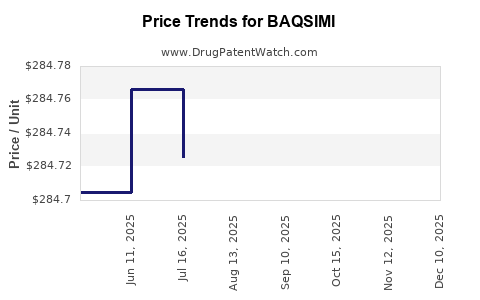
BAQSIMI's average retail price is approximately $290 per unit (per nasal spray). Insurance coverage affects out-of-pocket costs, with some patients qualifying for assistance programs reducing cost barriers.
Pricing Comparison
| Product |
Delivery Form |
Approximate Retail Price |
Approval Year |
Market Share (2022) |
| BAQSIMI |
Nasal spray |
$290 |
2019 |
60% (segment) |
| Glucagon Emergency Kit |
Injectable (powder + liquid) |
$250–$350 per kit |
1982 |
Remaining 40% |
| Other Nasal Glucagon |
Nasal spray (competitor) |
$250–$300 |
late 2020s* |
Small niche |
*Competitors emerging in 2020s.
Revenue Projections
Based on current market share and pricing:
- 2023: With approximately 100,000 units sold in the US, revenue is around $29 million.
- 2025: Market expansion could lead to a 15-20% annual increase in units sold, reaching 150,000–180,000 units, generating $44–$52 million annually.
- 2030: Continued growth and international expansion could push sales over 300,000 units, elevating revenues above $87 million.
Growth Drivers and Barriers
Drivers
- Rising diabetes prevalence worldwide.
- Increased awareness of hypoglycemia emergencies.
- Adoption by emergency services and pharmacies.
- Potential expansion into pediatric markets and other countries.
Barriers
- High price point relative to traditional glucagon kits.
- Insurance and reimbursement challenges.
- Limited awareness among patients and caregivers.
- Competition from emerging nasal formulations and generics.
Regulatory and Policy Impact
- The inclusion of BAQSIMI in emergency kits and insurance formularies boosts adoption.
- Policy changes favoring quicker, non-injectable emergency treatment favor growth.
- International approvals may expand market reach, though regulatory hurdles vary by country.
Price Projection Scenarios
| Scenario |
Units Sold (2025) |
Price per Unit |
Revenue Estimate |
Key Factors |
| Conservative |
150,000 |
$290 |
~$43.5 million |
Market saturation slower than estimates |
| Moderate |
180,000 |
$290 |
~$52.2 million |
Stronger adoption, clear reimbursement |
| Optimistic |
250,000 |
$290 |
~$72.5 million |
International expansion, increased awareness |
Key Takeaways
- BAQSIMI holds a significant share in nasal glucagon, with stable pricing around $290 per dose.
- Market growth is driven by escalating diabetes rates and emergency preparedness.
- Revenue projections suggest sustained growth, potentially exceeding $50 million domestically by 2025.
- Competition and reimbursement landscape influence pricing and adoption.
- International markets and expanding indications present future growth opportunities.
FAQs
-
What is the main advantage of BAQSIMI over injectable glucagon?
It is easier to administer via nasal spray, requiring no reconstitution, making it suitable for non-medical caregivers.
-
How does insurance coverage impact BAQSIMI pricing?
Many insurers cover BAQSIMI, reducing out-of-pocket costs to patients; assistance programs also lower financial barriers.
-
What barriers limit BAQSIMI’s market growth?
High price, limited awareness, and reimbursement issues constrain adoption. Competition from new nasal formulations and generics also present threats.
-
Are there international opportunities for BAQSIMI?
Yes, though approvals and market penetration vary. European, Asian, and Latin American markets are potential expansion targets.
-
What factors could influence future price changes?
Competition, manufacturing costs, reimbursement policies, and international market entry strategies. Price reductions may occur as production scales or generics enter.
References
[1] International Diabetes Federation. (2021). IDF Diabetes Atlas, 10th Edition.
[2] U.S. Food and Drug Administration. (2019). FDA approves first nasal glucagon for severe hypoglycemia treatment.
[3] Eli Lilly and Co. Financial statements and product brochures, 2022.