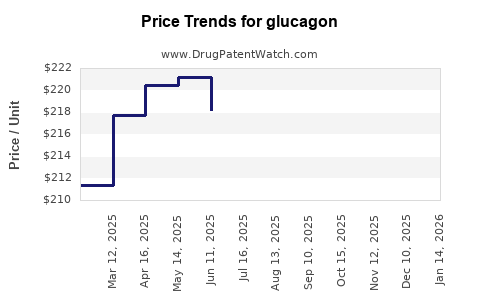
Last updated: August 25, 2026
Glucagon is a mature hormone drug category undergoing product-level transformation. Traditional emergency glucagon kits remain widely available, but ready-to-use nasal and autoinjector products are taking share because they eliminate reconstitution steps. The principal commercial products are Eli Lilly’s Baqsimi, Xeris Biopharma’s Gvoke and Zealand Pharma’s Zegalogue. Generic injectable kits continue to constrain pricing in hospitals and pharmacies.
The market’s financial trajectory is driven less by growth in glucagon’s underlying clinical use than by conversion from low-priced injectable kits to premium, easier-to-administer rescue products. Revenue growth is concentrated in chronic diabetes treatment, prescription access, payer coverage and caregiver adoption.
What is the current glucagon market structure?
The glucagon market has four principal segments:
| Segment |
Product type |
Primary use |
Commercial characteristics |
| Emergency hypoglycemia |
Traditional injectable glucagon kit |
Severe insulin-related hypoglycemia |
Low-cost, reconstitution required |
| Emergency hypoglycemia |
Nasal glucagon |
Severe hypoglycemia outside medical settings |
Premium pricing, no injection or reconstitution |
| Emergency hypoglycemia |
Ready-to-use autoinjector or prefilled syringe |
Severe hypoglycemia outside medical settings |
Ease-of-use advantage, higher unit economics |
| Hospital and diagnostic use |
Injectable glucagon |
Gastrointestinal imaging and selected diagnostic procedures |
Institutional purchasing, generic price pressure |
Glucagon is used primarily for severe hypoglycemia in people with diabetes who use insulin or other glucose-lowering therapies. Hospital and diagnostic demand is more mature and price-sensitive. The commercial opportunity is concentrated in outpatient rescue products.
Which glucagon products compete in the United States?
Baqsimi: nasal glucagon
Eli Lilly received FDA approval for Baqsimi, a 3 mg intranasal glucagon product, in July 2019. It was the first FDA-approved nasal glucagon product for severe hypoglycemia in adults and children aged four years and older at approval.[1]
Baqsimi’s value proposition is operational simplicity. The device is administered through the nose without injection, assembly or inhalation by the patient. It is distributed as a single-use device and is intended for emergency administration by caregivers.
Baqsimi competes against generic injectable kits on convenience and against Gvoke and Zegalogue on ready-to-use rescue design. Lilly has used its diabetes commercial infrastructure and patient-support programs to expand awareness and pharmacy access.
Gvoke: ready-to-use glucagon
Xeris received FDA approval for Gvoke in September 2019. Gvoke was the first ready-to-use liquid glucagon autoinjector approved in the United States. The product uses Xeris’ proprietary formulation technology to stabilize glucagon in liquid form.[2]
The initial Gvoke HypoPen product was followed by prefilled syringe presentations. Gvoke targets caregivers who may be unwilling or unable to prepare a traditional kit during a hypoglycemic emergency.
Xeris’ commercial strategy depends on premium pricing, insurance access and substitution for legacy emergency kits. Its broader portfolio includes other ready-to-use injectable products, allowing the company to spread commercialization costs across multiple products.
Zegalogue: dasiglucagon
Zealand Pharma received FDA approval for Zegalogue in March 2021. Zegalogue contains dasiglucagon, a glucagon analogue, and is available as an autoinjector and prefilled syringe for severe hypoglycemia in adults and children aged six years and older.[3]
Zegalogue competes directly with Gvoke and Baqsimi. Its commercial position depends on formulary access, supply reliability, pricing and Zealand’s ability to compete against larger diabetes franchises.
Generic injectable glucagon
Generic versions of emergency glucagon kits are available in the United States. The products generally require mixing a lyophilized glucagon powder with diluent before injection. This creates a usability disadvantage but supports lower acquisition costs.
Generic competition is strongest in hospitals, wholesalers, Medicaid channels and price-sensitive commercial plans. Traditional kits retain relevance where procurement departments prioritize unit cost over caregiver simplicity.
How large is the glucagon market?
Public companies generally do not disclose a consolidated global glucagon market total or product-level revenue for every glucagon product. Market-research estimates vary substantially because some reports include only emergency rescue products, while others include hospital, diagnostic and global injectable demand.
The most defensible commercial conclusion is that the United States is the leading premium market for glucagon rescue products. Growth is supported by:
- Rising insulin-treated diabetes prevalence.
- Greater clinical emphasis on hypoglycemia preparedness.
- Prescription of rescue products to caregivers, schools and family members.
- Expansion of continuous glucose monitoring, which identifies hypoglycemic events but does not eliminate severe episodes.
- Product conversion from reconstituted kits to ready-to-use devices.
- Broader prescribing in pediatric diabetes and high-risk adult populations.
The category remains smaller than major diabetes drug markets. Glucagon is an emergency rescue therapy, usually prescribed intermittently rather than taken daily. That limits prescription volume and creates dependence on coverage, refill behavior and replacement of expired devices.
What is the financial trajectory for glucagon manufacturers?
Eli Lilly
Baqsimi is strategically important as a diabetes-support product, but Lilly reports it within broader financial categories rather than as a separately disclosed major revenue line in its annual reporting. Lilly’s financial trajectory is dominated by Mounjaro, Zepbound, Trulicity, insulin products and other high-volume medicines, not glucagon.[4]
Baqsimi benefits from:
- Lilly’s established diabetes sales force.
- Broad pharmacy distribution.
- Recognition among endocrinologists and diabetes educators.
- A simple administration profile.
Its financial constraints include competition from Gvoke and Zegalogue, generic injectable kits and payer pressure on premium rescue products.
Xeris Biopharma
Gvoke is one of Xeris’ core commercial products. Xeris reports company-level product revenue and has identified Gvoke as a principal commercial asset, but public reporting does not always provide a uniform, standalone revenue series that can be compared directly with Lilly’s or Zealand’s disclosures.[5]
Gvoke’s economic model has stronger pricing potential than generic glucagon kits because the product is differentiated by formulation and delivery device. Xeris also faces high commercialization, manufacturing and market-access costs. Net revenue depends on gross-to-net deductions, rebates, copay assistance and payer mix.
Zealand Pharma
Zegalogue is a strategic commercial asset but has a smaller market position than the leading products. Zealand’s financial performance is increasingly influenced by its obesity and metabolic pipeline, including partnerships and development programs outside glucagon rescue.[6]
Zegalogue revenue is therefore less likely to determine Zealand’s overall valuation than pipeline milestones, partnering economics and obesity-related assets. The product still provides commercial validation for Zealand’s glucagon technology and diabetes franchise.
Generic manufacturers
Generic glucagon manufacturers compete primarily on price, supply and contracting. Their revenue opportunity is volume-based, with limited ability to sustain premium margins. Shortages or manufacturing interruptions can temporarily improve pricing and share, but the category does not have the structural pricing power of branded ready-to-use rescue products.
What patents protect branded glucagon products?
Patent protection is product-specific and generally covers formulation, device architecture, liquid stability, nasal delivery and manufacturing processes rather than the basic glucagon molecule.
| Product |
Main potential protection categories |
Commercial implication |
| Baqsimi |
Intranasal delivery, powder formulation, device and manufacturing |
May support differentiated nasal competition and regulatory barriers |
| Gvoke |
Stable liquid glucagon formulation, autoinjector, container and device |
Supports ready-to-use liquid product differentiation |
| Zegalogue |
Dasiglucagon composition, formulation, device and manufacturing |
Protection may extend beyond conventional glucagon formulations |
| Generic injectable kits |
Limited protection around the legacy product; generic approval pathway |
Creates price pressure on traditional kits |
The basic glucagon molecule is old and does not provide meaningful composition-of-matter exclusivity for modern products. The commercial patent estate is therefore more dependent on formulation and device claims.
Patent strength varies by claim scope and by whether competitors can design around the protected formulation or delivery system. A patent covering a specific stabilizer system may be commercially weaker than a patent covering a broad device-and-formulation combination. The FDA Orange Book and USPTO records should be reviewed by product and patent family because listings, terminal disclaimers, continuations and litigation outcomes can change the effective exclusivity position.[7]
When does glucagon lose exclusivity?
Glucagon does not have one universal loss-of-exclusivity date. Exclusivity depends on the product and the protected technology.
Traditional injectable glucagon has already experienced generic competition. Baqsimi, Gvoke and Zegalogue may retain protection through different combinations of regulatory exclusivity and patents. FDA approval dates are:
| Product |
Sponsor |
FDA approval |
Exclusivity position |
| Baqsimi |
Eli Lilly |
July 24, 2019 |
New-drug and formulation/device patent protection |
| Gvoke |
Xeris |
September 10, 2019 |
New-drug and formulation/device patent protection |
| Zegalogue |
Zealand Pharma |
March 22, 2021 |
New-drug and formulation/device patent protection |
FDA regulatory exclusivity and patent exclusivity are separate. Regulatory exclusivity may restrict approval of competing applications for a defined period, while patents can block commercial marketing after regulatory exclusivity ends. Patent expiry dates must be assessed from the specific Orange Book-listed patents and applicable patent-term adjustments or extensions.[1-3,7]
Are there Paragraph IV challenges to Baqsimi, Gvoke or Zegalogue?
Publicly documented Paragraph IV activity must be assessed separately for each branded product and abbreviated new drug application. The presence of a patent does not establish that a Paragraph IV challenge has occurred, and a public patent dispute does not necessarily mean that a generic has received approval.
Traditional glucagon kits have faced generic competition through established abbreviated new drug application pathways. The newer products present greater technical barriers because a competitor may need to replicate:
- A stable glucagon formulation.
- A specific nasal powder or liquid delivery system.
- A disposable autoinjector or prefilled presentation.
- Device performance and human-factors requirements.
- Combination-product manufacturing controls.
The greatest near-term generic threat is likely to remain injectable kits rather than direct substitution for branded nasal or ready-to-use products. A successful generic or 505(b)(2) entrant could still create substantial price pressure if it matches the delivery convenience of the branded product.
What FDA regulatory issues affect glucagon competition?
Glucagon products are regulated as prescription drugs, with delivery devices and formulation performance forming part of the approval package. The regulatory burden differs by product type.
Injectable kits
Generic injectable products may rely on established active-ingredient and dosage-form standards, but manufacturers must demonstrate quality, sterility, stability and device or presentation compatibility. Reconstitution adds usability risks and may require human-factors assessment.
Nasal glucagon
A nasal product must demonstrate consistent delivery and pharmacodynamic performance without requiring patient cooperation during severe hypoglycemia. Manufacturing controls for powder uniformity, dose delivery and container closure are commercially important.
Ready-to-use liquid glucagon
Liquid products require long-term stability of glucagon in solution. Aggregation, degradation and container interaction are core technical risks. Formulation technology can create a meaningful barrier even when the active ingredient is well known.
How do glucagon products compare commercially?
| Factor |
Baqsimi |
Gvoke |
Zegalogue |
Generic injection |
| Administration |
Nasal |
Autoinjector or prefilled syringe |
Autoinjector or prefilled syringe |
Reconstitution and injection |
| Reconstitution required |
No |
No |
No |
Yes |
| Main advantage |
Simple caregiver use |
Ready-to-use liquid delivery |
Ready-to-use rescue option |
Low price |
| Main weakness |
Premium pricing and competing devices |
Payer access and device competition |
Smaller commercial scale |
Operational complexity |
| Likely buyer |
Retail pharmacy, caregivers, schools |
Retail pharmacy, caregivers, diabetes specialists |
Retail pharmacy and diabetes specialists |
Hospitals, payers, price-sensitive channels |
Baqsimi has the clearest administration advantage for users who want to avoid needles. Gvoke and Zegalogue compete on ready-to-use injection, which may be preferable in situations where nasal administration is difficult or contraindicated. Generic kits remain the benchmark for low acquisition cost.
What generic launch scenarios exist for glucagon?
Three scenarios are commercially relevant:
- Legacy-kit erosion. Generic injectable products continue taking share from branded kits, reducing prices and margins.
- Device-specific competition. A generic or 505(b)(2) product enters with a comparable ready-to-use presentation, producing stronger price pressure on Gvoke and Zegalogue.
- Limited substitution. Device and formulation patents, manufacturing complexity or regulatory requirements delay direct competition, allowing branded products to maintain premium pricing.
The second scenario would have the greatest financial effect because it would attack the main value proposition of branded products: convenience rather than molecule novelty.
What licensing deals affect the glucagon market?
Lilly’s Baqsimi originated from technology developed by Locemia Solutions, which Lilly acquired in 2015.[8] The transaction gave Lilly rights to an intranasal glucagon platform and supported development of the product.
Xeris’ commercial glucagon strategy is linked to its proprietary XeriSol formulation technology. Zealand developed dasiglucagon and has pursued commercial and development partnerships across its broader metabolic portfolio, although Zegalogue’s economics are primarily tied to Zealand’s own commercialization and product strategy.[5,6]
Licensing value in glucagon depends on technology more than on the old active ingredient. The most valuable assets are stable-liquid formulation systems, delivery devices, manufacturing know-how and regulatory data packages.
What patent litigation affects glucagon products?
Glucagon litigation risk is concentrated in formulation and device patents. Potential disputes may involve:
- Infringement of Orange Book-listed patents.
- Invalidity challenges against formulation claims.
- Obviousness challenges based on older glucagon stability technology.
- Device-design-around disputes.
- Patent-term calculations and pediatric extensions.
- Declaratory-judgment actions before generic launch.
The absence of a widely reported, category-defining litigation settlement does not eliminate risk. Patent disputes can remain confidential until an ANDA notice, district-court complaint or regulatory filing becomes public. Settlement terms may include licensed entry dates, authorized generic rights, manufacturing restrictions and limits on product presentation.
How strong is the glucagon patent estate?
The patent estate is strongest where it combines formulation and device claims. A composition patent on a new glucagon analogue, such as dasiglucagon, is generally more defensible than a narrow claim covering a conventional glucagon formulation. Nasal and autoinjector patents can create meaningful barriers, but their strength depends on claim breadth and available design alternatives.
Overall, glucagon patent strength is mixed:
- Conventional injectable glucagon: weak because of age and generic availability.
- Intranasal glucagon: moderate, based on formulation, powder and device protection.
- Ready-to-use liquid glucagon: moderate to strong where stable-liquid claims are broad and difficult to design around.
- New glucagon analogues: potentially stronger composition and formulation protection.
What is the revenue exposure to generic glucagon entry?
Revenue exposure differs by manufacturer.
| Company |
Most exposed asset |
Generic-entry sensitivity |
| Eli Lilly |
Baqsimi |
Moderate; exposure depends on nasal-device competition and payer substitution |
| Xeris |
Gvoke |
High at the product level because Gvoke is a core commercial asset |
| Zealand Pharma |
Zegalogue |
Moderate at the product level; broader company valuation is increasingly pipeline-driven |
| Generic manufacturers |
Injectable glucagon |
Positive volume opportunity but limited margin expansion |
A direct ready-to-use competitor would have greater impact than another low-cost injectable kit. Premium rescue products are supported by convenience, but payer formularies can treat them as substitutable when clinical outcomes are considered equivalent.
Key Takeaways
- Glucagon is a mature molecule category with an expanding premium rescue-product segment.
- Baqsimi, Gvoke and Zegalogue compete by eliminating reconstitution and simplifying caregiver administration.
- Generic injectable kits remain the main source of price pressure.
- Lilly has the strongest distribution platform; Xeris has high product-level exposure to Gvoke; Zealand’s corporate valuation is increasingly influenced by its broader metabolic pipeline.
- Formulation and delivery-device patents matter more than basic glucagon composition patents.
- The largest competitive threat is a generic or 505(b)(2) ready-to-use product that matches the convenience of branded rescue products.
- Product-level financial data are limited because major manufacturers do not consistently disclose standalone glucagon revenue.
- Hospital and diagnostic glucagon demand is more commoditized than outpatient emergency rescue demand.
- Regulatory, manufacturing and human-factors requirements create barriers that can delay direct generic substitution.
Frequently Asked Questions
Is glucagon a growing pharmaceutical market?
The active ingredient is mature, but the ready-to-use emergency rescue segment is growing through conversion from traditional injectable kits.
Which glucagon product is easiest to administer?
Baqsimi is administered nasally without reconstitution or injection. Gvoke and Zegalogue are also ready to use but require injection through an autoinjector or prefilled syringe.
Is Baqsimi available as a generic?
Traditional generic injectable glucagon is available. Direct generic competition for Baqsimi requires a product that satisfies nasal delivery, formulation and regulatory requirements.
Does continuous glucose monitoring eliminate the need for glucagon?
No. Continuous glucose monitoring can identify hypoglycemia and support prevention, but it does not replace emergency rescue treatment when severe hypoglycemia occurs.
Which glucagon manufacturer has the highest financial exposure?
Xeris has comparatively high product-level exposure because Gvoke is a core commercial asset. Lilly has the largest distribution platform, while Zealand’s overall financial exposure is moderated by its broader pipeline.
References
- U.S. Food and Drug Administration. (2019). Baqsimi: Prescribing information.
- U.S. Food and Drug Administration. (2019). Gvoke: Prescribing information.
- U.S. Food and Drug Administration. (2021). Zegalogue: Prescribing information.
- Eli Lilly and Company. (2023). Annual report 2023.
- Xeris Biopharma Holdings, Inc. (2023). Annual report 2023.
- Zealand Pharma A/S. (2023). Annual report 2023.
- U.S. Food and Drug Administration. (2024). Approved drug products with therapeutic equivalence evaluations: Orange Book.
- Eli Lilly and Company. (2015, October 6). Lilly to acquire Locemia Solutions and nasal glucagon program.