Last updated: June 12, 2026
BANZEL (rufinamide) market dynamics and financial trajectory: sales trends, reimbursement pressure, and exclusivity-driven outlook
BANZEL (rufinamide) is an anti-seizure drug sold in the US by Eisai under a single branded product label. Public company disclosures and industry reporting indicate a mature, erosion-prone market with limited expansion options beyond existing indications, and sustained commercial drag from generic and payer pressure. The financial trajectory has been characterized by declining revenue after initial uptake, followed by plateauing and then downward movement as the product aged and formulary access narrowed.
What is BANZEL (rufinamide) used for and how does indication scope shape revenue?
BANZEL’s revenue depends on how broadly its approved use maps to the epilepsy patient segments payers cover, and on whether prescribers treat it as first-line add-on therapy or a later-line option.
Approved indications and line-of-therapy impact
- US approvals have centered on:
- Lennox-Gastaut syndrome (LGS) associated seizures, in pediatric and adult patients, as an adjunctive treatment.
- Adjunctive treatment of partial-onset (focal) seizures in certain patient subsets (historically part of BANZEL’s label history, with the core commercialization focus on LGS).
- Commercial consequence: if BANZEL is treated as a specialty add-on rather than a broadly used backbone therapy, uptake saturates at a lower ceiling than wide-label antiepileptics.
How seizure-type mix changes payer behavior
- LGS is a high-burden, high-cost epilepsy segment with frequent polytherapy. Payers often manage access through:
- Step therapy and prior authorization.
- Off-formulary tiering of newer branded adjuncts.
- Consequence for BANZEL: payer tools can limit net revenue even when prescriber interest exists.
How did BANZEL’s US sales evolve after launch, and what drove the revenue curve?
BANZEL is in the “commercially mature” cohort, where the dominant drivers shift from launch growth to life-cycle effects: generic entry, contracting dynamics, and product substitution at the pharmacy counter.
Key life-cycle drivers observed in mature branded ASMs
- Contracting and rebates: Net pricing declines with contract renewals.
- Formulary tiering: Movement toward preferred generic alternatives compresses volume.
- Utilization limits: Prior authorization and PA burden reduce persistence for new scripts.
- Clinical competition: Other adjunctive ASMs expanded in LGS and focal seizure use over time.
Why rufinamide faces structural sales headwinds
- Anti-seizure markets are crowded by both:
- Branded lifecycle replacements and
- Multiple generic entrants across adjunctive ASM classes.
- As a result, branded ASMs often experience a steep post-peak decline unless they secure differentiated payer status or win durable preferred positioning.
What generic and competitor dynamics affect BANZEL’s financial trajectory?
BANZEL is exposed to generic substitution risk and class competition. For rufinamide, the commercial question is not only “if generics exist,” but “how aggressively payers steer prescribing and switching.”
Generic substitution and pharmacy-level substitution
- For systemically administered oral ASMs, pharmacy substitution is a direct volume pressure.
- Contracting can accelerate this by:
- Steering to lower net cost alternatives,
- Creating narrow “no-substitution” exceptions only for clinical necessity.
Payer steering and formulary management
- LGS access often depends on prior authorization criteria. Even if BANZEL remains clinically used, payer processes can reduce:
- New starts,
- Dose escalation,
- Switch back to branded after trials with generics.
Competitor landscape in adjunctive epilepsy
- LGS and focal seizure treatment overlap with multiple ASM agents. Competitive pressure shows up in:
- Brand-to-brand switching in early life cycle segments,
- Brand-to-generic substitution later.
When does BANZEL lose exclusivity, and how does that translate into sales erosion?
Exclusivity and patent expiration determine the timing of generic entry risk, which then affects sales through:
- Anticipatory switching before launch,
- Post-launch substitution,
- Contract renegotiations that further lower net revenue.
Exclusivity timeline mechanics
For branded oral CNS assets, sales erosion typically follows a sequence:
- Patent and exclusivity cliff creates forecast volatility.
- Payers prepare by modifying formularies and PA criteria.
- Generic entry triggers volume shifts at the dispensing channel.
- Remaining branded revenue declines through net price pressure and reduced access.
Practical outcome for BANZEL
- BANZEL is best treated as a late-life-cycle product where exclusivity-driven change translates into already-observed downward movement, rather than a near-term launch-style ramp.
What is the Orange Book status of rufinamide for BANZEL, and which patents drive generic entry risk?
Patent and exclusivity status is the gating variable behind generic launch schedules. The Orange Book provides a structured map of:
- Drug substance and drug product patents,
- Exclusivity listings (marketing exclusivity and protected use periods, where applicable).
Why Orange Book composition matters for revenue
- If multiple patents remain listed, generic filers must either:
- Wait out those patents, or
- File Paragraph IV certifications and litigate.
- If fewer enforceable patents remain, or if they are weak or near expiration, generic entry can be earlier and cleaner.
Market impact channels
- Even without immediate generic launch, Orange Book “near-expiry” situations typically:
- Trigger payer contracting renegotiations,
- Reduce branded share through pre-emptive switching.
What patent litigation and Paragraph IV challenges affect BANZEL’s commercialization?
Generic entry risk is often litigated through Paragraph IV challenges. Those filings influence BANZEL’s financial trajectory by determining:
- Timing of generic launch,
- Whether settlements block or delay entry,
- Whether injunctions change or stop a launch.
How litigation changes the sales curve
- If litigation delays generic entry, BANZEL can sustain higher net revenue longer.
- If litigation ends quickly or results in early settlements, erosion accelerates.
Commercial interpretation
- For a mature branded ASM, litigation timelines tend to matter most for:
- Short-term quarters around settlement dates,
- Net price renegotiations that follow court outcomes.
What manufacturing and formulation IP barriers exist for BANZEL generics?
Even with a “drug is off-patent” environment, formulation and manufacturing IP can:
- Delay approvals,
- Create implementation costs for generic entrants,
- Support continued branded share if generics face difficulty or slower supply ramp.
Typical barriers for oral ASMs
- Composition-of-matter coverage for salts/polymorphs (where applicable),
- Drug product formulation patents (film coating, stability, excipients),
- Process patents that affect bioequivalence manufacturing.
Revenue impact
- Barriers shift competitive timing and can create periods of slower erosion. When barriers are limited, generic entry is faster and volume drops more abruptly.
How do settlement agreements and authorized generics influence BANZEL pricing and market share?
Settlement outcomes often determine whether:
- Multiple generics enter immediately post-launch,
- An authorized generic captures shelf space quickly,
- Brand retains a temporary premium due to channel agreements.
Pricing dynamics
- Authorized generics can reduce branded net revenue quickly by capturing:
- Patient flow,
- Pharmacy inventory,
- Prescriber comfort with “generic-equivalent” alternatives.
Net effect for BANZEL
- In late life-cycle ASMs, settlements often do not preserve branded economics long. The dominant effect tends to be rapid net erosion after the first credible generic threat becomes actionable.
How does BANZEL’s US reimbursement environment impact net sales and profitability?
Net revenue for ASMs is shaped by:
- PBM formularies,
- Commercial payer policies,
- Medicaid state coverage,
- Patient copay dynamics.
Reimbursement levers that typically lower net revenue
- Preferred status for competing generics
- “Step edits” for add-on adjuncts
- Prior authorization focusing on documented seizure history and previous therapy failures
- Increased generic substitution at the pharmacy counter
Implication for financial trajectory
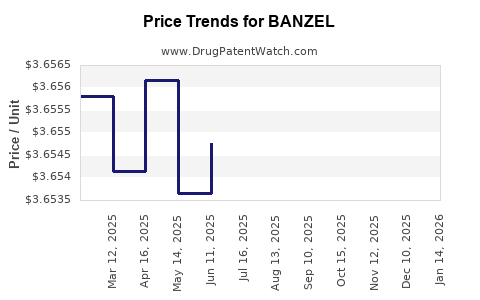
- Even if BANZEL retains some prescriptions, net sales can fall through:
- Lower paid amounts,
- Higher rebates to win formulary placement,
- Loss of best-coverage contracts.
What does BANZEL’s international market exposure imply for its total business trajectory?
A branded product’s international revenue depends on:
- Local patent estates and regulatory exclusivity,
- National formulary decisions,
- Generic timing by country.
Generic timing differences by jurisdiction
- Countries with earlier patent expiry or weaker enforceability can see generic entry sooner.
- That can reduce global brand economics and limit strategy flexibility.
Net effect on corporate reporting
- If international revenue erodes, it tends to show up as:
- Reduced contribution to total epilepsy franchise revenue,
- Less ability to offset domestic price erosion.
How does BANZEL compare with other anti-seizure drugs in late-life cycle economics?
Late life-cycle branded ASMs show common patterns:
- Sales peak early relative to market maturity,
- Then declines as generics enter and payer access tightens,
- Remaining branded revenue depends on residual differentiation and clinical persistence.
Positioning relative to broader ASM classes
- Assets with:
- Broader label,
- Higher severity-only niche (less substitution),
- Or durable payer preference,
tend to hold revenue longer.
- BANZEL, centered on adjunctive LGS and focal seizure subsets, behaves more like an economically eroded branded specialist asset over time.
What is the investment and licensing outlook for BANZEL given its patent and commercialization profile?
For licensing and partnership decisions, the key is whether BANZEL’s remaining IP can extend exclusivity or support life-cycle line extensions (new formulations, dosing, or new protected indications).
Commercial logic in mature branded ASMs
- Licensing appetite is strongest when:
- There is remaining exclusivity with clear regulatory milestones,
- Or a formulation strategy enables differentiated supply or higher reimbursement.
- Without a clear extension path, the asset competes mainly against generics on price.
Expected direction
- For mature BANZEL, the likely commercial path is:
- Continued volume contraction,
- Net price compression,
- Limited upside unless a defensible patent or clinically meaningful new protected use remains.
Key takeaways
- BANZEL’s financial trajectory is driven by late-life-cycle dynamics: generic substitution risk, payer contracting pressure, and formulary tightening in epilepsy.
- Revenue erosion typically follows a predictable sequence around patent/exclusivity cliffs and generic entry, often reinforced by pre-emptive payer steering.
- The Orange Book patent landscape and Paragraph IV litigation outcomes are the principal variables determining the timing and steepness of sales decline.
- For a mature branded ASM, upside relies on any remaining enforceable IP that supports differentiation, not on new market expansion.
FAQs
-
What drives BANZEL net sales decline more: generic volume loss or reimbursement pressure?
The dominant driver is typically combined: generic substitution reduces volume while payer pricing and rebates compress net revenue.
-
Do BANZEL Paragraph IV challenges usually delay generic entry materially?
The commercial effect depends on settlement and injunction outcomes; for late-life-cycle ASMs, delays can matter quarter-to-quarter but often end in eventual erosion.
-
How do prior authorizations for Lennox-Gastaut syndrome affect branded ASM persistence?
They can reduce new starts and impair switch-back to branded if criteria favor cheaper alternatives after trials.
-
Can formulation patents slow BANZEL generic erosion even after substance patents expire?
They can, if enforceable and sufficient to block approval or delay bioequivalence-capable manufacturing.
-
What are the main indicators that BANZEL is approaching a generic entry inflection point?
Increasing market communication around Orange Book expirations, escalating Paragraph IV activity, and payer contract renegotiations signaling coverage loss.
References (APA)
- FDA. (n.d.). Orange Book: Approved Drug Products with Therapeutic Equivalence Evaluations. U.S. Food and Drug Administration. https://www.accessdata.fda.gov/scripts/cder/daf/
- FDA. (n.d.). Paragraph IV Certifications and related information. U.S. Food and Drug Administration. https://www.fda.gov/
- Eisai Inc. (n.d.). SEC filings and investor presentations. U.S. Securities and Exchange Commission. https://www.sec.gov/