Last updated: September 24, 2026
AUVI-Q is a differentiated epinephrine auto-injector with a small but defensible position in the U.S. allergy market. Its commercial value comes from voice-guided operation, compact design, multiple dose strengths, and reimbursement programs rather than from a broad patent monopoly. The main constraints are intense competition from generic and branded epinephrine auto-injectors, limited public financial disclosure from privately held Kaleo, payer sensitivity to device prices, and the absence of durable regulatory exclusivity. AUVI-Q’s future revenue depends on premium-product retention, payer access, pediatric adoption, and the company’s ability to protect device and manufacturing know-how.
AUVI-Q Market Dynamics, Patent Position, Revenue Outlook, and Competitive Risk
What is AUVI-Q and how does it compete in the epinephrine auto-injector market?
AUVI-Q is a prescription epinephrine auto-injector marketed by Kaleo, Inc. It is approved for the emergency treatment of severe allergic reactions, including anaphylaxis, in patients at risk of anaphylaxis or with a history of severe allergic reactions. The product uses epinephrine in a compact, voice-guided auto-injector designed to instruct users through administration steps.
The U.S. product portfolio includes:
| Product |
Epinephrine dose |
Primary population |
| AUVI-Q 0.1 mg |
0.1 mg |
Infants and young children weighing 7.5 to 15 kg |
| AUVI-Q 0.15 mg |
0.15 mg |
Children weighing 15 to 30 kg |
| AUVI-Q 0.3 mg |
0.3 mg |
Patients weighing at least 30 kg |
The FDA-approved labeling states that AUVI-Q is intended for immediate administration and does not replace emergency medical care. Patients are instructed to seek emergency treatment after use because symptoms may recur or require additional intervention (FDA, 2024).
AUVI-Q competes against:
- EpiPen and authorized generic epinephrine auto-injectors from Viatris and Mylan-related entities.
- Generic epinephrine auto-injectors from Teva and other manufacturers.
- Adrenaclick and authorized generic products.
- SYMJEPI, a prefilled epinephrine syringe from Adamis Pharmaceuticals, now associated with Sandoz.
- Intranasal epinephrine products, if and when commercially available in the United States.
- Manual epinephrine syringes in institutional settings.
AUVI-Q’s differentiation is functional rather than pharmacologic. All leading products deliver epinephrine, but AUVI-Q attempts to reduce user error through audio instructions, an electronic voice system, and a compact form factor.
How large is the U.S. epinephrine auto-injector market?
The U.S. epinephrine auto-injector market is driven by several recurring-use factors:
- Food allergy prevalence.
- Asthma and severe allergic disease.
- Emergency preparedness requirements in schools and public venues.
- Prescriptions for multiple devices per patient.
- Product replacement after expiration or use.
- Pediatric diagnosis and weight-based dose transitions.
- Insurance coverage and copay support.
Patients commonly require more than one device because products are stored at home, school, work, or during travel. This increases unit demand but does not eliminate price pressure. Retail demand is concentrated in a relatively small number of branded and generic products.
The market has two distinct segments:
| Segment |
Buyer priorities |
Competitive advantage |
| Retail and commercial insurance |
Copay, convenience, size, brand familiarity |
Reimbursement and patient support |
| Hospitals, schools, public access programs |
Price, supply reliability, training, shelf life |
Contracting and procurement scale |
AUVI-Q is better positioned in the retail and caregiver segment than in commodity institutional procurement. Its compact size and voice guidance have less commercial value where purchasers prioritize the lowest acquisition cost.
What is the financial trajectory of AUVI-Q?
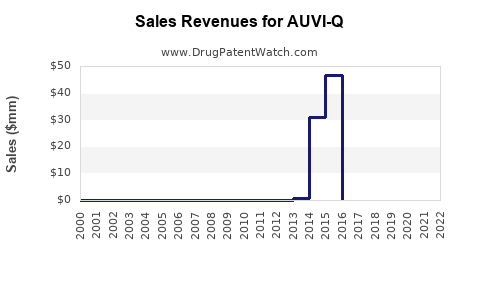
Kaleo is privately held, and it does not provide the same level of product-specific quarterly reporting as publicly traded pharmaceutical companies. Publicly available sources therefore do not establish a reliable, audited AUVI-Q revenue series comparable with the reporting available for EpiPen-related products or large pharmaceutical portfolios.
The commercial trajectory can be characterized as follows:
| Period |
Commercial development |
Financial implication |
| 2013 |
AUVI-Q launched by Sanofi |
Initial branded market entry |
| 2015 |
Product recall after device-delivery concerns |
Loss of sales momentum and reputational damage |
| 2016 |
Sanofi returned AUVI-Q rights to Kaleo |
Recommercialization under a private company |
| 2017-2018 |
Relaunch and expansion of commercial access programs |
Recovery depended on copay support and payer contracting |
| 2018 onward |
Expansion of generic epinephrine auto-injector competition |
Greater price pressure and substitution risk |
| 2020-2024 |
Continued branded positioning and pediatric differentiation |
Revenue dependent on retention of premium users and reimbursement |
Sanofi recalled all available AUVI-Q devices in 2015 after reports that the product could deliver inaccurate doses or fail to deliver epinephrine. The recall interrupted prescribing and reduced brand confidence at a critical stage of market development (FDA, 2015; Sanofi, 2015).
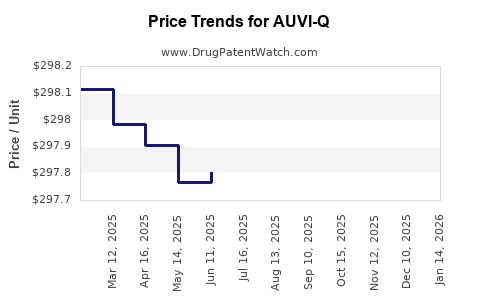
Kaleo subsequently reacquired U.S. rights and relaunched the product. The company’s model has relied heavily on patient affordability programs, insurance access, and brand differentiation. That approach can support prescription volume, but it can also reduce realized net price when copay assistance, rebates, and discounts are included.
The key financial variables are:
- Prescription volume.
- Net revenue per two-pack after rebates and assistance.
- Generic substitution.
- Payer formulary placement.
- Device manufacturing cost.
- Sales and marketing expense.
- Recall, quality, and regulatory costs.
- Renewal rates among existing users.
Because AUVI-Q is a device-heavy product with an established active ingredient, incremental manufacturing costs are higher than for a conventional tablet but lower than for a complex biologic. The product’s economics depend on maintaining a sufficient premium over generic alternatives.
What FDA regulatory status does AUVI-Q have?
AUVI-Q is approved under New Drug Application 201739. It is a drug-device combination product containing epinephrine as the active ingredient and an auto-injector delivery system.
Key regulatory characteristics include:
- FDA approval for emergency treatment of allergic reactions.
- Multiple dose strengths, including the 0.1 mg pediatric presentation.
- Prescription status.
- No biologic license application and no biosimilar pathway.
- No meaningful long-term biologic or orphan-drug exclusivity barrier.
- Reliance on device design, labeling, commercial differentiation, and intellectual property.
AUVI-Q does not face biosimilar competition because epinephrine is a small-molecule drug, not a biologic. Competition enters through abbreviated new drug applications, 505(b)(2) applications, device replication, and alternative delivery systems.
What is the Orange Book status of AUVI-Q?
AUVI-Q’s Orange Book position must be analyzed separately from conventional oral drugs because the product combines epinephrine with a proprietary delivery device.
The Orange Book identifies approved drug products and, where applicable, patent and exclusivity information. Device patents and combination-product claims may not create the same straightforward Orange Book barrier as a formulation patent for a tablet or injectable solution. A competitor can challenge the product through an ANDA while disputing patent applicability, listing scope, or certification requirements (FDA, 2024a).
Commercially relevant questions include:
- Whether patents are listed against the current AUVI-Q NDA.
- Whether listed claims cover epinephrine composition, device architecture, control systems, or methods of use.
- Whether an ANDA applicant must submit a Paragraph IV certification.
- Whether any listed patent remains unexpired.
- Whether a successful patent challenge would trigger 30-month litigation-related delay.
A complete current patent listing cannot be established from the public product label alone. The Orange Book and FDA patent-listing records are the controlling sources for listed-patent status.
What patents protect AUVI-Q?
AUVI-Q protection is likely to be distributed across several categories rather than one dominant composition-of-matter patent.
Device patents
Device claims may cover:
- Automatic needle deployment.
- Epinephrine injection mechanisms.
- Electronic voice guidance.
- Housing and compact form factor.
- Dose delivery controls.
- Safety interlocks.
- Removal of the safety cap.
- Device activation and user feedback.
The core commercial distinction is the integration of an auto-injector with an electronic guidance system. Device claims can be valuable, but they are often narrower and easier to design around than composition-of-matter patents.
Formulation and cartridge claims
Potential formulation protection may cover:
- Epinephrine concentration.
- Stability during storage.
- Container closure systems.
- Compatibility between epinephrine solution and device components.
- Shelf-life and degradation control.
These claims can impose manufacturing barriers if they are valid and difficult to design around. They generally provide less protection than a broad active-ingredient patent because epinephrine itself is an old drug.
Method-of-use claims
Method-of-use claims may address:
- Treatment of anaphylaxis.
- Administration to patients in specific weight ranges.
- Pediatric use.
- User-guidance steps.
- Repeat dosing or emergency response instructions.
Method-of-use patents are vulnerable when the underlying clinical use is already established or when an ANDA applicant uses a label that omits protected instructions. Their practical value depends on how narrowly the generic label can be carved out.
When does AUVI-Q lose exclusivity?
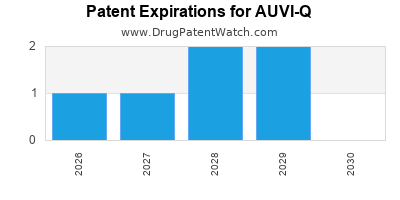
AUVI-Q does not have a conventional new chemical entity exclusivity period because epinephrine is an established active ingredient. The product’s regulatory protection is therefore based mainly on:
- NDA approval.
- Any applicable three-year exclusivity for new clinical investigations.
- Patent rights.
- Device claims.
- Trade secrets and manufacturing know-how.
- Brand recognition.
- Contractual and reimbursement advantages.
The original device-patent estate has aged substantially since AUVI-Q’s initial approval. Any remaining protection is likely to depend on later-filed patents covering specific device configurations, electronics, packaging, or manufacturing processes rather than on a broad monopoly over epinephrine auto-injectors.
A practical loss-of-exclusivity analysis must distinguish between:
| Protection type |
Commercial effect |
| Patent on device architecture |
Can delay or complicate a directly substitutable product |
| Patent on voice guidance |
May permit design-around using different instructions |
| Formulation patent |
Can create manufacturing or stability barriers |
| Method-of-use patent |
Often vulnerable to label carve-outs |
| NDA exclusivity |
Temporary and generally insufficient for long-term protection |
| Trade secret |
Important for production but difficult to assess externally |
No single date should be treated as AUVI-Q’s definitive loss-of-exclusivity date without reconciling all currently listed patents, continuations, terminal disclaimers, and regulatory exclusivity records.
Which companies are challenging AUVI-Q in the market?
The principal competitive threat is not a single litigation campaign. It is substitution from multiple epinephrine products.
| Competitor |
Company or commercial sponsor |
Threat to AUVI-Q |
| EpiPen |
Viatris and related commercial partners |
Strong brand recognition and formulary position |
| Authorized generic EpiPen |
Viatris |
Lower-price alternative with equivalent delivery concept |
| Generic epinephrine auto-injectors |
Teva and other manufacturers |
Direct price substitution |
| SYMJEPI |
Sandoz-related commercial platform |
Prefilled syringe alternative |
| Adrenaclick and equivalents |
Multiple sponsors |
Alternative auto-injector format |
| Future intranasal epinephrine |
Product-specific sponsors |
Potentially simpler administration and differentiated use |
Teva received FDA approval for a generic epinephrine auto-injector in 2018, increasing competitive pressure on branded products (Teva, 2018). Generic competition affects both payer negotiations and patient switching behavior.
What patent litigation and settlement agreements affect AUVI-Q?
Publicly visible AUVI-Q risk has been shaped more by product recall and market competition than by a widely reported, market-defining Paragraph IV settlement involving AUVI-Q.
The main legal and regulatory event was the 2015 recall. The FDA reported that the product could deliver an inaccurate dose or fail to deliver the intended dose, leading to a nationwide recall (FDA, 2015).
For current litigation monitoring, relevant issues include:
- Patent suits filed after ANDA Paragraph IV notices.
- Challenges to device patents.
- Product liability claims associated with administration failure.
- Manufacturing and quality-system disputes.
- Trademark disputes involving AUVI-Q branding.
- Contract claims involving distributors and payers.
- Settlement agreements that restrict generic launch dates.
No publicly established settlement should be treated as a guaranteed barrier to generic launch unless it is confirmed in court filings, FDA records, or company disclosures.
How strong is the AUVI-Q patent estate?
AUVI-Q’s patent estate is moderate rather than dominant.
Strengths include:
- Product-specific device engineering.
- Voice-guidance integration.
- Pediatric 0.1 mg positioning.
- Potential manufacturing know-how.
- Brand and user familiarity after years in the market.
Weaknesses include:
- Epinephrine is an old active ingredient.
- The emergency-use indication is well established.
- Device patents can often be designed around.
- Generic competitors can use different mechanisms.
- The product has no biologic exclusivity.
- Public revenue and patent-dispute disclosures are limited.
- Substitution can occur through formulary decisions even without a direct generic copy.
The estate is most valuable when paired with reimbursement access and a strong patient-support program. Patent rights alone are unlikely to sustain a large premium indefinitely.
What generic launch risks exist for AUVI-Q?
Generic launch risk is high for the broader epinephrine auto-injector category but more nuanced for a direct AUVI-Q copy.
A generic competitor may enter through:
- A directly comparable epinephrine auto-injector.
- A different auto-injector design with equivalent drug delivery.
- An authorized generic arrangement.
- A prefilled syringe.
- A future non-injectable delivery technology.
The highest-risk scenario is a device that matches AUVI-Q’s dose strengths and obtains preferred formulary placement while avoiding the most commercially important device claims. A second risk is payer-driven switching to lower-cost EpiPen or generic products even when AUVI-Q remains available.
AUVI-Q’s commercial defense is strongest where:
- Patients value voice instructions.
- Caregivers are concerned about administration errors.
- The 0.1 mg pediatric dose is clinically convenient.
- Insurance coverage reduces out-of-pocket cost.
- Physicians prescribe by brand.
- The product is included in school or emergency preparedness programs.
How does AUVI-Q compare with EpiPen and generic epinephrine auto-injectors?
| Attribute |
AUVI-Q |
EpiPen and authorized generic |
Other generics |
| Active ingredient |
Epinephrine |
Epinephrine |
Epinephrine |
| Delivery |
Auto-injector with voice guidance |
Auto-injector |
Auto-injector |
| Pediatric 0.1 mg strength |
Available |
Availability depends on product |
Product-specific |
| Brand recognition |
Lower than EpiPen |
Highest in category |
Low to moderate |
| Price positioning |
Premium-oriented, offset by assistance |
Broad payer access |
Lowest-price pressure |
| Device differentiation |
High |
Moderate |
Variable |
| Patent moat |
Device-focused |
Mature and contested |
Usually limited |
| Main commercial strength |
Usability and compact design |
Scale, familiarity, contracting |
Price |
AUVI-Q can retain patients who value ease of use, but EpiPen-related products have stronger scale and payer leverage. Generic products can win when formularies prioritize cost over device differentiation.
What manufacturing and intellectual-property barriers protect AUVI-Q?
Manufacturing barriers include:
- Stable epinephrine formulation production.
- Sterile filling and container compatibility.
- Device assembly and calibration.
- Electronic voice-system integration.
- Quality control for dose delivery.
- Shelf-life validation.
- Combination-product compliance.
- Reliable supply of specialized components.
These barriers can slow entry but do not necessarily prevent competition. A competitor can avoid AUVI-Q’s exact manufacturing process through a different device architecture or supplier base.
The most defensible assets may be process know-how, human-factors testing, supplier relationships, and regulatory experience. These assets are difficult to quantify from public filings but can affect launch timing and product reliability.
What is the AUVI-Q revenue exposure and commercial outlook?
AUVI-Q’s financial exposure is concentrated in a single therapeutic category and a small number of dose presentations. That concentration creates operating leverage but also increases vulnerability to:
- Product recalls.
- Supply interruptions.
- Generic substitution.
- Payer exclusion.
- Regulatory action.
- Loss of a major distributor or pharmacy channel.
- Declining reimbursement for premium devices.
The base-case outlook is stable to modest growth if Kaleo maintains reimbursement access and preserves brand differentiation. A downside case involves declining net price and unit share as payers adopt lower-cost alternatives. An upside case requires expanded institutional adoption, stronger pediatric penetration, improved coverage, or a new delivery platform that extends the brand beyond the existing auto-injector market.
Key Takeaways
- AUVI-Q is a differentiated epinephrine auto-injector, not a protected new chemical entity.
- Its core advantages are voice guidance, compact design, and the 0.1 mg pediatric dose.
- Kaleo’s private-company status limits visibility into audited product revenue and margins.
- The 2015 recall materially disrupted the original commercial trajectory.
- Generic and branded epinephrine auto-injectors create substantial price and formulary pressure.
- AUVI-Q’s patent protection is device- and process-oriented and is weaker than a composition-of-matter estate.
- There is no biosimilar risk because epinephrine is a small molecule.
- The most important commercial defense is reimbursement access combined with usability, not patent exclusivity alone.
- Generic launch risk is high for the category and moderate to high for a direct AUVI-Q substitute.
- Future revenue depends on net pricing, payer coverage, patient retention, and manufacturing reliability.
FAQs
Is AUVI-Q covered by insurance?
Coverage varies by plan, formulary tier, deductible, and prior-authorization requirements. Commercial access programs can reduce patient out-of-pocket costs, but eligibility and benefit terms change over time.
Does AUVI-Q have a generic equivalent?
Generic epinephrine auto-injectors compete with AUVI-Q, but a generic product is not necessarily an exact copy of AUVI-Q’s voice-guided device. Substitution depends on FDA approval, pharmacy rules, payer policy, and state law.
Is AUVI-Q safer than EpiPen?
Both products deliver epinephrine for emergency treatment of anaphylaxis. AUVI-Q’s voice guidance may help some users follow administration steps, but it does not establish superior clinical efficacy over other approved epinephrine auto-injectors.
What makes AUVI-Q’s 0.1 mg dose commercially important?
The 0.1 mg presentation is intended for infants and young children weighing 7.5 to 15 kg. It gives prescribers a lower-dose option than the 0.15 mg device for eligible pediatric patients.
Can a new epinephrine nasal product replace AUVI-Q?
A nasal product could compete for patients who have difficulty using an auto-injector, but replacement depends on FDA approval, clinical labeling, supply, reimbursement, caregiver confidence, and real-world adoption.
References
-
Food and Drug Administration. (2015). FDA Drug Safety Communication: FDA recommends EpiPen and Auvi-Q users be aware of potential device failure. U.S. Department of Health and Human Services.
-
Food and Drug Administration. (2024). AUVI-Q prescribing information. U.S. Department of Health and Human Services.
-
Food and Drug Administration. (2024a). Approved drug products with therapeutic equivalence evaluations. U.S. Department of Health and Human Services.
-
Sanofi. (2015). Sanofi issues voluntary nationwide recall of Auvi-Q auto-injectors. Sanofi.
-
Teva Pharmaceuticals. (2018). FDA approves Teva’s generic version of EpiPen auto-injector. Teva Pharmaceuticals.