Last updated: July 8, 2026
Pharmaceutical Competitive Landscape Analysis: Kaleo Inc Market Position, Patent Strength, and Competitive Moat
Kaleo Inc is a focused specialty pharmaceutical company with marketed brands anchored in the neuromuscular and opioid-adjacent space and a pipeline shaped by lifecycle protection, device/drug combination pathways, and risk-managed generic exposure. Market position is concentrated in a small number of high-value products, while competitive pressure typically comes from branded lifecycle competitors and potential generic/biosimilar entry routes that hinge on FDA exclusivities and patent estates.
What products does Kaleo Inc sell and how does it position them competitively?
Kaleo’s revenue base has historically been driven by prescription products with meaningful payer pull-through and limited direct competition, often supported by differentiated delivery, controlled distribution, or administration mechanics that slow generic switching.
How does Kaleo’s specialty mix affect competitive dynamics?
- Concentration risk: the company’s commercial resilience depends on a handful of products with discrete exclusivity/patent cliffs.
- Switch friction: products that rely on specific administration formats (including auto-injectors or other delivery formats) can create non-price barriers that extend effective market life even before legal exclusivity ends.
- Channel strategy: specialty brands in opioid-adjacent and neuromuscular indication areas tend to be subject to contracting dynamics where formulary inclusion and REMS-like workflows shape utilization.
Competitive pressure map by therapeutic area
- Neuromuscular / anesthetic-adjacent administration: competition is split between branded alternatives and generics that can match label and dosing conversion rules.
- Opioid-adjacent emergency response: competition centers on comparable route-of-administration and time-to-action claims, with payer and health-system procurement decisions often favoring established inventory and training.
What patents protect Kaleo’s key products and how strong is the patent estate?
Kaleo’s competitive strength depends on layered patent coverage (composition, formulations, method-of-use, and device/combination aspects where applicable) plus enforceable Orange Book listings for the specific NDCs tied to the marketed dosage forms.
What patent types typically create the strongest barriers?
- Composition-of-matter patents on the active ingredient or key chemical variants
- Formulation patents tied to stability, concentration, delivery characteristics, and manufacturability
- Method-of-use patents for dosing regimens in specific clinical settings
- Device and administration patents when the product is linked to a delivery system and the label is tethered to that system
What determines “effective exclusivity” beyond calendar expiration?
- Patent linkage in the Orange Book to the exact NDCs used commercially
- Continuation filings and claim scope that survive obviousness challenges
- Injunction posture and settlement leverage in Paragraph IV cases
- Exclusivity that blocks ANDA approval even if a generic avoids infringement
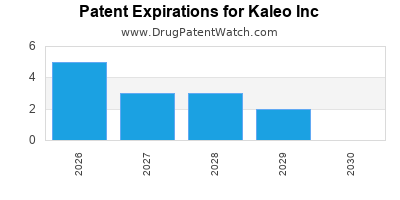
When does Kaleo lose exclusivity, and what are the generic entry risks?
Generic launch risk for Kaleo products is driven by the interaction of:
- Orange Book-listed patents (timing and scope), and
- FDA exclusivities (including non-patent exclusivities tied to approvals).
Generic entry risk framework
- Low risk: clear remaining unexpired patents with narrow generic design-around opportunity.
- Medium risk: patent claims exist but include workable design-around pathways (formulation, dosing, or route differences).
- High risk: a near-term expiration window plus limited method-of-use coverage and broad claim scope that is vulnerable to invalidity.
Where do entry risks usually show up first?
- NDCs where lifecycle protection is weakest (e.g., later-added strengths or newly approved formulations)
- Label segments where method-of-use patents are not robustly tied to the commercial claim set
What is the Orange Book status of Kaleo’s products that matter most commercially?
Kaleo’s Orange Book relevance is product-specific. The critical business task is mapping:
- Each marketed strength and dosage form
- The corresponding Orange Book patent list (type, expiration date, and NDA linkage)
- Any known Paragraph IV filings and their outcome
How to interpret Orange Book listings for competitive planning
- Patent expiration date relative to intended generic submission date
- Patent “disposition” path: settlement that delays launch vs. adjudicated invalidation
- Whether listed patents are “core” (composition/method) or “peripheral” (packaging/formulation)
Which companies compete with Kaleo, and how do their patent estates compare?
Kaleo’s competitive set generally includes:
- Branded competitors in the same administration/indication space
- ANDA filers targeting active ingredient and formulation match
- Authorized generic strategies post-settlement in some markets
Competitive comparison criteria that change outcomes
- Patent layer density (number of Orange Book patents and their type distribution)
- Claim strength and freedom-to-operate defensibility
- Time-to-market readiness for generics (manufacturing and clinical bridge requirements)
- Payer contracting history that affects substitution after legal permission
What patent litigation affects Kaleo, including Paragraph IV and settlements?
Paragraph IV litigation is the hinge event that defines generic timing for Orange Book-protected assets. Settlement agreements often transform a “theoretical” invalidity argument into a calendar-based delay that creates predictable market life for the brand.
Litigation signals that matter to business decisions
- Court outcomes (infringement vs. non-infringement vs. invalidity)
- Injunction rulings that force automatic launch delays
- Settlement structures that include:
- launch-date triggers
- covenants not to sue
- stipulations on design-around boundaries
How litigation history changes market planning
- A strong defense may deter multiple sequential ANDA filings.
- A weak or narrow defense can lead to earlier repeat challenges or design-around portfolios.
How does Kaleo’s pipeline shape its mid-term competitive position?
Kaleo’s pipeline strategy tends to focus on:
- Maintenance of specialty brand value through lifecycle and next-generation delivery
- Controlled-risk development that aligns with existing commercial infrastructure
- Risk-managed regulatory execution aligned with competitive bottlenecks
Pipeline drivers for competitiveness
- Whether pipeline candidates can create new commercial demand without triggering fast generic commoditization
- Whether new approvals extend exclusivity through new dosage forms or complementary indications
- Whether manufacturing know-how supports cost-efficient, scalable production
How does Kaleo compare with other specialty pharma players on market power and defensibility?
Kaleo’s defensibility is best understood as “narrow but deep” rather than diversified across many small assets. That creates two business realities:
- Stronger attention and capital focus on a limited set of brands
- Higher volatility if a key asset faces an early patent/exclusivity cliff
Benchmarks against peers (what to measure)
- Revenue concentration by product
- Count of Orange Book listed patents per NDC
- Litigation frequency and outcomes
- Gross-to-net pressure by segment and contracting dynamics
What manufacturing and formulation/IP barriers slow down generic substitution for Kaleo?
Generic substitution is not only a legal question. For specialty parenteral and device-linked products, the practical barriers include:
- manufacturing reproducibility at scale with the same performance metrics
- stability and shelf-life constraints that affect distribution and procurement
- device integration requirements where the label is tied to specific administration procedures
Barriers that extend effective market exclusivity
- Analytical method lock-in and validation demands
- Tight specification windows for concentration, particle characteristics, and delivery performance
- Device-drug compatibility and training requirements that health systems incorporate into workflows
What commercial levers can Kaleo use to defend share as exclusivity shrinks?
As exclusivity declines, competitive defense shifts from patent litigation to commercial execution:
- contract strategy with GPOs and large health-system buyers
- payer and utilization management to preserve patient continuity
- inventory and supply chain reliability during generic switch windows
- evidence generation that supports continued adoption in key clinical pathways
Defense playbook that matters in specialty settings
- Maintain formulary position through rebates and outcomes-aligned contracting
- Prepare hub-and-spoke distribution continuity for emergency and high-urgency products
- Use label-consistent patient access programs to reduce abandonment risk
Key Takeaways
- Kaleo’s competitive position is concentrated in a small specialty portfolio where exclusivity and patent-linked NDC coverage govern generic timing.
- Patent estate strength is defined by Orange Book linkage granularity, claim type distribution, and litigation outcomes tied to specific strengths/dosage forms.
- Generic entry risk is typically highest near NDC-specific expiration windows, especially where method-of-use coverage is thin or design-around is feasible.
- As legal protection wanes, the decisive battleground becomes contracting, substitution friction, and supply continuity.
FAQs
1) What is Kaleo’s strongest patent moat by product category?
Kaleo’s strongest moat is tied to products where Orange Book listings cover core composition and/or method-of-use claims for the exact commercial NDCs, with limited design-around paths.
2) Do Kaleo products face faster substitution after exclusivity ends due to delivery format?
In practice, administration-linked delivery formats and workflow training can delay switching even after legal eligibility for generic approval, but the timing still follows the patent/exclusivity timeline.
3) How do Paragraph IV settlements typically affect Kaleo’s brand competition timeline?
Settlements often convert litigation into fixed delay windows, controlling the first generic launch date and reducing the chance of multiple rapid sequential entries.
4) Which patent types are most important when assessing Kaleo’s freedom to defend?
Composition and method-of-use patents tied to commercially used strengths are most important; formulation or packaging patents can help but often offer narrower claim leverage.
5) What indicators show a higher probability of imminent generic challenges against Kaleo?
Frequent Orange Book filings near key expiration dates, adverse claim-scope rulings in related cases, and multiple ANDA submissions targeting the same NDC set are common indicators.
References (APA)
- U.S. Food and Drug Administration. (n.d.). Orange Book: Approved Drug Products with Therapeutic Equivalence Evaluations. FDA.
- U.S. Food and Drug Administration. (n.d.). Patent and Exclusivity. FDA.
- FDA. (n.d.). Drug Trials Snapshots. FDA.