Last updated: May 28, 2026
Atropine Market Dynamics and Financial Trajectory: Sales Trends, Pricing Pressure, Exclusivity, and Generic/Biosimilar Risks
Atropine (antimuscarinic agent; ophthalmic, injectable, and other branded/compounded uses) is a largely mature, price-pressured market dominated by generics. Financial trajectory is driven by (1) substitution to low-cost multi-source generics, (2) supply reliability for sterile injectables, (3) ophthalmic demand patterns, (4) government and wholesaler purchasing behavior, and (5) litigation and regulatory events that affect specific label strengths or presentations. In most developed markets, growth is incremental and largely volume-led, while revenue expansion is constrained by margin compression and contracting formularies.
What drives atropine sales in the US market: pricing, volume, and channel dynamics?
Featured snippet answer: Atropine revenue is primarily volume-led within mature therapeutic use segments, with pricing and margin compression from generic competition and contracting formularies dominating financial outcomes across injectable and ophthalmic presentations.
Channel and demand drivers by product type
Injectable atropine (IV/IM)
- Demand tracks emergency medicine utilization, peri-procedural use, toxicology workflows, and protocol-driven dosing.
- Financial outcomes are sensitive to sterile manufacturing uptime and lead times; shortage periods typically lift wholesaler pull-through temporarily and can support pricing before competition reasserts.
Ophthalmic atropine
- Demand is tied to ophthalmology prescribing for cycloplegia and mydriasis and, in some markets/indications, off-label or label-adjacent use for myopia management.
- Revenue trajectory depends on concentration of prescribing in retina/pediatric ophthalmology and competition among generic ophthalmic solutions.
Other presentations
- Compounded formulations (where permitted) can divert demand from commercially manufactured products, especially for low-dose schedules in myopia-management-like regimens.
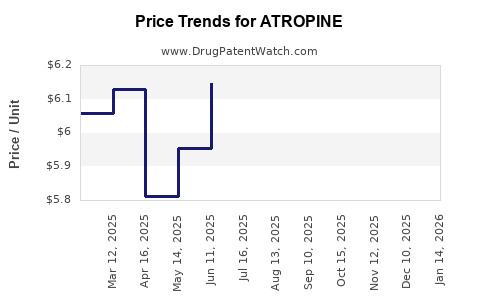
Pricing dynamics
- Generic atropine pricing tends to compress after additional Abbreviated New Drug Applications (ANDAs) enter specific strengths or dosage forms.
- Contracting with large pharmacy benefit managers (PBMs) and health systems generally results in downward price revisions and higher use of the lowest-cost multi-source supplier.
- Where supply constraints occur, wholesalers sometimes pay higher prices for limited supply, but that effect tends to be temporary and unwinds as supply normalizes.
Purchasing behavior
- Hospitals and group purchasing organizations emphasize total cost of therapy and procurement continuity for emergency and perioperative kits, favoring suppliers with reliable sterile production.
- Ophthalmology practices respond to effective pricing and product availability, with switching to generics driven by cost and pharmacy stocking practices.
How many generic products compete with atropine and what does that imply for revenue growth?
Featured snippet answer: Atropine is widely multi-sourced, and the presence of multiple ANDA equivalents for common strengths/dosage forms typically caps revenue growth and shifts the market from brand-led expansion to supplier share-and-volume competition.
Multi-source generic competition mechanics
- Once multiple generic suppliers exist, payer and provider formularies push toward the lowest contracted price.
- Revenue is stabilized by ongoing clinical use but rarely grows faster than underlying volume, because per-unit pricing declines with competition.
Supplier share vs. category demand
- Market growth becomes a function of incremental share capture during shortages, local contracting wins, and distribution alignment rather than therapeutic breakthrough.
- For injectables, “who can supply” can matter more than “who has the best price” during constrained periods.
When does atropine lose exclusivity and how does exclusivity timing affect market entry?
Featured snippet answer: Atropine’s core products are largely mature with expired or soon-expired brand exclusivity; practical entry risk is more tied to patent-by-patent and presentation-by-presentation coverage (formulation, packaging, manufacturing method, and specific dosing strengths) than to a single category-wide exclusivity date.
Exclusivity framework that matters commercially
- US patent term determines when ANDA entry can be launched without infringing listed patents.
- FDA market exclusivity (when applicable to a specific product listing) can delay approval/marketing beyond patent expiration.
- New formulations or dosing schedules can create localized pockets of IP that slow direct substitution.
Commercial implication
- Even with expired patents for “atropine” as an active ingredient, revenue can be protected for specific SKUs by:
- strength-specific composition of matter or formulation patents,
- manufacturing process or sterile fill/finish methods,
- device or packaging patents (where relevant),
- label-specific method-of-use claims.
What patents protect atropine by formulation, method of use, and manufacturing: and how strong is the estate?
Featured snippet answer: Patent protection for atropine is typically fragmented by product presentation and claim scope rather than covering the active ingredient broadly. For mature drugs, “estate strength” often translates into narrow, presentation-specific barriers.
How to think about atropine patent coverage
- Formulation patents: focus on solution composition, stabilization, pH control, or buffering system to preserve potency and sterility.
- Method-of-use patents: may cover specific therapeutic regimens, dosing schedules, or use in specific patient groups. These are more relevant for ophthalmic if any label-adjacent regimens exist.
- Manufacturing/sterile processing patents: can restrict generic replication if critical process steps are protected or if they affect stability and sterility assurance.
Commercially relevant IP levers
- Even if generic approval is obtainable, marketing can be delayed by:
- litigation-driven injunction threats,
- settlement agreements tied to launch dates,
- design-around that changes the formulation or presentation.
What is the Orange Book status of atropine and which patents typically appear for generic-entry risk?
Featured snippet answer: The Orange Book status for atropine is generally characterized by multiple listed patents across different atropine drug products, with generic entry risk concentrated on presentation-specific listed patents rather than on active-ingredient exclusivity.
Patent list patterns to expect
- Injectables often have patents tied to:
- sterile manufacturing,
- formulation stability and preservatives (where included),
- packaging compatibility.
- Ophthalmic solutions often include patents tied to:
- specific concentration,
- isotonicity and pH,
- stabilization agents,
- container closure system.
Practical risk assessment
- A generic’s Paragraph IV exposure depends on which patents are listed for that specific ANDA drug product (strength, dosage form, and applicant’s referenced reference-listed drug).
Which companies control atropine supply and how does that influence price and availability?
Featured snippet answer: Supplier concentration in sterile and ophthalmic presentations influences contract pricing and availability; multi-source markets can still show transient dominance during supply disruptions.
Competitive landscape dynamics
- Multi-source baseline: typically keeps long-run pricing compressed.
- Transient supplier gaps: affect pricing, purchase ordering behavior, and hospital stocking.
- Regional distribution: can shift pharmacy and institutional purchasing to local wholesalers with better access to a contracted supplier.
How does atropine compare with competing antimuscarinics for revenue stability and payer adoption?
Featured snippet answer: Atropine’s revenue stability is linked to entrenched use cases and multi-source generic availability, while newer antimuscarinic alternatives may compete in certain settings. Competitive pressure is usually strongest where prescribers can substitute dosing regimens without clinical penalty.
Substitution logic
- For emergency perioperative settings, atropine can be substituted only if protocol allows alternatives (practice patterns vary).
- Ophthalmic substitution depends on clinical goals (mydriasis/cycloplegia vs disease-specific regimens) and tolerability.
Financial implication
- If payer and protocol committees favor alternatives, volume can decline even if category demand is stable.
- If protocols lock in atropine for specific use cases, revenue trajectory stays steadier but pricing continues to compress under generic competition.
What Paragraph IV challenges exist for atropine and how do settlements shape launch dates?
Featured snippet answer: For mature, multi-source drugs like atropine, Paragraph IV challenges generally occur at the level of specific strengths/dosage forms, with settlements producing delayed entry for some entrants and earlier launch for others.
Settlement effects on financial trajectory
- Settlement can shift market shares among generic suppliers, often reallocating volumes in the year of launch.
- A first-to-file or litigating entrant may gain share faster if it wins earlier than peers.
- Conversely, a settlement with delayed launch extends pricing stability for the incumbent generic supplier.
Litigation impact channels
- Patent litigation rarely supports sustained price premiums long term; it more often redistributes share by controlling timing of additional generic approvals for specific SKUs.
How do shortages and supply constraints impact atropine quarterly financial performance?
Featured snippet answer: Atropine’s financial performance can show temporary step-ups during sterile supply constraints, followed by normalization as additional supply comes online and payer contracting reasserts lower prices.
Mechanisms
- Supply tightness increases wholesaler inventory costs and can temporarily raise net pricing, especially for injectables.
- Hospitals often reorder aggressively during shortages, pulling forward demand.
- Once supply stabilizes, contracted prices typically fall and utilization reverts to baseline.
What typically matters most
- Sterile manufacturing capacity,
- raw material availability,
- regulatory inspection outcomes,
- packaging/closure system sourcing for ophthalmic.
Is there biosimilar or biologics risk for atropine?
Featured snippet answer: No. Atropine is a small-molecule drug, so biosimilar risk does not apply. Competitive risk is generic and, in limited contexts, compounded substitution.
Regulatory pathway and market access: how do ANDAs affect the financial trajectory of atropine?
Featured snippet answer: ANDA approvals expand multi-source availability and accelerate price compression; financial trajectory is shaped by which presentations gain approvals first and how quickly payers and providers switch.
US access
- Generic entry timing is driven by:
- patent litigation posture for listed patents,
- eligibility of formulations for approval,
- launch logistics and distribution contracting.
Non-US access (high-level)
- Many markets mirror the US pattern: generic substitution drives long-run pricing declines.
- Importation/parallel trade dynamics can further compress net prices where applicable.
Which atropine indications create the biggest revenue upside: ophthalmology vs emergency vs toxicology?
Featured snippet answer: Revenue upside is most plausible in ophthalmic segments with stable or growing prescribing patterns, but it remains constrained by generic competition and procurement-driven price compression.
Emergency and perioperative
- Strength: entrenched use and protocol-based utilization.
- Limiter: generic pricing and substitution among antimuscarinics where protocols allow.
Ophthalmic
- Strength: chronic prescribing in ophthalmology workflows can sustain baseline volume.
- Limiter: concentration of multi-source generic brands and compounded alternatives for off-label-like regimens.
What generic entry risks exist for atropine and what are the most common technical/IP barriers?
Featured snippet answer: Generic entry risks are concentrated in (1) formulation and stability specifications for specific strengths, (2) sterile manufacturing process details, and (3) any presentation-specific patents listed in the Orange Book.
Typical barriers
- Demonstrating stability over labeled shelf life with the same preservative/buffering system (where required).
- Replicating sterile fill/finish process controls to meet sterility assurance.
- Meeting container closure compatibility targets for ophthalmic solutions.
Commercial translation
- Even if approval occurs, launch can be delayed by manufacturing readiness, quality system timing, and distribution onboarding.
How does atropine’s financial trajectory differ across regions and pricing regimes?
Featured snippet answer: Atropine’s long-run revenue trajectory is generally similar across developed markets: genericization reduces unit prices and makes volume the primary growth driver. Differences arise from reimbursement intensity, procurement rules, and whether supply disruptions produce short-lived price relief.
Key regional levers
- Tender procurement and reference pricing systems can compress net prices faster.
- National formularies and hospital procurement rules can drive early uptake of the lowest-cost generic.
- Parallel import policies can accelerate price convergence.
Key Takeaways
- Atropine’s financial trajectory is mature and largely governed by generic competition, procurement contracting, and presentation-specific IP/litigation rather than active-ingredient exclusivity.
- Revenue growth is typically volume-led with persistent margin pressure.
- Injectable performance is sensitive to sterile supply continuity; shortages can lift pricing temporarily before normalization.
- Ophthalmic upside can exist from prescribing intensity, but genericization and compounded substitution constrain durable premium pricing.
- Competitive and litigation events mainly reallocate share by launch timing for specific strengths/dosage forms.
FAQs
-
What does atropine market growth depend on when patents are expired?
Utilization volume, formulary contracting outcomes for specific strengths, and supplier share during supply disruptions.
-
Why can atropine prices spike during shortages even in a multi-generic market?
Sterile supply constraints reduce effective availability, driving temporary wholesaler and institutional reordering at higher net prices until additional supply enters.
-
Do presentation-specific strengths of atropine face different generic entry timelines?
Yes. Risk and launch timing typically differ by strength, dosage form, and the specific Orange Book-listed patents tied to that drug product.
-
Is there any biosimilar-like threat to atropine pricing?
No. The competitive threat is generic ANDA entry and, where permitted, compounded alternatives.
-
Which atropine segment is more likely to show incremental revenue gains?
Ophthalmic use can show incremental gains from prescribing patterns, but outcomes still hinge on rapid multi-source competition and contracting pressure.
References
- FDA. Approved Drug Products with Therapeutic Equivalence Evaluations (Orange Book). U.S. Food and Drug Administration.
- FDA. Abbreviated New Drug Applications (ANDA): Application Requirements. U.S. Food and Drug Administration.
- FDA. Drug Shortages. U.S. Food and Drug Administration.
- Federal Circuit and District Court decisions and FDA litigation dockets related to Paragraph IV disputes (where applicable). United States Courts.