Last updated: February 19, 2026
What is the Current Market Size and Distribution for Atropine?
Atropine is a well-established drug used primarily in ophthalmology, cardiology, and anesthesiology. It is employed to treat bradycardia, to induce mydriasis for eye exams, and as an antidote for organophosphate poisoning. The global atropine market was valued at approximately $75 million in 2022 and is projected to grow at a compound annual growth rate (CAGR) of 3.2% from 2023 to 2030. The market is segmented by application, end-user, and geography.
Key geographic regions include North America, Europe, Asia-Pacific, Latin America, and Middle East & Africa. North America dominated with roughly 40% of the market in 2022, driven by high incidence of cardiac diseases and ophthalmic procedures. Asia-Pacific presents the fastest growth, with expanding healthcare infrastructure and increasing awareness.
What Are the Driving Factors and Market Trends?
The market drivers include:
- Rising prevalence of cardiovascular diseases, including bradyarrhythmias.
- Increasing frequency of ophthalmic surgeries requiring mydriasis.
- Growing awareness and preparedness for chemical incidents, revealing the antidote’s importance.
- Continuous supply chain robustness from established pharmaceutical companies.
Market trends involve:
- Shifts toward synthetic production to ensure consistent quality.
- Expanded use in emergency medicine protocols.
- They are seldom reformulated but see increased adoption in combination therapies for specific applications.
What Are the Key Price Components and Historical Trends?
Pricing varies based on formulation, packaging, and region. Typical unit prices in North America (2022) ranged between $0.50 and $2.00 per vial (1 mg/mL). Bulk prices for hospital procurement are discounted, averaging $0.30–$0.80 per vial.
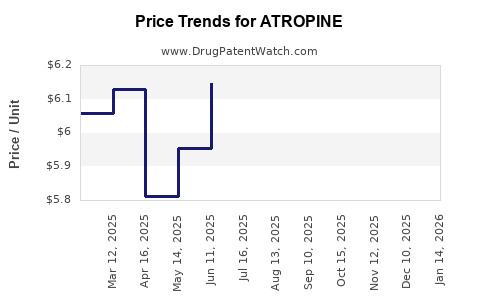
Historically, prices have remained relatively stable for commercially available atropine, with minor fluctuations due to raw material costs and regulatory changes. Generic versions dominate the market; brand-name products tend to command 10–15% higher prices. During supply shortages or increased demand, prices can spike temporarily.
What Are the Price Projections through 2030?
Assuming steady demand growth, the following projections are reasonable:
| Year |
Estimated Average Price per Vial (USD) |
Remarks |
| 2023 |
0.50 – 2.00 |
Current market state |
| 2025 |
0.55 – 2.15 |
Slight inflation, stable supply |
| 2027 |
0.60 – 2.30 |
Potential raw material increases |
| 2030 |
0.65 – 2.50 |
Market maturity, potential premium adjustments |
Analyzing global supply chains and raw material costs suggests that prices are unlikely to decline sharply, barring significant market disruptions or breakthroughs in synthetic production.
How Will Regulatory and Technological Developments Affect Prices?
Regulatory changes affecting manufacturing standards or patent protections could impact pricing margins. For example, if new regulations increase manufacturing costs, prices could rise 10–15%. Conversely, technological advances enabling more cost-efficient synthesis could lower prices over time.
No patent protections exist for atropine (patents expired decades ago), which keeps prices competitive. Future developments, such as novel formulations or delivery systems, may introduce premium pricing models but are unlikely to significantly affect baseline prices for standard vials.
What Are the Competitive Dynamics and Market Entry Barriers?
Market saturation among generic manufacturers limits pricing power. Barriers to entry include:
- Stringent quality standards and manufacturing approvals.
- Established supplier relationships.
- Supply chain complexity for active pharmaceutical ingredients (APIs).
Potential new entrants would need substantial investment in GMP-compliant production and regulatory approval processes. Market consolidation trends favor existing suppliers.
Summary
The atropine market is stable, with moderate growth driven by medical and emergency use. Prices are expected to see minimal fluctuation, maintaining a range from $0.50 to $2.50 per vial over the next decade, influenced by raw material costs, regulatory changes, and technological advances. Competitive pressures favor generic manufacturers, constraining significant price increases.
Key Takeaways
- The global atropine market is valued at ~$75 million (2022), growing at approximately 3.2% annually.
- Price stability prevails, with minor fluctuations driven by supply chain factors.
- Prices for standard vials are projected to stay within $0.65–$2.50 per unit by 2030.
- Market entry barriers favor established generics, with minimal innovation expected to influence prices.
- Regulatory and raw material costs will primarily determine future pricing trends.
FAQs
1. What factors most influence atropine pricing?
Raw material costs, regulatory standards, manufacturing capacity, and market competition.
2. Are there patent restrictions on atropine?
No, patent protections have expired, leading to widespread generics.
3. How does regional regulation affect prices?
Regions with stricter drug approval standards may face higher manufacturing costs, influencing local prices.
4. Will new formulations impact the market?
Potentially, but standard formulations dominate, limiting significant price changes unless new delivery methods offer substantial advantages.
5. What is the outlook for generic vs. brand-name atropine prices?
Generics remain the dominant, lower-cost option. Brand-name products tend to be 10–15% more expensive but are generally limited in number.
References
- MarketResearch.com. (2023). Global atropine market report.
- IQVIA. (2022). Pharmaceutical pricing and supply chain analysis.
- GlobalData. (2022). Ophthalmic and cardiovascular drug market trends.
- FDA. (2023). Drug approval and manufacturing standards.
- WHO. (2021). Essential medicines list and usage guidelines.