Last updated: June 11, 2026
ASACOL HD (mesalamine) market dynamics and financial trajectory (US)
Executive summary: ASACOL HD (mesalamine) faces steady erosion as branded and authorized generics compete in ulcerative colitis. The product’s financial trajectory is dominated by (1) patent and exclusivity-driven generic entry windows for oral mesalamine tablets, (2) contracting managed-care formularies and pharmacy benefit manager (PBM) pressure, and (3) channel and pricing migration as payers steer to lower-cost mesalamine products. Post-entry, sales typically flatten and decline unless differentiation is sustained through coverage positioning, patient adherence advantages, and contracting outcomes.
What are the US market dynamics for ASACOL HD (mesalamine) and oral UC therapies?
Featured answer: ASACOL HD competes in a large, mature ulcerative colitis (UC) market where payer cost controls and high generic penetration are primary drivers of demand and brand pricing.
Key market forces shaping demand
-
High-maturity therapeutic class
- Oral 5-aminosalicylic acid (5-ASA) products are core maintenance and mild-to-moderate UC therapies.
- The category has experienced long-running generic substitution, which limits branded price durability.
-
PBM and formulary steering
- UC maintenance dosing is chronic, so pharmacy coverage rules and step edits materially influence utilization.
- Preferred positioning often shifts between branded products and authorized generics (or chemically identical generics), depending on rebate structures.
-
Channel pricing and reimbursement compression
- As competitive pressure increases, net prices fall faster than gross list price.
- Rebate intensity rises to maintain formulary placement, pulling net revenue down even if unit volume holds.
-
Competitive substitution among oral mesalamines
- Oral mesalamine is delivered through distinct technologies (MMX, multi-matrix, controlled release, delayed release).
- Even when clinical equivalence is assumed at category level, prescriber and payer preferences can influence which delivery systems win.
-
Adherence and persistence effects
- Maintenance therapies are judged by persistence in real-world use.
- Product-specific dosing frequency and tolerability can affect persistence, but class-level substitution generally governs outcomes over time.
When does ASACOL HD face generic entry risk and loss of exclusivity?
Featured answer: ASACOL HD is a legacy mesalamine tablet brand; the market is already in the post-exclusivity environment, so the dominant future risk is not “first generic entry” but ongoing share capture by low-cost competitors and authorized generics.
How exclusivity dynamics typically work for 5-ASA brands
- Patent expiration and settlement-based generic launches drive the first wave.
- After the initial generic entrants, remaining branded share depends on coverage contracts and net price support.
- Orange Book-listed patents (composition, formulation, and method-of-use) can create staggered entry windows, but for widely used mesalamine oral products, category pricing dynamics often overwhelm brand advantages once generics are established.
What matters for financial trajectory after exclusivity
- Unit volume durability: rarely sustained at pre-entry levels.
- Net sales decline: typically accelerates after formulary changes.
- Gross-to-net: increases in pressure via rebates, chargebacks, and payer contract renegotiations.
- Trade-down: patients switch to cheaper therapeutics, reducing brand loyalty.
What patents protect ASACOL HD mesalamine tablets, and how do they affect commercialization?
Featured answer: For legacy oral mesalamine brands, the effective patent estate usually determines whether additional generic entrants are blocked or delayed, but once multiple generics are on the market, business impact shifts from “block entry” to “delay incremental share loss.”
Patent estate components that drive brand economics
-
Composition-of-matter
- Typically anchors early exclusivity.
- Expiration enables generic versions at the molecule level.
-
Formulation and release characteristics
- Multi-layer or delayed-release approaches can protect delivery technology and dissolution profiles.
- These patents can affect whether “drop-in” generics can be launched without design-around.
-
Manufacturing/process patents
- Can complicate or slow entry if process steps are required to meet release specs.
-
Method-of-use patents
- Less common as a durable shield in mature UC maintenance settings, but can matter if claimed dosing regimens are specific and enforceable.
Practical linkage to financial trajectory
- If formulation patents survive longer than composition patents, net sales often decline slower after first entry.
- If patents are not enforceable or are designed around, the market shifts quickly to price-led competition.
What is the Orange Book status of ASACOL HD (mesalamine), and which listings matter most to generic entry?
Featured answer: The Orange Book status is decisive for legal entry risk, but for ASACOL HD’s commercial stage the market effect is primarily already realized via post-exclusivity competition.
Which Orange Book items usually control litigation and Paragraph IV outcomes
- Listed patents under each NDA that can be leveraged for:
- Patent infringement claims
- Delays in FDA approval/launch timing
- Settlement-driven entry dates
How many generics and authorized generics compete with ASACOL HD, and how does that change net pricing?
Featured answer: In mature mesalamine oral categories, multiple ANDA products commonly compete, and once authorized generics appear, net pricing compresses quickly.
Expected commercial pattern
- Pre-generic: Brand dominates with strong gross sales and higher net.
- First generic wave: Branded sales fall sharply; net price decreases.
- Authorized generic or additional generics: Further erosion via PBM preferencing and patient cost-sharing optimization.
- Ongoing price competition: Branded product’s net sales often becomes small relative to the category.
What to track in financial trajectory
- Prescriber switching rate (proxy: script volume changes by label and strength).
- PBM formulary changes.
- Net sales per script and gross-to-net trend.
- Remaining branded share in maintenance therapy.
What generic entry risks exist for ASACOL HD and comparable oral mesalamines (MMX, delayed release, controlled release)?
Featured answer: The primary ongoing risks are additional generic launches of tablet strengths, alternative dosage-form designs, and competitive contracting that favors the lowest net-cost products.
How delivery-system differences influence substitution
- Payer policy may treat different release technologies as interchangeable or may require specific products under step edits.
- If a competitor is preferred due to rebate economics, “clinical equivalence” does not prevent commercial displacement.
Comparable product archetypes in UC
- Oral delayed-release and controlled-release mesalamines
- Multi-matrix or proprietary release mesalamines
- Rectal mesalamines (suppositories and enemas) that can partially shift treatment patterns, reducing overall oral demand in some patients
How do ASACOL HD sales typically perform versus competing mesalamine brands over time?
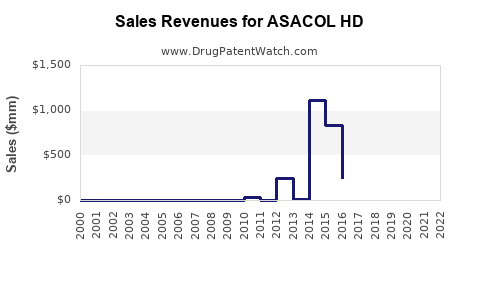
Featured answer: After generic entry and formulary displacement, ASACOL HD’s trajectory typically trends downward in unit sales and net revenue, with occasional stabilizations only when contracting preserves tier placement.
Competitive benchmarks to use
- Brand vs category script share
- Net sales vs units (pricing vs volume split)
- Managed-care penetration and formulary tier position
- Rebate intensity and gross-to-net changes
What US regulatory and FDA pathway factors influence ASACOL HD market access?
Featured answer: FDA labeling stability is necessary but not sufficient; the controlling access factor for a mature product is usually coverage and pricing, not regulatory novelty.
Elements that matter commercially
- Label expansions or safety updates that affect prescriber comfort
- Strength and dosage-form availability
- Bioequivalence requirements for generics that can affect perceived substitutability
What patent litigation or settlements have affected ASACOL HD’s competitive timeline?
Featured answer: For mature mesalamine brands, litigation and settlements typically govern timing of early generic entrants; later-stage pricing erosion is then driven by routine commercial contracting.
How to interpret litigation in a business forecast
- Case outcomes matter most if they:
- Block the first wave of ANDA approvals
- Force delayed entry for a specific label strength
- Once multiple products exist, incremental market share shifts are driven more by rebates than by IP.
What is the commercial trajectory implied by ASACOL HD’s market positioning and pricing power?
Featured answer: ASACOL HD’s pricing power is constrained by the availability of lower-cost oral mesalamine alternatives; the business trajectory typically becomes a function of net contract terms rather than product differentiation.
Financial mechanics
- Net sales decline: from both unit erosion and lower net price.
- Margin pressure: brand margins compress as rebates and co-pay programs are reduced or restructured.
- Portfolio reprioritization: brands often lose long-term investment as newer delivery technologies and higher-growth areas capture commercial attention.
Practical forecasting approach used by pharma finance
- Start from category maintenance demand trends.
- Apply expected share loss based on formulary shifts.
- Model net price decline from competitive intensity and rebate adjustments.
- Validate against gross-to-net and unit movement trends in recent quarters.
How does ASACOL HD compare with other oral mesalamine products in commercial risk profile?
Featured answer: Compared with brands that remain under tighter exclusivity, ASACOL HD’s commercial risk is higher because mature 5-ASA products face sustained generic substitution and recurring PBM-driven tier re-optimization.
Risk factors
- Higher generic count in the same therapeutic space
- Lower differentiation at payer decision points (maintenance UC often uses stepwise coverage)
- Greater sensitivity to cost-sharing changes and contracting outcomes
Key Takeaways
- ASACOL HD is exposed to mature-category dynamics where PBM contracting, rebate intensity, and generic substitution drive most financial outcomes.
- Exclusivity effects are typically front-loaded; after generics and authorized generics establish presence, the main drivers become net pricing pressure and formulary steering.
- Financial trajectory is best modeled via gross-to-net and unit share loss rather than assuming sustained brand pricing power.
- Continued competitive risk is less about “if” generics enter and more about ongoing share capture by the lowest net-cost mesalamine options and contract renewals.
FAQs
- What drives net sales declines for legacy mesalamine brands like ASACOL HD after generic entry?
- How do PBM formulary tiers and step edits affect patient switching among oral UC mesalamines?
- What is the typical impact of authorized generics on branded mesalamine pricing and volume?
- Do formulation or manufacturing process patents materially delay later mesalamine generic entry?
- How should investors separate unit share loss from net price erosion when assessing ASACOL HD performance?
References (APA)
- FDA. (n.d.). Orange Book: Approved Drug Products with Therapeutic Equivalence Evaluations. U.S. Food and Drug Administration. https://www.accessdata.fda.gov/scripts/cder/daf/
- FDA. (n.d.). Drug Approval Reports and related information for ANDAs and NDAs. U.S. Food and Drug Administration. https://www.fda.gov/drugs/drug-approvals-and-databases/