Share This Page
Drug Sales Trends for ASACOL HD
✉ Email this page to a colleague
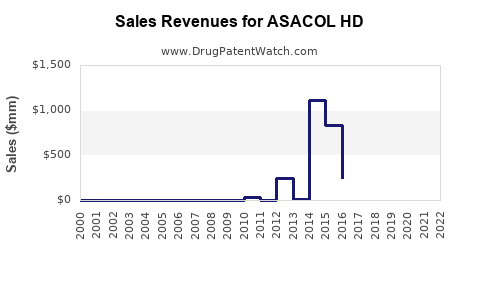
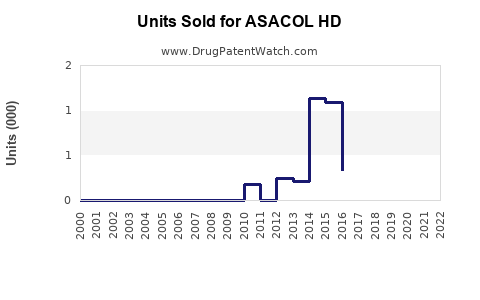
Annual Sales Revenues and Units Sold for ASACOL HD
| Drug Name | Revenues (USD) | Units | Year |
|---|---|---|---|
| ASACOL HD | ⤷ Start Trial | ⤷ Start Trial | 2022 |
| ASACOL HD | ⤷ Start Trial | ⤷ Start Trial | 2021 |
| ASACOL HD | ⤷ Start Trial | ⤷ Start Trial | 2020 |
| ASACOL HD | ⤷ Start Trial | ⤷ Start Trial | 2019 |
| >Drug Name | >Revenues (USD) | >Units | >Year |
Asacol HD Market Analysis and Sales Projections
Asacol HD is a branded mesalamine delayed-release tablet used to induce remission in adults with mildly to moderately active ulcerative colitis. Its commercial value has declined sharply because generic mesalamine 800 mg delayed-release tablets compete with the product, while other mesalamine formulations, including Lialda and Delzicol, cover overlapping clinical demand. Asacol HD is no longer a growth asset. Its remaining value is concentrated in residual brand prescriptions, payer coverage, physician familiarity, and patients who remain stable on the specific 800 mg tablet regimen.
The base-case forecast places U.S. Asacol HD-equivalent revenue at approximately $10 million to $15 million in 2025, declining to below $5 million by 2029. The broader U.S. mesalamine market remains commercially meaningful, but most future value will accrue to generic manufacturers and competing branded formulations rather than Asacol HD.
What is Asacol HD and how is it used?
Asacol HD contains mesalamine, also known as 5-aminosalicylic acid or 5-ASA. The product is an 800 mg delayed-release tablet designed to deliver mesalamine to the colon.
The FDA-approved indication is the induction of remission in adults with mildly to moderately active ulcerative colitis. The labeled adult dose is 1.6 grams twice daily, or 3.2 grams per day, for six weeks. Asacol HD is not approved for maintenance treatment under its primary FDA indication.[1]
| Attribute | Asacol HD |
|---|---|
| Active ingredient | Mesalamine |
| Strength | 800 mg |
| Dosage form | Delayed-release oral tablet |
| FDA application | NDA 022395 |
| Initial U.S. approval | 2013 |
| Primary indication | Induction of remission in mildly to moderately active ulcerative colitis |
| Typical labeled dose | 3.2 g per day for six weeks |
| Original commercial sponsor | Warner Chilcott |
| Later commercial ownership | Actavis, Allergan and related corporate successors |
| Main competitors | Generic mesalamine DR 800 mg, Lialda, Delzicol, Apriso, Pentasa |
Asacol HD competes in a mature 5-ASA market. Physicians often select among products based on dose frequency, tablet burden, release mechanism, formulary position, patient history and pharmacy substitution rules.
How large is the Asacol HD and mesalamine market?
The broader U.S. mesalamine market is substantially larger than the current Asacol HD brand market. Mesalamine is used for ulcerative colitis across induction and maintenance settings, and the market includes multiple delivery systems and strengths.
The main market segments are:
- Delayed-release tablets, including Asacol HD and generic equivalents.
- Multi-matrix release tablets, primarily associated with Lialda.
- Delayed-release capsules, including Apriso.
- Delayed-release tablets and capsules associated with Delzicol and Pentasa.
- Rectal formulations, including suppositories, enemas and foams.
Ulcerative colitis prevalence supports recurring demand. However, mesalamine is a mature therapy, and treatment growth is constrained by competition from biologics, Janus kinase inhibitors, selective immunomodulators and newer advanced therapies. Mesalamine remains widely used in mild disease and as maintenance therapy, but it is less competitive in moderate-to-severe disease requiring escalation.
Estimated commercial market structure
The following estimates represent U.S. retail and specialty pharmaceutical revenue attributable to mesalamine products. They are analyst estimates rather than reported Asacol HD sales.
| Market segment | Estimated 2025 U.S. revenue | Five-year direction |
|---|---|---|
| Generic mesalamine products | $500 million-$750 million | Stable to modest growth |
| Branded Lialda and related products | $250 million-$400 million | Declining |
| Branded Asacol HD | $10 million-$15 million | Rapid decline |
| Other oral mesalamine brands | $100 million-$200 million | Declining or stable |
| Rectal mesalamine products | $100 million-$175 million | Stable |
| Total U.S. mesalamine market | $1.0 billion-$1.5 billion | Low growth in volume, declining price |
The principal commercial shift is from branded net revenue to generic volume. Total prescription demand can remain relatively stable while manufacturer revenue falls because of lower generic prices and payer substitution.
What are the sales projections for Asacol HD?
Asacol HD sales are projected to continue declining through 2029. The forecast assumes that generic mesalamine 800 mg remains widely available, the brand does not receive a new indication, and no meaningful supply disruption affects generic competitors.
Base-case Asacol HD revenue projection
| Year | Estimated U.S. Asacol HD-equivalent revenue | Year-over-year change | Commercial interpretation |
|---|---|---|---|
| 2024 | $20 million-$30 million | -25% to -40% | Residual brand demand |
| 2025 | $10 million-$15 million | -40% to -55% | Generic substitution dominates |
| 2026 | $7 million-$10 million | -25% to -40% | Brand retention becomes concentrated |
| 2027 | $5 million-$7 million | -20% to -35% | Limited formulary access |
| 2028 | $3 million-$5 million | -20% to -35% | Niche continuation |
| 2029 | $1 million-$3 million | -25% to -50% | Possible practical market exit |
The forecast is for branded Asacol HD-equivalent revenue, not total mesalamine sales. Generic mesalamine revenue is excluded from the brand projection.
Scenario analysis
| Scenario | 2025 revenue | 2027 revenue | 2029 revenue | Key assumptions |
|---|---|---|---|---|
| Accelerated erosion | $0-$5 million | $0-$2 million | Below $1 million | Brand withdrawal, broad payer exclusion, multiple generic suppliers |
| Base case | $10 million-$15 million | $5 million-$7 million | $1 million-$3 million | Continued residual brand prescriptions |
| Upside retention | $20 million-$30 million | $12 million-$18 million | $7 million-$12 million | Supply shortages, limited generic availability, persistent physician-specific demand |
The accelerated-erosion case is the most likely outcome if the brand is no longer actively promoted or distributed. The upside case requires sustained generic supply constraints or a commercial decision to preserve Asacol HD access in selected channels.
When did Asacol HD lose exclusivity?
Asacol HD's commercial exclusivity weakened after generic mesalamine delayed-release 800 mg products entered the U.S. market. FDA records identify approved abbreviated new drug applications for mesalamine delayed-release tablets in the 800 mg strength, creating direct substitution pressure against Asacol HD.[2]
For a mature small-molecule product, FDA approval of an ANDA does not guarantee immediate commercial launch. Generic entry can depend on patent certifications, litigation, settlements, manufacturing readiness, state substitution rules and payer contracts. In Asacol HD's case, the market effect of generic competition was more important than the nominal expiration date of any single formulation patent.
Exclusivity factors
| Exclusivity category | Asacol HD position |
|---|---|
| New chemical entity exclusivity | Expired |
| Orphan exclusivity | Not applicable |
| Pediatric exclusivity | Not a material current barrier |
| Regulatory exclusivity | Expired or no longer commercially meaningful |
| Formulation patents | Historical barrier; limited current commercial protection |
| Method-of-use patents | Limited value where claims overlap established ulcerative colitis treatment |
| Generic substitution | Material and ongoing |
| Biosimilar protection | Not applicable |
Asacol HD is a small molecule, not a biologic. Biosimilar regulation under the Public Health Service Act does not apply. Generic competition proceeds through the ANDA pathway under the Federal Food, Drug, and Cosmetic Act.[3]
What is the Orange Book status of Asacol HD?
The FDA Orange Book is the controlling source for current approved products, listed patents and exclusivity information. Asacol HD was approved under NDA 022395. Orange Book analysis should distinguish between:
- The branded NDA product.
- Generic mesalamine delayed-release tablets approved through ANDAs.
- Any patent listings tied to the NDA.
- Delisted, expired or no-longer-enforceable patent entries.
- Patent certifications made by generic applicants.
The commercial importance of an Orange Book listing depends on whether the patent remains unexpired, whether the claim covers the marketed product, and whether a generic applicant has certified under Paragraph IV.
A listed patent does not establish a durable commercial barrier. A generic company can challenge a listed patent by certifying that the patent is invalid, unenforceable or not infringed. The brand holder may then file patent litigation, potentially triggering a 30-month stay of final FDA approval under the statutory framework.[3]
Which companies challenge or compete with Asacol HD?
The principal competitive threat comes from generic manufacturers rather than a single branded challenger.
Generic competitors
FDA-approved or marketed generic mesalamine products have included products from manufacturers such as Zydus Pharmaceuticals, Teva Pharmaceuticals, Amneal Pharmaceuticals and other ANDA holders. Availability varies by supplier, wholesaler channel and time period.
Generic manufacturers compete primarily on:
- Wholesale acquisition cost.
- Medicaid and commercial rebate positioning.
- Pharmacy benefit manager contracts.
- Manufacturing reliability.
- Tablet supply and wholesaler service levels.
- Ability to support automatic substitution.
Branded competitors
| Product | Company or commercial owner | Formulation | Competitive position |
|---|---|---|---|
| Lialda | Takeda | Multi-matrix release tablet | Strong branded oral competitor |
| Delzicol | Various commercial owners | Delayed-release capsule | Alternative oral delivery system |
| Apriso | Various commercial owners | Extended-release capsule | Maintenance-oriented positioning |
| Pentasa | Ferring | Controlled-release capsule | Alternative release technology |
| Generic mesalamine | Multiple manufacturers | Multiple forms | Primary price competitor |
Lialda has a particularly important competitive position because it is an established high-volume oral mesalamine product with once-daily dosing and broad physician familiarity. Asacol HD's 800 mg tablet strength can reduce pill burden at high daily doses, but that advantage is weakened when payers favor generic products or Lialda alternatives.
What patent litigation and Paragraph IV risks affect Asacol HD?
The principal historical litigation risk involved generic applicants challenging patents associated with the composition, coating or release characteristics of mesalamine delayed-release tablets. A Paragraph IV challenge can lead to litigation by the NDA holder, but it does not guarantee a permanent market block.
Current commercial risk is lower than the risk during the pre-generic period because:
- Multiple generic products have entered the market.
- The core active ingredient is long established.
- Prescribers have many therapeutically similar options.
- Formulation differentiation is limited in a mature oral 5-ASA category.
- Any remaining patent protection has less practical value against established generic supply.
The litigation record should be evaluated through FDA Orange Book patent data, PACER filings and district court opinions. Patent expiration alone does not determine launch timing. A generic may launch after settlement, after a court ruling, at risk, or following regulatory approval without commercial distribution.
What formulations are protected by Asacol HD patents?
Asacol HD's historical intellectual-property position centered on formulation and delivery technology rather than a new chemical entity. Relevant patent themes include:
- Delayed-release mesalamine tablets.
- Enteric coatings designed to resist gastric conditions.
- Release in the intestinal or colonic environment.
- Tablet composition and manufacturing parameters.
- Stability and dissolution performance.
- Dosing methods for ulcerative colitis.
These claims are narrower than a composition-of-matter patent and are easier to design around if a competitor can produce equivalent clinical performance using different excipients, coating systems or manufacturing conditions.
Formulation patents can delay generic entry, but they generally have less residual value after multiple ANDA approvals. The commercial barrier depends on whether the listed claims are valid, enforceable and infringed by the specific generic product.
How strong is the Asacol HD patent estate?
The current patent estate is commercially weak relative to the product's historical position.
| Patent-estate factor | Assessment |
|---|---|
| Composition-of-matter protection | None of current commercial significance |
| Formulation protection | Historically relevant, now limited |
| Method-of-use protection | Narrow practical value |
| Patent term remaining | Not a material growth driver |
| Generic design-around risk | High |
| Litigation leverage | Limited after generic market entry |
| Regulatory exclusivity | No current material advantage |
| Commercial moat | Low |
The brand's principal remaining defenses are operational rather than legal. These include physician familiarity, continuity of treatment, patient preference, pharmacy availability and the possibility that some payers retain the brand for specific patients.
What FDA regulatory status does Asacol HD have?
Asacol HD is an FDA-approved prescription drug under NDA 022395. It is regulated as a small-molecule oral prescription product. Generic versions are reviewed through ANDAs that must demonstrate pharmaceutical equivalence and bioequivalence to the reference listed drug.[1][2]
The FDA regulatory profile does not provide a current growth mechanism. A new indication, new strength, pediatric approval or clinically differentiated formulation could improve value, but no such commercial expansion is assumed in the base forecast.
What generic launch risks exist for Asacol HD?
Generic entry risk is already realized rather than prospective. The main remaining risks are commercial erosion risks:
- Additional generic suppliers can reduce price and increase substitution.
- Payers can exclude the brand from preferred tiers.
- Pharmacies can substitute generic tablets automatically where permitted.
- Wholesalers can reduce inventory support for a low-volume brand.
- Patients can be converted to Lialda, Delzicol or another mesalamine product.
- Generic supply interruptions can create temporary revenue opportunities for the brand.
The most plausible generic launch scenario is continued multi-source competition with falling prices and stable-to-declining prescription volume. A single generic entrant would create less pressure than a market with three or more reliable suppliers.
What licensing deals affect Asacol HD?
No current licensing transaction is a material driver of Asacol HD's forecast. The product has passed through multiple corporate ownership structures, including Warner Chilcott, Actavis and Allergan-related portfolios. Those transactions affected commercial control and portfolio reporting, but they did not create a new exclusivity period for mesalamine.
Any licensing value today would likely relate to manufacturing rights, regional distribution or portfolio transfer rather than core intellectual-property monetization.
How does Asacol HD compare with Lialda and generic mesalamine?
| Metric | Asacol HD | Lialda | Generic mesalamine |
|---|---|---|---|
| Active ingredient | Mesalamine | Mesalamine | Mesalamine |
| Main differentiation | 800 mg delayed-release tablet | Multi-matrix release, often once daily | Price and availability |
| Brand strength | Low to moderate | Moderate to strong | Not applicable |
| Price position | Unfavorable | Premium branded | Lowest |
| Payer risk | High | Moderate to high | Low |
| Patent value | Limited | More meaningful historically | Product-specific |
| Growth outlook | Declining | Declining to stable | Stable to modest growth |
| Biosimilar risk | None | None | None |
Generic mesalamine is the most important competitive benchmark. Lialda remains the main branded benchmark because it competes for similar oral ulcerative colitis patients while offering a different release technology and dosing profile.
What is the revenue exposure for manufacturers and investors?
Asacol HD has limited standalone revenue exposure for large pharmaceutical companies. A decline from $15 million to $3 million in brand revenue would have little effect on a diversified manufacturer but could be material for a specialty distributor, regional licensee or small portfolio company.
The broader mesalamine category remains financially relevant because of its recurring prescription volume. Investors should separate:
- Brand revenue exposure.
- Generic volume exposure.
- Net price after rebates.
- Revenue from other mesalamine products.
- Manufacturing margin.
- Supply-chain concentration.
- Payer mix.
A company with generic mesalamine manufacturing capacity can benefit from category volume even as Asacol HD brand revenue declines. A company dependent on the branded product faces a high risk of portfolio attrition.
Key Takeaways
- Asacol HD is an 800 mg delayed-release mesalamine tablet for induction of remission in ulcerative colitis.
- Its primary commercial barrier has been overcome by generic mesalamine competition.
- U.S. branded Asacol HD revenue is estimated at $10 million to $15 million in 2025.
- Base-case revenue falls below $5 million by 2029.
- The broader U.S. mesalamine market remains approximately a $1.0 billion to $1.5 billion category.
- Generic manufacturers capture most future volume and price-sensitive demand.
- Asacol HD has no biosimilar risk because mesalamine is a small molecule.
- Remaining formulation and method-of-use patents have limited practical value after generic entry.
- Lialda is the principal branded oral competitor.
- The most likely commercial outcome is continued brand erosion, not a new growth cycle.
FAQs
Is Asacol HD still commercially available?
Availability depends on the manufacturer, distributor and market channel. Generic mesalamine delayed-release 800 mg tablets are the principal source of equivalent therapy, while branded Asacol HD has a substantially reduced commercial presence.
Is generic mesalamine the same as Asacol HD?
Generic mesalamine delayed-release 800 mg tablets are approved as therapeutically equivalent products where listed by FDA as substitutable. Excipients, supplier, packaging and manufacturing site can differ.
Can Asacol HD patents block generic mesalamine?
A listed formulation patent can delay or complicate generic approval, particularly through Paragraph IV litigation. Once approved generics are marketed, the practical ability of the patent estate to preserve brand revenue falls sharply.
Does Asacol HD have biosimilar competition?
No. Biosimilars apply to biologic products. Asacol HD contains mesalamine, a small-molecule active ingredient, so competing products are reviewed as generic drugs through the ANDA pathway.
What is the investment outlook for Asacol HD?
The investment outlook is defensive and declining. The product may retain niche prescription demand, but its revenue trajectory is negative, and its patent estate does not provide a credible basis for material long-term growth.
References
-
U.S. Food and Drug Administration. (2013). Asacol HD prescribing information. FDA.
-
U.S. Food and Drug Administration. (n.d.). Approved drug products with therapeutic equivalence evaluations: Orange Book. FDA.
-
U.S. Congress. (1984). Drug Price Competition and Patent Term Restoration Act of 1984, Pub. L. No. 98-417.
-
U.S. Food and Drug Administration. (n.d.). Abbreviated new drug application approvals and generic drug guidance. FDA.
-
U.S. Food and Drug Administration. (n.d.). Drugs@FDA: FDA-approved drugs database. FDA.
More… ↓
