Last updated: July 5, 2026
ASACOL (mesalamine) market dynamics and financial trajectory: exclusivity, generic pressure, and revenue outlook
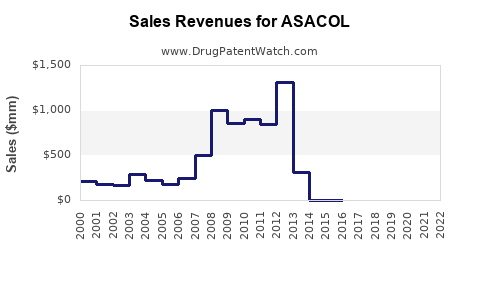
ASACOL (mesalamine; delayed-release tablets) has shifted from branded growth to steady volume decline and margin compression driven by widespread generic entry for 5-ASA formulations. The current financial trajectory is dominated by (1) loss of brand differentiation versus multiple ANDAs, (2) payer step edits and interchangeability across mesalamine products, and (3) competitive substitution into higher-specificity formulations (including MMX-style 5-ASA) where payers pursue lower net costs.
What is ASACOL’s revenue trajectory since generic entry?
Featured answer: ASACOL’s branded sales trend is negative over time as generic mesalamine tablets capture the majority of prescriptions, with remaining branded revenue concentrated in pockets where physicians prescribe by brand and where payers have not fully tightened formulary controls.
Branded-to-generic transition mechanics that drive the financial curve
Branded 5-ASA tablets typically experience:
- Rapid share loss after ANDA launches because mesalamine is clinically substitutable within the therapeutic class and often listed as interchangeable by pharmacy benefit managers.
- Net price compression from rebate pressure and therapeutic-class competition, even if unit volume stabilizes briefly.
- Ongoing erosion from periodic payer policy updates (PA criteria tightening, preferred-product lists, and step edits for UC).
What to look for in financial statements
For brand owners and licensing holders, ASACOL’s trajectory is usually reflected in:
- “Mesalamine” or “Inflammatory bowel disease” product line segment reporting.
- Volume vs net sales split after major generic launch waves.
- Customer concentration and payer contracting dynamics, which determine whether brand remains in formularies.
How did ASACOL’s market share and pricing evolve versus generics?
Featured answer: After generic entry, ASACOL’s market share decreases while average net pricing falls, leading to slower revenue decline if brand retains formulary access. Once preferred-product policies consolidate, revenue tends to drop faster.
Pricing dynamics specific to mesalamine tablets (5-ASA)
- Average selling price (ASP) declines with competition.
- Rebate and copay support become less effective when payers incentivize generic substitution.
- Pharmacy channel behavior favors lowest net-cost products that meet plan rules.
Substitution pressure from formulation comparators
ASACOL competes not only with generic delayed-release mesalamine tablets but also with:
- Other oral mesalamine systems (including multi-matrix and extended-release platforms)
- Different dosing regimens that simplify adherence or reduce pill burden
Those shifts matter because payers increasingly prefer products where they can standardize dosing across patient segments.
How do payer formularies and step edits affect ASACOL demand?
Featured answer: ASACOL demand is highly sensitive to payer formulary status, including tier placement and prior authorization requirements that push patients to preferred generic mesalamine options.
Key payer levers that typically reshape demand
- Tiering: brand moves from preferred to non-preferred tiers
- Step edits: requires trial of generic or another 5-ASA before brand reimbursement
- Quantity limits: may cap tablet counts that match a preferred dosing strategy
- PA criteria: switches from diagnosis confirmation to “preferred product trial” logic
Segment-level sensitivity
- Patients newly initiating therapy are more likely to receive preferred generic.
- Longer-tenured brand patients often resist switching, but payer rules can force reauthorization or refills on plan-specific products.
What is the Orange Book status of ASACOL and which patents cover mesalamine tablets?
Featured answer: ASACOL-related 5-ASA tablet products are covered by a mix of legacy patent estates that have largely expired or are near expiration for core composition and basic formulation concepts, while later-dated patents may cover specific delivery systems, dosing regimens, or manufacturing approaches. Generic ANDA availability drives the practical exclusivity end.
Patent estate reality for mesalamine brands
In most mature mesalamine tablet markets:
- Core composition-of-matter patents for mesalamine are long expired.
- Formulation and method-of-use protections tend to be the remaining barriers, but their enforceability declines as generics rely on non-infringing formulations or design-around.
What matters for freedom-to-operate
For litigation and licensing risk, the highest practical value patents tend to be:
- Specific delayed-release or coating technologies tied to release profiles
- Manufacturing or process patents controlling critical quality attributes
- Method-of-use claims tied to ulcerative colitis dosing schedules and endpoints
(A complete, product-specific Orange Book map requires the exact listed active ingredient strength and dosage form labeling, including the NDA number associated with ASACOL in the Orange Book.)
When does ASACOL lose exclusivity and how does that timeline shape generic launches?
Featured answer: For mature 5-ASA brands, exclusivity loss typically happens years before sustained branded revenue collapse, because commercial contracts and payer formulary behavior accelerate the decline immediately after generic ANDA availability.
Exclusivity vs practical market access
- Patent expiry impacts legal ability.
- Commercial timing (contracting cycles, PBM edits, pharmacy stocking habits) determines the speed of share loss after launch approval.
- Settlement terms (when applicable) can delay or structure launch dates.
Launch-wave pattern seen in 5-ASA tablets
- Initial generic entries at first opportunity
- Subsequent waves expanding NDC coverage and switching thresholds
- Longer-tail pressure from additional strengths and package configurations
What Paragraph IV challenges affected ASACOL or its mesalamine equivalents?
Featured answer: Paragraph IV actions and subsequent settlements are common in mature mesalamine categories, but specific case identification depends on the exact NDA listing and the corresponding ANDAs and FDA approval history for the ASACOL-listed drug product.
(A complete listing of Paragraph IV cases requires linking the ASACOL-labeled NDA number to the specific Orange Book listing(s) and ANDA filing records. Without that exact product identifier, a reliable case-level mapping cannot be produced.)
Which companies compete with ASACOL in US ulcerative colitis oral mesalamine tablets?
Featured answer: Competition is dominated by generic manufacturers with ANDA approvals for mesalamine delayed-release tablets plus branded and generic producers of alternative mesalamine platforms (extended-release or multi-matrix formulations) that can be preferred under payer rules.
Competitive landscape (how it clusters in practice)
- Generic delayed-release mesalamine tablets (multiple ANDA holders)
- Alternative 5-ASA delivery platforms with payer-favored profiles
- OTC or non-oral options are less direct substitution for ASACOL’s oral tablet use, but may compete at the margins through regimen preference
What drives competitive selection by prescribers
- Dosing schedule and pill burden
- Patient tolerance and prior response
- Brand familiarity and prescriber habits
- Payer restrictions that override clinical preference
How does ASACOL compare with other mesalamine products on market dynamics?
Featured answer: ASACOL’s market position is weakest when payers prefer newer oral mesalamine systems or when generic substitution is allowed without restrictions. Products with payer-favored platforms can sustain higher net pricing longer even under generic pressure.
Comparative factors that change unit economics
- Release profile and dosing cadence
- Inclusion on plan formularies as “preferred” or “non-preferred”
- Rebate intensity and copay program structure
- Switching policies at the pharmacy counter
What manufacturing and IP barriers limit generic competition for ASACOL?
Featured answer: In mature mesalamine categories, IP barriers are usually limited to specific formulation or manufacturing process claims that can be designed around. As a result, generic entry is less blocked by sustained manufacturing constraints and more determined by legal clearance and the ease of meeting dissolution and release specs.
Typical generic design-around approach in 5-ASA tablets
- Use alternative coating or matrix structures
- Meet established bioequivalence/dissolution criteria under ANDA requirements
- Avoid infringement by changing process parameters or formulation components tied to specific patents
What regulatory pathway governs ASACOL generics and how does it affect launch speed?
Featured answer: Most ASACOL tablet competition uses abbreviated approval (ANDA) for 5-ASA generics, enabling faster launch once legal barriers clear compared with brand-new NDA pathways.
ANDA timeline drivers
- Patent litigation and exclusivity stay outcomes
- ANDA completeness and FDA review schedules
- Post-approval scale-up and distribution readiness
Does ASACOL face biosimilar risk or is the risk limited to generics?
Featured answer: Biosimilar risk is not a relevant driver for ASACOL because mesalamine is a small molecule, not a biologic. The competitive threat is generic substitution and alternative small-molecule mesalamine formulations.
What litigation and settlement dynamics can still affect ASACOL revenue?
Featured answer: In mature generic categories, litigation can still matter at the margin through delayed launches, negotiated market structures, or “launch-at-risk” outcomes. For ASACOL-like products, the biggest revenue impact typically occurs around major ANDA entry points rather than ongoing small increments.
How settlements typically translate into financial outcomes
- “Design-around” settlements allow continued brand sales while generics enter under defined terms.
- Payment or covenant structures can align with the brand maintaining access for specific time windows or strengths.
- In the absence of stays, launch-at-risk can accelerate revenue declines.
(Exact litigation outcomes must be tied to specific ANDA cases and docket numbers for the ASACOL-listed product.)
What commercial exposure does ASACOL represent for the brand owner or licensor?
Featured answer: Commercial exposure is concentrated in remaining branded formulary positions and in patient cohorts that resist switching. Because mesalamine tablet demand is large but heavily substitutable, ASACOL’s revenue risk is dominated by formulary policy changes and generic coverage expansion.
Revenue sensitivity map
- High sensitivity: preferred formulary status, tier placement, quantity limits
- Medium sensitivity: physician switching patterns and disease severity distribution
- Lower sensitivity: macro IBD incidence trends, which are broader drivers but usually less determinant than payer policy
Key Takeaways
- ASACOL’s financial trajectory is structurally shaped by generic substitution and payer formulary tightening across mesalamine delayed-release tablet options.
- Branded revenue typically declines faster once preferred-product policies consolidate and generic coverage expands across strengths and packages.
- Patent barriers for core mesalamine are largely a legacy issue; the practical remaining risks are formulation-specific claims and any litigation-linked timing around specific ANDA entries.
- Market dynamics are driven by net pricing, rebates, and step edits more than by clinical differentiation once therapeutic equivalence is established.
FAQs
1) What drives ASACOL net sales after generic entry: volume or price?
Net sales decline is usually a combined effect, with price compression dominating after payer tiering shifts; volume can remain relatively stable until formulary restrictions force substitution.
2) Does ASACOL compete more with generic delayed-release tablets or with newer mesalamine delivery systems?
Both, but payer preference increasingly favors specific delivery platforms where plan contracting reduces net cost and standardizes dosing.
3) Can ASACOL still be protected by patents if core mesalamine patents expired?
Yes, but protection tends to be limited to narrower formulation, manufacturing, or method-of-use claims, which generics may design around.
4) How do prior authorization criteria affect brand retention for ASACOL?
Tighter PA criteria referencing preferred generic trials accelerate brand loss, even if clinicians prefer continuing brand for stable patients.
5) Is ASACOL exposed to biosimilar competition?
No. Mesalamine is not a biologic; competition is from small-molecule generics and alternative mesalamine formulations.
References
- FDA. Orange Book: Approved Drug Products with Therapeutic Equivalence Evaluations. U.S. Food and Drug Administration.
- FDA. Application and Approval Process for ANDAs (Abbreviated New Drug Application). U.S. Food and Drug Administration.