Last updated: September 1, 2026
Amphetamine sulfate is an established generic central nervous system stimulant used primarily for attention-deficit/hyperactivity disorder (ADHD) and narcolepsy. Its commercial outlook is shaped by sustained stimulant demand, generic price erosion, controlled-substance manufacturing limits, periodic shortages, and competition from mixed amphetamine salts, lisdexamfetamine, methylphenidate, and branded delivery systems. The molecule has limited standalone financial transparency because amphetamine sulfate revenue is rarely reported separately from broader stimulant portfolios.
What is the current market position of amphetamine sulfate?
Amphetamine sulfate is a short-acting oral amphetamine product. In the U.S., the branded reference product is Evekeo, marketed in 5 mg and 10 mg tablets. The product is approved for ADHD and narcolepsy and is also labeled for short-term weight reduction in selected patients, although stimulant use for obesity has declined substantially relative to modern anti-obesity therapies. [1]
The market has two distinct segments:
| Segment |
Principal products |
Commercial characteristics |
| Amphetamine sulfate |
Evekeo and generic amphetamine sulfate tablets |
Low-price, short-acting, generic-oriented market |
| Amphetamine-based alternatives |
Adderall, generic mixed amphetamine salts, Mydayis, Vyvanse, generic lisdexamfetamine |
Larger market, broader prescriber familiarity, more extensive branded differentiation |
Amphetamine sulfate is clinically interchangeable with neither mixed amphetamine salts nor lisdexamfetamine on a milligram-for-milligram basis. Prescribers select among products based on duration, titration flexibility, abuse-deterrence considerations, payer coverage, and supply availability.
How large is the amphetamine sulfate market?
No major pharmaceutical company publicly reports global or U.S. revenue for amphetamine sulfate as a standalone product. Available public financial disclosures generally combine the product with broader portfolios or report only total revenue for the marketing company.
A reasonable commercial assessment is:
- The U.S. amphetamine sulfate tablet market is a niche within the broader prescription stimulant market.
- Generic products account for most unit volume.
- Branded Evekeo captures higher revenue per prescription but has limited share compared with generic mixed amphetamine salts and lisdexamfetamine.
- The economic value is concentrated in U.S. controlled-substance channels because regulatory barriers, prescribing practices, and product availability vary by country.
- Revenue is more sensitive to supply continuity and contract access than to patent exclusivity.
The broader U.S. ADHD-drug market is materially larger than the amphetamine sulfate segment. IQVIA data and company disclosures consistently identify ADHD therapies as a multibillion-dollar pharmaceutical category, supported by diagnosis growth, adult treatment, expanded telehealth prescribing, and treatment continuation. Amphetamine sulfate participates in that growth but does not capture the commercial economics of the leading branded products. [2]
What is the financial trajectory for amphetamine sulfate?
The financial trajectory is likely to follow a mature-generic pattern:
| Period |
Expected market condition |
Financial effect |
| Near term |
Persistent ADHD demand and intermittent stimulant shortages |
Stable-to-rising unit demand, volatile realized prices |
| Medium term |
Continued generic competition and contracting pressure |
Lower revenue per prescription; limited margin expansion |
| Long term |
Mature generic market with formulation or supply-chain differentiation |
Volume retention, but weak pricing power |
The key financial variables are:
- Prescription volume. Demand remains supported by ADHD diagnosis and treatment, including adult patients.
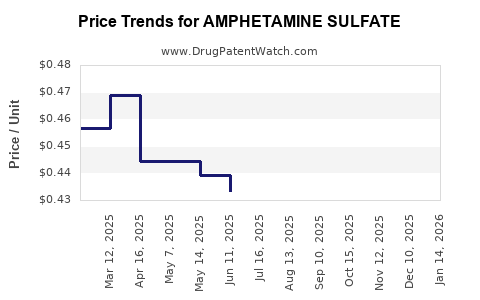
- Net price. Generic competition suppresses prices, while shortages can produce temporary increases in reimbursement and acquisition costs.
- Manufacturing reliability. Controlled-substance quota access and active pharmaceutical ingredient supply directly affect sales.
- Product differentiation. Short-acting tablets have limited differentiation unless a manufacturer offers a new dosage form, packaging configuration, or distribution advantage.
- Payer and wholesaler access. Formulary position and pharmacy purchasing arrangements can determine market share despite limited clinical differentiation.
Standalone product revenue should not be inferred from the revenue of an amphetamine-focused company. Companies may sell several stimulant products, and public filings may aggregate branded, generic, and contract-manufactured products.
Which companies market amphetamine sulfate?
Evekeo was developed and commercialized by Arbor Pharmaceuticals. Arbor was acquired by KVK-Tech in 2021, although product ownership, distribution, and manufacturing arrangements should be evaluated from the applicable FDA labeling and current commercial records rather than assumed from historical corporate ownership. [3]
The generic market includes manufacturers and distributors that may change over time based on FDA approvals, supply contracts, and product discontinuations. The relevant competitive set can include:
- Generic amphetamine sulfate tablet manufacturers
- Specialty pharmaceutical companies with controlled-substance portfolios
- Contract manufacturers supplying authorized generic or private-label products
- Wholesalers and pharmacy networks operating under controlled-substance purchasing controls
The commercial market is therefore less concentrated around a single originator than the market for patented specialty medicines. Manufacturer-level share data requires paid prescription or IQVIA datasets because FDA approval records do not provide reliable sales share.
What is the FDA regulatory status of amphetamine sulfate?
Amphetamine sulfate is an FDA-approved prescription drug and a Schedule II controlled substance under the federal Controlled Substances Act. Schedule II status imposes strict requirements for prescribing, ordering, inventory control, recordkeeping, dispensing, and manufacturing. [4]
The principal approved use areas are:
- ADHD
- Narcolepsy
- Short-term obesity treatment under the applicable product labeling
Evekeo is an immediate-release tablet. FDA-approved generic products must demonstrate pharmaceutical equivalence and bioequivalence to the applicable reference-listed drug. Product availability can still differ because manufacturers may discontinue products, receive manufacturing observations, or face quota constraints.
The FDA shortage framework is commercially important. Stimulant shortages have affected multiple amphetamine products, particularly mixed amphetamine salts. Shortages in adjacent amphetamine products can shift prescriptions toward amphetamine sulfate, but substitution is constrained by clinical judgment, available strengths, state rules, payer policies, and pharmacy inventory. [5]
What is the Orange Book status of amphetamine sulfate?
The Orange Book identifies FDA-approved drug products, reference-listed drugs, therapeutic-equivalence evaluations, and listed patents or regulatory exclusivities where applicable. Amphetamine sulfate has an old active-ingredient history and does not have the patent profile associated with a recently approved small-molecule product. [6]
The commercially important distinction is between:
- The active ingredient, amphetamine sulfate
- The tablet formulation
- The specific reference-listed drug
- Any later dosage form, delivery mechanism, or combination product
For standard immediate-release amphetamine sulfate tablets, market access is primarily a generic-approval and supply issue rather than a current composition-of-matter patent issue. Orange Book listings must be checked by NDA and product presentation because patent and exclusivity records can differ among branded products, reformulations, and related amphetamine products.
What patents protect amphetamine sulfate?
The core amphetamine sulfate molecule is an old active ingredient and is not expected to have enforceable composition-of-matter patent protection in the United States. The relevant intellectual-property risks are more likely to involve:
- Formulation patents
- Extended-release delivery systems
- Orally disintegrating tablets
- Abuse-deterrent or tamper-resistant designs
- Combination products
- Manufacturing processes
- Device or packaging claims
- Method-of-use patents for specific patient populations
Those rights generally protect a particular product design rather than generic immediate-release amphetamine sulfate itself. Patents covering Adderall XR, Mydayis, Vyvanse, or other amphetamine products should not automatically be treated as blocking patents for standard amphetamine sulfate tablets. [6]
When does amphetamine sulfate lose exclusivity?
Standard amphetamine sulfate has already passed the principal period of new-molecule exclusivity and basic compound patent protection. Generic competition is therefore legally available, subject to FDA approval and applicable product-specific patents.
The commercial exclusivity timeline is best understood as follows:
| Exclusivity category |
Position for standard amphetamine sulfate |
| New chemical entity exclusivity |
Expired |
| Core composition-of-matter patent |
Expired or not commercially relevant |
| Pediatric exclusivity |
Not a current barrier to standard generic entry |
| Orphan exclusivity |
Not generally applicable to the standard product |
| Formulation exclusivity |
May apply to specific later products, not necessarily immediate-release tablets |
| Market exclusivity |
Determined by product-specific FDA records and patent certifications |
There is no single future “loss of exclusivity” date comparable to a newly launched branded medicine. The product is already in the generic phase.
Are there Paragraph IV challenges involving amphetamine sulfate?
Paragraph IV litigation risk for standard amphetamine sulfate is limited because the relevant product is old and genericized. Paragraph IV activity is more commercially relevant to newer amphetamine formulations, including extended-release and orally disintegrating products.
A generic applicant filing an abbreviated new drug application may certify that listed patents are invalid, unenforceable, or not infringed. A Paragraph IV notice can trigger litigation and a potential 30-month stay under the Hatch-Waxman framework. [7]
For standard amphetamine sulfate tablets, the principal entry risks are more likely to be:
- FDA review delays
- Bioequivalence deficiencies
- Controlled-substance quota limits
- Active pharmaceutical ingredient shortages
- Manufacturing or quality-system issues
- Commercial inability to secure pharmacy and wholesaler access
These risks can prevent effective market entry even when patent barriers are weak.
What formulation patents protect competing amphetamine products?
Formulation and delivery patents are more significant for competing products than for immediate-release amphetamine sulfate tablets.
Extended-release amphetamine products
Adderall XR and Mydayis use extended-release technologies intended to produce longer therapeutic coverage than immediate-release tablets. Their patent histories relate to release profiles, bead or dosage-unit architecture, and dosing duration. Generic entry has occurred or been pursued for several products, but product-specific patent disputes and regulatory requirements have affected timing. [8]
Lisdexamfetamine
Vyvanse contains lisdexamfetamine, a prodrug of dextroamphetamine. Its product profile and patent estate differ materially from amphetamine sulfate. FDA approval of generic lisdexamfetamine in 2023 increased competitive pressure in the broader stimulant market. [9]
Orally disintegrating formulations
Orally disintegrating amphetamine products may have patent protection directed to excipients, tablet structure, taste masking, or administration characteristics. Those claims can support premium pricing for a limited period but do not generally block conventional immediate-release tablets.
How does amphetamine sulfate compare with Adderall and Vyvanse?
| Attribute |
Amphetamine sulfate |
Mixed amphetamine salts |
Lisdexamfetamine |
| Typical product |
Immediate-release tablet |
Immediate- and extended-release products |
Extended-duration prodrug |
| Main market position |
Niche generic and branded tablet |
Large mainstream stimulant category |
Premium ADHD product, now facing generic competition |
| Duration |
Short acting |
Short or extended, depending on product |
Generally extended |
| Patent exposure |
Low for standard tablet |
Higher for extended-release products |
Historically high, reduced after generic approval |
| Pricing power |
Low |
Low for generics, higher for branded products |
Historically high, declining with generics |
| Supply risk |
Controlled-substance and manufacturer dependent |
Significant shortage exposure |
Supply and manufacturing dependent |
| Commercial differentiation |
Limited |
Release profile and brand recognition |
Duration, prodrug design, and brand history |
Amphetamine sulfate can gain demand when patients need flexible short-acting dosing or cannot obtain other stimulants. It loses share when patients prioritize once-daily coverage, longer duration, or established insurance coverage for competing products.
What generic entry risks exist for amphetamine sulfate?
Generic entry risk is structurally high because the standard product is old and clinically familiar. The main risks to an incumbent manufacturer are:
- New generic approvals
- Contract-manufacturer switching
- Wholesaler price competition
- Pharmacy substitution
- Private-label offerings
- Product discontinuations followed by rapid inventory replacement
- Temporary price compression after supply normalizes
A manufacturer can defend share through reliable supply, multiple strengths, national distribution, and an established controlled-substance compliance infrastructure. Patent litigation is less likely to provide durable protection for the conventional tablet.
What manufacturing and supply barriers affect amphetamine sulfate?
Manufacturing constraints are central to the market.
Amphetamine is a controlled substance. Manufacturers must operate within DEA production quotas and comply with security, inventory, recordkeeping, and distribution requirements. The FDA has also identified broader supply-chain vulnerabilities affecting stimulant availability, including demand surges, manufacturing interruptions, and uneven inventory distribution. [4, 5]
The principal barriers are:
- DEA quota allocation
- Availability of qualified API suppliers
- Controlled-substance facility controls
- Validation and batch-release requirements
- API and excipient sourcing
- National wholesaler allocation
- Pharmacy-level inventory volatility
These barriers can create temporary pricing power for a supplier with available inventory. They do not create durable patent-like exclusivity.
What litigation and settlement issues affect amphetamine sulfate?
No major current patent settlement is broadly associated with standard immediate-release amphetamine sulfate comparable to the high-profile settlements involving newer branded stimulant formulations. Litigation risk is more relevant to:
- Extended-release amphetamine products
- Prodrug formulations
- Device-enabled delivery systems
- Authorized generics
- Manufacturing and supply agreements
- Controlled-substance distribution compliance
A company evaluating acquisition or licensing opportunities should separate product patent litigation from ordinary FDA, DEA, contract, and product-liability exposure. These risks have different financial consequences and different resolution timelines.
What is the competitive landscape for amphetamine sulfate?
The competitive landscape is divided into four tiers:
- Low-cost immediate-release generics, including amphetamine sulfate and generic mixed amphetamine salts.
- Branded and generic extended-release amphetamine products.
- Lisdexamfetamine and its generic alternatives.
- Methylphenidate products, including immediate-release, extended-release, and newer delivery systems.
Amphetamine sulfate is most exposed to substitution within the first tier. Its larger strategic risk is not a single patent-protected competitor but gradual migration to longer-acting products and payer-preferred generic alternatives.
What revenue exposure should investors assign to amphetamine sulfate?
Investors should treat amphetamine sulfate as a mature, low-transparency product unless a company discloses product-level sales. The expected profile is:
- Low-to-moderate revenue growth from prescription demand
- Low pricing power
- Moderate-to-high supply volatility
- Limited patent-driven upside
- Potential margin compression from new generic entrants
- Temporary revenue opportunities during shortages
- Greater value from portfolio placement than from the molecule alone
For a specialty pharmaceutical company, amphetamine sulfate may contribute strategically through manufacturing utilization, controlled-substance distribution capability, or cross-selling with other CNS products. It is unlikely to support a high multiple based solely on patent exclusivity.
Key Takeaways
- Amphetamine sulfate is an FDA-approved, Schedule II stimulant with a mature generic market.
- Its primary uses are ADHD and narcolepsy.
- Standard immediate-release amphetamine sulfate has limited current patent protection.
- Revenue is not normally disclosed as a standalone line item.
- Generic competition limits pricing power, while DEA quotas and supply interruptions create short-term volatility.
- Formulation patents matter more for extended-release, prodrug, and orally disintegrating amphetamine products than for conventional tablets.
- The strongest commercial advantages are reliable manufacturing, quota access, distribution, and pharmacy availability.
- Generic launch risk is high, but operational and regulatory barriers are more important than patent litigation.
- The product has modest standalone growth potential and greater value as part of a broader controlled-substance portfolio.
FAQs About Amphetamine Sulfate Market and Exclusivity
Is amphetamine sulfate the same as Adderall?
No. Amphetamine sulfate is one amphetamine salt. Adderall contains mixed amphetamine salts, including different sulfate, saccharate, aspartate, and phosphate salt components. The products have different formulations and labeling.
Is Evekeo still a branded amphetamine sulfate product?
Evekeo is the principal branded reference product associated with amphetamine sulfate tablets in the United States. Current marketing and distribution arrangements should be verified through FDA labeling and commercial records.
Can pharmacies automatically substitute generic amphetamine sulfate for Adderall?
No. Substitution depends on the prescribed product, state law, therapeutic-equivalence designation, prescription instructions, payer rules, and pharmacist judgment. Amphetamine sulfate and mixed amphetamine salts are not automatically interchangeable.
Does amphetamine sulfate have biosimilar risk?
No. Biosimilar rules apply to biologic products. Amphetamine sulfate is a chemically synthesized small molecule, so its competitive risk comes from generic abbreviated new drug applications rather than biosimilar applications.
Can a manufacturer obtain premium pricing for generic amphetamine sulfate?
Only to a limited extent. Premium pricing may occur during shortages or where a supplier offers superior availability, but standard immediate-release amphetamine sulfate has weak long-term pricing power because the active ingredient and dosage form are mature.
References
- U.S. Food and Drug Administration. (2019). Evekeo (amphetamine sulfate) tablets prescribing information. https://www.accessdata.fda.gov
- IQVIA. (2024). The use of medicines in the U.S. 2024: Usage and spending trends and outlook to 2028. IQVIA Institute for Human Data Science.
- KVK-Tech. (2021). KVK-Tech completes acquisition of Arbor Pharmaceuticals. Company announcement.
- U.S. Drug Enforcement Administration. (2024). Controlled substances quotas. https://www.deadiversion.usdoj.gov
- U.S. Food and Drug Administration. (2024). Drug shortages. https://www.fda.gov/drugs/drug-safety-and-availability/drug-shortages
- U.S. Food and Drug Administration. (2024). Approved drug products with therapeutic equivalence evaluations: Orange Book. https://www.fda.gov/drugs/drug-approvals-and-databases/approved-drug-products-therapeutic-equivalence-evaluations-orange-book
- U.S. Congress. (1984). Drug Price Competition and Patent Term Restoration Act of 1984, Pub. L. No. 98-417, 98 Stat. 1585.
- U.S. Food and Drug Administration. (2024). Drugs@FDA: FDA-approved drug database. https://www.accessdata.fda.gov/scripts/cder/daf/
- U.S. Food and Drug Administration. (2023). FDA approves first generics of Vyvanse to treat ADHD and binge-eating disorder. https://www.fda.gov/news-events/press-announcements/fda-approves-first-generics-vyvanse-treat-adhd-and-binge-eating-disorder