AMPHETAMINE SULFATE - Generic Drug Details
✉ Email this page to a colleague
What are the generic sources for amphetamine sulfate and what is the scope of freedom to operate?
Amphetamine sulfate
is the generic ingredient in three branded drugs marketed by Azurity, Alkem Labs Ltd, Amneal Pharms, Aurolife Pharma Llc, Bionpharma, Dr Reddys Labs Sa, Epic Pharma Llc, Glenmark Pharms Ltd, Granules, Ingenus Pharms Llc, Lannett, Prinston Inc, Rhodes Pharms, Sanaluz, Senores Pharms, Specgx Llc, and Sun Pharm Inds Inc, and is included in eighteen NDAs. There are three patents protecting this compound. Additional information is available in the individual branded drug profile pages.There are twenty drug master file entries for amphetamine sulfate. Twelve suppliers are listed for this compound.
Summary for AMPHETAMINE SULFATE
| US Patents: | 3 |
| Tradenames: | 3 |
| Applicants: | 17 |
| NDAs: | 18 |
| Drug Master File Entries: | 20 |
| Finished Product Suppliers / Packagers: | 12 |
| Raw Ingredient (Bulk) Api Vendors: | 1 |
| Clinical Trials: | 8 |
| Patent Applications: | 2,347 |
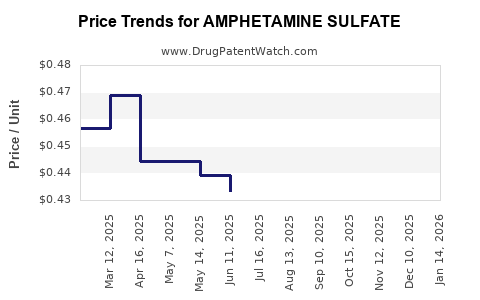
| Drug Prices: | Drug price trends for AMPHETAMINE SULFATE |
| What excipients (inactive ingredients) are in AMPHETAMINE SULFATE? | AMPHETAMINE SULFATE excipients list |
| DailyMed Link: | AMPHETAMINE SULFATE at DailyMed |
Recent Clinical Trials for AMPHETAMINE SULFATE
Identify potential brand extensions & 505(b)(2) entrants
| Sponsor | Phase |
|---|---|
| Vallon Pharmaceuticals, Inc. | Phase 1 |
| Arbor Pharmaceuticals, Inc. | Phase 3 |
| Sarah Morrow | Phase 2/Phase 3 |
Pharmacology for AMPHETAMINE SULFATE
| Drug Class | Central Nervous System Stimulant |
| Physiological Effect | Central Nervous System Stimulation |
US Patents and Regulatory Information for AMPHETAMINE SULFATE
| Applicant | Tradename | Generic Name | Dosage | NDA | Approval Date | TE | Type | RLD | RS | Patent No. | Patent Expiration | Product | Substance | Delist Req. | Exclusivity Expiration |
|---|---|---|---|---|---|---|---|---|---|---|---|---|---|---|---|
| Azurity | EVEKEO ODT | amphetamine sulfate | TABLET, ORALLY DISINTEGRATING;ORAL | 209905-004 | Jan 30, 2019 | DISCN | Yes | No | ⤷ Start Trial | ⤷ Start Trial | ⤷ Start Trial | ||||
| Alkem Labs Ltd | AMPHETAMINE SULFATE | amphetamine sulfate | TABLET;ORAL | 213720-001 | Oct 27, 2020 | AA | RX | No | No | ⤷ Start Trial | ⤷ Start Trial | ⤷ Start Trial | |||
| Specgx Llc | AMPHETAMINE SULFATE | amphetamine sulfate | TABLET;ORAL | 213583-001 | Jan 22, 2021 | AA | RX | No | No | ⤷ Start Trial | ⤷ Start Trial | ⤷ Start Trial | |||
| Prinston Inc | AMPHETAMINE SULFATE | amphetamine sulfate | TABLET;ORAL | 211861-002 | Mar 11, 2020 | AA | RX | No | No | ⤷ Start Trial | ⤷ Start Trial | ⤷ Start Trial | |||
| Azurity | EVEKEO ODT | amphetamine sulfate | TABLET, ORALLY DISINTEGRATING;ORAL | 209905-003 | Jan 30, 2019 | DISCN | Yes | No | ⤷ Start Trial | ⤷ Start Trial | Y | ⤷ Start Trial | |||
| Azurity | EVEKEO ODT | amphetamine sulfate | TABLET, ORALLY DISINTEGRATING;ORAL | 209905-002 | Jan 30, 2019 | DISCN | Yes | No | ⤷ Start Trial | ⤷ Start Trial | ⤷ Start Trial | ||||
| >Applicant | >Tradename | >Generic Name | >Dosage | >NDA | >Approval Date | >TE | >Type | >RLD | >RS | >Patent No. | >Patent Expiration | >Product | >Substance | >Delist Req. | >Exclusivity Expiration |
Expired US Patents for AMPHETAMINE SULFATE
| Applicant | Tradename | Generic Name | Dosage | NDA | Approval Date | Patent No. | Patent Expiration |
|---|---|---|---|---|---|---|---|
| Azurity | EVEKEO ODT | amphetamine sulfate | TABLET, ORALLY DISINTEGRATING;ORAL | 209905-004 | Jan 30, 2019 | ⤷ Start Trial | ⤷ Start Trial |
| Azurity | EVEKEO ODT | amphetamine sulfate | TABLET, ORALLY DISINTEGRATING;ORAL | 209905-002 | Jan 30, 2019 | ⤷ Start Trial | ⤷ Start Trial |
| Azurity | EVEKEO ODT | amphetamine sulfate | TABLET, ORALLY DISINTEGRATING;ORAL | 209905-005 | Apr 16, 2021 | ⤷ Start Trial | ⤷ Start Trial |
| Azurity | EVEKEO ODT | amphetamine sulfate | TABLET, ORALLY DISINTEGRATING;ORAL | 209905-001 | Jan 30, 2019 | ⤷ Start Trial | ⤷ Start Trial |
| Azurity | EVEKEO ODT | amphetamine sulfate | TABLET, ORALLY DISINTEGRATING;ORAL | 209905-003 | Jan 30, 2019 | ⤷ Start Trial | ⤷ Start Trial |
| >Applicant | >Tradename | >Generic Name | >Dosage | >NDA | >Approval Date | >Patent No. | >Patent Expiration |
Summary
More… ↓
Make Better Decisions: Try a trial or see plans & pricing
Drugs may be covered by multiple patents or regulatory protections. All trademarks and applicant names are the property of their respective owners or licensors. Although great care is taken in the proper and correct provision of this service, thinkBiotech LLC does not accept any responsibility for possible consequences of errors or omissions in the provided data. The data presented herein is for information purposes only. There is no warranty that the data contained herein is error free. We do not provide individual investment advice. This service is not registered with any financial regulatory agency. The information we publish is educational only and based on our opinions plus our models. By using DrugPatentWatch you acknowledge that we do not provide personalized recommendations or advice. thinkBiotech performs no independent verification of facts as provided by public sources nor are attempts made to provide legal or investing advice. Any reliance on data provided herein is done solely at the discretion of the user. Users of this service are advised to seek professional advice and independent confirmation before considering acting on any of the provided information. thinkBiotech LLC reserves the right to amend, extend or withdraw any part or all of the offered service without notice.
ISSN: 2162-2639

Privacy and Cookies
Terms & Conditions
Site Map
DrugPatentWatch Alternatives
LOE / Major Patent Expirations 2026 - 2027
NCE-1 Patent Challenge Dates 2026 - 2027
Friedman, Yali. "DrugPatentWatch" DrugPatentWatch, thinkBiotech, 2026, www.DrugPatentWatch.com.
See Primary Research Papers Citing DrugPatentWatch