Last updated: August 4, 2026
Allopurinol is a mature, low-cost generic medicine with durable demand in gout, hyperuricemia and tumor lysis syndrome. Its commercial value comes from high prescription volume rather than pricing power. The active ingredient has no meaningful remaining market exclusivity in the United States, and generic competition limits manufacturer revenue. Market growth is likely to track the prevalence of gout, wider use of urate-lowering therapy, oncology supportive care and expansion of treatment in emerging markets.
What is the current market position of allopurinol?
Allopurinol is the dominant first-line urate-lowering therapy in many treatment guidelines. It is available primarily as immediate-release oral tablets in 100 mg and 300 mg strengths. The drug inhibits xanthine oxidase, reducing uric acid production.
The principal indications are:
| Market segment |
Use of allopurinol |
Commercial relevance |
| Chronic gout |
Long-term reduction of serum urate |
Largest and most durable demand segment |
| Hyperuricemia associated with cancer therapy |
Prevention of uric acid accumulation during chemotherapy |
Smaller, episodic demand |
| Recurrent calcium oxalate kidney stones |
Use in selected hyperuricosuric patients |
Niche demand |
| Chronic kidney disease with hyperuricemia |
Often used when gout or urate-related complications are present |
Expanding clinical relevance, but treatment without gout remains contested |
The American College of Rheumatology recommends allopurinol as the preferred first-line urate-lowering therapy, including for patients with moderate-to-severe chronic kidney disease. The guideline recommends a low starting dose followed by titration to a serum urate target, generally below 6 mg/dL [1].
Gout affects approximately 4% of U.S. adults, with prevalence rising with age, obesity, chronic kidney disease, hypertension and metabolic disease [2]. Global prevalence estimates vary by country and methodology, but gout remains a substantial and underdiagnosed chronic disease burden.
When did allopurinol lose exclusivity?
Allopurinol lost meaningful U.S. patent exclusivity decades ago. The drug was approved by the FDA in the 1960s, and generic versions have been marketed for many years. It is not protected by a current new chemical entity exclusivity period, pediatric exclusivity period or commercially relevant composition-of-matter patent.
| Exclusivity category |
Current status |
| New chemical entity exclusivity |
Expired |
| Original composition patent |
Expired |
| U.S. market exclusivity |
None of commercial significance |
| Generic approval pathway |
Abbreviated New Drug Application, or ANDA |
| Biosimilar exclusivity |
Not applicable |
| Orphan-drug exclusivity |
Not applicable to standard allopurinol products |
The practical consequence is that manufacturers compete primarily on price, supply reliability, API sourcing, regulatory compliance and wholesaler access.
What patents protect allopurinol products?
No active U.S. patent estate is known to create a material barrier to ordinary allopurinol tablets. The original product and core active-ingredient rights are long expired.
Formulation patents
Allopurinol tablets are conventional immediate-release products. They do not rely on a complex delivery system, device, depot formulation or biologic manufacturing process. Older formulation and process rights, where applicable, are not generally viewed as barriers to generic entry.
A manufacturer may still seek patents covering:
- Modified-release formulations
- Combination products
- Alternative dosage forms
- Manufacturing processes
- Crystalline forms or particle-size specifications
- Methods of treating narrow patient subgroups
These rights would need to meet patentability and infringement standards and would not automatically block standard immediate-release tablets. No formulation category currently appears to support a high-value branded franchise comparable with extended-release cardiovascular or oncology products.
Method-of-use patents
Method-of-use protection is limited because allopurinol has been used clinically for decades across its principal indications. Potentially narrower claims could address selected patient populations, dosing regimens or disease settings, but such claims would not generally prevent generic manufacturers from selling tablets for non infringing indications.
What is the Orange Book status of allopurinol?
The FDA Orange Book lists approved allopurinol products and therapeutic-equivalence information, including generic tablet products. The brand reference product has historically been Zyloprim, associated with allopurinol tablets.
The relevant regulatory structure is:
| Regulatory issue |
Status |
| Reference product |
Zyloprim and approved allopurinol tablet products |
| Dosage form |
Oral tablet |
| Strengths |
Commonly 100 mg and 300 mg |
| Generic pathway |
ANDA |
| Therapeutic equivalence |
Generic products may receive an “AB” rating when FDA requirements are met |
| Current patent blocking risk |
Low |
| Listed exclusivity blocking generic approval |
None of material commercial importance |
The Orange Book remains important for confirming the reference-listed drug, therapeutic-equivalence codes and any listed patents or exclusivity. For allopurinol, the commercial issue is not delayed generic entry. It is whether a manufacturer can produce and distribute the drug profitably at a low selling price.
How many patents cover allopurinol?
There is no commercially meaningful active U.S. patent portfolio covering the standard allopurinol tablet market. Patent counts can vary depending on whether expired patents, foreign family members, formulation claims and unrelated process patents are included.
A useful commercial classification is:
| Patent category |
Commercial blocking power |
| Core allopurinol molecule |
None |
| Standard immediate-release tablet |
Very low |
| Generic manufacturing process |
Usually limited and product-specific |
| Narrow method of use |
Low for broad market access |
| Novel formulation |
Potentially moderate if clinically differentiated |
| Device or delivery system |
Not material for standard tablets |
Patent searching should distinguish between live claims and historical documents. A large family count does not indicate meaningful exclusivity if the relevant claims have expired, lapsed or do not read on ordinary tablets.
Which companies are challenging allopurinol patents?
No major current Paragraph IV campaign defines the U.S. allopurinol market. Paragraph IV litigation is generally associated with a generic applicant challenging an unexpired patent listed for a branded reference product. Allopurinol has no comparable active patent barrier in its core market.
Generic manufacturers compete without needing to defeat a valuable patent franchise. Competition typically occurs through:
- ANDA approval
- FDA manufacturing inspections
- Product availability
- National wholesaler contracts
- Medicaid and commercial formulary placement
- Pharmacy benefit manager pricing
- API cost management
The principal litigation risks are therefore more likely to involve product liability, manufacturing compliance, recalls, antitrust conduct or supply arrangements than classic Paragraph IV patent litigation.
What FDA regulatory issues affect allopurinol?
Allopurinol is FDA-approved, but its safety profile creates important regulatory and commercial obligations.
Allopurinol hypersensitivity syndrome
Severe cutaneous adverse reactions, including Stevens-Johnson syndrome and toxic epidermal necrolysis, are the most important safety concern. The FDA labeling identifies renal impairment, certain genetic risk factors and higher starting doses as clinically relevant considerations [3].
The HLA-B*58:01 allele is strongly associated with severe allopurinol hypersensitivity. The American College of Rheumatology conditionally recommends testing before initiation in patients from groups with elevated allele prevalence, including many individuals of Southeast Asian ancestry and African American patients [1]. Testing practices can affect prescribing, but they do not eliminate allopurinol’s role as first-line therapy.
Renal dosing and titration
Allopurinol is commonly started at a low dose and titrated upward. This approach reduces toxicity risk and supports achievement of serum urate targets. Under-dosing has historically limited treatment effectiveness, particularly in patients with chronic kidney disease or high body weight.
FDA manufacturing and shortage exposure
Because the product is inexpensive, some suppliers operate with narrow margins. A manufacturing interruption, API issue, quality warning letter or contract change can affect availability even when national demand is stable. The FDA Drug Shortages database and product-recall notices are the most relevant regulatory monitoring sources [4].
How does allopurinol compare with febuxostat?
Febuxostat is the closest branded pharmacologic competitor, but it has a different commercial and regulatory position.
| Factor |
Allopurinol |
Febuxostat |
| Mechanism |
Xanthine oxidase inhibitor |
Xanthine oxidase inhibitor |
| Market age |
Approved in the 1960s |
Approved in the United States in 2009 |
| Current U.S. status |
Mature generic |
Generic and branded products |
| Cost position |
Very low |
Generally higher |
| First-line guideline position |
Preferred for most patients |
Alternative when allopurinol is not tolerated or insufficient |
| Key safety issue |
Severe hypersensitivity |
Cardiovascular safety warning and mortality findings in CARES |
| Dose titration |
Required |
Required |
| Patent value |
Expired |
Later patent history, but generic competition is established |
Febuxostat gained share among patients who cannot tolerate allopurinol or do not reach target urate levels. Its use is constrained by cardiovascular safety concerns and guideline recommendations favoring allopurinol as the initial treatment for most patients [1,5].
Other competitors include probenecid and other uricosuric agents, while pegloticase addresses severe refractory chronic gout. These products do not materially threaten allopurinol’s broad first-line position because they are generally reserved for specific clinical circumstances.
What is the financial trajectory for allopurinol?
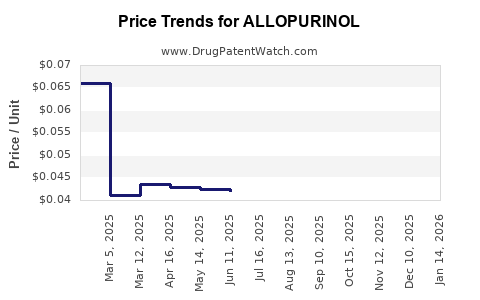
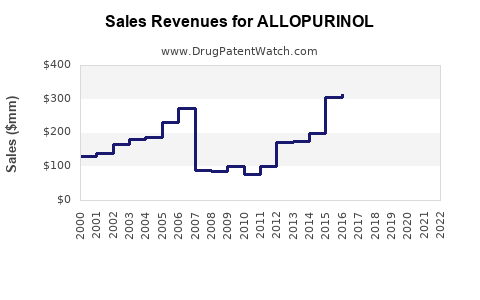
Allopurinol’s financial trajectory is stable to modestly growing in volume and structurally weak in price.
Revenue drivers
The main drivers are:
- Rising gout prevalence and diagnosis.
- Longer patient persistence with treat-to-target therapy.
- Increased treatment among patients with chronic kidney disease.
- Oncology use for prevention of chemotherapy-associated hyperuricemia.
- Expansion of healthcare access in developing markets.
- Greater guideline adherence and serum urate monitoring.
Revenue constraints
Pricing is limited by:
- Multiple generic suppliers
- Low manufacturing complexity
- Pharmacy benefit manager substitution
- Medicaid and government purchasing pressure
- Lack of differentiation among immediate-release tablets
- Retail and mail-order competition
- Low switching costs for pharmacies
No major manufacturer generally reports allopurinol revenue as a separate financial segment. Sales are usually included within broader generic pharmaceutical portfolios. As a result, public-company revenue attribution is limited, and industry market-size estimates vary depending on whether they include APIs, hospital sales, retail prescriptions, combination products and international markets.
Expected financial pattern
| Time horizon |
Likely market behavior |
| Near term |
Stable demand, continued price competition and periodic supply volatility |
| Medium term |
Volume growth from gout prevalence and treatment expansion |
| Long term |
Low nominal revenue growth unless a differentiated formulation or new indication emerges |
| Margin outlook |
Low for commodity tablets; better for vertically integrated or specialized suppliers |
| Investment profile |
Defensive volume product, not a high-growth branded asset |
A manufacturer with integrated API production, high-volume tablet capacity and reliable regulatory history can earn acceptable returns despite low prices. A smaller supplier dependent on external API procurement is more exposed to cost inflation, quality events and contract losses.
What manufacturing and IP barriers exist for allopurinol?
Manufacturing barriers are operational rather than patent-based.
Key barriers include:
- Consistent API quality
- Control of impurities and degradation products
- Demonstration of bioequivalence
- FDA-compliant facilities
- Reliable tablet compression and packaging
- Stability data across storage conditions
- Supply-chain continuity
- Pharmacovigilance and complaint handling
The API is commercially available from established international suppliers. Vertical integration can improve margins and reduce dependence on external API vendors, but it requires capital, regulatory controls and sufficient volume.
Geographic barriers are also limited. Allopurinol is marketed in the United States, Europe, Asia and other regions under national regulatory systems. Product names, approved strengths, manufacturing sites and prescription status vary by country. European and other non-U.S. patent positions do not normally affect U.S. generic access, and expired U.S. rights do not guarantee freedom to operate in every foreign jurisdiction.
What generic launch scenarios exist for allopurinol?
Because standard allopurinol tablets are already generic, the relevant scenarios concern supply and product differentiation rather than initial market entry.
Base case
Multiple suppliers remain active. Prices stay low, demand grows gradually and pharmacies maintain substitution among therapeutically equivalent products.
Supply disruption case
A manufacturing shutdown, API shortage or regulatory action removes one or more suppliers. Prices rise temporarily, and remaining manufacturers gain volume. The effect is usually reversible if alternative capacity is available.
Differentiated-product case
A manufacturer introduces a modified-release, combination or patient-friendly dosage form with clinical or adherence advantages. Commercial upside would depend on FDA approval, reimbursement and evidence that the product improves persistence or safety.
Clinical expansion case
More patients receive treat-to-target urate-lowering therapy, increasing prescription volume without materially changing unit economics. This is the most plausible source of long-term market growth.
What patent litigation and settlement agreements affect allopurinol?
No major active U.S. patent litigation or settlement agreement is central to the standard allopurinol market. The drug’s principal commercial rights expired long ago, and generic entry is not dependent on a current settlement with an originator.
Any future dispute would more likely involve:
- A new formulation patent
- A narrow method-of-use claim
- ANDA product labeling
- Manufacturing or API technology
- Product liability
- Antitrust issues involving supply or distribution
A new patent filing alone would not establish a durable market barrier. The relevant questions would be claim scope, patent term, Orange Book listing status, ANDA certification and the availability of non infringing generic labeling.
How strong is the allopurinol patent estate?
The patent estate is weak for ordinary immediate-release tablets and has little value as an investment moat.
| Attribute |
Assessment |
| Composition-of-matter protection |
Expired |
| Formulation differentiation |
Limited |
| Method-of-use protection |
Narrow and commercially limited |
| Generic substitution risk |
Very high |
| Litigation leverage |
Low |
| Manufacturing moat |
Moderate only for efficient, compliant suppliers |
| Brand pricing power |
Minimal |
| Long-term exclusivity value |
Negligible |
Key Takeaways
- Allopurinol is a mature FDA-approved generic with no meaningful remaining U.S. market exclusivity.
- Demand is durable because gout prevalence is increasing and guidelines continue to favor allopurinol as first-line therapy.
- Revenue growth is volume-driven, while pricing and margins remain constrained by generic competition.
- The standard 100 mg and 300 mg immediate-release tablets have little meaningful patent protection.
- Paragraph IV litigation, Orange Book patent disputes and settlement agreements do not materially shape the current market.
- Febuxostat is the main pharmacologic competitor, but cardiovascular safety concerns and higher cost support allopurinol’s first-line position.
- Supply reliability, API integration and regulatory compliance are more important than patent ownership for commercial success.
- A differentiated formulation or clinically supported new use would be required to create material pricing power.
FAQs
Is allopurinol still under patent in the United States?
No. The original molecule and core product rights expired decades ago. Standard generic allopurinol tablets can be marketed without overcoming a current composition patent.
Does allopurinol have FDA exclusivity?
No commercially meaningful FDA exclusivity remains for conventional allopurinol tablets. The product is distributed through generic ANDA approvals.
Can a new allopurinol formulation obtain patent protection?
Yes. A genuinely novel formulation, delivery system, manufacturing process or narrow method of use could qualify for patent protection. Such a patent would not automatically block existing immediate-release tablets.
Is allopurinol a high-growth pharmaceutical market?
No. It is a stable, mature market. Prescription volume may grow with gout prevalence and improved treatment, but low generic prices limit revenue growth.
What is the main investment risk for an allopurinol manufacturer?
The main risks are low pricing, supplier substitution, API disruption, manufacturing noncompliance and product liability associated with severe hypersensitivity reactions. Patent expiration is not the primary risk because exclusivity has already expired.
References
-
FitzGerald, J. D., Dalbeth, N., Mikuls, T., Brignardello-Petersen, R., Guyatt, G., Abhishek, A., et al. (2020). 2020 American College of Rheumatology guideline for the management of gout. Arthritis Care & Research, 72(6), 744-760. https://doi.org/10.1002/acr.24180
-
Centers for Disease Control and Prevention. (2023). Gout and other crystal arthropathies. U.S. Department of Health and Human Services.
-
U.S. Food and Drug Administration. (2023). Allopurinol tablets, USP: Prescribing information. FDA.
-
U.S. Food and Drug Administration. (2024). Drug shortages database. FDA. https://www.accessdata.fda.gov/scripts/drugshortages/
-
White, W. B., Saag, K. G., Becker, M. A., Borer, J. S., Gorelick, P. B., Whelton, A., et al. (2018). Cardiovascular safety of febuxostat or allopurinol in patients with gout. New England Journal of Medicine, 378(13), 1200-1210. https://doi.org/10.1056/NEJMoa1710895