Last updated: August 17, 2026
ACIPHEX, the branded formulation of rabeprazole sodium, moved from a high-value proton-pump inhibitor franchise to a mature generic market after U.S. exclusivity ended. FDA approval came in 1997. The core delayed-release tablet patents expired in the late 2000s and early 2010s, enabling generic rabeprazole products. Current commercial value is concentrated in generic rabeprazole, residual branded prescriptions, and limited formulation or institutional demand rather than in the original ACIPHEX franchise.
What is ACIPHEX and how does rabeprazole compete in the proton-pump inhibitor market?
ACIPHEX contains rabeprazole sodium, a proton-pump inhibitor that suppresses gastric acid secretion. The product was developed by Eisai and commercialized in the United States through a collaboration with Janssen Pharmaceuticals, a Johnson & Johnson company.
The original U.S. indications included:
- Healing and maintenance of healing of erosive or ulcerative gastroesophageal reflux disease
- Treatment of symptomatic gastroesophageal reflux disease
- Healing of duodenal ulcers
- Eradication of Helicobacter pylori in combination with antibiotics
- Treatment of pathological hypersecretory conditions, including Zollinger-Ellison syndrome
The U.S. product was marketed primarily as delayed-release tablets in 20 mg and lower-dose strengths. ACIPHEX competed with Prilosec and later generic omeprazole, Prevacid and lansoprazole, Protonix and pantoprazole, Nexium and esomeprazole, and Dexilant and dexlansoprazole.
Rabeprazole had pharmacological differentiation based on rapid acid suppression and a lower degree of dependence on CYP2C19 metabolism than some other proton-pump inhibitors. Those attributes supported early prescribing but did not prevent therapeutic substitution after generic entry.
When did ACIPHEX lose market exclusivity?
ACIPHEX lost meaningful U.S. market exclusivity in stages. The first major generic entry occurred after settlement and patent litigation involving Teva and other generic manufacturers.
| Milestone |
Approximate date |
Commercial effect |
| U.S. FDA approval of ACIPHEX tablets |
1997 |
Initial U.S. launch |
| Core compound and product patent protection |
Late 1990s to late 2000s |
Protected branded tablets |
| Pediatric exclusivity period |
Early 2000s |
Extended regulatory protection for covered indications |
| First major generic challenges |
Mid- to late 2000s |
Increased litigation and launch risk |
| Generic rabeprazole entry |
2009 onward |
Rapid erosion of branded tablet sales |
| Later formulation and indication activity |
2010s |
Limited protection for specific dosage forms or populations |
| Mature generic market |
2010s to present |
Low pricing and broad substitution |
The core commercial loss of exclusivity occurred when generic rabeprazole delayed-release tablets entered the U.S. market. The date often cited for the major U.S. erosion event is 2009, although the precise timing varied by strength, manufacturer, litigation outcome, and regulatory approval.
ACIPHEX therefore does not have the patent profile of a currently protected branded medicine. Its principal patent risk shifted from entry prevention to residual enforcement involving specific formulations, methods of use, or pediatric presentations.
What patents protected ACIPHEX?
The original ACIPHEX estate included patents covering rabeprazole, pharmaceutical compositions, salts, enteric-coated dosage forms, and methods for treating acid-related disorders.
The principal U.S. patent associated with rabeprazole sodium was U.S. Patent No. 5,045,552, which covered rabeprazole-related compounds and pharmaceutical use. The patent was filed before the U.S. launch and expired after the statutory patent term, subject to patent-term adjustment or extension and pediatric exclusivity where applicable.
Later patents addressed product-specific features, including:
- Enteric-coated delayed-release tablets
- Stabilization of rabeprazole against degradation
- Pharmaceutical compositions containing rabeprazole sodium
- Specific coating systems and excipients
- Dosing regimens and treatment methods
- Pediatric formulations and administration
The commercial value of these later patents was narrower than the original compound and composition rights. A generic manufacturer could often enter with a formulation that avoided a particular coating or excipient claim, provided its product met FDA bioequivalence requirements.
What is the Orange Book status of ACIPHEX?
The FDA Orange Book historically listed ACIPHEX tablets and patent information submitted by the innovator. The relevant listings included patents associated with the delayed-release tablet formulation and approved methods of use.
Orange Book protection for a mature drug must be assessed at the product level. Key distinctions include:
- A listed patent does not necessarily prevent all generic entry.
- A patent may cover only a method of use that a generic can carve out.
- A patent may expire while the reference product remains listed.
- A generic applicant may challenge a listed patent through an Abbreviated New Drug Application Paragraph IV certification.
- Later dosage forms may have a separate patent and exclusivity history.
For ACIPHEX, the practical market outcome is clear: generic rabeprazole tablets reached the U.S. market despite the historical Orange Book estate. The remaining branded listings have limited ability to support premium pricing.
Which companies challenged ACIPHEX patents?
Generic manufacturers challenged ACIPHEX patent protection as the product approached the end of its commercial life. Teva Pharmaceuticals was among the principal companies involved in rabeprazole generic development and patent litigation. Other generic companies later entered or obtained approval for rabeprazole delayed-release tablets.
Paragraph IV litigation typically alleged that the relevant ACIPHEX patents were invalid, unenforceable, or not infringed. Innovators could respond with patent litigation under the Hatch-Waxman framework, triggering a statutory stay of FDA approval for a defined period.
The commercial objective of these disputes was often an early-entry agreement rather than a complete trial victory. Settlement terms in proton-pump inhibitor litigation frequently included:
- A defined generic launch date before patent expiry
- Authorized generic provisions
- Restrictions on the timing or scope of launch
- Commercial supply arrangements
- Resolution of infringement claims without a final validity judgment
The existence of a settlement does not establish patent validity. It establishes that the parties accepted a negotiated commercial outcome.
What formulation patents protected ACIPHEX?
The most commercially relevant formulation claims covered delayed release. Rabeprazole is acid-labile, so the dosage form must protect the active ingredient from degradation in the stomach and permit release in the intestine.
Formulation protection could include:
- Enteric polymer coatings
- Core tablet composition
- Alkaline stabilizers
- Separation of rabeprazole from acidic excipients
- Coating thickness and dissolution performance
- Alternative sprinkle or capsule delivery systems
These claims had less defensive power than a broad compound patent. Formulation patents can be designed around by changing excipients, coating materials, manufacturing sequence, or dosage form, although the alternative product must still satisfy bioequivalence and quality requirements.
The commercial significance of formulation patents was higher for pediatric products and differentiated delivery systems than for standard adult tablets. Once multiple suppliers produced therapeutically substitutable delayed-release tablets, payers and pharmacies had limited incentive to preserve the branded premium.
How did ACIPHEX compare with competing proton-pump inhibitors?
ACIPHEX entered a crowded class with strong generic competition. The competitive structure changed materially after omeprazole, lansoprazole, and pantoprazole lost exclusivity.
| Product |
Active ingredient |
Brand owner or principal marketer |
Generic exposure |
Competitive position |
| ACIPHEX |
Rabeprazole |
Eisai/Janssen |
Extensive |
Mature, low-price segment |
| Prilosec |
Omeprazole |
AstraZeneca |
Extensive |
Large generic base |
| Prevacid |
Lansoprazole |
Takeda |
Extensive |
Broad generic substitution |
| Protonix |
Pantoprazole |
Wyeth/Pfizer |
Extensive |
Strong hospital and outpatient use |
| Nexium |
Esomeprazole |
AstraZeneca |
Extensive |
Later branded lifecycle and OTC presence |
| Dexilant |
Dexlansoprazole |
Takeda |
Generic competition developed later |
Modified-release differentiation |
ACIPHEX had no durable class-wide clinical advantage sufficient to offset the price difference between the brand and generic alternatives. Formularies generally treated proton-pump inhibitors as interchangeable for many indications, with product selection driven by cost, contracting, dosage form, and prescriber preference.
What was the financial trajectory of ACIPHEX?
ACIPHEX followed the standard lifecycle of a small-molecule primary-care medicine:
- Rapid commercial expansion after launch
- Peak value during the branded prescription period
- Slower growth as competing proton-pump inhibitors gained share
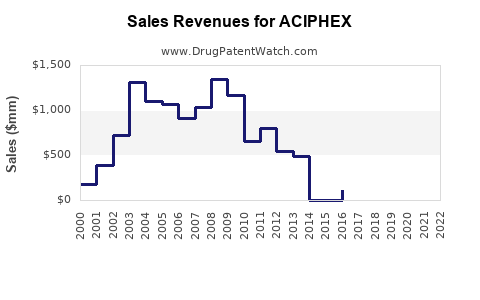
- Sharp revenue erosion after generic entry
- Residual royalty, licensing, or mature-product economics
Eisai’s financial disclosures historically reported ACIPHEX as a major product during the period before generic competition. As generic rabeprazole entered, branded sales declined sharply. The product lost the ability to sustain high branded pricing because generic substitution reduced prescription volume and net price simultaneously.
The key financial variables were:
- U.S. prescription erosion after generic launch
- Reduced net sales from formulary exclusion
- Lower royalty and collaboration income
- Competition from generic omeprazole, pantoprazole, and lansoprazole
- Limited remaining value from branded tablets
- Costs associated with litigation and lifecycle management
- International differences in patent expiry and reimbursement
Public company reporting after the principal loss-of-exclusivity period generally gives less standalone visibility to ACIPHEX. Mature products may be grouped within regional or product-category revenue, making current brand-specific sales difficult to isolate from consolidated filings.
What generic entry risks exist for ACIPHEX?
The generic-entry risk is no longer a forward-looking threat for the core U.S. delayed-release tablet. It is an established market condition.
Potential residual risks include:
- Continued prescription migration from branded ACIPHEX to generic rabeprazole
- Price compression among generic manufacturers
- Pharmacy benefit manager substitution
- Authorized-generic or private-label competition
- Product discontinuation if manufacturing economics deteriorate
- Reduced physician awareness of the branded product
- Loss of shelf space in retail and mail-order channels
Generic rabeprazole manufacturers compete primarily on supply reliability, wholesaler access, quality compliance, and price. The market has limited room for premium differentiation unless a supplier offers a distinct dosage form or secures a restricted institutional contract.
Does ACIPHEX face biosimilar risk?
ACIPHEX does not face biosimilar risk because rabeprazole is a chemically synthesized small molecule. The relevant competitive pathway is the FDA abbreviated new drug application, not the biologics license application and biosimilar pathway.
The primary regulatory issues are:
- ANDA approval
- Pharmaceutical equivalence
- Bioequivalence
- Delayed-release dissolution
- Stability of rabeprazole sodium
- Manufacturing compliance
- Labeling and permissible indication carve-outs
This distinction matters commercially. Generic entry can occur through a relatively standardized regulatory pathway, and the market does not require the clinical comparability program associated with biosimilars.
What licensing deals affected ACIPHEX?
The U.S. commercial history of ACIPHEX involved collaboration between Eisai and Janssen. Eisai was the principal developer and rights holder associated with rabeprazole, while Janssen participated in U.S. commercialization.
The arrangement gave ACIPHEX access to a large U.S. primary-care sales infrastructure. As exclusivity declined, the value of that collaboration also declined. Licensing economics for a mature proton-pump inhibitor are generally tied to remaining branded sales, royalties, territory rights, and supply obligations rather than to substantial new product investment.
The most important licensing question is whether rights remain economically active in a given country. ACIPHEX commercialization and ownership arrangements differed by territory, and the U.S. market was more heavily affected by generic entry than jurisdictions with later patent expiry or different substitution rules.
What is the current commercial outlook for ACIPHEX?
ACIPHEX is a mature product with limited branded growth potential. Its future commercial value depends on residual brand loyalty, availability of lower-dose or pediatric formulations, international market access, and the economics of generic supply.
The original franchise is unlikely to regain peak-era revenue without a new formulation, new indication, or materially differentiated delivery system. Even then, a new product would compete against low-cost proton-pump inhibitors and established treatment guidelines.
For investors and licensing teams, ACIPHEX should be evaluated as:
- A post-exclusivity small-molecule franchise
- A generic rabeprazole market rather than a protected branded asset
- A low patent-barrier product for standard tablets
- A possible niche asset only where formulation or geographic rights remain differentiated
- A product with limited standalone revenue disclosure in recent public filings
Key Takeaways
- ACIPHEX is rabeprazole sodium, a proton-pump inhibitor first approved in the United States in 1997.
- The core U.S. delayed-release tablet franchise lost meaningful exclusivity when generic rabeprazole entered around 2009.
- Historical patent protection covered rabeprazole compounds, pharmaceutical compositions, delayed-release dosage forms, and treatment methods.
- Generic competition, not biosimilar competition, determines the current market structure.
- The brand’s financial trajectory changed from high-value branded revenue to mature, low-margin generic economics.
- Standard ACIPHEX tablets have limited current patent strength as a market-exclusion tool.
- Formulation, pediatric, international, and manufacturing rights may retain niche value, but they do not recreate the original U.S. franchise.
- Any current valuation should separate residual branded rights from generic rabeprazole supply economics.
FAQs
Is ACIPHEX still protected by patents?
The original U.S. patents that supported branded ACIPHEX tablets have expired or no longer prevent generic entry. Any remaining rights must be assessed against specific formulations, indications, jurisdictions, and patent expiration dates.
When did generic rabeprazole launch in the United States?
Major U.S. generic rabeprazole entry began around 2009, following patent challenges and commercial settlements involving generic manufacturers.
Is rabeprazole interchangeable with omeprazole?
Both are proton-pump inhibitors, but FDA substitution depends on the specific product, dosage, formulation, and state pharmacy law. Clinical interchangeability is not identical to automatic pharmacy substitution.
Did ACIPHEX have pediatric exclusivity?
FDA pediatric exclusivity was associated with certain ACIPHEX development and labeling activity. The benefit extended applicable regulatory protection but did not permanently block later generic entry.
Is ACIPHEX a valuable licensing asset today?
The standard U.S. tablet franchise has limited licensing value because generic competition is established. Potential value is more likely in regional rights, specialty formulations, manufacturing capability, or distribution contracts.
References
-
U.S. Food and Drug Administration. (1997). ACIPHEX (rabeprazole sodium) delayed-release tablets: Prescribing information. FDA.
-
U.S. Food and Drug Administration. (n.d.). Approved drug products with therapeutic equivalence evaluations. FDA.
-
U.S. Food and Drug Administration. (n.d.). Orange Book: Approved drug products with therapeutic equivalence evaluations. FDA.
-
U.S. Patent and Trademark Office. (1991). U.S. Patent No. 5,045,552: Pyridine derivatives. USPTO.
-
Eisai Co., Ltd. (Various years). Annual report. Eisai Co., Ltd.
-
U.S. Food and Drug Administration. (1984). Drug Price Competition and Patent Term Restoration Act of 1984. FDA.