Last updated: July 2, 2026
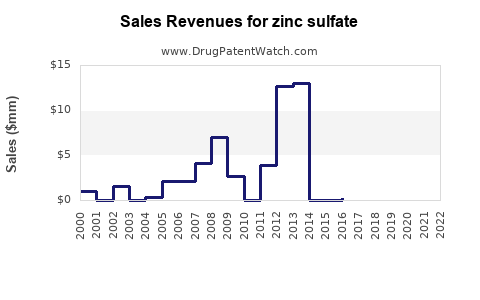
Zinc sulfate is a mature, off-patent small-molecule mineral supplement used in deficiency correction and select therapeutic settings. Commercial value is driven by generic pricing, formulation preferences (oral solids, liquids, chewables), supply continuity, and nutrient-market volume cycles rather than proprietary drug economics. In the US, the product is generally not protected by meaningful branded drug exclusivity; business outcomes track input costs (zinc metal, sulfuric acid), reimbursement patterns for indications, and retailer/pharmacy mix.
Where does zinc sulfate fit in the US market, and what drives demand?
Featured snippet answer: Zinc sulfate demand tracks zinc deficiency prevalence, mineral-supplement consumption, and pharmacy channel volume. Pricing is largely generic and cost-competitive, so revenue growth depends more on volume and mix than on exclusivity.
Zinc sulfate is used as an oral zinc source. Demand drivers differ by segment:
- Dietary supplements and OTC channels: Volume is sensitive to broad consumer supplement trends, seasonal buying, and retailer promotions. Pricing is low and highly competitive.
- Rx-coded deficiency treatment: Revenue is tied to prescribing behavior for zinc deficiency and related clinical pathways (often in patients with malabsorption, wound healing adjunct use, or nutrition support settings).
- Manufacturing availability: As a mineral salt, supply continuity and batch release reliability can outweigh brand differentiation.
Which indications matter commercially?
Because zinc sulfate is widely available as a generic, revenue is typically concentrated in:
- Zinc deficiency correction (oral).
- Clinical nutrition support contexts where oral zinc is used.
- Adjunct uses in specific patient populations where zinc is part of standard-of-care protocols (the commercial impact is typically distribution-driven rather than novel mechanism-driven).
What is the pricing and margin structure for zinc sulfate products?
Featured snippet answer: Zinc sulfate margins are constrained by generic competition; gross profit is usually supported by procurement scale, formulation IP (limited), packaging differentiation, and contracts with wholesalers and health systems.
Key economic features of mineral-salt therapeutics:
- Generic price compression: Once multiple ANDA competitors exist, net pricing trends toward wholesale acquisition cost parity.
- Mix effects: Higher-margin formats can come from:
- Liquid formulations (syrup/suspension/solutions) where dosing flexibility matters.
- Chewables in consumer channels.
- High-dose tablets when differentiated by dosing strength or excipients.
- Input cost pass-through: Zinc metal and processing costs can influence landed cost and short-cycle gross margin.
How do channel contracts shape financial outcomes?
- Wholesaler/distributor contracting reduces retail variability, but also accelerates price alignment across suppliers.
- PBM and formulary placement influences Rx-coded volumes. With an off-patent product, formulary tiers usually favor lowest net cost.
How does zinc sulfate’s financial trajectory compare with other mineral supplements?
Featured snippet answer: Zinc sulfate behaves like a mature, commoditized oral generic. Revenue tends to be stable with modest growth, unless there is a demand shock in deficiency prevalence or reimbursement shifts.
Compared with:
- Iron salts: Iron can show larger volume swings due to anemia treatment patterns and periodic shortages, plus stronger clinical demand.
- Magnesium salts: Magnesium products can fluctuate with consumer supplement trends and gut-tolerance preferences.
- Vitamins (D, C, B complexes): Vitamins have stronger consumer branding and marketing, which can sustain price differentials.
Zinc sulfate’s typical financial profile:
- Lower brand premium
- Higher volume sensitivity
- Limited ability to maintain price without differentiation
- Cashflow resilience if supply is reliable and distribution relationships are entrenched
What patents protect zinc sulfate, and when do they expire?
Featured snippet answer: Zinc sulfate itself is a simple inorganic salt, so proprietary patent estates are usually not the primary driver of long-run exclusivity. Where patents exist, they more often cover specific formulations, manufacturing processes, or dosage forms rather than the base compound.
For zinc sulfate, protection typically takes these forms:
- Oral dosage form patents (tablet coatings, excipient systems, sustained-release variants).
- Process patents (crystallization, purification, particle size control).
- Method-of-use patents are uncommon for a standard mineral salt, but can occur when tied to specific dosing regimens or clinical protocols.
What is the Orange Book status likely to look like?
For inorganic salts like zinc sulfate, the Orange Book listing pattern is commonly:
- Multiple ANDA products
- A small set of listed patents when formulation-specific patents exist
- Near-total off-exclusivity in practice
What formulations are protected by patents, and what generic entry risks exist?
Featured snippet answer: Generic entry risk is high for bulk zinc sulfate tablets and capsules. Patent barriers concentrate in distinct formulations, dose forms, and manufacturing specifications rather than the API.
Potential formulation-based differentiation
Commercially relevant differentiators include:
- Tablet hardness and dissolution profile
- Chewable matrix stability
- Taste-masked suspensions
- High bioavailability excipient packages
- Sustained-release or controlled-release concepts (if patented in a specific product)
Generic entry risks for incumbents
Risks tend to come from:
- Rapid ANDA filings once any listed patent expires.
- “Design-around” formulations that change excipients while preserving bioequivalence.
- Process replication that avoids a manufacturing patent trigger.
What Orange Book listings and FDA status determine launch timing for zinc sulfate generics?
Featured snippet answer: For zinc sulfate, launch timing is mainly a function of product-specific patent lists and practical bioequivalence acceptance rather than compound-level exclusivity.
The regulatory pathway is typically:
- ANDA for the oral immediate-release version.
- Branded Rx products if any exist locally can still be generic-substitutable, with competitive pressure translating quickly into price declines.
What FDA milestones matter for the financial calendar?
- ANDA approval dates
- First commercial shipment timing
- Labeling changes and strength transitions
- Stability/packaging updates that can temporarily slow market entries but rarely sustain pricing
How strong is the patent estate for zinc sulfate?
Featured snippet answer: Patent strength is generally limited and fragmented, with most value protected by formulation specifics rather than a unified, long-duration estate.
In business terms, zinc sulfate incumbency usually relies on:
- Supply chain execution
- Contract scale
- Regulatory and quality record
- Distribution relationships
- Low-cost manufacturing
When patents exist, they are typically:
- Short to medium duration
- Product-specific
- Easily mitigated via formulation changes
What patent litigation affects zinc sulfate?
Featured snippet answer: Litigation is usually sporadic and concentrated on specific formulations or process claims rather than the zinc sulfate molecule itself.
Common litigation patterns for mature generic categories:
- Paragraph IV challenges against listed formulation patents for specific NDA/ANDA products.
- Settlement-driven design-around where the challenger launches after a date or under a revised product profile.
For zinc sulfate specifically, litigation is not a dominant driver of market dynamics compared with commodity pricing, unless a particular branded formulation has an unusually strong list of patents.
Which companies dominate zinc sulfate supply and what is the competitive landscape?
Featured snippet answer: Competition is broad across generic manufacturers, with dominance driven by scale and ability to supply consistent quality. Branded share, if present, is usually limited.
Competitive dynamics typically include:
- Generic oral zinc sulfates from multiple firms competing on price and contract terms.
- Formulation competitors on specific dosage forms (liquids, chewables).
- Private label retailers in OTC zinc products where zinc sulfate competes with other zinc salts and forms.
How does zinc sulfate compete with other zinc forms?
Zinc sulfate competes with:
- Zinc gluconate
- Zinc acetate
- Zinc picolinate and other chelated forms (often priced higher and marketed for absorption)
Net effect:
- Zinc sulfate often wins on cost
- Chelated/high-absorption variants win on marketing and perceived tolerability
When does zinc sulfate lose exclusivity and how does that change pricing?
Featured snippet answer: The market is functionally in a post-exclusivity state for most zinc sulfate products, so “loss of exclusivity” translates into incremental price pressure when any remaining formulation patents expire.
Financial translation:
- Pre-expiry: modest price premiums for particular formulations.
- Post-expiry/settlement: sharp increase in authorized supply, lowering net prices and raising volume for lower-cost suppliers.
How does biosimilar risk apply to zinc sulfate?
Featured snippet answer: Biosimilar frameworks do not apply; zinc sulfate is not biologic.
The comparable risk categories are:
- Generic substitution risk
- OTC conversion risk
- Formulation/design-around competition
- Quality and supply disruption risk
What manufacturing/IP barriers can block competitors?
Featured snippet answer: Barriers are typically non-patent and operational: cost-competitive manufacturing, regulatory compliance, and consistent impurity control.
Key operational blockers:
- Quality system robustness
- Trace impurity specifications and batch consistency
- Scalability of crystallization and purification
- Packaging stability and shelf-life management
IP barriers, when present, usually map to:
- Process controls that are not trivial to replicate at scale
- Specific formulation excipients that affect dissolution and bioequivalence
Revenue exposure: what drives growth or decline for zinc sulfate businesses?
Featured snippet answer: Revenue changes are volume- and contract-driven. Profit changes are driven by input costs and net pricing.
Core financial levers:
- Volume growth: depends on deficiency demand and substitution behavior.
- Net price: compressed by generic competition; short-term promotions can distort revenue but rarely protect margins.
- Mix shift: higher priced formats and larger strengths can stabilize revenue even as average price declines.
- Input costs: zinc metal price swings can hit gross margin with a lag.
- Channel shifts: institutional contracts and Medicare/Medicaid reimbursement patterns influence Rx volume.
What scenario analysis most plausibly matters?
- Base case: stable demand, ongoing price erosion, incremental share gains for lowest-cost/highly contracted suppliers.
- Upside: zinc deficiency prevalence increase or supply tightening that temporarily supports pricing.
- Downside: accelerated generic entries into a formulation-specific segment or sustained input cost increases that cannot be passed through.
Key Takeaways
- Zinc sulfate is a mature, commoditized oral zinc source with market dynamics driven by volume, generic pricing, and supply continuity rather than long-term proprietary exclusivity.
- Patent protection, when it exists, is more likely formulation- or process-specific and does not typically sustain broad market premiums.
- Financial trajectory tracks net pricing erosion and margin pressure from generic competition, with periodic relief from mix improvements (liquid/chewable/high-dose formats) and contract scale.
- Competitive landscape is broad and favors manufacturers with low-cost, reliable supply and strong quality/regulatory performance.
FAQs
1) Is zinc sulfate available as an OTC supplement, and how does that affect Rx pricing?
OTC availability usually accelerates substitution and limits sustained Rx price premiums, pushing net Rx pricing toward the lowest available generic.
2) Which zinc salt typically offers the best price-to-performance for formulary buyers?
Zinc sulfate often wins on cost; higher-priced chelated forms compete on marketing and tolerability claims rather than exclusivity.
3) Do formulation differences (liquids vs tablets) change regulatory and commercial barriers?
Yes. Liquids and chewables can require distinct bioequivalence and stability work, creating short-cycle competitive differentiation even in an off-patent category.
4) Are there meaningful method-of-use patents for zinc deficiency treatments?
Method-of-use protection for a standard mineral salt is less common than formulation/process protection and generally has limited duration impact.
5) What operational risks matter most for zinc sulfate supply?
Quality system compliance, impurity control, batch-to-batch consistency, and the ability to maintain scale during input-cost swings are the main determinants of business continuity.
References
- FDA. Orange Book: Approved Drug Products with Therapeutic Equivalence Evaluations. (Accessed 2026-07-02). https://www.accessdata.fda.gov/scripts/cder/daf/
- FDA. ANDA Drug Product Submissions. (Accessed 2026-07-02). https://www.fda.gov/drugs/abbreviated-new-drug-application-anda