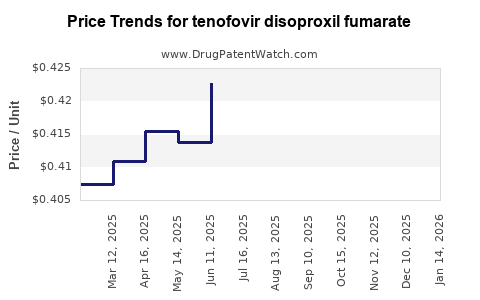
Last updated: September 8, 2026
Tenofovir disoproxil fumarate, or TDF, moved from a high-value branded HIV franchise to a largely generic active pharmaceutical ingredient. Gilead Sciences commercialized TDF through Viread, Truvada, Atripla, Complera/Eviplera, and Stribild. The compound generated substantial revenue during the 2000s and 2010s, but patent expiry, generic entry, and migration to tenofovir alafenamide, or TAF, materially reduced the branded TDF opportunity.
TDF remains commercially important in HIV treatment, pre-exposure prophylaxis, hepatitis B, fixed-dose combinations, and lower-cost global-access markets. Its current value is concentrated in volume, manufacturing scale, combination products, and emerging-market supply rather than premium pricing.
What is the current market position of tenofovir disoproxil fumarate?
TDF is a nucleotide reverse transcriptase inhibitor used primarily in combination therapy for HIV-1 and as antiviral treatment for chronic hepatitis B. Its principal commercial attributes are established efficacy, broad regulatory history, low-cost generic manufacture, and compatibility with fixed-dose combinations.
The commercial market has divided into four segments:
| Segment |
Principal products |
Current market position |
| Branded HIV treatment |
Truvada, Atripla, Complera/Eviplera, Stribild |
Mature and declining in developed markets |
| HIV pre-exposure prophylaxis |
Truvada and generic emtricitabine/TDF |
Large-volume, price-sensitive market |
| Chronic hepatitis B |
Viread and generic TDF |
Generic-dominated |
| Global-access combinations |
Efavirenz/emtricitabine/TDF and other fixed-dose products |
Important in low- and middle-income countries |
TDF has not disappeared from clinical practice. It remains widely used where cost, procurement simplicity, and long-term clinical familiarity outweigh TAF’s renal and bone safety advantages.
The principal competitive threat is TAF, not another new TDF molecule. TAF delivers tenofovir more efficiently into cells and generally produces lower plasma tenofovir exposure. This supported premium branded products such as Genvoya, Odefsey, Biktarvy and Descovy, although TAF products carry their own pricing, indication, and access limitations.
How has the financial trajectory of TDF changed?
TDF revenue peaked when Gilead sold multiple branded combination products and controlled key HIV treatment and PrEP patents. Revenue then declined in stages:
- Viread and Truvada established TDF as a core HIV franchise.
- Atripla expanded use through a once-daily three-drug regimen.
- TDF combinations generated large recurring sales in North America and Europe.
- Generic competition began after product and combination patents expired.
- Gilead shifted patients toward TAF-based products before and during broad generic entry.
- TDF revenue became concentrated in generic, government, and international channels.
Gilead does not separately report global revenue for the TDF molecule. It reports sales by branded product, and several products contain TDF or have included TDF in different presentations. The following table shows the financial direction rather than a standalone TDF revenue figure.
| Period |
Financial profile of TDF franchise |
| 2001-2006 |
Rapid adoption following Viread and Truvada approvals |
| 2007-2014 |
Expansion through Atripla and broader combination use |
| 2015-2017 |
High branded revenue but increasing TAF substitution |
| 2018-2020 |
Declining legacy-product sales; generic preparations approach launch |
| 2021 onward |
Generic price erosion and continued migration to TAF-based branded products |
| Current market |
High unit demand, lower average selling prices, limited branded pricing power |
Truvada was one of Gilead’s largest HIV products before generic entry. Atripla also generated multibillion-dollar annual sales at its peak, although efavirenz tolerability issues and newer regimens accelerated its decline. The financial effect of TDF patent expiry extended beyond Viread because TDF was embedded in several high-value fixed-dose combinations.
Gilead’s HIV portfolio has since become economically dependent on newer products, particularly Biktarvy and Descovy. Biktarvy, which contains TAF rather than TDF, became the company’s leading HIV product. This transition reduced Gilead’s exposure to direct TDF erosion but created a new dependence on the patent estate and commercial performance of TAF-based products.
When did tenofovir disoproxil fumarate lose exclusivity?
The core TDF compound lost meaningful U.S. exclusivity years before the commercial franchise fully eroded. Relevant milestones include:
| Milestone |
Approximate date |
Commercial effect |
| FDA approval of Viread |
2001 |
Established branded TDF |
| FDA approval of Truvada |
2004 |
Created the principal TDF/emtricitabine product |
| FDA approval of Atripla |
2006 |
Expanded TDF into a high-volume three-drug regimen |
| FDA approval of Truvada for PrEP |
2012 |
Opened a major prevention market |
| Core TDF compound patent expiry |
2017-2018 |
Enabled broader generic development |
| Generic Truvada-related approvals and settlements |
2017-2020 |
Delayed or staged commercial entry |
| Broad generic market availability |
2020 onward |
Accelerated price erosion |
The key legal distinction is between compound expiry and combination-product or indication protection. Expiry of a core TDF patent did not automatically eliminate every barrier covering Truvada, PrEP, or specific fixed-dose combinations.
What patents protected Viread and Truvada?
Gilead’s TDF estate included compound, prodrug, combination, formulation, and method-of-use patents. Representative U.S. patents included the following:
| Product or technology |
Representative patent |
General subject matter |
Commercial relevance |
| Tenofovir chemistry |
U.S. Patent No. 5,922,695 |
Tenofovir-related antiviral compounds |
Core compound protection; expired |
| Tenofovir disoproxil formulation and prodrug technology |
U.S. Patent No. 5,935,946 and related family members |
Prodrug and pharmaceutical compositions |
Supported Viread and related products |
| TDF/emtricitabine combination |
U.S. Patent No. 6,642,245 and related patents |
Fixed-dose antiviral combinations |
Relevant to Truvada and combination-product entry |
| PrEP use |
Later method-of-use patents and regulatory exclusivity |
Prevention of HIV infection |
Created an additional litigation and settlement layer |
| Product-specific formulations |
Various Orange Book-listed patents |
Tablet, dosage, and formulation protection |
Generally narrower than compound protection |
Patent scope and expiration dates varied by jurisdiction, patent-family member, terminal disclaimers, patent-term adjustment, pediatric exclusivity, and product listing. The core TDF chemistry is no longer a meaningful U.S. exclusivity barrier. Remaining value resides in specific combinations, methods of use, manufacturing claims, and country-level rights.
What is the Orange Book status of TDF products?
Viread, Truvada, Atripla, Complera, Stribild and related products were subject to product-specific FDA listing histories. The Orange Book records patents associated with approved drug products, but it does not create a single consolidated “TDF patent” record.
The commercial implications are:
- Core TDF tablets are generally open to abbreviated new drug application competition.
- Product-specific patents can still affect the timing of an ANDA launch.
- A generic applicant may certify that a listed patent is invalid, unenforceable, or not infringed under Paragraph IV.
- Method-of-use patents may be carved out through a section viii statement when the generic label omits the protected use.
- Orange Book listings do not determine patent rights outside the United States.
The most important Orange Book distinction is between standalone TDF or TDF/emtricitabine products and newer TAF products. TAF products have separate patent estates and cannot be treated as expired merely because older TDF patents have expired.
Which companies challenged TDF patents under Paragraph IV?
Generic competition involved large international manufacturers and specialized HIV suppliers. Companies that participated in generic development, approval, licensing, or supply arrangements included Teva, Mylan, Cipla, Hetero and other manufacturers active in antiretroviral markets.
The principal U.S. entry pattern was shaped by patent settlements and authorized or licensed generic arrangements. Gilead used agreements with generic manufacturers to manage the timing of competition for Truvada and other HIV products. As a result, the first commercial generic launch date did not necessarily coincide with the earliest FDA approval date.
Paragraph IV activity affected:
- Truvada tablets containing emtricitabine and TDF.
- Atripla-related combinations.
- TDF products used for HIV treatment.
- PrEP formulations and related method-of-use rights.
- Fixed-dose combinations containing TDF and other antiretrovirals.
Generic entry risk was highest once the primary compound and combination claims became vulnerable. Litigation risk was lower for mature standalone TDF products than for newer TAF combinations, where Gilead maintained later-expiring patents.
What FDA regulatory status does TDF have?
TDF has a broad FDA regulatory record.
| Product |
Active ingredients |
FDA milestone |
| Viread |
Tenofovir disoproxil fumarate |
Approved 2001 |
| Truvada |
Emtricitabine/TDF |
Approved 2004 |
| Atripla |
Efavirenz/emtricitabine/TDF |
Approved 2006 |
| Complera |
Rilpivirine/emtricitabine/TDF |
Approved 2011 |
| Stribild |
Elvitegravir/cobicistat/emtricitabine/TDF |
Approved 2012 |
| Truvada for PrEP |
Emtricitabine/TDF |
Approved for HIV prevention in 2012 |
Generic TDF and emtricitabine/TDF products have entered through the ANDA pathway. These are small-molecule generics, not biosimilars. The FDA therefore evaluates pharmaceutical equivalence, bioequivalence, manufacturing quality, labeling, and applicable patent certifications rather than biosimilarity.
No biosimilar risk applies to TDF itself. The relevant competitive risks are generic substitution, therapeutic interchange, tenders, procurement contracts, and physician switching to TAF or other single-tablet regimens.
How strong is the remaining patent estate for TDF?
The remaining TDF estate is weak for the active ingredient and stronger only in selected product or use categories.
| Patent layer |
Current strength |
| Core TDF molecule |
Low in the United States and other mature markets |
| Standalone TDF tablet |
Low to moderate, depending on jurisdiction |
| Emtricitabine/TDF combination |
Low after principal combination expiries, subject to country-specific rights |
| PrEP method of use |
Historically material; current impact depends on jurisdiction and claim status |
| TDF fixed-dose combinations |
Moderate for selected formulations and markets |
| TAF products |
Stronger and later-expiring than TDF products |
| Manufacturing know-how |
Moderate operational value, limited exclusionary value |
TDF’s manufacturing barrier is manageable. The molecule is commercially established, production processes are well understood, and multiple suppliers operate globally. The principal barriers are regulatory compliance, impurity control, scale, supply reliability, and access to qualified API sources. These barriers can support margins for reliable suppliers but rarely sustain branded-monopoly pricing.
What generic launch scenarios exist for TDF?
The most likely launch scenario is continued price compression in developed markets combined with stable or growing volume in lower-cost markets.
| Scenario |
Market outcome |
| Rapid generic substitution |
Steep decline in branded Truvada, Viread and legacy combination sales |
| Gradual substitution |
Continued branded use where physicians favor established products or contracts limit switching |
| PrEP volume expansion |
Higher unit demand offsets part of the price decline |
| TAF migration |
TDF volume declines in affluent markets while remaining strong in cost-sensitive settings |
| Procurement consolidation |
Large-volume tenders favor a smaller number of low-cost suppliers |
| Manufacturing disruption |
Temporary price increases or supply shifts, without restoring durable exclusivity |
TDF’s generic economics are most attractive where the product is included in national HIV or hepatitis B programs, where demand is predictable and manufacturing can be scaled efficiently. Margins are likely to remain under pressure in U.S. commercial channels because multiple suppliers can compete on price.
What patent litigation and settlement issues affected TDF?
The main disputes involved the timing of generic entry, validity of combination patents, method-of-use rights for PrEP, and agreements between Gilead and generic manufacturers. Settlement structures commonly included delayed entry dates, licenses, authorized-generic terms, or market-specific rights.
The U.S. government also asserted rights concerning patents related to HIV PrEP. Those disputes increased the legal complexity surrounding Truvada’s prevention indication but did not restore long-term exclusivity for the TDF molecule.
The practical result was controlled erosion rather than an immediate competitive shock. Gilead had time to transition patients and prescribers toward TAF-based products before generic TDF became broadly available.
How does TDF compare with TAF commercially?
| Attribute |
TDF |
TAF |
| Plasma tenofovir exposure |
Higher |
Lower |
| Renal and bone profile |
Less favorable in some patients |
Generally more favorable |
| Patent maturity |
Largely expired for core technology |
Later-expiring estate |
| Generic competition |
Extensive |
More limited |
| Pricing |
Low in generic markets |
Higher for branded products |
| Main commercial role |
Cost-efficient legacy and global-access therapy |
Premium or differentiated branded therapy |
| Revenue outlook |
Stable volume, declining value per unit |
Greater branded revenue potential |
TAF’s commercial advantage is not only clinical. It also gave Gilead a later patent runway and allowed the company to reposition its HIV portfolio before TDF generic erosion reached full scale. TDF remains important as a low-cost option, while TAF captures more value in developed-market branded treatment and PrEP.
What revenue exposure remains for manufacturers and investors?
For Gilead, direct TDF revenue exposure is now limited relative to the company’s total HIV business. The more significant financial exposure is indirect:
- Decline in legacy Truvada, Atripla and Stribild sales.
- Persistence or erosion of generic PrEP demand.
- Switching from TDF to Descovy or Biktarvy.
- Pricing and reimbursement for TAF products.
- Global access agreements and public-health procurement.
- Cannibalization within Gilead’s HIV portfolio.
For generic manufacturers, TDF is a volume opportunity rather than a high-margin innovation product. Competitive advantage depends on API sourcing, regulatory approvals, supply continuity, government tenders, and combination-product capacity.
For investors, the relevant valuation question is not whether TDF retains molecule-level exclusivity. It does not in major markets. The question is how quickly TDF volume declines, how much PrEP expands total demand, and whether TAF products preserve branded HIV revenue.
Key Takeaways
- TDF is a mature, genericized antiviral with substantial residual global demand.
- Gilead’s principal branded TDF products were Viread, Truvada, Atripla, Complera and Stribild.
- Core U.S. TDF exclusivity expired around 2017-2018, while combination and use patents extended commercial control in selected products and markets.
- Generic Truvada competition became commercially significant from 2020 onward.
- TDF revenue declined because of patent expiry, generic substitution and migration to TAF.
- TAF, not another TDF product, is the main branded competitive platform.
- TDF has no biosimilar risk because it is a small molecule; the relevant risk is generic substitution.
- Future TDF value is concentrated in PrEP, hepatitis B, public procurement and emerging markets.
- Manufacturing barriers are operational rather than strongly exclusionary.
- Gilead’s current HIV financial exposure is concentrated in newer products, especially Biktarvy and Descovy.
FAQs About Tenofovir Disoproxil Fumarate
Is tenofovir disoproxil fumarate still commercially relevant?
Yes. It remains widely used in generic HIV treatment, PrEP, hepatitis B therapy and global-access antiretroviral programs, although branded revenue has declined sharply.
Is generic Truvada available?
Yes. Generic emtricitabine/TDF products are available in the United States and international markets, subject to product approval, patent settlements and local regulatory requirements.
Does TDF still have patent protection?
The core TDF molecule is no longer a major exclusivity barrier in the United States. Certain combination, formulation, method-of-use and foreign patents may have had later expiration dates.
Is tenofovir alafenamide a replacement for TDF?
TAF replaced part of the branded TDF market because of its lower plasma tenofovir exposure and differentiated renal and bone profile. TDF remains important where price and procurement access are primary considerations.
What is the investment outlook for TDF manufacturers?
The outlook favors high-volume, low-cost suppliers with reliable API access and government-market capability. The product has limited prospects for sustained premium pricing in mature markets.
References
-
Gilead Sciences, Inc. (2024). Annual report pursuant to Section 13 or 15(d) of the Securities Exchange Act of 1934 for the fiscal year ended December 31, 2023. U.S. Securities and Exchange Commission.
-
Gilead Sciences, Inc. (2025). Annual report pursuant to Section 13 or 15(d) of the Securities Exchange Act of 1934 for the fiscal year ended December 31, 2024. U.S. Securities and Exchange Commission.
-
U.S. Food and Drug Administration. (2001). Viread approval package and prescribing information. Center for Drug Evaluation and Research.
-
U.S. Food and Drug Administration. (2004). Truvada approval package and prescribing information. Center for Drug Evaluation and Research.
-
U.S. Food and Drug Administration. (2012). Truvada for preexposure prophylaxis approval and prescribing information. Center for Drug Evaluation and Research.
-
U.S. Food and Drug Administration. (2024). Approved drug products with therapeutic equivalence evaluations. Center for Drug Evaluation and Research.
-
U.S. Patent and Trademark Office. (1999). U.S. Patent No. 5,922,695: Nucleotide analogues. Washington, DC.
-
U.S. Patent and Trademark Office. (1999). U.S. Patent No. 5,935,946: Nucleotide analogues. Washington, DC.
-
U.S. Patent and Trademark Office. (2003). U.S. Patent No. 6,642,245: Combination of tenofovir and emtricitabine. Washington, DC.