Last updated: September 9, 2026
Oxaprozin is a mature, nonselective NSAID marketed originally as Daypro and now primarily through generic manufacturers. Its commercial trajectory has followed the standard lifecycle of an older small-molecule medicine: initial branded growth after FDA approval, loss of exclusivity, rapid generic substitution, declining net pricing, and limited manufacturer-level revenue visibility. Current value is concentrated in low-cost generic volume rather than branded market power.
What is oxaprozin and how is it used?
Oxaprozin is an oral, long-acting nonsteroidal anti-inflammatory drug indicated for the signs and symptoms of osteoarthritis and rheumatoid arthritis in adults. The reference product, Daypro, was approved by the U.S. Food and Drug Administration in 1992. The active ingredient is oxaprozin, a propionic-acid derivative with analgesic, anti-inflammatory, and antipyretic activity.[1]
| Attribute |
Oxaprozin |
| Reference brand |
Daypro |
| Active ingredient |
Oxaprozin |
| Drug class |
Nonselective NSAID |
| FDA approval |
1992 |
| Primary indications |
Osteoarthritis and rheumatoid arthritis |
| Typical adult dosing |
600 mg or 1,200 mg once daily, depending on indication and clinical response |
| Dosage form |
Oral tablets |
| Current market status |
Mature generic product |
| Biosimilar exposure |
None; oxaprozin is a small molecule |
| Primary commercial competitors |
Ibuprofen, naproxen, diclofenac, meloxicam, celecoxib, aspirin |
Oxaprozin’s once-daily dosing differentiated it from shorter-acting NSAIDs when Daypro entered the market. That advantage was limited by the availability of inexpensive alternatives, including generic naproxen and ibuprofen, and by the safety risks shared across the NSAID class.
When did oxaprozin lose exclusivity?
Oxaprozin lost meaningful U.S. commercial exclusivity years ago. The reference product’s market protection was based on older small-molecule patent and regulatory rights that predated the modern patent-term framework. Generic oxaprozin tablets are approved through abbreviated new drug applications, and the product is no longer a protected branded growth asset.
The practical exclusivity timeline is:
| Period |
Commercial status |
| 1992 |
FDA approves Daypro |
| 1990s |
Branded commercialization and physician adoption |
| Early 2000s |
Increasing competition from alternative NSAIDs and generic products |
| Mid-to-late 2000s |
Generic oxaprozin availability expands |
| 2010s |
Mature generic pricing and declining branded relevance |
| 2020s |
Commodity-like multisource generic market |
The exact remaining value of any historical patent claims is not commercially material to the current U.S. market. Oxaprozin does not have the profile of a product approaching patent expiry. It is already in the post-exclusivity phase.
What is the FDA and Orange Book status of oxaprozin?
FDA regulatory status is generic and multisource rather than innovator-led. The FDA Orange Book identifies approved oxaprozin products by dosage strength and manufacturer, while the discontinued Daypro brand is no longer the principal source of market supply.[2]
The main regulatory characteristics are:
- Approval through ANDA pathways for generic manufacturers.
- No biologic license application and no biosimilar pathway.
- No current dependence on a single reference-product manufacturer.
- Established tablet dosage forms, primarily 600 mg.
- Generic substitution governed by state pharmacy rules and payer formularies.
- Limited opportunity for new regulatory exclusivity absent a novel formulation, indication, or delivery system.
FDA labeling retains class-wide NSAID warnings concerning gastrointestinal bleeding, cardiovascular thrombotic events, renal toxicity, hypertension, heart failure, and serious skin reactions.[1] These warnings affect prescribing and payer positioning across the entire NSAID category.
How many patents protect oxaprozin today?
No commercially meaningful exclusivity remains around the original oxaprozin product in the United States. The relevant patent estate was created for the original active ingredient and product development program, not for a contemporary specialty formulation platform.
Current patent-related risk is therefore low for standard oxaprozin tablets. A potential entrant would face ordinary generic regulatory and manufacturing requirements rather than a significant branded patent thicket.
| Patent category |
Current commercial relevance |
| Original compound patents |
Historical; no material current barrier to standard generic tablets |
| Original formulation patents |
Historical or expired for the conventional tablet product |
| Method-of-use patents |
Limited relevance to the approved arthritis uses |
| New formulation patents |
Potentially relevant only if a company develops a differentiated product |
| Manufacturing patents |
Possible process protection, but unlikely to block ordinary tablet manufacture |
| Orange Book-listed patents |
No known current estate comparable with protected branded drugs |
A company developing an extended-release, topical, combination, or targeted oxaprozin product would need to establish a new commercial rationale. A reformulation alone would not guarantee market adoption because payers and prescribers have inexpensive NSAID substitutes.
What are the main market dynamics for oxaprozin?
Oxaprozin competes in a mature, price-sensitive NSAID market. The strongest market forces are generic substitution, therapeutic interchange, safety monitoring, and payer preference.
Generic price erosion
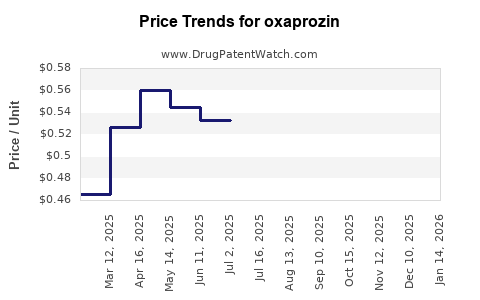
Once several manufacturers supply the same strength, wholesale and pharmacy acquisition prices typically decline. Oxaprozin has limited negotiating leverage because the active ingredient is established, the dosage form is conventional, and alternative NSAIDs are widely available.
The commercial consequences include:
- Lower average selling prices.
- Reduced manufacturer gross margins.
- Greater dependence on purchasing contracts and pharmacy distribution.
- Periodic supply volatility if manufacturers exit low-margin products.
- Minimal ability to increase prices without risking substitution.
Therapeutic substitution
Oxaprozin competes not only with generic oxaprozin but with drugs that physicians may select for the same clinical uses. Generic naproxen and ibuprofen generally have greater name recognition and broader retail availability. Meloxicam offers once-daily dosing and is commonly used in chronic osteoarthritis treatment. Celecoxib provides a branded and generic COX-2-selective alternative, although its cardiovascular and formulary considerations differ.
Oxaprozin’s once-daily administration remains a functional advantage, but it is not usually sufficient to create premium pricing in a generic market.
Safety and prescribing restrictions
NSAID use is constrained by patient age, renal function, gastrointestinal history, cardiovascular risk, anticoagulant use, and duration of therapy. These clinical constraints reduce the addressable market for chronic high-dose use and encourage lower doses, shorter treatment periods, or non-NSAID alternatives.
The FDA requires the class to carry boxed warnings for serious cardiovascular and gastrointestinal risks.[1] Oxaprozin therefore cannot compete solely on efficacy. Its commercial position depends on price, familiarity, availability, and physician preference.
What is the financial trajectory of oxaprozin?
The financial trajectory is best characterized as a transition from branded revenue to low-value generic turnover.
Branded phase
Daypro’s initial commercial value came from its approval for chronic arthritis, once-daily dosing, and positioning as an alternative to established NSAIDs. Branded revenue would have been supported by physician promotion, formulary access, and the absence of direct generic oxaprozin competition.
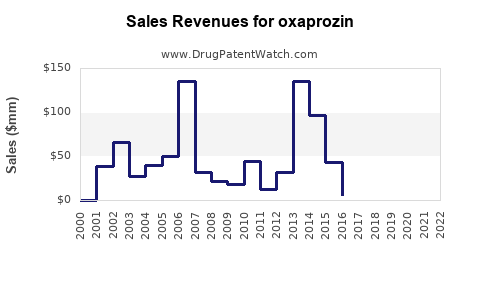
Public disclosures do not generally provide a durable standalone revenue series for oxaprozin. The product was historically included within broader pharmaceutical portfolios, and reported revenue was not consistently separated from the manufacturer’s total prescription-drug sales.
Post-exclusivity phase
After generic entry, the financial model changed:
- Brand prescriptions shifted to generic equivalents.
- Net price declined.
- Retail and institutional purchasers gained negotiating leverage.
- Multiple suppliers competed for formulary and wholesaler contracts.
- The reference brand lost strategic importance.
Generic manufacturers can continue selling oxaprozin if production and distribution costs remain low, but the product is unlikely to support major sales and marketing investment.
Current phase
Current oxaprozin economics are likely driven by unit volume rather than price expansion. Revenue is distributed among generic manufacturers and wholesalers, and individual-company exposure is difficult to measure because manufacturers often report generic products in aggregated portfolios.
| Financial driver |
Current effect |
| Unit demand |
Stable to declining, linked to chronic arthritis treatment |
| Price |
Low and pressured by multisource competition |
| Gross margin |
Sensitive to manufacturing scale and contract pricing |
| Promotional spending |
Minimal |
| Brand revenue |
Commercially limited |
| Payer leverage |
High |
| Supply-chain risk |
Moderate if manufacturers exit low-volume production |
| Growth potential |
Low without a differentiated formulation or new indication |
What is the competitive landscape for oxaprozin?
Oxaprozin sits below the largest generic NSAIDs in market visibility and volume. Its main competitors are not direct oxaprozin equivalents alone. They include all commonly reimbursed oral NSAIDs used for osteoarthritis and rheumatoid arthritis.
| Product |
Competitive position |
| Ibuprofen |
High-volume, low-cost, extensive over-the-counter and prescription presence |
| Naproxen |
Strong chronic-use position and broad generic availability |
| Diclofenac |
Widely used in oral and topical forms |
| Meloxicam |
Once-daily prescription competitor |
| Celecoxib |
COX-2-selective option with generic availability |
| Oxaprozin |
Once-daily mature generic with limited differentiation |
| Aspirin |
Important analgesic and antiplatelet product, but not a direct substitute in all uses |
Oxaprozin’s main advantage is convenient once-daily administration. Its main disadvantages are lower market familiarity, limited differentiation, generic pricing, and the same class-level safety issues affecting competing NSAIDs.
What generic entry risks exist for oxaprozin?
For conventional oxaprozin tablets, generic entry risk has already been realized. The product is not facing a future cliff; it is operating after the cliff.
The remaining commercial risks are different:
- A manufacturer may discontinue the product because of low margins.
- A supply disruption could shift prescriptions to naproxen or meloxicam.
- Payers may remove oxaprozin from preferred tiers.
- Safety-driven prescribing reductions could reduce chronic-use volume.
- Large buyers may consolidate supply among fewer vendors.
- A new formulation could redirect limited demand away from standard tablets.
A generic manufacturer evaluating entry would likely prioritize supply reliability and cost control over promotional activity. The product is more suitable for a portfolio strategy than as a standalone launch.
What formulation patents or method-of-use opportunities exist?
Standard oxaprozin tablets have limited innovation potential. Possible differentiated products include:
- Modified-release tablets.
- Lower-dose products for selected patients.
- Fixed-dose combinations.
- Gastroprotective combinations.
- Topical or localized delivery systems.
- Formulations designed to reduce gastrointestinal exposure.
These approaches would face a difficult commercial test. Any new product would compete against inexpensive generic NSAIDs, established topical diclofenac, proton-pump-inhibitor co-therapy, and nonpharmacologic arthritis treatments. A new patent would need to protect a clinically meaningful benefit that payers are willing to reimburse.
Method-of-use claims would also face limits. The core arthritis indications are well established, and broad claims around pain or inflammation could encounter validity and obviousness challenges.
Which companies are relevant to the oxaprozin market?
The relevant manufacturer group consists mainly of generic pharmaceutical companies and contract suppliers rather than a single dominant innovator. Generic oxaprozin has historically been associated with manufacturers such as Teva, Actavis, and other ANDA holders, although product availability and marketing status can change over time.[2]
Commercial control is fragmented. The key competitive assets are:
- FDA-approved ANDAs.
- Reliable active pharmaceutical ingredient supply.
- Low-cost tablet manufacturing.
- National wholesaler access.
- Pharmacy benefit manager contracts.
- Capacity to maintain supply despite low unit economics.
The identity of the largest current supplier should be determined from the latest FDA product listing and commercial dispensing data rather than assumed from historical approvals.
What is the revenue exposure and investment outlook?
Oxaprozin presents low direct revenue exposure for diversified pharmaceutical companies. It is unlikely to materially affect the financial results of a large manufacturer unless the company has unusually concentrated exposure to a narrow generic portfolio.
The investment profile is:
| Factor |
Assessment |
| Market growth |
Low |
| Pricing power |
Very low |
| Patent protection |
No meaningful current protection for standard tablets |
| Regulatory complexity |
Low to moderate |
| Manufacturing complexity |
Low for conventional tablets |
| Litigation exposure |
Low relative to protected branded products |
| Supply-chain exposure |
Moderate |
| Commercial upside |
Limited |
| Downside |
Margin compression and product discontinuation |
| Strategic value |
Portfolio completeness or niche supply |
Oxaprozin could generate modest, recurring generic revenue where manufacturing costs are competitive. It is not an attractive standalone asset for a company seeking high growth, durable exclusivity, or significant pricing power.
How does oxaprozin compare with competing arthritis drugs?
Oxaprozin’s competitive profile is strongest when once-daily dosing and low acquisition cost are important. It is weaker where prescribers prioritize extensive clinical familiarity, over-the-counter availability, topical delivery, or COX-2 selectivity.
| Criterion |
Oxaprozin |
Naproxen |
Meloxicam |
Celecoxib |
| Dosing convenience |
Once daily |
Usually once or twice daily |
Once daily |
Once or twice daily |
| Generic competition |
High |
High |
High |
High |
| OTC presence |
No |
Yes |
No |
No |
| Market familiarity |
Moderate to low |
High |
High |
High |
| Differentiation |
Limited |
Limited |
Once-daily use |
COX-2 selectivity |
| Patent upside |
Minimal |
Minimal |
Minimal |
Limited for generic product |
| Commercial outlook |
Mature niche |
Large mature market |
Strong generic prescription use |
Established generic and branded legacy |
Key Takeaways
- Oxaprozin is a mature generic NSAID with no meaningful current branded exclusivity.
- Daypro was FDA-approved in 1992 for osteoarthritis and rheumatoid arthritis.
- The product’s original commercial value came from once-daily dosing and branded positioning.
- Generic competition has eliminated most pricing power and reduced manufacturer-level revenue visibility.
- Oxaprozin competes with naproxen, ibuprofen, meloxicam, diclofenac, and celecoxib, not only with generic oxaprozin.
- No biosimilar risk exists because oxaprozin is a small molecule.
- Standard tablet manufacturing is relatively uncomplicated, but low margins can create supply and discontinuation risks.
- New formulations could obtain patent protection, but payer and substitution barriers would limit commercial upside.
- Oxaprozin is more suitable as a low-cost generic portfolio product than as a standalone growth or licensing asset.
- Publicly reported standalone oxaprozin revenue is limited, making unit volume, manufacturer listings, and dispensing data more useful than company financial statements for market analysis.
FAQs
Is oxaprozin still available in the United States?
Yes. Oxaprozin is available primarily as a generic prescription tablet, although manufacturer participation and pharmacy inventory can vary.
Is Daypro still marketed as a branded drug?
Daypro is no longer the principal commercial source of oxaprozin in the United States. Generic products dominate supply.
Does oxaprozin have a patent-protected extended-release formulation?
No commercially significant extended-release patent position is associated with the standard U.S. oxaprozin market. A new extended-release product would require separate development and patent protection.
Is oxaprozin more profitable than naproxen?
Generally, no. Naproxen has greater market scale, broader recognition, and more extensive retail use. Oxaprozin may remain commercially viable for a low-cost supplier but does not generally offer superior pricing power.
Could a new oxaprozin formulation support a licensing deal?
Only if it demonstrates a defensible clinical or adherence advantage. A formulation with improved tolerability, targeted delivery, or a meaningful dosing benefit could support licensing, but generic NSAID substitution would limit valuation.
References
-
U.S. Food and Drug Administration. (2015). Daypro (oxaprozin) tablets: Prescribing information. FDA.
-
U.S. Food and Drug Administration. (n.d.). Approved drug products with therapeutic equivalence evaluations: Orange Book. FDA. https://www.accessdata.fda.gov/scripts/cder/ob/index.cfm