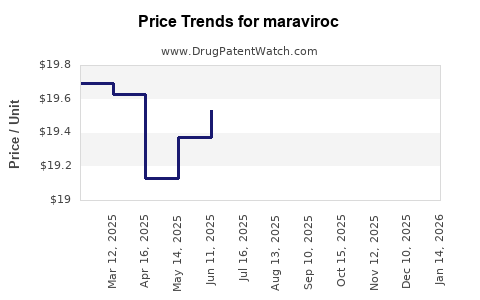
Last updated: September 7, 2026
Maraviroc is a mature, niche HIV medicine with limited growth potential. Its commercial value rests on use in treatment-experienced patients with CCR5-tropic HIV-1, not first-line therapy. The drug has faced strong clinical competition from integrase inhibitors, while its commercial trajectory has been constrained by twice-daily dosing, tropism testing, drug-interaction management and limited standalone financial disclosure. Patent protection has largely expired or lost practical force in major markets, but generic competition remains commercially modest because the eligible patient population is small.
Maraviroc Market Dynamics, Patent Estate and Financial Trajectory
What is maraviroc and how is it used?
Maraviroc is an oral CCR5 antagonist marketed in the United States as Selzentry and in many international markets as Celsentri. It blocks the CCR5 co-receptor used by certain strains of HIV-1 to enter CD4-positive cells.
The FDA approved maraviroc in August 2007 for adults with CCR5-tropic HIV-1 who have evidence of previous treatment experience and resistance to multiple antiretroviral agents. The indication was later expanded to pediatric patients at least 2 years old and weighing at least 10 kilograms. Maraviroc must be used with other antiretroviral agents and is not appropriate for patients infected with CXCR4-tropic or dual/mixed-tropic virus [1].
| Attribute |
Maraviroc |
| Brand names |
Selzentry, Celsentri |
| Active ingredient |
Maraviroc |
| Mechanism |
CCR5 antagonist |
| Initial FDA approval |
August 2007 |
| Original developer |
Pfizer |
| Current commercial association |
ViiV Healthcare in major HIV markets |
| Dosage forms |
25 mg, 75 mg, 150 mg and 300 mg tablets |
| Typical dosing |
Once or twice daily depending on interacting medicines |
| Core patient segment |
Treatment-experienced patients with CCR5-tropic HIV-1 |
| Therapeutic category |
Antiretroviral, HIV entry inhibitor |
| Biosimilar exposure |
None; maraviroc is a small molecule |
| Principal market limitation |
Requires tropism testing and has a narrow clinical position |
How has the maraviroc market changed since launch?
Maraviroc entered a market in which treatment-experienced patients had substantial unmet need. Its mechanism was differentiated from nucleoside reverse transcriptase inhibitors, protease inhibitors and non-nucleoside reverse transcriptase inhibitors.
The commercial environment changed rapidly after the launch of more convenient and potent integrase inhibitor regimens. Dolutegravir, bictegravir and long-acting cabotegravir-based products captured treatment initiation and a growing share of treatment-switching activity. These products generally avoid the need for CCR5 tropism testing and have simpler prescribing profiles.
Maraviroc therefore moved from a differentiated salvage product toward a specialist option. Its remaining demand is concentrated in:
- Patients with CCR5-tropic, multidrug-resistant HIV-1.
- Patients requiring a mechanism outside the major established antiretroviral classes.
- Patients for whom an integrase inhibitor or other standard backbone is unsuitable.
- Select treatment-experienced patients managed by HIV specialists.
The drug is less competitive in treatment-naive patients because first-line guidelines favor highly effective, fixed-dose regimens with lower monitoring and testing burdens [2].
What clinical factors limit demand?
The requirement for a tropism assay is the largest structural constraint. Maraviroc is effective only when the virus uses CCR5 for cell entry. A patient with CXCR4-tropic or dual/mixed-tropic virus is not an appropriate candidate.
The label also contains dosing restrictions related to cytochrome P450 3A and P-glycoprotein interactions. Dose selection depends on concomitant medicines and renal function. These requirements raise prescribing complexity relative to fixed-dose integrase inhibitor combinations [1].
Twice-daily dosing also reduces convenience. Although once-daily administration is possible in selected interaction settings, many patients require twice-daily dosing.
What is the financial trajectory of maraviroc?
Maraviroc revenue has declined from its early commercial period, but Pfizer and ViiV have not consistently reported standalone global sales in recent public financial disclosures. The product is generally grouped within broader HIV or established-product revenue categories.
The financial trajectory can be divided into four phases:
| Period |
Commercial phase |
Financial effect |
| 2007-2010 |
Launch and adoption in treatment-experienced HIV |
Initial uptake supported by differentiated mechanism |
| 2011-2015 |
Specialist-market expansion |
Sales supported by multidrug-resistant HIV but limited by tropism testing |
| 2016-2020 |
Competitive erosion |
Integrase inhibitor adoption reduced new-patient and switch demand |
| 2021-present |
Mature or declining product |
Residual salvage use, price pressure and generic-entry risk |
Maraviroc did not become a major global HIV franchise comparable with dolutegravir, bictegravir, tenofovir-based combinations or long-acting cabotegravir. Its revenue exposure is therefore strategically limited for the sponsor, but the product retains value as part of a broader HIV portfolio.
ViiV’s public reporting focuses on its leading products and total HIV sales. Maraviroc is not normally presented as a separately material revenue line. Pfizer’s public reporting similarly does not provide a current standalone maraviroc sales series [3, 4].
The absence of standalone disclosure means that market analysts should not infer product-level revenue from total ViiV HIV sales. Any estimate requires prescription data, channel sales or third-party market research.
Who owns and markets maraviroc?
What licensing and portfolio transactions affect maraviroc?
Maraviroc originated at Pfizer. Its commercial history is linked to the formation and development of ViiV Healthcare, the HIV-focused company created by GlaxoSmithKline and Pfizer.
ViiV’s ownership structure has historically included majority ownership by GSK and a minority interest held by Pfizer. Pfizer contributed HIV-related assets to the ViiV structure, allowing maraviroc to remain within a dedicated HIV portfolio rather than being managed as a standalone Pfizer growth product [4].
This structure affects commercial strategy in three ways:
- Maraviroc is retained as a complementary HIV option rather than a central growth asset.
- Marketing resources are concentrated on higher-growth products such as dolutegravir and cabotegravir.
- The product can remain available for specialist use without requiring large promotional expenditure.
In the United States, product labeling and commercial responsibility have been associated with ViiV Healthcare Company. International responsibility varies by market and may involve local affiliates or distribution arrangements.
What patents protect maraviroc?
The core patent estate covers the chemical compound, related piperidine derivatives, pharmaceutical compositions and therapeutic use. A foundational U.S. patent associated with maraviroc is U.S. Patent No. 6,667,314, covering CCR5 antagonist compounds developed from Pfizer’s antiviral research program [5].
What formulation patents protect Selzentry and Celsentri?
Maraviroc is marketed primarily as an immediate-release tablet. The principal commercial protection was directed to the active compound and related composition claims rather than a highly differentiated delivery system.
The tablet formulation does not create the same type of durable lifecycle barrier associated with long-acting injectables, osmotic-release products or complex biologics. This limits the sponsor’s ability to extend exclusivity through formulation innovation.
Potential secondary protection can include:
- Pharmaceutical compositions containing maraviroc.
- Specific dosage forms and strengths.
- Crystalline or solid-state forms.
- Treatment methods for patients with CCR5-tropic HIV.
- Dosing regimens involving interacting medicines or renal impairment.
Secondary patents generally have less commercial value when the underlying compound is old, the patient population is narrow and the indication is difficult to distinguish from the approved label.
What is the geographic coverage of the maraviroc patent estate?
The compound was protected through patent families filed in major pharmaceutical jurisdictions, including the United States, Europe and Japan. National rights depended on prosecution outcomes, patent-term adjustments, supplementary protection certificates and regulatory extensions.
The U.S. composition patent and corresponding foreign rights were filed around the original discovery and development period. The effective exclusivity period has now ended or materially weakened in major markets. European protection may have been extended in selected countries through supplementary protection certificates, but those rights do not create a current global barrier.
When does maraviroc lose exclusivity?
Maraviroc’s effective market exclusivity began to erode after expiration of its core compound protection and associated regulatory protections. The exact date varies by country because patent term adjustments, supplementary protection certificates, pediatric extensions and national enforcement differ.
The original U.S. patent family dates to the late 1990s and early 2000s. Core U.S. patent protection was therefore expected to expire in the late 2010s or early 2020s, subject to applicable patent-term adjustments and extensions. The product is now a mature small molecule rather than a protected growth asset.
| Exclusivity category |
Maraviroc status |
| U.S. chemical patent |
Mature; core protection has substantially expired or reached the end of its commercial life |
| U.S. regulatory exclusivity |
Expired |
| Pediatric exclusivity |
Historical; no current commercial protection |
| European supplementary protection |
Market-specific and largely historical |
| Biosimilar exclusivity |
Not applicable |
| Generic-entry exposure |
High in legal terms, moderate in commercial terms |
The FDA Orange Book remains the controlling source for current U.S. listed patents and approved generic status. A patent expiration date should be evaluated against the current Orange Book entry rather than older launch-era estimates [6].
What is the Orange Book status of maraviroc?
Selzentry is an FDA-approved small-molecule product listed in the Orange Book. The relevant regulatory questions are whether patents remain listed, whether any listed patents carry enforceable scope and whether an ANDA applicant has filed a Paragraph IV certification.
The Orange Book does not itself establish that a generic will launch. It records listed patents and exclusivity information. A generic applicant may file:
- Paragraph I, stating that no patent information has been submitted.
- Paragraph II, stating that listed patents have expired.
- Paragraph III, accepting delayed approval until patent expiration.
- Paragraph IV, asserting that a listed patent is invalid, unenforceable or not infringed.
Publicly reported Paragraph IV litigation has not made maraviroc a major generic litigation target comparable with blockbuster HIV products. The narrow market and modest commercial value reduce the incentive for extensive patent challenges.
Which companies are challenging maraviroc?
No major, widely reported U.S. patent campaign has made maraviroc a significant Paragraph IV battleground. Generic drug manufacturers may still pursue ANDA filings, but the commercial case is weaker than for high-volume antiretroviral combinations.
Potential competitors include generic manufacturers with established HIV manufacturing and distribution capabilities. The most likely entry model is a low-cost tablet product targeting public-sector, institutional and specialist channels rather than a large branded consumer market.
A generic entrant would face technical requirements involving:
- Demonstration of pharmaceutical equivalence.
- Bioequivalence across relevant tablet strengths.
- Manufacturing controls for a low-volume product.
- Labeling consistent with the approved indication.
- Commercial access to a specialized HIV prescriber base.
What patent litigation affects maraviroc?
Maraviroc has not generated a high-profile litigation record comparable with major HIV products such as tenofovir alafenamide combinations, dolutegravir or certain protease inhibitors.
The main litigation risks are:
- ANDA litigation involving listed compound or formulation patents.
- Patent challenges to secondary crystalline-form or composition claims.
- Contract disputes involving distribution or licensing.
- Regulatory exclusivity disputes involving generic approval timing.
The absence of major public litigation does not eliminate entry risk. It indicates that the product’s expected commercial value may not justify expensive litigation, especially where core patent protection has matured.
How strong is the maraviroc patent estate?
The estate is historically strong at the compound level but commercially weak as a current growth barrier.
| Strength factor |
Assessment |
| Original mechanism |
Strong scientific differentiation |
| Core compound claims |
Historically important, now mature |
| Formulation protection |
Limited lifecycle-extension value |
| Method-of-use claims |
Narrowed by CCR5-tropism requirement |
| Manufacturing complexity |
Moderate |
| Regulatory barriers |
Lower than for biologics |
| Generic substitution risk |
High if an approved generic enters |
| Commercial attractiveness to challengers |
Moderate to low |
| Current defensive value |
Mainly protects residual specialist revenue |
The remaining value is less about blocking all competitors and more about preserving supply, regulatory control and specialist use in patients with limited alternatives.
What generic launch scenarios exist for maraviroc?
Three scenarios are commercially plausible.
Delayed or limited generic entry
No generic entrant gains sufficient expected return to justify launch. Maraviroc remains available as a branded product, with price concessions in government and institutional channels.
Single-generic entry
One manufacturer launches a generic tablet. The entrant captures price-sensitive volume, while the originator retains some specialist and continuity-of-care demand.
Multi-generic erosion
Several manufacturers enter after the relevant patents and regulatory barriers expire. Pricing declines sharply, distribution shifts toward tenders and the originator’s revenue becomes marginal.
The second scenario is the most commercially credible for a low-volume, specialist antiretroviral. Generic entry would likely produce rapid price erosion but not necessarily a large expansion in total treated patients.
How does maraviroc compare with competing HIV drugs?
| Drug or class |
Main advantage over maraviroc |
Main disadvantage relative to maraviroc |
| Dolutegravir |
High potency, broad use, low cost in many markets |
Resistance and interaction considerations remain |
| Bictegravir combinations |
Single-tablet convenience |
Less flexible for some treatment-experienced patients |
| Cabotegravir |
Long-acting administration |
Injection logistics and resistance-management issues |
| Boosted protease inhibitors |
Useful in selected resistant cases |
Metabolic and interaction burden |
| Fostemsavir |
Option for heavily treatment-experienced patients |
Narrow indication and high cost |
| Ibalizumab |
Novel mechanism for multidrug-resistant disease |
Intravenous administration and high cost |
| Maraviroc |
Oral entry inhibition and distinct mechanism |
Requires tropism testing and has limited eligible population |
Maraviroc remains relevant where a clinician needs a CCR5-directed mechanism. It is not positioned to regain broad first-line market share without a major change in treatment guidelines, dosing convenience or resistance-management value.
What FDA regulatory status does maraviroc have?
Maraviroc remains FDA approved for use with other antiretroviral agents in appropriate patients with CCR5-tropic HIV-1. The FDA-approved label includes warnings concerning hepatotoxicity, cardiovascular events, postural hypotension and immune reconstitution inflammatory syndrome, along with dosing instructions for renal impairment and interacting medicines [1].
The product has no biosimilar pathway because it is a chemically synthesized small molecule. Generic approval proceeds through the ANDA pathway, subject to applicable patent certifications and regulatory requirements.
What is the investment and revenue outlook for maraviroc?
Maraviroc is a cash-generating mature product only if manufacturing and distribution costs remain low. Its financial profile has four defining characteristics:
- Low standalone revenue visibility.
- Limited growth from new patient starts.
- High sensitivity to generic entry.
- Continued specialist value in treatment-experienced HIV.
Revenue is more likely to decline gradually before a generic event and sharply afterward. A patent settlement could delay entry, but the economic incentive for a large reverse-payment or complex settlement is limited compared with blockbuster products.
The product’s strategic value is therefore defensive. It can support portfolio completeness in HIV and provide an option for multidrug-resistant patients, but it is unlikely to materially influence the growth outlook of ViiV or another large pharmaceutical company.
Key Takeaways
- Maraviroc is a mature CCR5 antagonist marketed as Selzentry or Celsentri.
- Its approved use is concentrated in treatment-experienced patients with confirmed CCR5-tropic HIV-1.
- Integrase inhibitors and long-acting antiretrovirals have reduced its role in treatment initiation and routine switching.
- Standalone global revenue is not separately disclosed in recent public company reporting.
- Core compound protection is historically important but no longer provides a durable growth barrier.
- Formulation and method-of-use protection have limited ability to extend the franchise.
- The drug has no biosimilar risk, but generic tablet entry remains a material threat.
- Paragraph IV litigation has not made maraviroc a major U.S. patent battleground.
- Financial performance is likely to remain flat to declining, with sharper erosion after meaningful generic competition.
- Maraviroc’s residual value is concentrated in specialist HIV care and treatment-experienced patients.
FAQs
Is maraviroc still prescribed in 2025?
Yes. It remains an option for selected patients with CCR5-tropic HIV-1, particularly those with resistance or intolerance to other antiretroviral classes.
Does maraviroc require a resistance test?
It requires a tropism test to determine whether the patient’s virus uses the CCR5 co-receptor. Standard resistance testing may also be used to design the accompanying antiretroviral regimen.
Is there a generic version of Selzentry?
Generic availability depends on jurisdiction and current regulatory approvals. In the United States, FDA Orange Book and Drugs@FDA records control the current status of approved generic maraviroc products and listed patents.
Can maraviroc be used with dolutegravir or bictegravir?
It may be combined with other antiretroviral agents when clinically appropriate, but the complete regimen must account for resistance history, drug interactions, renal function and the approved labeling of each component.
Is maraviroc strategically valuable to ViiV Healthcare?
Its strategic value is limited but persistent. It fills a distinct mechanism-of-action niche in treatment-experienced HIV, although it is not a major driver of ViiV’s growth or revenue trajectory.
References
- U.S. Food and Drug Administration. (2024). Selzentry (maraviroc) prescribing information.
- U.S. Department of Health and Human Services. (2024). Guidelines for the use of antiretroviral agents in adults and adolescents with HIV. ClinicalInfo.HIV.gov.
- Pfizer Inc. (2024). Annual report 2023.
- ViiV Healthcare. (2024). Annual report and corporate information.
- U.S. Patent No. 6,667,314. (2003). Piperidine derivatives as CCR5 antagonists.
- U.S. Food and Drug Administration. (2025). Approved drug products with therapeutic equivalence evaluations, Orange Book.