Last updated: September 28, 2026
Flecainide acetate is a mature, multisource generic antiarrhythmic with limited patent protection, low manufacturing complexity, and declining commercial differentiation. The U.S. market is driven by generic tablet prescriptions, hospital and cardiology demand, supply reliability, and reimbursement rather than branded innovation. No active Orange Book patent estate is expected to block generic entry, and biosimilar risk is not relevant because flecainide acetate is a small-molecule drug.
What is the current market position of flecainide acetate?
Flecainide acetate is a Class IC sodium-channel blocker used for rhythm control in selected patients with:
- Paroxysmal atrial fibrillation
- Paroxysmal atrial flutter
- Paroxysmal supraventricular tachycardia
- Certain life-threatening ventricular arrhythmias
The FDA-approved product was originally marketed as Tambocor by 3M Pharmaceuticals. The active ingredient is now supplied mainly through generic manufacturers in immediate-release tablets, commonly in 50 mg, 100 mg, and 150 mg strengths.[1]
The drug occupies a stable but narrow segment of the antiarrhythmic market. Its use is constrained by safety considerations, particularly in patients with structural heart disease or prior myocardial infarction. The Cardiac Arrhythmia Suppression Trial linked Class IC therapy, including flecainide-related treatment strategies, to increased mortality in certain post-myocardial-infarction populations.[2]
This safety profile limits broad population expansion but supports continued use in carefully selected patients under cardiology supervision.
How large is the flecainide acetate market?
Public companies generally do not report flecainide acetate revenue as a standalone product line. Generic manufacturers aggregate sales across portfolios, therapeutic areas, and national markets. As a result, a precise global market size or product-level revenue figure is not available from public issuer filings.
The market has the following financial characteristics:
| Market factor |
Effect on flecainide acetate |
| Product maturity |
Limits pricing power and new-patient growth |
| Multiple generic suppliers |
Creates substantial price competition |
| Chronic treatment use |
Supports recurring prescription volume |
| Narrow clinical population |
Restricts total addressable market |
| Tablet manufacturing |
Keeps production requirements relatively simple |
| Low brand differentiation |
Shifts competition to cost and availability |
| Cardiologist prescribing |
Supports stable demand in defined patients |
| Safety restrictions |
Limits use in broader atrial-fibrillation populations |
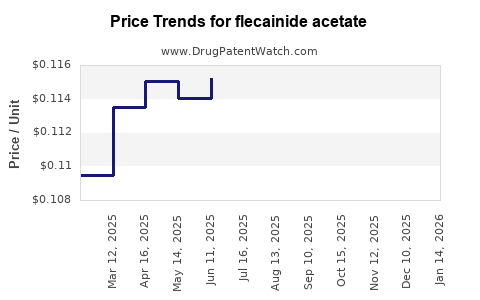
The commercial trajectory is therefore best characterized as mature and volume-stable, with declining unit prices and periodic supply-driven revenue fluctuations. Growth is more likely to come from population aging, increased diagnosis of atrial arrhythmias, and continued use of rhythm-control strategies than from premium pricing.
When did flecainide acetate lose exclusivity?
Flecainide’s original branded exclusivity expired decades ago. The originator product, Tambocor, was approved in the United States in 1985 under NDA 019251.[3] Any original compound, formulation, or use protections associated with that launch are no longer commercially relevant to generic market access.
The product is now in the post-exclusivity phase:
| Milestone |
Approximate timing |
Commercial impact |
| U.S. Tambocor approval |
1985 |
Established branded product |
| Generic tablet development |
1990s-2000s |
Created multisource competition |
| Broad generic availability |
2000s onward |
Reduced price and brand share |
| Current market phase |
2020s |
Mature generic supply market |
The remaining commercial value is based on prescription persistence, supplier reliability, manufacturing economics, and regulatory compliance rather than exclusivity.
What patents protect flecainide acetate?
Flecainide acetate does not have a meaningful active composition-of-matter patent barrier in the United States. The original active-ingredient protection expired long ago. Generic products are marketed under abbreviated new drug applications rather than through a new chemical entity pathway.
Potential patent categories historically associated with flecainide could include:
- The active compound or salt
- Pharmaceutical compositions
- Tablet formulations
- Methods of treating arrhythmias
- Manufacturing processes
- Dosage regimens
Those categories do not create a material current barrier to ordinary generic tablet competition. Any residual process or formulation patents would need to be evaluated claim by claim and jurisdiction by jurisdiction, but they do not appear to define the current U.S. market structure.
What is the Orange Book status of flecainide acetate?
The FDA Orange Book identifies approved flecainide acetate drug products and their therapeutic-equivalence status. The commercial market is dominated by generic products rather than an actively protected branded reference product.[4]
The key Orange Book implications are:
- No commercially significant active ingredient patent is expected to block generic entry.
- Generic tablets can compete through ANDA approval and therapeutic equivalence.
- Formulation differentiation is limited because the principal market consists of immediate-release oral tablets.
- Product-level Orange Book listings should be distinguished from patents that may exist in other jurisdictions or in unrelated manufacturing contexts.
Are there Paragraph IV challenges involving flecainide acetate?
Flecainide acetate is an old generic product, so Paragraph IV litigation is not a central market issue. Paragraph IV certifications are typically most relevant when a generic applicant challenges an unexpired listed patent. Flecainide’s original exclusivity period and commercially material patent protection have expired.
No widely recognized active U.S. Paragraph IV campaign currently defines the flecainide acetate market. Generic entry has already occurred across multiple manufacturers, eliminating the strategic value of a new patent challenge against the original product.
For investors and suppliers, the more relevant legal risks are:
- FDA manufacturing or quality enforcement
- Product liability claims tied to arrhythmia outcomes
- Label-compliance disputes
- Supply contracts and pricing disputes
- State procurement and reimbursement litigation
What formulations are protected by flecainide acetate patents?
The principal commercial formulation is the immediate-release oral tablet. Flecainide acetate does not have a high-value long-acting injectable, transdermal, implantable, or biologic delivery platform that would support formulation-based exclusivity.
Available dosage strengths generally include:
| Dosage form |
Typical strength |
| Immediate-release tablet |
50 mg |
| Immediate-release tablet |
100 mg |
| Immediate-release tablet |
150 mg |
The lack of a differentiated delivery system limits opportunities for branded lifecycle management. An oral solution may be relevant for compounding or specialized use, but it has not displaced the generic tablet as the core commercial product.
How strong is the patent estate for flecainide acetate?
The patent estate is weak from a commercial defense perspective.
| Patent estate attribute |
Assessment |
| Active ingredient patent |
Expired |
| Original branded exclusivity |
Expired |
| Core tablet formulation protection |
No material current barrier identified |
| Method-of-use exclusivity |
Expired or commercially nonblocking |
| Manufacturing patent value |
Potentially narrow and supplier-specific |
| Generic entry risk |
High, but already realized |
| Litigation leverage |
Low |
| Lifecycle-management potential |
Limited |
Flecainide has no meaningful patent moat comparable to newer antiarrhythmic or cardiovascular products. A supplier could protect a specific manufacturing process or improve impurity control, but those protections would generally be narrower than a composition-of-matter patent and easier for competitors to design around.
What is the FDA regulatory status of flecainide acetate?
Flecainide acetate is an FDA-approved prescription drug. The approved product is subject to labeling requirements covering dosing, contraindications, cardiac monitoring, drug interactions, and proarrhythmic risk.[1]
Regulatory considerations include:
- Use for selected patients with supraventricular arrhythmias
- Use for certain life-threatening ventricular arrhythmias
- Avoidance or careful assessment in structural heart disease
- Electrocardiographic monitoring during dose initiation and adjustment
- Dose modification in renal or hepatic impairment
- Interaction management with other antiarrhythmic and cardiac drugs
The regulatory environment is established rather than developmental. No major clinical or regulatory event is required to sustain the existing market.
Which companies compete in flecainide acetate?
Competition is primarily generic and fragmented. Manufacturers and distributors have changed over time because generic firms enter, exit, transfer applications, or discontinue low-margin products.
The competitive field typically includes:
- Large generic manufacturers
- Specialized U.S. oral-solid-dose suppliers
- Contract manufacturers
- National wholesalers
- Retail and mail-order pharmacy channels
- Hospital purchasing organizations
Brand recognition has little impact on prescribing. Physicians generally select among therapeutically equivalent products based on availability, payer coverage, pharmacy inventory, and patient continuity.
The most important competitive variables are:
- Manufacturing cost
- FDA compliance record
- Reliable supply of all major tablet strengths
- Wholesale acquisition and contract pricing
- Ability to maintain adequate inventory
- Absence of recalls or quality defects
What manufacturing and intellectual-property barriers affect flecainide acetate?
Flecainide acetate is an oral solid with no biologic manufacturing burden. Its production does not require cell culture, aseptic fill-finish, cold-chain distribution, or complex device assembly.
Manufacturing barriers remain operational rather than technological:
- Active pharmaceutical ingredient sourcing
- Control of impurities and degradation products
- Content uniformity across tablet strengths
- Stability testing
- Packaging and moisture protection
- FDA inspection readiness
- Validation of scale-up and site transfers
The API supply chain is more important than patent protection. A disruption at an API producer, contract manufacturer, or packaging site can produce temporary shortages even when several approved suppliers exist.
What generic entry risks exist for flecainide acetate?
Generic entry risk is already realized and remains structurally high. New entrants would face low scientific barriers but difficult economics.
Generic launch scenario
A new manufacturer could seek approval through an ANDA demonstrating bioequivalence to the reference product. The likely commercial outcome would be:
- Rapid price competition
- Limited prescriber switching
- Dependence on wholesaler and pharmacy contracts
- Low per-unit margins
- Greater viability during a supply disruption
- Minimal opportunity for premium positioning
A new entrant could achieve a stronger position by offering reliable supply across all strengths, maintaining high service levels, or securing institutional contracts. A novel clinical strategy would not normally be required.
Does flecainide acetate face biosimilar competition?
No. Biosimilar competition is not relevant because flecainide acetate is a synthetic small-molecule drug. Competition occurs through conventional generic-drug pathways, primarily ANDAs in the United States.
The relevant substitutes are other antiarrhythmic therapies, not biosimilars. These include propafenone, sotalol, amiodarone, dronedarone, and catheter ablation, depending on the patient’s disease profile and risk factors. Clinical substitution is constrained because these therapies have different safety profiles, monitoring requirements, and treatment positions.
How does flecainide compare with competing antiarrhythmic drugs?
| Product |
Primary competitive position |
Commercial distinction |
| Flecainide |
Rhythm control in selected patients without significant structural heart disease |
Low-cost generic |
| Propafenone |
Similar Class IC rhythm-control use |
Generic substitute with different pharmacology |
| Sotalol |
Rhythm control with beta-blocking and QT-prolongation effects |
Monitoring burden |
| Amiodarone |
Broad rhythm-control efficacy |
Generic but toxicity limits chronic use |
| Dronedarone |
Branded or authorized generic positioning in some markets |
Higher cost and narrower clinical use |
| Catheter ablation |
Procedural alternative |
Higher upfront cost, non-drug intervention |
Flecainide’s commercial advantage is low cost and established physician familiarity. Its disadvantage is a narrow safety envelope. It is not a universal substitute for rate-control drugs or for antiarrhythmics used in patients with substantial structural heart disease.
What is the financial trajectory for flecainide acetate?
The financial trajectory is mature, low-growth, and price-sensitive.
Revenue drivers
- Persistent chronic prescriptions
- Aging populations
- Diagnosis of atrial fibrillation and supraventricular tachycardia
- Continued use of rhythm-control treatment
- Temporary supply shortages
- Institutional purchasing contracts
Revenue constraints
- Expired exclusivity
- Multiple generic suppliers
- Low unit prices
- Limited brand loyalty
- Safety restrictions
- Substitution by propafenone, sotalol, amiodarone, or ablation
- Low potential for premium reformulation
For manufacturers, flecainide is more likely to contribute incremental portfolio revenue than material standalone growth. Profitability depends on manufacturing scale, procurement discipline, and supply reliability. Revenue can rise temporarily when competitors discontinue products or experience shortages, but such gains are difficult to sustain.
What litigation and settlement agreements affect flecainide acetate?
No major active patent litigation or settlement agreement is widely associated with the current flecainide acetate market. The product’s litigation profile is less important than its regulatory and product-liability exposure.
Historical and ongoing legal attention is more likely to concern:
- Arrhythmia-related adverse events
- Inappropriate use in high-risk cardiac patients
- Labeling adequacy
- Failure to monitor ECG or renal function
- Manufacturing defects
- Recalls and distribution interruptions
Because generic entry is established, there is little commercial rationale for an originator-style patent settlement restricting entry.
What is the geographic coverage of flecainide acetate?
Flecainide acetate is marketed in multiple jurisdictions, but regulatory status and commercial availability vary by country. The United States has a mature generic market. European markets also rely heavily on generic oral products, while prescribing is shaped by national reimbursement systems and local clinical guidelines.
Geographic commercial risks include:
- Different national patent histories
- Separate marketing authorizations
- Local bioequivalence requirements
- Government price controls
- National tendering
- API import dependence
- Country-specific pharmacovigilance requirements
The strongest commercial opportunity is not geographic exclusivity. It is reliable supply into markets where a small number of suppliers serve a stable chronic-treatment population.
Key Takeaways
- Flecainide acetate is a mature generic antiarrhythmic with no meaningful current U.S. patent moat.
- The original Tambocor exclusivity period expired decades ago.
- Generic competition, rather than patent litigation, determines market economics.
- Immediate-release tablets remain the core formulation.
- Biosimilar risk does not apply.
- Revenue is recurring but low-growth, with limited pricing power.
- Supply reliability, API access, FDA compliance, and contract execution are more important than intellectual property.
- Product-level revenue is generally not disclosed by generic manufacturers.
- The main commercial upside comes from supply disruptions, portfolio scale, and dependable distribution.
- Clinical safety restrictions limit expansion into broader arrhythmia populations.
Frequently Asked Questions
Is flecainide acetate still under patent?
No commercially material composition-of-matter patent is expected to remain active for flecainide acetate in the United States. The drug is widely available as a generic.
Is flecainide acetate an FDA-approved generic?
Yes. Generic manufacturers market flecainide acetate tablets through FDA-approved ANDAs referencing the approved product.
Can a company obtain exclusivity for a new flecainide formulation?
Potentially, but a new formulation would need to establish clinical, pharmacokinetic, or adherence value and obtain separate patent and FDA protection. The commercial opportunity is limited because standard tablets are inexpensive and established.
What is the main substitute for flecainide acetate?
Propafenone is the closest pharmacologic substitute because it is also a Class IC antiarrhythmic. Sotalol, amiodarone, dronedarone, and catheter ablation may be alternatives depending on patient characteristics.
Is flecainide acetate a high-revenue pharmaceutical product?
No. It is commercially important as a recurring generic product but is unlikely to generate high standalone revenue for any supplier. Its financial value depends on volume, low-cost manufacturing, and supply continuity.
References
- U.S. Food and Drug Administration. (2023). Flecainide acetate prescribing information. FDA/DailyMed.
- Echt, D. S., Liebson, P. R., Mitchell, L. B., Peters, R. W., Obias-Manno, D., Barker, A. H., Arensberg, D., Baker, A., Friedman, L., Greene, H. L., Huther, M. L., Richardson, D. W., & The CAST Investigators. (1991). Mortality and morbidity in patients receiving encainide, flecainide, or placebo. The New England Journal of Medicine, 324(12), 781-788.
- U.S. Food and Drug Administration. (1985). NDA 019251: Tambocor (flecainide acetate). Drugs@FDA.
- U.S. Food and Drug Administration. (2024). Approved drug products with therapeutic equivalence evaluations: Orange Book. FDA.