Last updated: August 6, 2026
Etodolac is a mature, multi-source NSAID with limited branded economics and low strategic value for large pharmaceutical companies. Its commercial trajectory followed the standard small-molecule lifecycle: prescription launch, formulation expansion, loss of exclusivity, generic substitution, and long-term price compression. Current value is concentrated in manufacturing efficiency, dependable supply, hospital and retail contracts, and selective international distribution rather than innovation or patent protection.
The product remains clinically relevant for osteoarthritis, rheumatoid arthritis, and acute pain, but it competes against lower-cost ibuprofen and naproxen and against differentiated prescription NSAIDs such as meloxicam, celecoxib, and diclofenac. There is no biosimilar exposure because etodolac is a synthetic small molecule. The U.S. market has no meaningful branded franchise comparable to a patented specialty drug.
What is etodolac and how is it used?
Etodolac is an orally administered nonsteroidal anti-inflammatory drug used to reduce pain and inflammation. U.S. labeling covers osteoarthritis, rheumatoid arthritis, and acute pain. Available dosage forms include immediate-release tablets and capsules, along with extended-release tablets in certain markets and product lines.[1]
| Attribute |
Etodolac profile |
| Active ingredient |
Etodolac |
| Drug class |
NSAID |
| Primary indications |
Osteoarthritis, rheumatoid arthritis, acute pain |
| U.S. regulatory status |
Prescription drug |
| Dosage forms |
Immediate-release tablets and capsules; extended-release tablets |
| Molecular type |
Synthetic small molecule |
| Biosimilar exposure |
None |
| Original U.S. brand |
Lodine |
| Current market structure |
Generic, multi-source |
| Main competitors |
Ibuprofen, naproxen, diclofenac, meloxicam, celecoxib |
Etodolac is sometimes described as relatively COX-2-preferential compared with older nonselective NSAIDs. That pharmacologic positioning has not created durable pricing power because the product remains exposed to class-wide gastrointestinal, renal, cardiovascular, and bleeding risks and competes with both generic nonselective NSAIDs and newer prescription agents.[2]
When did etodolac lose exclusivity?
Etodolac lost its commercially important exclusivity after generic competition entered the U.S. market in the late 1990s. The original Lodine franchise was approved by the FDA in 1991 under NDA 19-763. The branded product was commercialized by Wyeth-Ayerst Laboratories, later part of Wyeth and Pfizer.[1]
| Milestone |
Approximate timing |
Commercial effect |
| U.S. approval of Lodine |
1991 |
Launch of branded etodolac |
| Immediate-release generic entry |
Late 1990s |
Rapid erosion of branded pricing |
| Extended-release development |
Late 1990s to early 2000s |
Limited lifecycle management |
| Mature generic phase |
2000s onward |
Multi-source competition and low prices |
| Current position |
2020s |
Low-cost generic NSAID |
The original composition-of-matter and related product protection no longer determine the commercial market. Current competitive barriers are manufacturing economics, FDA compliance, customer contracts, supply reliability, and the ability to maintain approval across multiple strengths and dosage forms.
A precise current patent-expiration analysis for the original Lodine estate is commercially immaterial because the relevant protection expired before the present generic market structure developed. The product has been exposed to generic competition for more than two decades.
What patents protect etodolac today?
No active U.S. Orange Book patent listing is central to the current etodolac market. FDA Orange Book records for marketed etodolac products are primarily relevant to product identification, approval status, dosage form, and therapeutic-equivalence evaluation rather than a live branded patent barrier.[3]
What formulation patents cover etodolac?
Etodolac has been marketed in immediate-release and extended-release forms. Extended-release products historically provided the clearest lifecycle-management opportunity because they could support separate development, labeling, and approval work. That opportunity has limited current financial significance because extended-release etodolac is also exposed to generic competition and lacks the commercial scale of major modified-release products.
Potential formulation claims can cover:
- Extended-release matrices
- Tablet composition
- Release-rate control
- Specific excipient combinations
- Manufacturing processes
- Dosage strengths and administration schedules
Formulation patents do not automatically create a durable market monopoly. Their value depends on claim breadth, validity, enforceability, regulatory listing, and whether alternative release technologies can avoid infringement.
What method-of-use patents protect etodolac?
Etodolac’s core indications are established chronic and acute pain uses. Method-of-use claims tied to osteoarthritis, rheumatoid arthritis, or acute pain have limited practical value because these indications are long established and generic labels generally include the relevant therapeutic uses. Any later method-of-use patent would need to support a commercially meaningful, legally enforceable indication that could be carved out from generic labeling.
The current product economics do not indicate that method-of-use rights are driving price or market share.
What is the FDA regulatory status of etodolac?
Etodolac is an FDA-approved prescription NSAID. FDA-approved generic versions are listed through the agency’s Approved Drug Products with Therapeutic Equivalence Evaluations, commonly known as the Orange Book.[3]
Immediate-release etodolac products have generally been evaluated as therapeutically equivalent when approved with the relevant reference product. Extended-release products require separate consideration because release characteristics, dosage-form design, and reference-product designations can differ from immediate-release products.
| Regulatory issue |
Etodolac status |
| New drug approval |
Established |
| Generic approvals |
Multiple approved products over time |
| Prescription status |
Yes in the U.S. |
| OTC status in the U.S. |
No general OTC etodolac switch |
| Orange Book relevance |
Product approvals, therapeutic equivalence, patent listings |
| REMS requirement |
No major product-specific REMS franchise |
| Biosimilar pathway |
Not applicable |
The absence of an OTC switch limits consumer-brand expansion. Etodolac therefore remains dependent on prescription channels, pharmacy benefit design, physician prescribing, and generic purchasing contracts.
How many companies compete in the etodolac market?
The U.S. market is supplied by multiple generic manufacturers and contract manufacturers. The exact active supplier count varies by dosage strength, product form, approval status, and commercial availability. Generic firms historically associated with etodolac products include large and mid-sized manufacturers such as Teva, Sandoz, Dr. Reddy’s, Zydus, Lupin, Amneal, and other FDA-approved suppliers, depending on the relevant product and period.
A manufacturer may hold FDA approval without actively selling the product. This distinction matters because nominal approval count overstates effective competition. Buyers typically assess:
- Active product availability by strength.
- Approved manufacturing sites.
- Supply continuity.
- FDA inspection history.
- Contract pricing.
- Back-up supplier capacity.
- Ability to support recalls and regulatory changes.
Etodolac has low differentiation at the molecule level. Suppliers that remain competitive usually do so through low conversion cost, efficient active pharmaceutical ingredient sourcing, reliable batch release, and broad portfolio contracting.
What is the financial trajectory for etodolac?
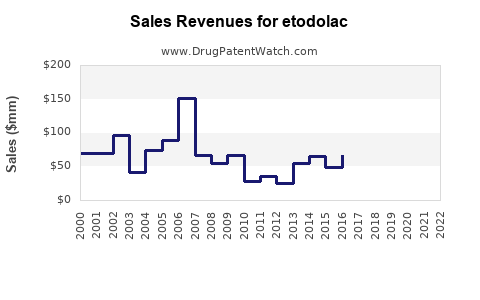
Etodolac’s financial trajectory is best described as a transition from branded revenue to mature generic cash flow.
| Phase |
Revenue pattern |
Margin pattern |
Primary value driver |
| Branded launch |
Growing prescription revenue |
High branded gross margin |
Physician adoption and indication expansion |
| Pre-generic period |
Peak branded sales |
Strong pricing |
Brand recognition and limited competition |
| Generic entry |
Sharp branded decline |
Generic prices fall rapidly |
First-wave generic volume |
| Mature generic phase |
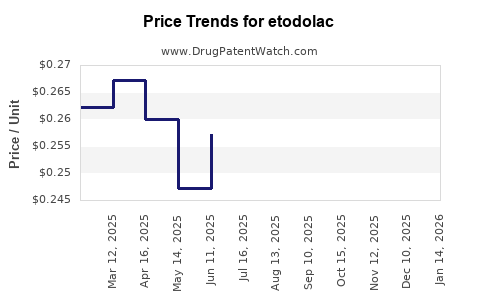
Low unit prices, stable demand |
Thin and variable margins |
Manufacturing cost and supply reliability |
| Current market |
Small molecule maintenance revenue |
Contract-dependent |
Portfolio efficiency and availability |
Public companies generally do not report etodolac revenue as a separate line item. It is usually included within broader generic pharmaceutical revenue. As a result, there is no reliable public company-level revenue series for the molecule comparable to products with dedicated disclosures.
The financial profile has several characteristics:
- Branded revenue is effectively exhausted in the U.S.
- Generic revenue is fragmented across suppliers.
- Unit demand is relatively stable because pain and arthritis treatment remain recurring needs.
- Price competition limits revenue growth even when prescription volume is steady.
- Short-term shortages or supplier exits can temporarily improve pricing, but these effects are not durable without a structural reduction in supply.
- International revenue can remain relevant where local reimbursement, physician practice, and brand recognition differ from the U.S. market.
For a generic manufacturer, etodolac is more likely to be a portfolio-completion product than a major growth asset. Its value may increase when a company can bundle it with other pain and inflammation products, use the same manufacturing network, or secure institutional tenders.
What generic entry risks exist for etodolac?
Generic entry risk is no longer an event facing the market. It is the market’s operating condition. The principal risk is continued price erosion rather than a future patent cliff.
Generic launch scenarios
| Scenario |
Likely effect |
| New supplier enters an established IR market |
Lower prices and reduced incumbent share |
| Supplier exits because of low margins |
Temporary supply tightening |
| FDA or manufacturing disruption |
Short-term availability risk and possible price movement |
| New ER competitor enters |
Increased substitution and contract pressure |
| Hospital or payer formulary change |
Volume shifts among approved suppliers |
| International tender loss |
Sharp regional revenue decline |
Generic substitution is strongest in immediate-release products because prescribers and pharmacists have extensive experience with established NSAIDs. Extended-release products may have somewhat greater switching friction, but this does not establish durable pricing power.
Which drugs compete most directly with etodolac?
Etodolac competes in a crowded therapeutic class. The most relevant comparison is not another patented product but the combination of clinical positioning, cost, dosing convenience, and safety perception.
| Drug |
Market position relative to etodolac |
| Ibuprofen |
Very low-cost, broad consumer and prescription use |
| Naproxen |
Broad use and perceived duration advantage |
| Diclofenac |
Strong international presence; generic pricing |
| Meloxicam |
Prescription chronic-arthritis competitor with once-daily dosing |
| Celecoxib |
COX-2-selective option with differentiated labeling and pricing |
| Etodolac |
Generic prescription option with established arthritis use |
Etodolac’s competitive advantages are familiarity, established approval history, and availability in multiple dosage forms. Its disadvantages are limited brand equity, weak differentiation, and broad exposure to generic NSAID substitution.
What patent litigation and Paragraph IV challenges affect etodolac?
There is no current high-value patent litigation strategy associated with the core etodolac market comparable to active disputes involving patented oncology, immunology, or specialty drugs. Paragraph IV litigation was more relevant during the original generic-entry period, when abbreviated new drug applicants could challenge patents listed against Lodine or related formulations.
A Paragraph IV certification asserts that a listed patent is invalid, unenforceable, or not infringed. For an old generic product such as etodolac, the commercial impact of any historical challenge has already been reflected in the multi-source market. Current commercial risk is instead concentrated in:
- Product-specific approval disputes.
- Manufacturing compliance.
- Supply interruptions.
- ANDA litigation involving a particular formulation.
- Antitrust or contracting issues in generic procurement.
The absence of a current branded patent barrier means settlement agreements are unlikely to control broad U.S. market entry. Any historical patent settlement would have limited continuing relevance unless it contained unusual manufacturing, supply, or licensing provisions.
What licensing deals affect etodolac?
Etodolac has no widely disclosed current licensing transaction that materially shapes its global market. The original branded rights were associated with the Lodine franchise and corporate ownership changes involving Wyeth and Pfizer. Current generic supply is generally based on manufacturer-owned or contract-manufactured approvals rather than a high-value originator license.
Licensing value is therefore limited to:
- Regional distribution rights.
- Contract manufacturing.
- API supply agreements.
- Transfer of approved dossiers.
- Portfolio acquisitions involving multiple generic products.
A standalone etodolac license would likely command limited economics unless it included a scarce manufacturing source, an important regional market, or a differentiated extended-release product.
How strong is the etodolac patent estate?
The current patent estate is weak as a commercial moat. Its strengths are historical rather than actionable.
| Patent-estate factor |
Assessment |
| Core molecule protection |
Expired |
| Branded product exclusivity |
Expired |
| Generic availability |
Established |
| Formulation differentiation |
Limited |
| Method-of-use leverage |
Limited |
| Orange Book barrier |
Not material to current market |
| Biosimilar protection |
Not applicable |
| Manufacturing know-how |
Potentially relevant |
| Commercial defensibility |
Low |
The strongest remaining intellectual-property position for an etodolac supplier would generally involve process efficiency, formulation know-how, regulatory data, or a specialized delivery system. Those assets may improve margins but do not recreate a molecule-level monopoly.
What is the geographic coverage of etodolac?
Etodolac is sold as a generic prescription medicine in multiple international markets, although product availability, brand names, strengths, and regulatory status vary by country. The U.S. market is mature and highly price-sensitive. European and other international markets may offer greater brand or distributor influence, but reimbursement controls and tender procurement can produce the same margin pressure.
Geographic value depends on local factors:
- Whether etodolac is prescription-only.
- Generic substitution rules.
- National reimbursement.
- Local manufacturing requirements.
- Tender concentration.
- Physician familiarity.
- Availability of competing NSAIDs.
No single geographic market is likely to generate originator-level returns without a differentiated formulation or protected distribution position.
What is the commercial outlook for etodolac?
Etodolac should be viewed as a stable but low-growth generic asset. Demand is supported by chronic musculoskeletal disease and acute pain treatment. Revenue is constrained by intense substitution, limited clinical differentiation, and low unit pricing.
The most credible outlook is:
- Stable or modestly declining prescription volume.
- Continued price pressure in multi-source markets.
- Periodic supply-driven price volatility.
- Low probability of a meaningful branded resurgence.
- Limited licensing or acquisition premium.
- Greater value in operational execution than patent ownership.
For investors and generic manufacturers, etodolac is unlikely to alter the valuation of a diversified pharmaceutical company. For smaller suppliers, it can contribute incremental revenue when produced at low cost and sold through established distribution channels.
Key Takeaways
- Etodolac is a mature generic NSAID whose U.S. branded franchise has ended.
- Lodine was approved in 1991, and generic competition has existed since the late 1990s.
- Current Orange Book patent protection is not a meaningful market barrier.
- No biosimilar risk exists because etodolac is a synthetic small molecule.
- Immediate-release etodolac faces intense competition from ibuprofen, naproxen, diclofenac, and meloxicam.
- Extended-release formulations provide limited differentiation but no durable broad-market moat.
- Public companies do not generally disclose etodolac revenue separately.
- Financial value depends on manufacturing cost, supply reliability, tenders, and portfolio bundling.
- The main risks are price erosion, supplier exits, manufacturing disruptions, and formulary substitution.
- Etodolac is a maintenance generic asset, not a high-growth pharmaceutical franchise.
FAQs
Is etodolac still profitable for generic manufacturers?
It can be profitable when produced efficiently, but margins are typically thin and contract-dependent. Profitability depends on supplier count, active demand, API cost, manufacturing utilization, and customer concentration.
Is etodolac available over the counter?
In the United States, etodolac is generally prescription-only. This limits consumer-brand expansion compared with ibuprofen and naproxen.
Does etodolac have a 180-day generic exclusivity period today?
No current first-to-file exclusivity period drives the mature market. Any historical generic exclusivity would have expired long ago.
Can a company obtain new patents on an etodolac formulation?
A new formulation could be patentable if it satisfies novelty, non-obviousness, and other statutory requirements. Patentability would not guarantee meaningful market exclusivity because alternative formulations and generic substitution could remain available.
Is etodolac a potential acquisition target?
A standalone etodolac acquisition is unlikely to attract a high valuation. It may have strategic value inside a broader generic portfolio, particularly where the buyer has manufacturing synergies, regional distribution, or a differentiated extended-release product.
References
-
U.S. Food and Drug Administration. (1991). Lodine (etodolac) prescribing information, NDA 19-763. FDA Drugs@FDA database.
-
U.S. Food and Drug Administration. (2023). Etodolac prescribing information. FDA labeling database.
-
U.S. Food and Drug Administration. (2024). Approved drug products with therapeutic equivalence evaluations. Center for Drug Evaluation and Research.
-
U.S. Food and Drug Administration. (2024). Drugs@FDA: FDA-approved drugs database. Center for Drug Evaluation and Research.