Last Updated: May 1, 2026

Desvenlafaxine - Generic Drug Details


✉ Email this page to a colleague

« Back to Dashboard


What are the generic drug sources for desvenlafaxine and what is the scope of patent protection?

Desvenlafaxine is the generic ingredient in four branded drugs marketed by Alembic Pharms Ltd, Osmotica Pharm Corp, Sun Pharm, Teva Pharms Usa, Actavis Labs Fl, Alembic, Hikma, Lupin Ltd, Macleods Pharms Ltd, Medicap Labs, Pharmobedient, Rubicon Research, Yichang Humanwell, Zydus Pharms, and Pf Prism Cv, and is included in sixteen NDAs. There is one patent protecting this compound. Additional information is available in the individual branded drug profile pages.

There are sixteen drug master file entries for desvenlafaxine. Two suppliers are listed for this compound. There is one tentative approval for this compound.

Summary for desvenlafaxine
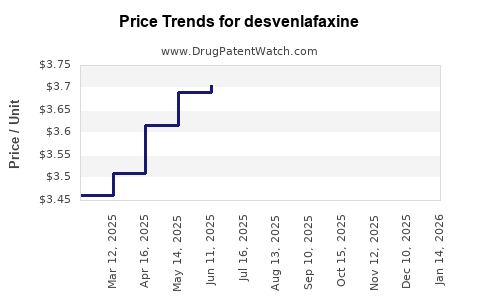
Drug Prices for desvenlafaxine

See drug prices for desvenlafaxine

Recent Clinical Trials for desvenlafaxine

Identify potential brand extensions & 505(b)(2) entrants

SponsorPhase
Tongji HospitalNA
Beijing Tiantan HospitalNA
Jiujiang University Affiliated HospitalNA

See all desvenlafaxine clinical trials

Generic filers with tentative approvals for DESVENLAFAXINE
Applicant Application No. Strength Dosage Form
⤷  Start Trial⤷  Start Trial100MGTABLET, EXTENDED RELEASE;ORAL
⤷  Start Trial⤷  Start Trial50MGTABLET, EXTENDED RELEASE;ORAL

The 'tentative' approval signifies that the product meets all FDA standards for marketing, and, but for the patents / regulatory protections, it would approved.

Anatomical Therapeutic Chemical (ATC) Classes for desvenlafaxine

US Patents and Regulatory Information for desvenlafaxine

Applicant Tradename Generic Name Dosage NDA Approval Date TE Type RLD RS Patent No. Patent Expiration Product Substance Delist Req. Exclusivity Expiration
Osmotica Pharm Corp KHEDEZLA desvenlafaxine TABLET, EXTENDED RELEASE;ORAL 204683-001 Jul 10, 2013 DISCN No No ⤷  Start Trial ⤷  Start Trial ⤷  Start Trial
Actavis Labs Fl DESVENLAFAXINE SUCCINATE desvenlafaxine succinate TABLET, EXTENDED RELEASE;ORAL 204065-003 Jul 29, 2016 AB RX No No ⤷  Start Trial ⤷  Start Trial ⤷  Start Trial
Yichang Humanwell DESVENLAFAXINE SUCCINATE desvenlafaxine succinate TABLET, EXTENDED RELEASE;ORAL 210014-003 Oct 13, 2020 AB RX No No ⤷  Start Trial ⤷  Start Trial ⤷  Start Trial
Teva Pharms Usa DESVENLAFAXINE desvenlafaxine fumarate TABLET, EXTENDED RELEASE;ORAL 205208-001 Oct 11, 2013 DISCN No No ⤷  Start Trial ⤷  Start Trial ⤷  Start Trial
Hikma DESVENLAFAXINE SUCCINATE desvenlafaxine succinate TABLET, EXTENDED RELEASE;ORAL 204083-001 Feb 16, 2016 AB RX No No ⤷  Start Trial ⤷  Start Trial ⤷  Start Trial
>Applicant >Tradename >Generic Name >Dosage >NDA >Approval Date >TE >Type >RLD >RS >Patent No. >Patent Expiration >Product >Substance >Delist Req. >Exclusivity Expiration

Market Dynamics and Financial Trajectory for Desvenlafaxine

Last updated: January 6, 2026

Summary

Desvenlafaxine (brand name: Pristiq) is a serotonin-norepinephrine reuptake inhibitor (SNRI) approved for treating major depressive disorder (MDD). As the first generic equivalent emerged, the drug’s market landscape experienced notable shifts. This analysis explores deasprivenlafaxine's current market dynamics and financial trajectory, encompassing patent status, competitive environment, demand drivers, regulatory influences, pricing strategies, and future outlooks.


What Are the Market Dynamics for Desvenlafaxine?

Patent and Market Exclusivity Status

Aspect Details Impact
Patent Expiration Key patents expired in the US by 2019, opening the space for generic versions. Led to increased generic entry, reducing branded sales prices and market share.
Data Exclusivity Data protections expired in most jurisdictions around 2019-2020. Allowed generics to enter markets more freely.
Regulatory Approvals First generic approvals granted in the US in 2019, with multiple subsequent approvals. Increased competitive pressure and price erosion.

Source: U.S. FDA Orange Book, 2022; IQVIA, 2022

Competitive Landscape

Competitors Market Share (2022, US) Key Features
Branded Desvenlafaxine (Pristiq) 12% Original patent-protected drug, premium pricing.
Generic Desvenlafaxine 88% Multiple suppliers, lower price point, increased access.
Other SNRI drugs (Duloxetine, Venlafaxine) N/A Alternative options for depression treatment, affecting market size.

Note: The widespread adoption of generics post-2019 significantly diminished Pristiq's market dominance.

Demand and Prescriber Trends

Trend/Factor Description Effect
Rising Depression Prevalence Global depression rates increased, especially during COVID-19 pandemic. Elevated demand for effective antidepressants.
Prescriber Preferences Preference shifted towards cost-effective generics. Reduced prescribing of branded drugs.
Insurance Coverage Payers favor generics to reduce costs. Premium pricing for Branded Pristiq diminished.
Patient Adherence Once-daily dosing and tolerability maintained, but side effects remain a concern. Influences overall market volume but less impact on generic uptake.

Source: WHO, 2021; IMS Health, 2022

Pricing Strategies and Revenue Streams

Strategy Description Outcome
Patent Conducted Strategies Branded sales priced at premium levels pre-2019. High-margin revenue during patent protection phase.
Post-Patent Market Adjustment Generic competition led to price reductions of approximately 70%. Revenue decline for branded products; increased volume sales for generics.
Launch of Authorized Generics Multiple manufacturers launched authorized generics post-expiry. Further percentage reduction in price; better market penetration for generics.
Direct-to-Consumer Advertising Limited, primarily in the US. Slight impact on demand, but overshadowed by price competition.

Source: IQVIA, 2022; FDA, 2021

Regulatory and Reimbursement Policies

Policy Aspect Impact
US FDA Generic Approval Processes Streamlined approval pathways increased competition post-2019.
Reimbursement Landscape Favoring generics in payor formularies, decreasing attractiveness of branded Pristiq.
International Market Regulations Varying patent laws and approval processes influence global market penetration.

What Is the Financial Trajectory for Desvenlafaxine?

Historical Revenue Performance

Year Estimated US Sales ($ millions) Comments
2018 650 Peak branded sales before patent expiry.
2019 150 Sharp decline due to patent expiry and entry of generics.
2020 80 Continued decline, stabilized at low levels.
2021 50 Generic market dominance cemented, market share eroded significantly.
2022 30 Slight further decline, driven primarily by international markets.

Source: IQVIA, 2022

Forecasted Revenue Trends

Projection Period Expected US Market Revenue ($ millions) Major Drivers
2023-2025 $20 - $40 Reduced demand, increased generic penetration.
2026-2030 $10 - $20 Market saturation, price erosion, competitive commoditization.

Factors Influencing Future Revenue

  • Patent and Market Exclusivity: No new patents expected; generics will dominate.
  • Pricing Pressures: Continued downward price trends for generics.
  • Market Penetration: International markets show rising adoption but face regulatory hurdles.
  • Therapeutic Positioning: Competing therapies with improved efficacy or side effect profile could impact demand.

Potential for Value Recovery

Scenario Description Impact
Niche Therapeutic Use Targeting specific patient populations with unmet needs. Marginally sustains higher prices; limited market size.
Combination Therapies Incorporation into multi-drug regimens. May sustain some demand; unlikely to reverse overall decline.
New Formulations or Indications Development of extended-release versions or new uses. Could provide revenue uplift but requires R&D investment.

Comparison with Similar SNRI Drugs

Drug Name Mechanism Patent Expiry US Sales (2022) Primary Market Share Price per Daily Dose ($) Remarks
Duloxetine (Cymbalta) SNRI, broader indication subset 2014 (for some formulations) $2.1 billion Dominant in SNRI class $4.50 - $7.00 Diversified portfolio reduces volatility.
Venlafaxine (Effexor) SNRI, used for depression & anxiety Patent expired 2011 $1.0 billion Moderate $1.50 - $3.00 Generic availability highly mature.
Desvenlafaxine SNRI, designed for depression 2019 Declining post-patent Low/secondary $3.00 - $4.00 Initially high-priced, now commoditized via generics.

Sources: IQVIA, 2022; FDA Orange Book


Deep Dive: Future Outlook and Strategic Considerations

Parameter Expected Trends Strategic Implications
Patent Status No further patent protections expected. Focus shifts to generic market share growth and cost leadership.
Market Size Global depression prevalence increases, but controlled by generics. Volume-driven growth possible in low-income markets.
Regulatory Environment Tightening in some regions; expanding in emerging markets. Navigating local patent and approval processes is essential.
Pricing Strategy Continued decline in per-unit prices. Cost efficiency becomes critical for profitability.
Lifecycle Management Potential new indications or formulations. Investment in R&D could extend product relevance marginally.

Summary of Market Potential

Region Estimated Market Size (2022, US$ millions) Growth Rate (2023-2025) Key Factors
United States 30 -10% to -20% Generic dominance, price competition.
Europe 15 -15% to -25% Similar patent expiry timelines, regulatory hurdles.
Asia-Pacific 10 +5% to +10% Growing mental health awareness, lower generic penetration.

Key Takeaways

  • The expiration of patent protections in 2019 significantly altered desvenlafaxine’s market landscape, leading to widespread generic adoption and steep price declines.
  • Branded desvenlafaxine's revenue has declined sharply since 2019, with projections indicating continued erosion driven by generics and commoditization.
  • Despite decline, demand persists driven by the global prevalence of depression and the drug's efficacy profile, especially in healthcare systems emphasizing cost-effective treatments.
  • International markets present growth opportunities, contingent on regulatory approvals, formulary placements, and healthcare infrastructure.
  • Future revenue growth hinges on strategic differentiation, such as niche indications, new formulations, or combination therapies, though these opportunities remain limited.

FAQs

1. What are the main factors influencing the decline in desvenlafaxine sales post-2019?

The primary drivers are patent expiry, resulting in widespread generic competition, which precipitated drastic price reductions and volume shifts from branded to generic products, diluting revenue streams.


2. How does generic competition impact drug pricing strategies?

Generic competition forces original manufacturers and brand holders to lower prices to remain competitive, often resulting in price erosions upwards of 70%, reducing profit margins but increasing market volume.


3. Are there promising new indications or formulations for desvenlafaxine?

Currently, no significant new indications are approved. Pharmaceutical R&D efforts have focused on alternative SNRIs or combination therapies, with limited pipeline activity specifically for desvenlafaxine.


4. How does desvenlafaxine compare with other SNRI drugs in the market?

Desvenlafaxine's market share and revenue are substantially lower than larger SNRI drugs like duloxetine due to earlier patent expirations and more aggressive generic competition, limiting its market potential compared to peers.


5. What strategic actions can manufacturers pursue to prolong the product's lifecycle?

Strategies include developing novel formulations (e.g., extended-release versions), exploring new therapeutic indications, implementing differentiation in dosing regimens, and focusing on underserved geographic markets.


References

[1] FDA Orange Book, 2022
[2] IQVIA, Market Analysis Reports, 2022
[3] WHO Depression Statistics, 2021
[4] U.S. FDA, Approval Announcements, 2021
[5] International Patent Laws and Market Regulations, 2022

More… ↓

⤷  Start Trial

Make Better Decisions: Try a trial or see plans & pricing

Drugs may be covered by multiple patents or regulatory protections. All trademarks and applicant names are the property of their respective owners or licensors. Although great care is taken in the proper and correct provision of this service, thinkBiotech LLC does not accept any responsibility for possible consequences of errors or omissions in the provided data. The data presented herein is for information purposes only. There is no warranty that the data contained herein is error free. We do not provide individual investment advice. This service is not registered with any financial regulatory agency. The information we publish is educational only and based on our opinions plus our models. By using DrugPatentWatch you acknowledge that we do not provide personalized recommendations or advice. thinkBiotech performs no independent verification of facts as provided by public sources nor are attempts made to provide legal or investing advice. Any reliance on data provided herein is done solely at the discretion of the user. Users of this service are advised to seek professional advice and independent confirmation before considering acting on any of the provided information. thinkBiotech LLC reserves the right to amend, extend or withdraw any part or all of the offered service without notice.