Last updated: June 15, 2026
Desvenlafaxine Market Dynamics and Financial Trajectory (US and Key Ex-US Markets)
Desvenlafaxine (active ingredient: desvenlafaxine succinate) faces a mature, price-compressed market driven by (1) generics and authorized generics in the US, (2) a patent estate that is largely past peak exclusivity, and (3) ongoing class competition from duloxetine, venlafaxine, and other antidepressants. The financial trajectory is characterized by steady volume growth offset by declining net price per unit, with growth largely tied to formulary positioning and conversion to lower-cost entrants. Revenue exposure is concentrated in the US and a limited set of ex-US markets where local exclusivity or slower generic penetration delayed price erosion.
How does desvenlafaxine perform in the US antidepressant market?
Desvenlafaxine is positioned as a serotonin-norepinephrine reuptake inhibitor (SNRI) for major depressive disorder (MDD). The US market is shaped by:
- Generic conversion after originator exclusivity.
- Formulary management (tiering to lower-cost generics and preferred SNRIs).
- Switching behavior from branded therapy to generic equivalents with preserved tolerability profiles.
What is the commercial end-market for desvenlafaxine?
- Core indication: MDD
- Typical payer mix: commercial formularies, Medicare Part D, Medicaid managed care
- Real-world use overlaps with duloxetine and venlafaxine XR due to prescriber comfort with the SNRI class.
What are the primary drivers of US net revenue?
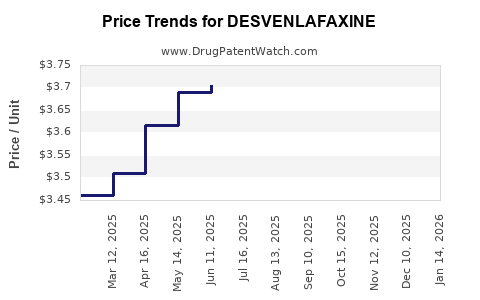
- Net price decline as competitors increase share with lower-priced products.
- Script volume stability as patients remain on the same molecule.
- Manufacturer rebate pressure and contracting dynamics post-generic entry.
- Dose mix (ER formulations and strength availability influence NBRx and ASP trends, even when unit volume grows).
When did generic entry materially change desvenlafaxine revenues?
The financial trajectory is tied to generic availability events. Once multiple generic manufacturers enter, the market typically shifts into a cycle of:
- Rapid share loss for the brand.
- Continued ASP compression as channel inventory and payer contracts rationalize.
- Ongoing “winner-take-most” dynamics among the lowest-cost suppliers.
What do the post-exclusivity economics typically look like?
- Brand revenue decline accelerates during initial conversion.
- Generic revenue becomes fragmented across NDCs but often concentrates in top contracted SKUs.
- Net sales growth becomes harder because price erosion continues even if prescriptions remain stable.
What patents and exclusivity timelines affect desvenlafaxine pricing power?
Desvenlafaxine’s value proposition historically depended on patent coverage for the molecule and its pharmaceutical presentation, not on clinical differentiation against other SNRIs. As exclusivity expired, competitive entry drove the pricing curve down.
How does patent expiration translate into market dynamics?
- Near-term: originator holds share through branded differentiation.
- Mid-term: generic entry reduces net price; rebates and contracting drive margin compression.
- Long-term: residual higher-priced products survive only where payer preferences and contracting keep them competitive.
What is the exclusivity posture for desvenlafaxine in the US?
Regulatory exclusivity and Orange Book listings govern the timing of generic entry. For branded desvenlafaxine, the originator’s exclusivity window has largely ended, enabling multiple generic products to compete.
What is the Orange Book status of desvenlafaxine?
The Orange Book controls ANDA referencing. Desvenlafaxine has a mature regulatory footprint with:
- Multiple ANDA products on the market.
- Orange Book entries that reflect the remaining patent landscape at different times, which in practice has shifted the market to generic predominance.
Business implication: in a mature generic market, incremental revenue comes more from contracting and dispensing/channel economics than from IP exclusivity.
Which companies sell desvenlafaxine, and how does competitive structure impact price?
In the US, desvenlafaxine is sold by:
- Branded originator legacy (historically the main source of higher pricing)
- Generic manufacturers including multi-source ANDA entrants and authorized generics
How does multi-source competition change ASP and gross-to-net?
- Multi-source competition compresses WAC-to-NBRx spreads.
- Contracting and rebates drive gross-to-net volatility, even for generics, because GPO and PBM contracting determines effective net selling prices.
- The market becomes sensitive to supply continuity and NDC-level pricing.
How does desvenlafaxine compare with duloxetine and venlafaxine in revenue trajectory?
SNRI class competition creates a substitution effect. In practice:
- Duloxetine often maintains strong formulary share due to entrenched SNRI positioning.
- Venlafaxine XR competes on cost and payer preference.
- Desvenlafaxine competes on tolerability perceptions and dosing convenience, but pricing pressure increases as generic supply expands.
What is the market outcome when class substitutes exist?
- When desvenlafaxine loses pricing advantage due to generic entrants, payers rationalize across SNRIs.
- Brands of the same class struggle to maintain premium unless they have meaningful formulary differentiation (rare in a single-molecule generics era).
What is the biosimilar and biologics risk profile for desvenlafaxine?
Desvenlafaxine is a small-molecule SNRI, not a biologic. There is no biosimilar pathway risk. The competitive threat is generic and authorized generic rather than biosimilar substitution.
What formulation and method-of-use patent categories matter commercially?
For mature antidepressant molecules, the highest commercial impact typically comes from:
- API and salt form patents (or their expiration status).
- Extended-release formulation coverage (if any remains).
- Method-of-use patents, which can constrain some generics if they cover specific dosing regimens or patient subsets.
In practice, once multiple ANDA products exist, most remaining value shifts from IP to channel contracting.
What generic entry risks exist for desvenlafaxine (Paragraph IV and design-around)?
Paragraph IV and design-around risk is relevant only while branded protection persists. For a mature molecule with ongoing multi-source supply:
- The market is no longer dominated by single-event litigation outcomes.
- Remaining litigation, if any, is more likely to affect incremental NDC launches than the overall market direction.
Business implication: the financial trajectory is driven more by continued generic penetration and pricing than by episodic Paragraph IV outcomes.
What FDA regulatory milestones influence desvenlafaxine commercialization?
Key milestones for small-molecule antidepressants include:
- ANDA approvals referencing the RLD
- Labeling harmonization
- Bioequivalence and product-specific changes
How do these milestones affect financial trajectory?
- New ANDA approvals typically increase competitive intensity.
- Labeling updates can shift prescribing comfort marginally but rarely reverse a price-compression cycle.
How does ex-US market exclusivity and generic timing change revenue exposure?
Ex-US revenue depends on:
- Local patent coverage strength and enforcement
- Local generic readiness and regulatory approvals
- Tender systems and national reimbursement rules
What patterns usually emerge internationally?
- Countries with faster generic launch see sharper price declines.
- Countries with tighter patent enforcement show slower erosion.
- Even when patents remain, payer systems often accelerate conversion once multiple low-cost suppliers appear.
What is the financial trajectory pattern after generic penetration?
A mature generic molecule typically follows:
- Initial conversion: fast brand revenue drop and share transfer
- Price compression phase: net sales stabilize only if volume grows
- Channel rationalization: ASP and gross-to-net settle into lower steady-state levels
- Ongoing micro-competition: NDC-level pricing and availability drive minor swings
What metrics best describe trajectory for investors and competitors?
- NBRx and scripts by dose strength
- ASP, WAC-to-NBRx ratio, and gross-to-net (if available)
- PBM formulary placement and tiering across major plans
- Dispensing share by top NDCs
Revenue exposure map: where is desvenlafaxine most exposed?
US
- Highest exposure because of mature generic penetration and high payer sophistication.
- Revenue becomes concentrated in contracted NDCs and supply stability.
Key ex-US
- Exposure varies by regulatory and patent enforcement speed.
- Markets with delayed generic availability show longer brand or higher-price survival.
Key Takeaways
- Desvenlafaxine’s financial trajectory reflects a post-exclusivity generic market: revenue is pressured by continued ASP decline and payer-driven contracting.
- US economics are dominated by multi-source generic competition, with growth dependent mainly on script stability and formulary positioning rather than premium pricing.
- Patent and exclusivity effects are now mostly historical; incremental revenue opportunities come from channel execution (supply, contracting, NDC-level economics) rather than new exclusivity events.
- Biosimilar risk is not applicable; the competitive threat remains generic substitution and class-level competition from duloxetine and venlafaxine.
FAQs
- What is the typical impact of generic entry on desvenlafaxine net pricing in US commercial plans?
- How does desvenlafaxine’s dosing strength mix influence NBRx and revenue when prices compress?
- Which SNRI class competitors most commonly substitute for desvenlafaxine at the payer level?
- Do method-of-use or formulation patents materially affect ongoing desvenlafaxine generic launches?
- How does supply continuity among contracted desvenlafaxine generics affect effective market share?
References (APA)
- U.S. Food and Drug Administration. Orange Book: Approved Drug Products with Therapeutic Equivalence Evaluations. FDA. https://www.accessdata.fda.gov/scripts/cder/daf/index.cfm
- U.S. Food and Drug Administration. Drug Trials Snapshots. FDA. https://www.fda.gov/drugs/drug-trials-snapshots