Aprepitant - Generic Drug Details
✉ Email this page to a colleague
What are the generic sources for aprepitant and what is the scope of patent protection?
Aprepitant
is the generic ingredient in four branded drugs marketed by Glenmark Speclt, Sandoz, Torrent, MSD, Heron Theraps Inc, Azurity, Mylan, and Msd Merck Co, and is included in nine NDAs. There are fifteen patents protecting this compound and four Paragraph IV challenges. Additional information is available in the individual branded drug profile pages.Seven suppliers are listed for this compound. There are two tentative approvals for this compound.
Summary for aprepitant
| International Patents: | 57 |
| US Patents: | 15 |
| Tradenames: | 4 |
| Applicants: | 8 |
| NDAs: | 9 |
| Finished Product Suppliers / Packagers: | 7 |
| Raw Ingredient (Bulk) Api Vendors: | 87 |
| Clinical Trials: | 186 |
| Patent Applications: | 4,261 |
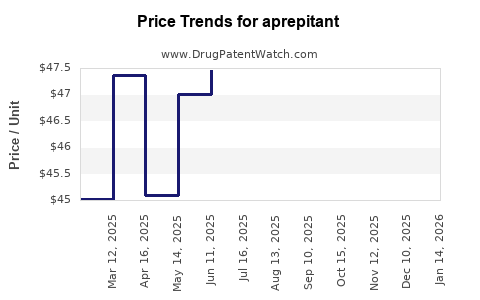
| Drug Prices: | Drug price trends for aprepitant |
| Patent Litigation and PTAB cases: | See patent lawsuits and PTAB cases for aprepitant |
| What excipients (inactive ingredients) are in aprepitant? | aprepitant excipients list |
| DailyMed Link: | aprepitant at DailyMed |
Recent Clinical Trials for aprepitant
Identify potential brand extensions & 505(b)(2) entrants
| Sponsor | Phase |
|---|---|
| Montefiore Medical Center | PHASE4 |
| Centre hospitalier de l'Universit de Montral (CHUM) | PHASE3 |
| Rabin Medical Center | PHASE1 |
Generic filers with tentative approvals for APREPITANT
| Applicant | Application No. | Strength | Dosage Form |
| ⤷ Start Trial | ⤷ Start Trial | 130MG/18ML | INJECTION, EMULSION |
| ⤷ Start Trial | ⤷ Start Trial | 130MG/18ML (7.2MG/ML) | INJECTABLE;INTRAVENOUS |
The 'tentative' approval signifies that the product meets all FDA standards for marketing, and, but for the patents / regulatory protections, it would approved.
Pharmacology for aprepitant
| Drug Class | Substance P/Neurokinin-1 Receptor Antagonist |
| Mechanism of Action | Cytochrome P450 2C9 Inducers Cytochrome P450 3A4 Inducers Cytochrome P450 3A4 Inhibitors Neurokinin 1 Antagonists |
Anatomical Therapeutic Chemical (ATC) Classes for aprepitant
Paragraph IV (Patent) Challenges for APREPITANT
| Tradename | Dosage | Ingredient | Strength | NDA | ANDAs Submitted | Submissiondate |
|---|---|---|---|---|---|---|
| APONVIE | Intravenous Emulsion | aprepitant | 32 mg/4.4 mL | 216457 | 1 | 2023-11-07 |
| CINVANTI | Intravenous Emulsion | aprepitant | 130 mg/18 mL | 209296 | 1 | 2022-04-29 |
| EMEND | for Oral Suspension | aprepitant | 125 mg/Kit | 207865 | 1 | 2016-11-23 |
| EMEND | Capsule | aprepitant | 40 mg, 80 mg and 125 mg | 021549 | 1 | 2008-11-03 |
US Patents and Regulatory Information for aprepitant
| Applicant | Tradename | Generic Name | Dosage | NDA | Approval Date | TE | Type | RLD | RS | Patent No. | Patent Expiration | Product | Substance | Delist Req. | Exclusivity Expiration |
|---|---|---|---|---|---|---|---|---|---|---|---|---|---|---|---|
| Heron Theraps Inc | CINVANTI | aprepitant | EMULSION;INTRAVENOUS | 209296-001 | Nov 9, 2017 | RX | Yes | Yes | 10,624,850 | ⤷ Start Trial | ⤷ Start Trial | ||||
| Msd | EMEND | aprepitant | CAPSULE;ORAL | 021549-003 | Jun 30, 2006 | DISCN | Yes | No | 8,258,132 | ⤷ Start Trial | Y | ⤷ Start Trial | |||
| Mylan | APREPITANT | aprepitant | EMULSION;INTRAVENOUS | 218851-001 | Mar 5, 2026 | DISCN | No | No | ⤷ Start Trial | ⤷ Start Trial | ⤷ Start Trial | ||||
| Heron Theraps Inc | CINVANTI | aprepitant | EMULSION;INTRAVENOUS | 209296-001 | Nov 9, 2017 | RX | Yes | Yes | 10,500,208 | ⤷ Start Trial | Y | ⤷ Start Trial | |||
| Heron Theraps Inc | CINVANTI | aprepitant | EMULSION;INTRAVENOUS | 209296-001 | Nov 9, 2017 | RX | Yes | Yes | 10,953,018 | ⤷ Start Trial | ⤷ Start Trial | ||||
| >Applicant | >Tradename | >Generic Name | >Dosage | >NDA | >Approval Date | >TE | >Type | >RLD | >RS | >Patent No. | >Patent Expiration | >Product | >Substance | >Delist Req. | >Exclusivity Expiration |
Expired US Patents for aprepitant
| Applicant | Tradename | Generic Name | Dosage | NDA | Approval Date | Patent No. | Patent Expiration |
|---|---|---|---|---|---|---|---|
| Msd Merck Co | EMEND | aprepitant | FOR SUSPENSION;ORAL | 207865-001 | Dec 17, 2015 | 6,096,742 | ⤷ Start Trial |
| Msd | EMEND | aprepitant | CAPSULE;ORAL | 021549-002 | Mar 26, 2003 | 6,048,859 | ⤷ Start Trial |
| Msd | EMEND | aprepitant | CAPSULE;ORAL | 021549-001 | Mar 26, 2003 | 7,214,692 | ⤷ Start Trial |
| Msd | EMEND | aprepitant | CAPSULE;ORAL | 021549-003 | Jun 30, 2006 | 5,145,684 | ⤷ Start Trial |
| Msd | EMEND | aprepitant | CAPSULE;ORAL | 021549-002 | Mar 26, 2003 | 5,145,684 | ⤷ Start Trial |
| >Applicant | >Tradename | >Generic Name | >Dosage | >NDA | >Approval Date | >Patent No. | >Patent Expiration |
EU/EMA Drug Approvals for aprepitant
| Company | Drugname | Inn | Product Number / Indication | Status | Generic | Biosimilar | Orphan | Marketing Authorisation | Marketing Refusal |
|---|---|---|---|---|---|---|---|---|---|
| Merck Sharp & Dohme B.V. | Emend | aprepitant | EMEA/H/C/000527Emend 40 mg hard capsules is indicated for the prevention of postoperative nausea and vomiting (PONV) in adults.Emend is also available as 80 mg and 125 mg hard capsules for the prevention of nausea and vomiting associated with highly and moderately emetogenic cancer chemotherapy in adults and adolescents from the age of 12 (see separate Summary of Product Characteristics).Emend is also available as 165 mg hard capsules for the prevention of acute and delayed nausea and vomiting associated with highly emetogenic cisplatin based cancer chemotherapy in adults and the prevention of nausea and vomiting associated with moderately emetogenic cancer chemotherapy in adults.Emend is also available as powder for oral suspension for the prevention of nausea and vomiting associated with highly and moderately emetogenic cancer chemotherapy in children, toddlers and infants from the age of 6 months to less than 12 years.Emend 80 mg, 125 mg, 165 mg hard capsules and Emend powder for oral suspension are given as part of combination therapy. | Authorised | no | no | no | 2003-11-11 | |
| >Company | >Drugname | >Inn | >Product Number / Indication | >Status | >Generic | >Biosimilar | >Orphan | >Marketing Authorisation | >Marketing Refusal |
International Patents for aprepitant
| Country | Patent Number | Title | Estimated Expiration |
|---|---|---|---|
| China | 106852118 | 阿瑞吡坦乳剂制剂 (Emulson formulations of aprepitant) | ⤷ Start Trial |
| European Patent Office | 3193830 | FORMULATIONS D'ÉMULSON D'APRÉPITANT (EMULSON FORMULATIONS OF APREPITANT) | ⤷ Start Trial |
| Japan | 2017533183 | アプレピタントのエマルジョン製剤 | ⤷ Start Trial |
| Japan | 2019196398 | アプレピタントのエマルジョン製剤 (EMULSION FORMULATIONS OF APREPITANT) | ⤷ Start Trial |
| Japan | 2022092040 | アプレピタントのエマルジョン製剤 | ⤷ Start Trial |
| >Country | >Patent Number | >Title | >Estimated Expiration |
Supplementary Protection Certificates for aprepitant
| Patent Number | Supplementary Protection Certificate | SPC Country | SPC Expiration | SPC Description |
|---|---|---|---|---|
| 0734381 | SPC/GB04/011 | United Kingdom | ⤷ Start Trial | PRODUCT NAME: APREPITANT, OPTIONALLY IN THE FORM OF A PHARMACEUTICALLY ACCEPTABLE SALT; REGISTERED: UK EU/1/03/262/001 20031113; UK EU/1/03/262/002 20031113; UK EU/1/03/262/003 20031113; UK EU/1/03/262/004 20031113; UK EU/1/03/262/005 20031113; UK EU/1/03/262/006 20031113 |
| 0734381 | 3/2004 | Austria | ⤷ Start Trial | PRODUCT NAME: APREPITANT, GEGEBENENFALLS IN FORM EINES PHARMAZEUTISCH ANNEMBAREN SALZES; REGISTRATION NO/DATE: EU/1/03/262/001 - EU/1/03/262/006 20031111 |
| 0734381 | PA2004002,C0734381 | Lithuania | ⤷ Start Trial | PRODUCT NAME: 5-(((2R,3S)-2-((1R)-1-(3,5-BIS(TRIFLUORMETIL)FENIL)ETOKSI)-3-(4-FLUORFENIL)-4-MORFOLINIL)METIL)-1,2-DIHIDRO-3H-1,2,4-TRIAZOL-3-ONAS (APREPITANTAS); REGISTRATION NO/DATE: EU/1/03/262/001, 2003 11 11, EU/1/03/262/002, 2003 11 11, EU/1/03/262/003, 2003 11 11, EU/1/03/262/004, 2003 11 11, EU/1/03/262/005, 2003 11 11, EU/1/03/262/006 20031111 |
| 0748320 | SPC/GB08/021 | United Kingdom | ⤷ Start Trial | PRODUCT NAME: FOSAPREPITANT AND PHARMACEUTICALLY ACCEPTABLE SALTS THEREOF, IN PARTICULAR THE BIS(N-METHYL-D-GLUCAMINE)SALT; REGISTERED: UK EU/1/07/437/001 20080111; UK EU/1/07/437/002 20080111 |
| 0748320 | 08C0019 | France | ⤷ Start Trial | PRODUCT NAME: FOSAPREPITANT DIMEGLUMINE; REGISTRATION NO/DATE: EU/1/07/437/001 20080111 |
| >Patent Number | >Supplementary Protection Certificate | >SPC Country | >SPC Expiration | >SPC Description |
More… ↓
Make Better Decisions: Try a trial or see plans & pricing
Drugs may be covered by multiple patents or regulatory protections. All trademarks and applicant names are the property of their respective owners or licensors. Although great care is taken in the proper and correct provision of this service, thinkBiotech LLC does not accept any responsibility for possible consequences of errors or omissions in the provided data. The data presented herein is for information purposes only. There is no warranty that the data contained herein is error free. We do not provide individual investment advice. This service is not registered with any financial regulatory agency. The information we publish is educational only and based on our opinions plus our models. By using DrugPatentWatch you acknowledge that we do not provide personalized recommendations or advice. thinkBiotech performs no independent verification of facts as provided by public sources nor are attempts made to provide legal or investing advice. Any reliance on data provided herein is done solely at the discretion of the user. Users of this service are advised to seek professional advice and independent confirmation before considering acting on any of the provided information. thinkBiotech LLC reserves the right to amend, extend or withdraw any part or all of the offered service without notice.
ISSN: 2162-2639

Privacy and Cookies
Terms & Conditions
Site Map
DrugPatentWatch Alternatives
LOE / Major Patent Expirations 2026 - 2027
NCE-1 Patent Challenge Dates 2026 - 2027
Friedman, Yali. "DrugPatentWatch" DrugPatentWatch, thinkBiotech, 2026, www.DrugPatentWatch.com.
See Primary Research Papers Citing DrugPatentWatch