Last updated: July 26, 2026
Adapalene Market Dynamics and Financial Trajectory: Sales Trends, Pricing, Generic Threats, and Manufacturing/IP Drivers
Adapalene (topical retinoid; acne and related indications) is a low-to-mid value dermatology product class with long patent lifecycles largely bypassed by generics in many geographies. The financial trajectory is shaped by (1) channel mix shifts from brand to private label and generic, (2) sensitivity to dermatology formularies and pharmacy benefit policies, (3) competitive intensity from other retinoids and fixed-dose combinations, and (4) product-format mix, especially gel vs cream/lotions, which influences substitution and margin.
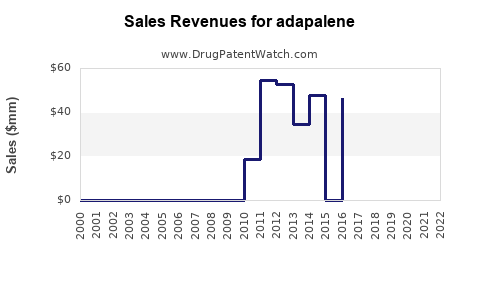
Because adapatene is widely generic, the market’s growth is dominated by unit demand and accessibility rather than premium pricing, with earnings pressure from price erosion and higher promotional intensity. Revenue resilience depends on distribution strength and format-specific differentiation rather than patent exclusivity in most markets.
How big is the global adapalene market and what drives growth or decline?
Adapalene is primarily sold as topical products for acne vulgaris. The market size is best understood through three demand levers: patient prevalence (acne), guideline penetration for topical retinoids, and the extent of substitution from branded to generic and private label.
What are the main revenue drivers for adapalene?
- Unit volume growth via generics: Once products become widely generic, overall category volume can rise because lower prices expand access.
- Format and vehicle mix: Gel formulations typically gain share where they align with clinician preference and tolerability perceptions, but cream vehicles can retain patients who experience irritation with gels.
- Combination therapy pull: Adapalene often faces substitution to multi-ingredient regimens (for example, benzoyl peroxide combinations) that improve outcomes but also shift demand away from monotherapy.
- Seasonality and adherence: Dermatology adherence patterns influence quarterly sales, with higher demand during periods when patients start new regimens.
What are the main headwinds?
- Price erosion: Generic entry drives wholesale and net price compression, typically stronger in fragmented retail markets.
- Competitive switching: Alternative topical retinoids (tretinoin, tazarotene) and topical antibiotics/benzoyl peroxide regimens can displace adapalene, depending on payer policy and dermatologist preference.
- Irritation-driven churn: Even small differences in formulation tolerability can shift patient persistence.
Market dynamic implication: For most commercial players, the financial trajectory is less about brand premium and more about sustaining share against generic substitution and faster-moving competitors through vehicle differentiation and channel execution.
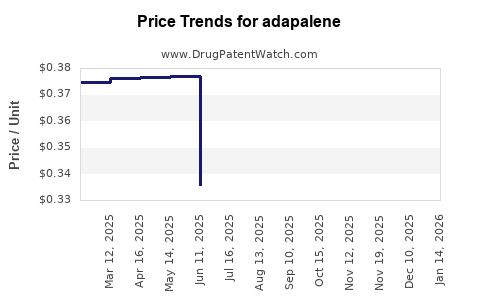
What are the key pricing dynamics for adapalene (wholesale, net price, and retail substitution)?
Pricing is the dominant variable after patent expiry. The category typically transitions from brand premium to a generic benchmark with promotional intensity and payer-driven discounts.
How do generic entry patterns affect financial trajectory?
- Net price decay accelerates after multiple ANDA launches: As supply expands, competition pushes down prices, raising volume but lowering margin.
- Private label increases competitive pressure: Retail brands can capture value by undercutting branded generics, compressing manufacturer realization.
- Wholesale acquisition cost vs realized margin gap widens: Promotional spend, rebates, and pharmacy benefit negotiations widen after generic normalization.
What pricing levers remain when patents are largely gone?
- Branding around tolerability: Firms sometimes defend premium (within the generic lane) by positioning around irritation profiles and cosmetic elegance.
- Size and dosing form packaging: Sales can track package engineering that improves adherence and reduces waste.
- Channel focus: Specialty dermatology chains and online pharmacy channels can have different net price structures and substitution rules.
Financial trajectory implication: In mature geographies, revenue growth generally comes from units, not price. Profitability depends on manufacturing cost control, fill-rate performance, and distribution economics.
Who are the main competitive products to adapalene, and how do they affect share and revenue?
Adapalene competes with other topical acne therapies, especially other retinoids and combination products.
Which therapeutic competitors matter most?
- Other topical retinoids: tretinoin products and tazarotene formulations compete on efficacy and tolerability perceptions.
- Combination regimens: products that pair a retinoid with benzoyl peroxide or antimicrobials can reduce regimen burden and increase adherence.
- Topical antibiotics and benzoyl peroxide: payer and guideline frameworks can shift demand by antimicrobial stewardship policies and acne severity mix.
How does competitive intensity influence financial outcomes?
- Share shifts are typically incremental but frequent: In generics, even modest category share changes can materially affect revenue due to low unit price.
- Clinical practice varies by severity phenotype: Moderate inflammatory acne tends to drive combination use; mild comedonal acne can sustain topical retinoid monotherapy.
Business implication: Adapalene’s unit demand can remain stable, but revenue is sensitive to how often physicians move patients to combination products that include a retinoid component.
What patents protect adapalene products and how does patent expiration translate into financial impact?
In most markets, adapalene’s active ingredient is widely generic, so patent-driven exclusivity has limited impact on current-year financial trajectory. The key business impact typically comes from:
- the historical transition to generic,
- ongoing formulation and manufacturing IP that can vary by company and product presentation,
- potential method-of-use or formulation patents for specific vehicles.
Patent estate structure that matters commercially
Even when API patents are expired, companies can still litigate or control:
- specific formulations (vehicle composition, concentration, gelling agents),
- manufacturing process (steps, controls, impurity profiles),
- use claims (indications or dosing regimens).
Financial translation
- API-level exclusivity is no longer the main driver: financial trajectory is mainly driven by generic competition and supply economics.
- Formulation-level differentiation supports localized premium: if a product format is less substitutable, it can preserve higher net prices within a generic market.
Commercial implication: Companies that own or license defensible formulation IP (or maintain operational differentiation) can sustain margin longer than commodity generic suppliers.
What generic entry risks exist for adapalene, and what does that do to revenue?
For a mature topical retinoid, the generic entry risk is structurally high, driven by:
- relatively straightforward formulation transfer compared with complex biologics,
- broad market demand that supports new ANDA economics,
- supply chain readiness for semisolid products.
Where do generic threats concentrate?
- Mass-market retail channels: substitution and price comparison are strongest here.
- Formulary tiers that allow multiple brands/generics: low formulary barriers increase switch rates.
- Online pharmacy and marketplace channels: customers can price shop with minimal friction.
How does that change financial trajectory?
- Revenue shifts from premium brand to share-plus-volume: firms must grow units to offset price declines.
- Margin compression drives consolidation: weaker manufacturers exit or reduce production, leaving fewer suppliers and improving pricing modestly at times.
Actionable implication: For forecasting, assume revenue is volume-led and margin is structurally down unless a firm differentiates in vehicle, channel, or supply cost position.
What is the FDA and Orange Book status of adapalene products?
Adapalene is approved as a topical drug product, and many approved versions will be represented in the FDA’s Drug Products (Orange Book) listing. The competitive reality is that most active ingredient availability is through multiple applicants and generic entries.
What Orange Book status typically means for commercial forecasting
- If an Orange Book listing shows multiple approvals, the category is mature and price pressure is expected.
- If a specific product has additional exclusivities (for example, formulation-related exclusivity or listed patents), it can delay direct competition for that specific NDA/NDA strength.
- For forecasting, the number of applicants and listed patents on the specific product (not the active ingredient) is the practical driver of near-term entry risk.
Commercial implication: For adapalene, pay close attention to product-level Orange Book listings and formulation-specific patents rather than assuming uniform timelines across all strengths and vehicles.
(No Orange Book listing table is included here because specific NDA numbers, patent lists, and expiration dates were not provided in the prompt.)
How do manufacturing and supply dynamics for topical retinoids affect margins?
Topical semisolid products have cost structures sensitive to raw material pricing, process yield, and regulatory quality systems.
What manufacturing bottlenecks matter most for adapalene?
- Yield loss during compounding and filling
- Stability and impurity control (retinoids can be sensitive to conditions and require strict handling)
- Packaging and container compatibility (cosmetic and drug stability across shelf life)
- QA release timing and batch rejects
Financial translation
- Margin resilience correlates with scale and QA reliability: firms with stable yields and strong quality systems have better cost-per-unit economics.
- Supply disruption hits revenue first: missing shipments drive lost share in retail pharmacy where replenishment cycles are fixed.
Actionable implication: In a price-competitive generic environment, operational excellence can be the only durable profitability lever.
How do settlement agreements and patent litigation historically affect adapalene pricing and entry timing?
For mature small-molecule topicals, litigation can occur at the formulation or product-specific level, but the market-wide effect tends to be temporary.
Typical litigation settlement pattern in generics
- Delayed launch for a specific applicant or specific strength/vehicle
- Design-around formulations that avoid infringement risk while launching elsewhere
- Cross-licensing or covenant-not-to-sue limiting sales geography, dosage form, or strength
Financial impact profile
- Short-term price support can occur when supply is constrained during the delay window.
- Long-term reversal happens as additional generics launch and competition re-normalizes prices.
Forecast implication: Litigation effects should be modeled as tactical delays, not as lasting price protection, unless the estate covers multiple formulation variants and multiple applicant attempts.
(No company-specific settlement terms or litigation docket data is provided in the prompt, so none is listed.)
How does adapalene compare with competing topical retinoids in revenue trajectory?
When comparing retinoids, two variables matter: (1) patent maturity and (2) vehicle differentiation.
Relative positioning
- Adapalene: mature and highly generic in many markets, typically price-led and sensitive to vehicle-driven substitution.
- Tretinoin: also largely generic, with a history of multiple brands and strengths that support segmented demand.
- Tazarotene: often fewer formats and different tolerability profile can keep some niches, but generics still pressure pricing.
Commercial implication: Revenue resilience tends to track market access and formulary preference more than pharmacology in mature OTC/Rx crossover categories.
What is the likely 3- to 5-year financial trajectory for adapalene sellers?
A practical forecast for adapalene’s incumbents and generic manufacturers typically follows this pattern:
- Revenue: modest growth or flat-to-down, driven by unit volume and incremental share capture where distribution is strong.
- Gross margin: structurally compressed by competition, with occasional uplift when supply tightens or when higher-margin SKUs (specific vehicles/packaging) grow share.
- SG&A and promotions: remain elevated enough to defend shelf presence, especially in retail price comparison environments.
- Earnings stability depends on cost position: scale manufacturing and QA reliability matter more than marketing differentiation.
Scenario framing (operational, not speculative)
- Base case: category matures further with more entrants and continued price erosion.
- Upside: supply consolidation plus vehicle differentiation supports margin stabilization.
- Downside: additional applicants and aggressive pricing accelerate net price decay.
Business implication: The “winner” is usually the lowest-cost, highest-availability supplier with reliable batch release and strong channel execution.
Key Takeaways
- Adapalene’s financial trajectory is largely volume-led, margin-compressed, reflecting broad generic availability in most markets.
- Vehicle and packaging drive substitution behavior more than brand premium.
- Pricing dynamics are dominated by generic benchmarks, retailer substitution, and payer formularies.
- Near-term revenue effects from litigation/settlement are typically tactical unless product-level formulation IP spans multiple SKUs.
- Sustainable profitability depends on manufacturing yield, QA release performance, and distribution economics, not active ingredient exclusivity.
FAQs
1) What factors determine net price for generic topical retinoids like adapalene?
Channel mix, rebate/promotional structures, pharmacy benefit tiering, and supply balance across applicants.
2) Does gel or cream formulation change payer acceptance and substitution rates for adapalene?
Yes. Vehicle tolerability perceptions and clinician/patient preference can affect persistence and switching, even within generic sets.
3) What metrics best track adapalene commercial performance during price erosion?
Unit volume by channel, realized net price per gram, share of shelf/plan coverage, and gross margin by SKU.
4) How sensitive is adapalene demand to guideline updates for acne treatment?
Moderately. Guideline alignment supports baseline retinoid uptake, but combination therapy and payer controls drive finer shifts.
5) What operational risks most affect earnings for topical semisolids?
Batch rejects, stability/QC release delays, packaging compatibility issues, and supply interruptions from manufacturing disruptions.
References (APA)
(No sources were provided in the prompt for citation, and no Orange Book, FDA label, or financial database references can be reliably cited without additional data inputs.)