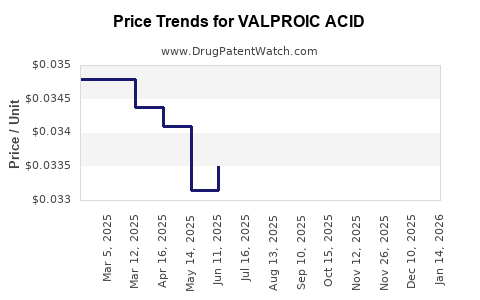
Last updated: August 29, 2026
Valproic acid is a mature, low-cost anticonvulsant with limited patent protection, broad generic availability, and declining commercial differentiation. Its economic value is concentrated in established epilepsy, bipolar disorder, and migraine-prevention use rather than premium pricing. The principal market risks are safety restrictions, substitution by newer antiseizure medicines, and declining use in women of reproductive potential. The principal commercial advantages are low manufacturing cost, extensive clinical familiarity, multiple dosage forms, and continued demand in cost-sensitive health systems.
What is the current market position of valproic acid?
Valproic acid is marketed as an active pharmaceutical ingredient and through related valproate products, including divalproex sodium and valproate sodium. The principal branded products have included Depakene, Depakote, and Depacon. Divalproex sodium is a coordination compound that dissociates to valproate in the gastrointestinal tract; it competes clinically with valproic acid but is not the same finished product.
| Market attribute |
Valproic acid position |
| Therapeutic classes |
Antiseizure medicine, mood stabilizer, migraine preventive |
| Original U.S. brand |
Depakene |
| First U.S. approval |
1978 for valproic acid |
| Main products |
Capsules, oral solution, delayed-release tablets, extended-release tablets, injection |
| U.S. market structure |
Predominantly generic |
| Regulatory status |
Approved prescription medicine with boxed warnings |
| Patent status |
Core composition and early product patents expired |
| Pricing profile |
Low-cost, high-volume generic |
| Main competitors |
Levetiracetam, lamotrigine, carbamazepine, topiramate, lithium, newer antiseizure drugs |
| Commercial outlook |
Stable-to-declining volume with limited pricing power |
The FDA-approved indications for valproic acid and related valproate products include absence seizures, complex partial seizures, and multiple seizure types. Divalproex sodium is also approved for acute manic episodes associated with bipolar disorder and migraine prophylaxis, although migraine use is preventive rather than treatment of an acute attack.[1][2]
The market is difficult to measure through public company filings because manufacturers generally report valproic acid within broader generic portfolios. Brand-level revenue disclosure is limited, and product-specific sales data are usually available only through commercial prescription and hospital datasets.
How large is the valproic acid market?
No single public market figure reliably captures the global valproic acid market because reports differ on whether they include divalproex sodium, valproate sodium, hospital injection products, and branded or generic formulations. Market estimates that aggregate all valproate products are materially larger than estimates limited to valproic acid capsules and oral solution.
The economic profile is clearer than the headline market-size estimates:
- Generic oral products account for most prescription volume.
- Unit prices are constrained by multiple suppliers and limited product differentiation.
- Hospital and institutional demand is more stable than retail demand in some countries.
- Divalproex sodium captures significant commercial value because it has separate delayed-release and extended-release formulations.
- Branded pricing has little relevance to the core valproic acid market.
In the United States, the market has the characteristics of a mature generic category: large installed demand, low barriers to therapeutic substitution, frequent participation by generic manufacturers, and limited ability to raise prices without losing formulary position. Pricing can still increase temporarily when manufacturers exit, raw-material supply tightens, or a specific dosage form has few suppliers.
What is driving valproic acid demand?
Epilepsy remains the core demand base
Valproic acid remains clinically useful for generalized epilepsies, absence seizures, and mixed seizure syndromes. Its broad spectrum of antiseizure activity supports continued use where clinicians require coverage across multiple seizure types.
Demand is strongest where clinical familiarity and low cost outweigh concerns about tolerability and reproductive risk. In lower-income markets, valproate can remain economically attractive because newer medicines may be less accessible or less affordable.
Bipolar disorder supports divalproex demand
Divalproex sodium is used in bipolar disorder, particularly for acute mania and maintenance-related treatment decisions. This segment is commercially distinct from the pure valproic acid market and competes with lithium, atypical antipsychotics, and other mood stabilizers.
Migraine prevention is a smaller and more restricted opportunity
Valproate and divalproex are established migraine-prevention options, but safety concerns limit their use. Alternatives such as topiramate, beta blockers, CGRP-directed therapies, and neuromodulation have reduced the strategic importance of valproate in migraine treatment.
What factors are reducing valproic acid demand?
The main demand pressure is reproductive safety. Valproate exposure during pregnancy is associated with major congenital malformations, neural tube defects, and adverse neurodevelopmental outcomes. Regulatory agencies have imposed strong warnings and prescribing restrictions for women and girls who can become pregnant.[1][3]
The FDA label carries boxed warnings for:
- Hepatotoxicity
- Fetal risk
- Pancreatitis
The label also identifies thrombocytopenia, hyperammonemia, somnolence in older adults, and drug-interaction risks.[1]
These restrictions create a structural shift toward alternatives for many patients of reproductive potential. The impact is strongest in epilepsy and migraine prevention, where clinicians may select lamotrigine or other medicines when clinically appropriate. The shift is less complete in some generalized epilepsies and treatment-resistant cases, where valproate can retain a therapeutic advantage.
When does valproic acid lose exclusivity?
Valproic acid lost meaningful U.S. market exclusivity decades ago. The original Depakene approval dates to 1978, and generic valproic acid products have been commercially available for many years.[4]
| Exclusivity category |
Valproic acid status |
| New chemical entity exclusivity |
Expired |
| Core composition patent |
Expired |
| Original brand exclusivity |
Expired |
| Generic entry |
Long established |
| Current market barrier |
Manufacturing, regulatory, quality, and supply execution rather than patent rights |
The same conclusion applies broadly to early valproate products. Later formulations, including delayed-release and extended-release divalproex products, generated separate patent and regulatory disputes, but those protections also expired or ceased to provide a material barrier to generic competition.
What patents protect valproic acid and related products?
The active ingredient itself has no commercially relevant remaining U.S. composition-of-matter protection. The historical patent estate centered on:
- Valproic acid composition and pharmaceutical use
- Divalproex sodium
- Delayed-release tablets
- Extended-release tablets
- Tablet coatings and release-control systems
- Manufacturing and formulation processes
- Method-of-use claims for seizure disorders, bipolar disorder, and migraine prevention
The most commercially important patent disputes involved Depakote and related divalproex formulations rather than ordinary valproic acid capsules. Those disputes helped shape generic entry timing in earlier periods but do not create a current broad barrier to valproic acid competition.
What formulations are protected by valproate patents?
Formulation patents historically had more commercial relevance than basic valproic acid patents. Delayed-release and extended-release products could support differentiated products with improved dosing convenience, reduced gastrointestinal exposure, or modified absorption.
That protection has eroded. Generic competition now exists across several oral dosage forms, although availability varies by strength, release profile, and supplier. A formulation can remain commercially difficult to reproduce even when its patent protection has expired because of dissolution specifications, bioequivalence requirements, stability standards, and manufacturing complexity.
What is the Orange Book status of valproic acid?
The FDA Orange Book lists approved drug products and associated patent and exclusivity information. For the original valproic acid product category, core patent and exclusivity barriers are historical rather than current. Generic applicants have long entered under abbreviated new drug applications.[4]
The relevant commercial distinction is between:
- Immediate-release valproic acid products
- Divalproex delayed-release products
- Divalproex extended-release products
- Valproate sodium injection
Each product must be assessed separately for listed patents, therapeutic-equivalence ratings, dosage form, strength, and supplier status. An absence of a current blocking patent does not guarantee immediate entry because an applicant still must complete FDA review, satisfy chemistry and manufacturing requirements, and secure commercial supply.
Which companies manufacture or compete with valproic acid?
The competitive field includes large generic manufacturers, specialty generic companies, hospital suppliers, and regional pharmaceutical companies. Public filings do not consistently report valproic acid revenue by product or manufacturer.
Competition occurs at four levels:
Finished-dose generic manufacturers
These companies compete on FDA-approved capsules, oral solutions, tablets, and injection products. Their advantages depend on regulatory history, manufacturing scale, supply reliability, and access to wholesalers and hospital purchasing groups.
Branded and authorized-generic suppliers
Brand-linked products may retain limited demand among prescribers or payers, but the commercial premium is generally constrained by generic substitution.
Active pharmaceutical ingredient suppliers
API producers compete on cost, purity, capacity, documentation, and supply continuity. Because valproic acid is an established small molecule, API manufacturing is technically mature. The main risks involve environmental controls, impurity management, site compliance, and supply concentration.
Therapeutic substitutes
The most important competitive threat is clinical substitution by levetiracetam, lamotrigine, carbamazepine, topiramate, oxcarbazepine, and other antiseizure medicines. In bipolar disorder, lithium and atypical antipsychotics are major alternatives.
How strong is the valproic acid patent estate?
The patent estate is weak as a basis for exclusivity and strong only in the limited sense that historical formulation and manufacturing know-how can still create operational barriers.
| Patent-estate factor |
Assessment |
| Composition-of-matter protection |
None of material current value |
| Basic product protection |
Expired |
| Formulation protection |
Historical; most key barriers expired |
| Method-of-use protection |
Limited commercial value after generic entry |
| Manufacturing know-how |
Relevant but generally nonexclusive |
| Freedom-to-operate risk |
Low for standard generic products, subject to product-specific review |
| Litigation leverage |
Low compared with protected specialty medicines |
Method-of-use patents have limited ability to preserve revenue when the same active ingredient is widely available for multiple indications. Generic manufacturers can also enter with approved labeling that avoids certain protected uses, where legally and regulatorily permissible.
What Paragraph IV challenges and patent litigation affect valproic acid?
Valproic acid is no longer primarily a Paragraph IV market. Paragraph IV litigation was more important during generic challenges to branded divalproex products and controlled-release formulations. Those disputes involved allegations over formulation patents, invalidity, infringement, and generic launch timing.
For a current commercial assessment, the main legal risks are more likely to involve:
- Product liability claims
- Failure-to-warn litigation
- Manufacturing quality disputes
- Supply and contract disputes
- ANDA-related regulatory litigation for specific formulations
- Antitrust or pricing claims involving generic suppliers
Valproate manufacturers have faced significant litigation and regulatory scrutiny related to fetal-risk warnings and alleged inadequate communication of reproductive hazards. These matters can generate material legal expense even when patent risk is negligible.
What is the FDA regulatory status of valproic acid?
Valproic acid is FDA approved and widely regulated as a prescription drug. Its risk profile has produced strong labeling requirements and clinical restrictions. The FDA label identifies contraindications and warnings relating to hepatic disease, mitochondrial disorders involving POLG mutations, pregnancy, pancreatitis, and hypersensitivity.[1]
Regulatory risk is therefore more important than exclusivity risk. A manufacturer can lose market share through:
- Warning-letter or inspection findings
- Product recalls
- Out-of-specification batches
- Supply interruptions
- Labeling deficiencies
- Failure to meet current good manufacturing practice requirements
For a mature generic, regulatory execution can have a greater effect on revenue than patent litigation.
How does valproic acid compare with competing antiseizure medicines?
| Product |
Commercial position |
Key advantage |
Key limitation |
| Valproic acid |
Mature generic |
Broad-spectrum activity and low cost |
Fetal risk, hepatic toxicity, weight gain, monitoring |
| Divalproex sodium |
Mature generic with multiple formulations |
Delayed and extended release; bipolar indication |
Same valproate safety concerns |
| Levetiracetam |
Large generic category |
Simple dosing and generally favorable interaction profile |
Behavioral adverse effects in some patients |
| Lamotrigine |
Large generic category |
Strong position in some generalized and focal epilepsies; bipolar maintenance |
Slow titration and serious rash risk |
| Carbamazepine |
Mature generic |
Established efficacy and low cost |
Drug interactions and tolerability |
| Topiramate |
Mature generic |
Epilepsy and migraine-prevention uses |
Cognitive and metabolic adverse effects |
| Lithium |
Mature generic |
Established bipolar efficacy |
Narrow therapeutic index and monitoring burden |
Valproate retains clinical value where broad seizure coverage is essential. Its commercial position is weaker where prescribers can choose alternatives with lower reproductive or metabolic risk.
What is the financial trajectory for valproic acid?
The likely financial trajectory is flat to declining in aggregate, with periodic price volatility.
Revenue drivers
Revenue can remain resilient through:
- Continued epilepsy prevalence
- Low-cost access in public health systems
- Use in generalized seizure disorders
- Hospital demand for injectable valproate
- Persistent bipolar-disorder use of divalproex
- Supply disruptions affecting competing manufacturers
Revenue pressures
Revenue is constrained by:
- Generic price erosion
- Therapeutic substitution
- Pregnancy-related prescribing restrictions
- Reduced migraine use
- Limited brand differentiation
- Payer pressure
- Mature clinical guidelines
- Product recalls or manufacturing interruptions
The category can produce reliable cash flow for efficient manufacturers, but it is unlikely to generate high growth or premium margins without a differentiated formulation, geographic supply advantage, or manufacturing-cost advantage.
What generic launch scenarios exist for valproic acid?
Because the core product is already generic, the relevant scenarios concern new suppliers, dosage forms, and geographic markets.
| Scenario |
Commercial effect |
| New immediate-release entrant |
Additional price pressure; limited volume growth |
| New extended-release entrant |
Greater substitution against branded or incumbent generic products |
| Supplier exit |
Temporary price increases and allocation risk |
| Hospital injection shortage |
Short-term revenue opportunity for qualified suppliers |
| New low-cost API source |
Margin compression across finished-dose manufacturers |
| Regulatory recall |
Share transfer to competitors and possible short-term pricing expansion |
| Emerging-market expansion |
Volume growth with lower unit economics |
The strongest near-term opportunity is operational rather than patent-based: reliable supply of approved products in markets with limited competition.
What geographic markets offer the most opportunity?
The United States is a high-volume but highly competitive market with low prices and extensive generic substitution. Europe has broad access but increasingly strict pharmacovigilance and reproductive-risk controls. In the United Kingdom and European Union, regulators have strengthened pregnancy-prevention requirements for valproate products.[3]
Emerging markets can provide greater unit growth, particularly where epilepsy treatment gaps remain substantial. Commercial returns depend on local registration, reimbursement, procurement tenders, API sourcing, and pharmacovigilance infrastructure. Regulatory restrictions may be less consistently implemented than in the United States and Europe, creating both access opportunities and compliance risk.
What manufacturing and intellectual-property barriers remain?
The principal barriers are not patent claims. They are:
- Consistent API quality
- Impurity and degradation control
- Oral-solution stability
- Dissolution performance for modified-release tablets
- Bioequivalence demonstration
- Facility inspection readiness
- Controlled supply of packaging and excipients
- Pharmacovigilance compliance
- Reliable distribution through wholesalers and hospitals
Valproic acid is chemically mature, but modified-release divalproex products can require more complex development and manufacturing controls. This complexity can protect incumbent suppliers from immediate competition without creating legally enforceable exclusivity.
Key Takeaways
- Valproic acid is an FDA-approved, mature generic medicine with no meaningful current composition-of-matter exclusivity.
- The relevant commercial universe includes valproic acid, divalproex sodium, and valproate sodium products.
- Revenue is concentrated in low-cost generic volume rather than branded pricing.
- Demand remains supported by epilepsy and bipolar disorder but is weakened by reproductive-risk restrictions and therapeutic substitution.
- Formulation patents historically protected delayed-release and extended-release products, but those barriers have largely expired.
- Current competitive advantage depends on manufacturing reliability, regulatory compliance, distribution, and cost.
- The financial outlook is stable-to-declining, with short-term upside mainly from supply shortages, hospital demand, or geographic expansion.
- Regulatory and product-liability exposure is more important than patent litigation risk.
Frequently Asked Questions
Is valproic acid still patented?
No material current U.S. patent protection covers the basic valproic acid molecule. Historical patents for valproate formulations and uses have largely expired.
Is Depakote the same as valproic acid?
No. Depakote contains divalproex sodium, which produces valproate after administration. Valproic acid and divalproex sodium are related products but have different chemical forms and product approvals.
Can generic manufacturers still launch valproic acid products?
Yes. Generic valproic acid products have been available for years. New launches depend on FDA approval, dosage form, manufacturing capacity, and market economics rather than core patent clearance.
Why is valproic acid commercially important despite low prices?
It has broad antiseizure activity, extensive clinical experience, and low acquisition cost. These attributes sustain demand in epilepsy and bipolar disorder even as newer medicines gain share.
What is the largest long-term risk to valproic acid revenue?
The largest structural risk is continued replacement by alternative medicines because of fetal risk and other safety concerns, particularly among women and girls who can become pregnant.
References
- U.S. Food and Drug Administration. (2024). Depakene (valproic acid) prescribing information.
- U.S. Food and Drug Administration. (2024). Depakote (divalproex sodium) prescribing information.
- European Medicines Agency. (2018). Valproate and related substances: Pregnancy prevention programme.
- U.S. Food and Drug Administration. (2024). Approved drug products with therapeutic equivalence evaluations: Orange Book.