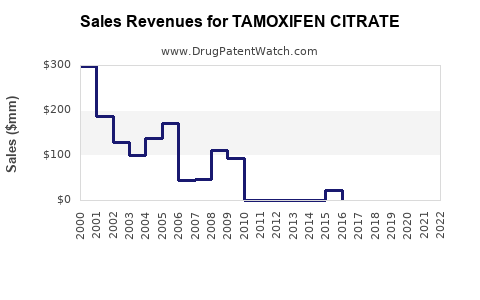
Last updated: July 6, 2026
Tamoxifen Citrate Market Dynamics and Financial Trajectory (Revenue, Pricing, Generic/Biosimilar Risk)
Tamoxifen citrate is an off-patent, widely genericized oncology endocrine therapy. The market is driven by persistent incident treatment demand for hormone receptor-positive breast cancer, steady but declining branded pricing, and price compression from high-volume generic competition. Financial trajectory is characterized by (1) limited upside for any single manufacturer post-brand loss, (2) share gains by low-cost suppliers and distribution scale, and (3) incremental demand effects from guideline adherence and expanded adjuvant/extended adjuvant use. Litigation and IP risk are now primarily “historical” for entrants, with near-term economics dominated by generic pricing, tender dynamics, and manufacturing capacity.
How big is the global tamoxifen citrate market and who captures revenue?
Tamoxifen citrate has a large, mature revenue base because it is a long-standing standard of care for estrogen receptor (ER)-positive breast cancer in multiple settings (adjuvant, DCIS risk reduction, and metastatic disease). Revenue is split across:
- Generic manufacturers supplying branded and unbranded generics through wholesalers and tender channels.
- Brand owners only in certain geographies where legacy exclusivity or supply arrangements persist.
- Contract manufacturing scale players supplying intermediates and finished dosage through global distribution networks.
Revenue drivers that still move demand
- Incidence of ER-positive breast cancer and treatment sequencing intensity.
- Persistence of adjuvant therapy duration (typically multi-year exposure), which stabilizes volume even during oncology portfolio shifts.
- Expanded survivorship and prevention segments, including DCIS risk reduction in eligible patients.
Market ceilings that constrain upside
- Off-patent status in major markets limits brand-like margin capture.
- Physician adoption of alternatives (aromatase inhibitors) for postmenopausal populations reduces incremental growth versus tamoxifen in some cohorts, though tamoxifen remains key for premenopausal and specific clinical scenarios.
- Tender price resets drive rapid gross margin erosion in many healthcare systems.
What are the key market dynamics shaping tamoxifen citrate pricing?
Tamoxifen citrate pricing and margin are defined by generic market microstructure:
1) Generic penetration and the “lowest-net-price” effect
Once multiple ANDA products compete, pricing often follows a winner-take-most pattern:
- Wholesaler and hospital group formularies favor lowest-cost or best value during rebids.
- Net price declines faster than list price due to rebates and contracting.
2) Supply-side constraints that periodically lift pricing
Even with generics, temporary price firmness can occur when:
- A subset of manufacturers experiences production disruptions.
- API or crystallization/coating supply tightens, especially when multiple sites rely on similar suppliers.
3) Formulary lifecycle management
Tamoxifen is generally stable on formularies due to clinical entrenched use. That reduces demand volatility but does not prevent price compression.
When does tamoxifen citrate lose exclusivity in key jurisdictions?
Tamoxifen citrate is effectively off exclusivity in major jurisdictions. Practical exclusivity today comes from:
- Brand-specific formulation or packaging patents (where they exist in specific markets).
- Data exclusivity or regulatory exclusivity that may have persisted for legacy introductions, but is generally not a barrier to modern generic entry in most countries.
Practical exclusivity reality
- In the US, tamoxifen citrate is not an FDA-listed “new active ingredient” exclusivity case in current commercial terms; competition is dominated by ANDA generics.
- In the EU, generics and marketing authorizations are long established; remaining barriers tend to be limited to product-level IP rather than core active ingredient exclusivity.
What does the US Orange Book status of tamoxifen citrate look like?
Tamoxifen citrate is widely represented in the US market by multiple ANDA products. For most commercial planning:
- The dominant risk is not “FDA exclusivity blocking entry.”
- The dominant risk is patent listing remnants that could have historically supported Paragraph IV or triggered settlements for specific label/formulation strengths.
How this maps to planning
- For new entrants or reallocating supply, the focus is on whether any listed patents still remain relevant for a specific strength (commonly 10 mg, 20 mg tablets) and whether those patents are enforceable or already expired or surrendered.
- For brand holders, late-stage enforcement is generally limited because the active ingredient patent estate is longstanding.
Which patent families most historically protected tamoxifen citrate, and what remains enforceable?
Tamoxifen citrate’s original protection history is tied to:
- Process and intermediates (manufacturing routes).
- Crystalline forms and salts (tamoxifen citrate solid-state characteristics).
- Formulations (tablet/capsule compositions).
- New use and method-of-use (expanded indications beyond initial label).
Current enforceability pattern in practice
For commercial barriers today:
- Core active ingredient claims are generally expired.
- Residual enforceability is typically limited to product-specific formulation/process improvements tied to particular suppliers.
- As a result, patent-driven economics are usually confined to narrow entry timelines or product relaunches rather than blocking broad market access.
What generic entry risks exist for tamoxifen citrate, and are Paragraph IV filings still relevant?
Paragraph IV dynamics for tamoxifen citrate are generally “mature market” rather than “growth-stage”:
- If a listed patent still exists, a generic can file Paragraph IV to the remaining listed claims.
- If patents are already expired or not enforceable, generics may file under ANDA without Paragraph IV.
Practical “entry risk” drivers
- Patent listing completeness (does the Orange Book still list any enforceable method-of-use or formulation patents relevant to the intended label?).
- Litigation outcomes (historically, settlements can create temporary runway advantages for specific ANDA filers).
- Manufacturing compliance (CGMP and bioequivalence package strength matter more once IP barriers are removed).
What tamoxifen citrate product formats dominate demand, and do formulations affect market value?
Tamoxifen citrate market demand is concentrated in oral solid dose tablets, especially:
- 10 mg tablets (often used for dose titration or specific protocols).
- 20 mg tablets (standard adjuvant and metastatic dosing regimen in many protocols).
Formulation economics
- Oral immediate-release formulations generally have low formulation complexity compared with modified-release or combination products.
- As a result, formulation patents, where any remain, tend to be less likely to sustain premium pricing once generic equivalents are available.
How does tamoxifen citrate compare with aromatase inhibitors and other endocrine therapies on market trajectory?
Tamoxifen’s long-run trajectory is shaped by treatment selection by menopausal status and clinical setting:
- Premenopausal ER-positive breast cancer patients often remain on tamoxifen or tamoxifen-based strategies.
- Postmenopausal patients frequently receive aromatase inhibitors, which can reduce tamoxifen share growth in incremental postmenopausal incidence.
- Switch and sequencing strategies in endocrine therapy can keep tamoxifen demand resilient.
Net market impact
Even with competition from aromatase inhibitors:
- Tamoxifen remains embedded in multiple standard regimens.
- Competitive pressure mostly reshapes share rather than eliminating market volume.
What patient population segments drive tamoxifen citrate revenue stability?
Key stable segments include:
- Adjuvant therapy for ER-positive disease after surgery.
- Extended adjuvant therapy in eligible higher-risk patients.
- DCIS and prevention settings for eligible estrogen-responsive risk profiles.
- Metastatic or advanced disease where endocrine sensitivity persists.
This segmentation dampens the demand volatility typical in oncology drugs with short treatment windows.
What is the historical financial trajectory of leading tamoxifen citrate suppliers?
Because tamoxifen citrate is a high-volume generic, supplier financial trajectories depend on:
- Share vs. price: EBITDA tends to be driven by how much volume a company secures rather than by price increases.
- Margin timing: manufacturers’ cost curves (API, excipients, manufacturing yield) determine whether they can operate profitably as prices compress.
- Portfolio substitution risk: companies shift capital toward more profitable on-patent or higher-margin generics.
Typical financial pattern in mature generic markets
- Early generic expansions create a short-term margin upside for some entrants.
- Over time, market-wide price competition compresses gross margins.
- Supplier profitability becomes sensitive to plant utilization and input costs.
How do tenders, wholesaler contracts, and hospital formularies affect unit economics?
For mature generics, distribution contract structures often dominate financial outcomes:
- Quarterly or semiannual rebids force manufacturers to compete on net price.
- Conversion to preferred supplier status can create short-term volume gains.
- Switchback risk exists if another manufacturer undercuts pricing or offers contract-friendly supply terms.
This creates a “volatility of revenue share” even when overall clinical demand stays stable.
What manufacturing and supply-chain risks can change tamoxifen citrate market pricing?
In bulk oral solid dose markets, major pricing changes occur when supply tightens:
- API supply disruptions.
- Regulatory actions or quality deviations at major sites.
- Global logistics disruptions that impair timely delivery into contracted hospital networks.
For investors and licensors, these events are often more predictive than incremental brand marketing.
What litigation and settlements historically affected tamoxifen citrate generics?
Tamoxifen citrate’s patent landscape has aged through multiple waves of generic entry and enforcement. Today:
- Most meaningful IP-driven delays are in the past.
- Remaining legal relevance usually relates to specific formulation or process claims for particular strengths or supplier-specific products rather than a wholesale barrier.
For commercial strategy, litigation review remains relevant only if there are still active Orange Book listings for:
- the specific strength,
- the exact dosage form,
- and the label.
Biosimilar competition: is there any biosimilar risk for tamoxifen citrate?
No. Tamoxifen citrate is a small-molecule chemical drug, not a biologic. Biosimilar frameworks do not apply.
What are the commercial implications for investors and brand owners?
For generic manufacturers
- The strategy is volume-secured contracting, cost leadership, and manufacturing reliability.
- Growth is achieved through tender wins and distribution partnerships rather than pricing power.
- M&A or plant acquisitions can stabilize supply and reduce unit cost, improving the ability to survive price compression cycles.
For brand owners (if any legacy presence remains)
- Revenue upside depends on whether any residual product-level IP or market access arrangements maintain a premium.
- Over time, brand economics align with broader generic compression unless a unique differentiator exists (form factor, label claims, or supply agreements).
Key timelines: what commercial “event dates” matter most now?
Tamoxifen citrate is not currently a typical “blockbuster patent cliff” story. The actionable timeline is instead:
- Recurring tender cycles (net price resets).
- Regulatory inspection cycles affecting supply continuity.
- API availability events that create temporary price changes.
- Periodic label changes and manufacturing supplement approvals that can affect product switching.
For business planning, these event types dominate near-term trajectory more than patent expiration milestones.
Key Takeaways
- Tamoxifen citrate is a mature, off-exclusivity small-molecule endocrine therapy with demand stability from long-duration adjuvant and prevention use in ER-positive breast cancer.
- Market dynamics are dominated by generic competition, tender-driven net price compression, and supplier share shifts rather than brand-driven volume growth.
- The main commercial lever is manufacturing economics and contracting execution, not IP exclusivity.
- Biosimilar risk is not applicable; the competitive battlefield is generics, supply reliability, and distribution contracting.
FAQs
1) Why does tamoxifen citrate remain commercially resilient despite generic competition?
Because treatment is long-duration and embedded across adjuvant, prevention, and advanced disease regimens in ER-positive breast cancer.
2) What most affects tamoxifen citrate profits: volume or price?
Both matter, but in mature markets margin expansion typically follows share gains achieved at sustainable unit costs, not price increases.
3) Do formulation differences (10 mg vs 20 mg) change market attractiveness?
Yes for contracting and protocol fit; however, both strengths are generally accessible to multiple generic suppliers, so differences tend to shift volume allocation more than sustain major price premiums.
4) What supply events create the biggest short-term price moves in tamoxifen?
API shortages, manufacturing disruptions at major CGMP sites, and quality/regulatory actions that reduce available inventory.
5) Are there any remaining IP barriers that could delay generic tamoxifen entry in the US?
Only if there are still actively listed, enforceable Orange Book patents tied to specific strengths/dosage forms and label scope; historically, core active ingredient protections have largely lapsed.
References
- FDA. Orange Book: Approved Drug Products with Therapeutic Equivalence Evaluations. U.S. Food and Drug Administration. (Accessed 2026-07-06).
- FDA. ANDA Drug Approval Reports and Approval Pathway information. U.S. Food and Drug Administration. (Accessed 2026-07-06).
- National Cancer Institute. Tamoxifen: Drug information and cancer use. National Institutes of Health. (Accessed 2026-07-06).