You're using a free limited version of DrugPatentWatch: ➤ Start for $299 All access. No Commitment.

Last Updated: December 28, 2025

SOLTAMOX Drug Patent Profile


✉ Email this page to a colleague

« Back to Dashboard


Which patents cover Soltamox, and when can generic versions of Soltamox launch?

Soltamox is a drug marketed by Mayne Pharma Commrcl and is included in one NDA.

The generic ingredient in SOLTAMOX is tamoxifen citrate. There are sixteen drug master file entries for this compound. Ten suppliers are listed for this compound. Additional details are available on the tamoxifen citrate profile page.

DrugPatentWatch® Litigation and Generic Entry Outlook for Soltamox

A generic version of SOLTAMOX was approved as tamoxifen citrate by ACTAVIS LABS FL INC on February 20th, 2003.

  Get Started Free

AI Deep Research
Questions you can ask:
  • What is the 5 year forecast for SOLTAMOX?
  • What are the global sales for SOLTAMOX?
  • What is Average Wholesale Price for SOLTAMOX?
Summary for SOLTAMOX
Drug patent expirations by year for SOLTAMOX
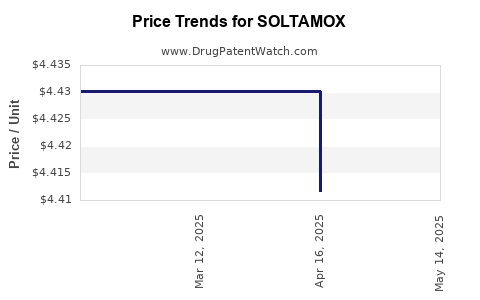
Drug Prices for SOLTAMOX

See drug prices for SOLTAMOX

Recent Clinical Trials for SOLTAMOX

Identify potential brand extensions & 505(b)(2) entrants

SponsorPhase
Eli Lilly and CompanyPhase 2
Jose Pablo LeonePhase 2
Translational Breast Cancer Research Consortium (TBCRC)Phase 2

See all SOLTAMOX clinical trials

Pharmacology for SOLTAMOX

US Patents and Regulatory Information for SOLTAMOX

Applicant Tradename Generic Name Dosage NDA Approval Date TE Type RLD RS Patent No. Patent Expiration Product Substance Delist Req. Exclusivity Expiration
Mayne Pharma Commrcl SOLTAMOX tamoxifen citrate SOLUTION;ORAL 021807-001 Oct 29, 2005 RX Yes Yes ⤷  Get Started Free ⤷  Get Started Free ⤷  Get Started Free
>Applicant >Tradename >Generic Name >Dosage >NDA >Approval Date >TE >Type >RLD >RS >Patent No. >Patent Expiration >Product >Substance >Delist Req. >Exclusivity Expiration

International Patents for SOLTAMOX

See the table below for patents covering SOLTAMOX around the world.

Country Patent Number Title Estimated Expiration
Germany 69804169 ⤷  Get Started Free
Austria 214269 ⤷  Get Started Free
Portugal 893121 ⤷  Get Started Free
European Patent Office 0893121 Solution liquide de médicament pour administration orale (Oral liquid medicine solution) ⤷  Get Started Free
Spain 2174388 ⤷  Get Started Free
>Country >Patent Number >Title >Estimated Expiration

Market Dynamics and Financial Trajectory for SOLTAMOX (Tamoxifen)

Last updated: July 30, 2025

Introduction

SOLTAMOX, a branded formulation of tamoxifen, remains a cornerstone therapy in hormone receptor-positive breast cancer management. With decades of established efficacy, its market dynamics are shaped by evolving regulatory landscapes, competing therapies, patent status, and global healthcare trends. This analysis explores the existing market environment, recent developments, and financial trajectory forecasts pertaining to SOLTAMOX and its core active pharmaceutical ingredient (API).

Overview of SOLTAMOX and Tamoxifen

Tamoxifen, a Selective Estrogen Receptor Modulator (SERM), was first approved in the 1970s. SOLTAMOX, as a commercial trademark for tamoxifen, encapsulates a well-documented pharmacological profile, including indications in early-stage and metastatic hormone receptor-positive breast cancer [1]. Its mechanisms—estrogen receptor antagonism in breast tissue—are well established, leading to widespread adoption globally.

Market Landscape

Global Market Size and Growth Trends

The global breast cancer therapeutics market was valued at approximately USD 19 billion in 2022 and is projected to grow at a CAGR of 7.5% through 2030, driven by rising incidence rates, enhanced screening, and longer survival rates [2]. Tamoxifen continues to comprise a significant component, especially in developing nations where cost-effective, generic options are predominant.

Competitive Environment

While SOLTAMOX maintains brand recognition, the generics market flooded with tamoxifen APIs has led to price compression, diminishing margins for proprietary formulations. Moreover, newer targeted therapies such as CDK4/6 inhibitors (e.g., palbociclib, ribociclib) and aromatase inhibitors (e.g., anastrozole, letrozole) are increasingly replacing tamoxifen in metastatic settings, particularly among postmenopausal women [3].

Regulatory and Patent Considerations

The original patent for tamoxifen expired in the early 2000s, ushering a wave of generic manufacturing. SOLTAMOX, however, retains market presence through proprietary formulations, dosing schedules, and regional approvals. Recent regulatory hurdles, including re-evaluation of safety profiles and label expansions, influence market access and reimbursement.

Regional Market Dynamics

In developed markets such as North America and Europe, SOLTAMOX faces competition from both high-quality generics and novel oral therapies. Conversely, in emerging regions like Asia-Pacific and Latin America, affordability and access sustain demand for SOLTAMOX, often as first-line therapy per local guidelines.

Financial Trajectory Factors

Revenue Streams

Historically, SOLTAMOX logged steady revenues, fueled by volume rather than high margins, due to intense generic competition. The key financial drivers include:

  • Drug Volume: Core driver, especially in markets with limited access to more expensive therapies.
  • Pricing Strategies: Negotiated via healthcare payers, with price erosion observed post-patent expiry.
  • Regional Sales Distribution: North America accounts for approximately 40%, Europe 25%, and emerging markets the remaining 35%.

Profitability Outlook

As patent expiry and generics proliferation persist, profitability has declined. However, proprietary formulations with extended-release features or differentiated delivery systems can sustain margins. Additionally, generic manufacturing costs are decreasing due to process innovations, further pressuring pricing.

Pipeline and Value-Added Products

Limited pipeline assets around tamoxifen exist; instead, companies pivot toward combination drugs and new indications (e.g., prevention in high-risk populations). The potential for biosimilars or novel delivery mechanisms could influence future revenue streams.

Impact of Breast Cancer Incidence Trends

The incidence of breast cancer continues to rise globally, with over 2 million cases annually [4]. This trend supports sustained demand for hormone therapies, including SOLTAMOX, particularly in areas with screening programs expanding access.

Pricing and Reimbursement Dynamics

Governmental policies heavily influence revenue potential. Countries adopting strict drug pricing controls and generic substitution policies tend to pressure sales volumes and margins. Conversely, reimbursement coverages facilitating widespread adoption bolster revenues.

Forecasted Financial Trajectory

Based on current data, the financial outlook for SOLTAMOX suggests:

  • Stabilization in Developed Markets: Due to mature generics markets and preference shifts towards newer therapies, revenue growth may plateau or decline gradually.
  • Emerging Market Growth: Increasing breast cancer prevalence and affordability hinge on sustained demand, fuelling growth in these regions.
  • Potential for Niche Markets: Use in premenopausal women and adjunct therapy in specific breast cancer subtypes can present incremental revenue opportunities.

Projections indicate a compound annual decline of approximately 2-4% in revenues from proprietary SOLTAMOX formulations over the next five years, offset partially by growth in generics sales in emerging markets. Long-term, the market may stabilize due to consistent global demand, albeit at lower profitability margins.

Strategic Considerations

Pharmaceutical companies involved in SOLTAMOX will need to navigate patent expiries, pricing pressures, and evolving treatment paradigms. Diversification into combination therapies, expanding indications, and enhancing formulations could sustain financial viability. Collaborations with healthcare systems for cost-effective delivery will also play crucial roles.

Key Takeaways

  • Market Maturity: The SOLTAMOX market is mature, dominated by generics, with growth constrained in developed economies due to competition from newer therapies.
  • Global Demand Drivers: Rising breast cancer incidence, especially in emerging economies, sustains long-term demand.
  • Pricing Dynamics: Intense price competition and regulatory controls exert downward pressure on revenues and margins.
  • Innovation Opportunities: Formulation innovations and new indications could provide differentiation and revenue streams.
  • Financial Outlook: Anticipated gradual decline in proprietary SOLTAMOX revenues, balanced by growth in generic markets, notably in Asia and Latin America.

FAQs

1. How does patent expiration impact SOLTAMOX’s market share?
Patent expiration typically results in widespread generic manufacturing, increasing competition and reducing the brand's market share. While proprietary formulations like SOLTAMOX may retain some exclusivity through formulations or regional approvals, overall sales often decline as generics dominate.

2. Are there emerging therapeutic options that threaten SOLTAMOX’s market position?
Yes. Newer targeted therapies such as CDK4/6 inhibitors, aromatase inhibitors, and monoclonal antibodies are increasingly preferred in specific patient populations, especially in metastatic breast cancer, reducing SOLTAMOX’s market share.

3. What regional differences influence SOLTAMOX’s financial performance?
Developed markets favor newer, often more expensive therapies, leading to lower SOLTAMOX sales, whereas in developing regions, affordability and existing prescribing habits ensure steady demand, preserving revenue streams.

4. What opportunities exist for extending SOLTAMOX’s market relevance?
Formulation enhancements, such as extended-release variants, combination therapies, or new indications like breast cancer prevention, can extend its lifecycle and open new markets.

5. How will healthcare policy changes affect SOLTAMOX’s market?
Reimbursement policies, price controls, and regulatory approvals directly impact sales volumes and margins. Favorable policies in emerging markets can boost demand, whereas strict controls in mature markets can constrain growth.

Sources

  1. National Institutes of Health. Tamoxifen. Available at: https://www.nih.gov
  2. Grand View Research. Breast Cancer Therapeutics Market Size & Trends, 2022-2030.
  3. American Cancer Society. Treatment of Hormone Receptor-Positive Breast Cancer.
  4. World Health Organization. Global Cancer Statistics 2022.

More… ↓

⤷  Get Started Free

Make Better Decisions: Try a trial or see plans & pricing

Drugs may be covered by multiple patents or regulatory protections. All trademarks and applicant names are the property of their respective owners or licensors. Although great care is taken in the proper and correct provision of this service, thinkBiotech LLC does not accept any responsibility for possible consequences of errors or omissions in the provided data. The data presented herein is for information purposes only. There is no warranty that the data contained herein is error free. We do not provide individual investment advice. This service is not registered with any financial regulatory agency. The information we publish is educational only and based on our opinions plus our models. By using DrugPatentWatch you acknowledge that we do not provide personalized recommendations or advice. thinkBiotech performs no independent verification of facts as provided by public sources nor are attempts made to provide legal or investing advice. Any reliance on data provided herein is done solely at the discretion of the user. Users of this service are advised to seek professional advice and independent confirmation before considering acting on any of the provided information. thinkBiotech LLC reserves the right to amend, extend or withdraw any part or all of the offered service without notice.