Last updated: July 31, 2026
Piroxicam is a mature, off-patent oxicam NSAID with limited commercial growth potential. Its principal market value comes from low-cost generic oral products, not branded pricing or patent protection. Pfizer’s Feldene franchise lost meaningful exclusivity decades ago, and current competition includes generic piroxicam, meloxicam, naproxen, ibuprofen, diclofenac, celecoxib, and other anti-inflammatory therapies. Regulatory warnings concerning gastrointestinal, cardiovascular, renal, and dermatologic risks restrict use and reduce its attractiveness relative to newer or shorter-acting NSAIDs.
What is piroxicam and how is it used?
Piroxicam is a nonsteroidal anti-inflammatory drug used to treat osteoarthritis and rheumatoid arthritis. In the United States, the approved oral dosage forms are generally 10-mg and 20-mg capsules. The recommended maximum daily dosage is 20 mg, with administration at the lowest effective dose for the shortest appropriate duration [1].
Piroxicam inhibits cyclooxygenase-mediated prostaglandin synthesis. Its long elimination half-life, approximately 50 hours, supports once-daily dosing but also increases the period during which adverse effects may persist [1].
| Attribute |
Piroxicam |
| Drug class |
Nonsteroidal anti-inflammatory drug |
| Chemical class |
Oxicam |
| Original brand |
Feldene |
| Original developer |
Pfizer |
| Main approved uses |
Osteoarthritis and rheumatoid arthritis |
| Common U.S. oral strengths |
10 mg and 20 mg |
| Administration |
Usually once daily |
| Approximate half-life |
About 50 hours |
| Current U.S. market |
Generic, mature, low-price |
| Primary competitive products |
Meloxicam, naproxen, ibuprofen, diclofenac, celecoxib |
| Biosimilar relevance |
None; piroxicam is a small-molecule drug |
Piroxicam is generally not preferred for routine acute pain because of its long half-life and safety profile. The FDA label warns about serious gastrointestinal bleeding, ulceration, and perforation, as well as cardiovascular thrombotic events, renal toxicity, hypertension, heart failure, and severe skin reactions [1].
When did piroxicam lose exclusivity?
Piroxicam lost meaningful U.S. market exclusivity many years ago. The original Feldene product was approved in the early 1980s, and generic versions entered after expiration of the relevant composition and product protections.
The commercial consequence is straightforward: no current U.S. exclusivity period supports premium pricing for standard oral piroxicam. FDA-approved generic products can compete on price, supply reliability, wholesaler access, and pharmacy contracting.
| Exclusivity category |
Current position |
| New chemical entity exclusivity |
Expired |
| Original composition patent protection |
Expired |
| Brand-product exclusivity |
Expired |
| Pediatric exclusivity |
No current market significance |
| Orphan-drug exclusivity |
Not applicable |
| Current blocking patent estate |
No material blocking estate identified for standard oral piroxicam |
| Generic substitution |
Available in the U.S., subject to product and state requirements |
The original product’s patent history is commercially historical rather than a present barrier to entry. Current competition is driven by abbreviated new drug application approvals, manufacturing economics, and distribution.
What patents protect piroxicam?
No active U.S. patent estate appears to provide meaningful exclusivity for conventional piroxicam capsules. The relevant protection attached to the original Feldene product and earlier piroxicam compositions has expired.
Formulation patents
Piroxicam formulation patents may still exist in selected jurisdictions or for specific delivery systems, including:
- Topical gels and creams
- Transdermal or dermal delivery systems
- Controlled-release formulations
- Combinations with penetration enhancers
- Cyclodextrin or other solubility-enhanced systems
- Nanoparticle, liposomal, or microsphere formulations
- Fixed-dose combinations
These rights do not automatically block conventional 10-mg or 20-mg oral capsules. Their commercial value depends on claim scope, jurisdiction, prosecution status, regulatory approval, and whether the formulation has a clinically meaningful advantage.
In the United States, the Orange Book generally focuses on approved drug products and patents submitted by the NDA holder. A formulation patent covering an unapproved topical or controlled-release product would not necessarily create a listed-patent barrier for generic oral capsules.
Method-of-use patents
Method-of-use patents for piroxicam are unlikely to create substantial U.S. market control for the approved osteoarthritis and rheumatoid arthritis indications. Those indications have been available for decades, and generic applicants can use labeling strategies that omit protected uses when applicable.
Any commercial analysis of a method-of-use patent must separate:
- The patented indication.
- The approved labeling.
- The product claims in an ANDA.
- The ability to use a section viii label carve-out.
- The patent’s remaining term and enforceability.
For standard piroxicam, these factors do not currently create a broad generic-entry barrier.
What is the Orange Book status of piroxicam?
The U.S. Orange Book lists the reference product associated with Feldene and approved generic piroxicam products. The important commercial point is that the product is in the mature generic segment, with no current branded exclusivity supporting a protected market.
A generic applicant seeking approval for piroxicam capsules generally relies on an abbreviated new drug application demonstrating pharmaceutical equivalence and bioequivalence to the reference listed drug. The regulatory pathway does not require a new clinical efficacy program comparable to an NDA.
Paragraph IV challenges
Paragraph IV litigation was relevant during the original generic-entry period, when applicants challenged unexpired patents associated with Feldene or its formulations. It is not a central current risk for standard piroxicam capsules because the foundational patent estate has expired.
For any newly developed piroxicam formulation, a Paragraph IV dispute could arise if the product relies on an ANDA and the Orange Book lists unexpired formulation or method-of-use patents. The risk would be product-specific, not representative of the conventional piroxicam market.
Which companies compete in the piroxicam market?
The market is fragmented across generic manufacturers, contract manufacturers, distributors, and national pharmacy suppliers. The commercial identity of piroxicam is usually the active ingredient and dosage form rather than a strong consumer brand.
Potential competitors include manufacturers with approved generic piroxicam capsules in the United States and suppliers active in European, Asian, Latin American, and other national markets. The supplier set changes with FDA approvals, discontinued products, shortages, tender awards, and commercial decisions.
The most important competitive products are not only piroxicam generics. Prescribers can substitute among several NSAIDs and, in suitable patients, non-NSAID analgesics.
| Competitive product |
Commercial distinction versus piroxicam |
| Meloxicam |
Similar oxicam class; commonly positioned for chronic musculoskeletal conditions |
| Naproxen |
Broad generic availability and extensive clinical familiarity |
| Ibuprofen |
High-volume, low-cost product with over-the-counter access |
| Diclofenac |
Broad global use and multiple oral, topical, and injectable forms |
| Celecoxib |
COX-2 selective positioning, with higher value potential than traditional NSAIDs |
| Etodolac |
Generic chronic-use alternative |
| Acetaminophen |
Non-NSAID option for selected pain indications |
| Topical NSAIDs |
Lower systemic exposure for some localized conditions |
Meloxicam is the closest major class competitor. It has a more modern commercial profile and broader chronic-use positioning in several markets. Piroxicam retains advantages in once-daily dosing and low acquisition cost, but those advantages are usually insufficient to support premium pricing.
How strong is the piroxicam patent estate?
The patent estate is weak as a current commercial defense for standard oral products. Its strength can be assessed across four dimensions:
| Patent factor |
Assessment |
| Composition-of-matter protection |
Expired |
| Core oral formulation protection |
Expired or commercially immaterial |
| Method-of-use protection |
Limited practical blocking value |
| New delivery-system protection |
Possible in narrow, product-specific cases |
| Freedom to enter with standard capsules |
Generally favorable |
| Ability to sustain branded pricing |
Very limited |
The principal barriers are operational rather than intellectual-property based. A new entrant must establish compliant manufacturing, bioequivalence, quality systems, supplier qualification, pharmacovigilance, and distribution. Those requirements can delay entry, but they do not create durable exclusivity.
What is piroxicam’s FDA regulatory status?
Piroxicam remains an FDA-approved prescription NSAID. The reference labeling contains boxed warnings for cardiovascular and gastrointestinal risks [1]. The FDA also requires risk information addressing concomitant anticoagulant use, aspirin, corticosteroids, selective serotonin reuptake inhibitors, renal impairment, pregnancy, and hypersensitivity reactions.
The regulatory profile affects demand in several ways:
- Physicians may prefer NSAIDs with shorter half-lives for acute treatment.
- Patients with cardiovascular or gastrointestinal risk may require alternative therapy or gastroprotection.
- Older adults, who represent a major chronic-pain population, have higher susceptibility to NSAID toxicity.
- Health systems may use formulary controls and step therapy.
- Regulatory warnings limit the ability to market piroxicam as a broad first-line analgesic.
Piroxicam is not a biologic and has no biosimilar pathway. Its generic competition is governed by the ANDA framework, not by the Biologics Price Competition and Innovation Act.
What is the market size and financial trajectory for piroxicam?
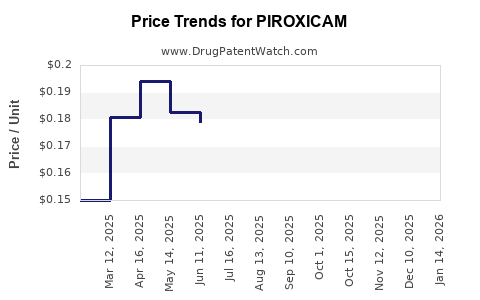
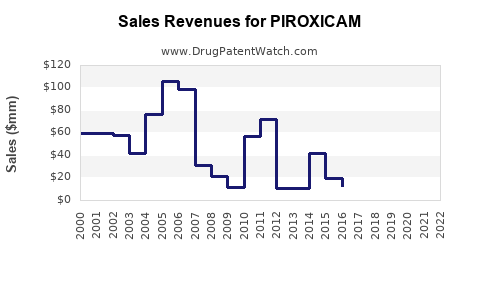
Piroxicam has a mature, low-value financial profile. Pfizer no longer reports Feldene as a material standalone growth franchise in its current financial reporting. Any remaining branded or legacy revenue is not generally disclosed as a separate major line item.
The financial trajectory follows a common lifecycle:
| Period |
Financial profile |
| 1980s |
Branded growth following launch and expansion of NSAID use |
| 1990s |
Generic-entry pressure and erosion of branded pricing |
| 2000s |
Mature generic market with fragmented supply |
| 2010s |
Continued substitution toward meloxicam, celecoxib, topical NSAIDs, and OTC products |
| 2020s |
Low-price, stable-to-declining mature product; value concentrated in manufacturing efficiency and selected international markets |
Revenue exposure is concentrated in unit volume rather than price. A manufacturer can generate a modest return through efficient production, hospital or government tenders, and multi-country distribution. The product is unlikely to support major investment in new clinical development unless paired with a differentiated delivery system, combination product, or new indication.
The main financial sensitivities are:
- Generic price erosion. More approved suppliers can reduce average selling prices.
- Volume stability. Chronic arthritis treatment supports recurring demand, but prescribing may shift to other NSAIDs.
- Manufacturing cost. Active pharmaceutical ingredient sourcing and batch economics determine margin.
- Regulatory compliance. FDA warning-letter, inspection, or supply issues can remove a supplier from the market.
- Geographic mix. Piroxicam may retain stronger use in countries where once-daily dosing and low cost matter more than newer branded alternatives.
- Formulation differentiation. Topical or enhanced-delivery products may command higher prices than standard capsules.
Public financial data do not support treating piroxicam as a material driver of Pfizer’s current revenue trajectory. The commercial opportunity is more relevant to generic manufacturers, regional licensees, and specialty formulation developers.
What manufacturing and intellectual-property barriers affect generic entry?
Manufacturing barriers are moderate but manageable. Piroxicam is a small-molecule active ingredient with long-established synthesis and formulation methods. A standard capsule product does not require complex biologic manufacturing or specialized delivery equipment.
Key operational requirements include:
- Consistent API quality and impurity control
- Control of dissolution and content uniformity
- Stability data for the proposed packaging configuration
- Bioequivalence against the reference product
- Good manufacturing practice compliance
- Reliable API and excipient supply
- Pharmacovigilance and post-market quality monitoring
For a conventional product, the primary risk is commercial oversupply rather than patent infringement. A new entrant may obtain approval but fail to achieve attractive margins because the market already has low-cost suppliers.
What generic launch scenarios exist for piroxicam?
Standard oral capsule launch
This is the lowest-risk regulatory scenario. Entry is technically straightforward, but pricing pressure is severe. Success depends on supply reliability, channel access, and low manufacturing cost.
Authorized or licensed branded-generic launch
A branded-generic strategy may improve recognition in selected markets, but the product’s safety warnings and mature clinical profile limit premium pricing.
Topical formulation launch
A topical piroxicam product could command higher pricing if approved for a defined indication and supported by differentiation. The developer would face formulation, local tolerability, clinical, and jurisdiction-specific patent issues.
Controlled-release or enhanced-solubility product
A differentiated oral product may qualify for stronger intellectual-property protection than standard capsules. Its commercial viability would depend on demonstrating superior adherence, tolerability, pharmacokinetics, or clinical outcomes.
Geographic expansion
International expansion can produce incremental volume where piroxicam remains established in national formularies. Each market requires separate review of registration status, patents, pricing controls, reimbursement, and local manufacturing rules.
What patent litigation and settlement agreements affect piroxicam?
Historical generic-entry disputes may have involved patents associated with the Feldene reference product. Those disputes no longer define the standard oral piroxicam market because the original exclusivity period has ended.
No current litigation or settlement agreement should be presumed to block generic piroxicam capsules solely because historical Feldene patent litigation existed. Current litigation risk would arise from a specific later patent, formulation, label, or product configuration.
For investment or licensing decisions, the relevant litigation screen is:
- Current FDA Orange Book listings
- Patent expiration and terminal-disclaimer data
- Federal district court docket activity
- ANDA Paragraph IV notices
- Settlement restrictions
- Product-specific formulation claims
- Current manufacturing or regulatory enforcement
How does piroxicam compare with meloxicam?
Meloxicam has the stronger current commercial position in many chronic musculoskeletal markets. Both drugs belong to the oxicam class, but meloxicam is often selected more frequently in contemporary prescribing because of broader clinical familiarity and a more favorable market position.
| Factor |
Piroxicam |
Meloxicam |
| Patent status |
Mature generic |
Mature generic |
| Dosing |
Usually once daily |
Usually once daily |
| Half-life |
Approximately 50 hours |
Approximately 20 hours |
| Branded pricing power |
Minimal |
Minimal to modest in selected formulations |
| Chronic arthritis use |
Established |
Strong contemporary positioning |
| Formulation opportunity |
Topical and enhanced delivery |
Oral, injectable, and other market-specific products |
| Generic competition |
High |
High |
| Commercial growth |
Low |
More resilient in selected markets |
Piroxicam’s commercial advantage is low cost. Meloxicam generally has stronger prescribing momentum and product-line depth.
Key Takeaways
- Piroxicam is a mature generic NSAID with no meaningful composition-of-matter exclusivity remaining.
- The original Feldene franchise no longer provides material patent-based pricing power.
- Standard 10-mg and 20-mg capsules face intense generic and therapeutic substitution.
- FDA safety warnings limit first-line use and constrain commercial expansion.
- No biosimilar risk exists because piroxicam is a small-molecule drug.
- The principal barriers to entry are manufacturing, quality, distribution, and pricing, not core patent rights.
- Financial upside is limited for standard oral products and is more plausible for differentiated topical, controlled-release, or enhanced-delivery formulations.
- Piroxicam is unlikely to contribute materially to Pfizer’s current revenue trajectory.
- Meloxicam is generally the stronger contemporary oxicam competitor.
- International markets may provide incremental volume, but revenue remains fragmented and price sensitive.
Frequently Asked Questions About Piroxicam Market Exclusivity and Commercial Value
Is Feldene still patent protected?
No material patent protection for the original Feldene oral product remains commercially relevant in the United States. The product is in the mature generic market.
Can a company launch a generic piroxicam capsule without a Paragraph IV challenge?
Yes. If no relevant unexpired Orange Book patent blocks the product, an applicant can use the applicable ANDA certification pathway without challenging an active patent.
Does piroxicam have a topical formulation opportunity?
Yes. Topical piroxicam products exist in some international markets and may offer formulation-based differentiation. U.S. commercialization would require the appropriate FDA regulatory pathway and market-specific clinical and intellectual-property analysis.
Is piroxicam more profitable than meloxicam?
Usually not. Both are generic products, but meloxicam often has stronger prescribing demand and broader contemporary commercial positioning. Piroxicam can remain profitable where manufacturing and distribution costs are low.
What would increase the commercial value of piroxicam?
A clinically differentiated delivery system, improved tolerability, a validated localized-use product, or a combination product could increase value. Standard oral capsules are unlikely to support significant premium pricing.
References
-
U.S. Food and Drug Administration. (2023). Piroxicam capsules: Prescribing information. DailyMed. https://dailymed.nlm.nih.gov/
-
U.S. Food and Drug Administration. (2024). Approved drug products with therapeutic equivalence evaluations. Orange Book. https://www.accessdata.fda.gov/scripts/cder/ob/
-
U.S. Food and Drug Administration. (2024). Drugs@FDA: FDA-approved drugs database. https://www.accessdata.fda.gov/scripts/cder/daf/
-
Pfizer Inc. (2024). Annual report. https://www.pfizer.com/investors/financial-reports
-
U.S. Food and Drug Administration. (2017). Drug safety communication: FDA strengthens warning that non-aspirin nonsteroidal anti-inflammatory drugs increase chance of heart attack or stroke. https://www.fda.gov/Drugs/DrugSafety/ucm451800.htm