Last updated: September 7, 2026
Nabumetone is a mature, off-patent nonsteroidal anti-inflammatory drug (NSAID) with limited commercial growth potential. The product is marketed primarily as low-cost generic 500 mg and 750 mg tablets for osteoarthritis and rheumatoid arthritis. Originator-brand economics have largely disappeared, while generic demand remains tied to price, formulary placement, prescriber familiarity, and the clinical preference for a nonacidic NSAID prodrug.
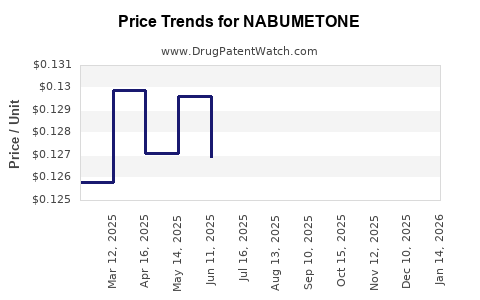
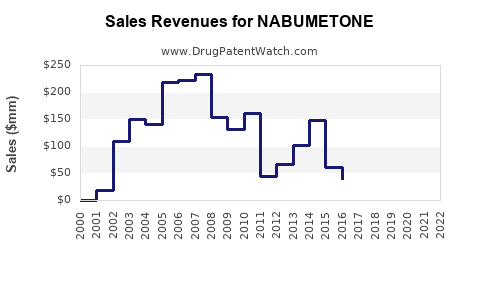
No reliable public source reports a standalone current market size or manufacturer revenue figure for nabumetone. The financial trajectory is therefore best assessed through regulatory status, generic competition, prescription utilization, pricing, and the absence of meaningful exclusivity.
What is nabumetone and how is it used?
Nabumetone is an orally administered NSAID and prodrug. Its principal active metabolite is 6-methoxy-2-naphthylacetic acid, commonly called 6-MNA. The FDA-approved indications are relief of the signs and symptoms of osteoarthritis and rheumatoid arthritis in adults (FDA, 2023).
| Attribute |
Nabumetone |
| Drug class |
NSAID |
| Active metabolite |
6-MNA |
| Original brand |
Relafen |
| Common strengths |
500 mg and 750 mg tablets |
| Administration |
Oral, usually once or twice daily |
| Primary indications |
Osteoarthritis and rheumatoid arthritis |
| Regulatory pathway |
Small-molecule NDA followed by ANDA generic approvals |
| Biosimilar exposure |
None |
| Current commercial status |
Mature generic market |
Nabumetone differs chemically from acidic NSAIDs such as naproxen, ibuprofen, and diclofenac because the administered compound is a nonacidic prodrug. The distinction has supported physician interest in gastrointestinal tolerability, but it has not created a durable premium in the generic market.
The product carries standard NSAID class risks, including gastrointestinal bleeding, ulceration, cardiovascular thrombotic events, renal toxicity, hypertension, and serious skin reactions. These risks constrain long-term use and create competition from acetaminophen, topical NSAIDs, selective COX-2 inhibitors, corticosteroid injections, and nonpharmacologic treatment.
What is the FDA regulatory status of nabumetone?
Nabumetone remains an FDA-approved prescription product, primarily through generic abbreviated new drug applications (ANDAs). The original Relafen product was approved under NDA 19-714. FDA labeling identifies osteoarthritis and rheumatoid arthritis as the principal approved uses (FDA, 1991; FDA, 2023).
The product has no biologic component and does not use the biosimilar pathway. Generic versions demonstrate pharmaceutical equivalence to the reference product, rather than biosimilarity.
FDA milestones
| Event |
Approximate date |
| Original U.S. approval of Relafen |
1991 |
| Core patent and exclusivity period |
Expired |
| Generic nabumetone approvals |
Late 1990s and subsequent years |
| Current FDA status |
Multiple generic products marketed or listed |
| New chemical entity exclusivity today |
None |
FDA product listings and current labeling support a mature generic market with multiple manufacturers and no remaining regulatory exclusivity that would prevent ordinary ANDA competition (FDA, n.d.-a; FDA, n.d.-b).
When did nabumetone lose market exclusivity?
Nabumetone lost meaningful U.S. market exclusivity decades ago. The original product was launched in the early 1990s, and generic competition entered after expiration of the relevant patent and regulatory exclusivity period.
The commercial result was typical for a conventional oral NSAID:
- The branded product initially competed on physician familiarity and perceived tolerability.
- Generic entry shifted purchasing toward price and formulary status.
- Retail and institutional buyers gained multiple interchangeable sources.
- Originator revenue declined as generic substitution increased.
- The market became fragmented among manufacturers with limited brand differentiation.
Nabumetone is not a current new chemical entity, first generic, or protected first-to-file opportunity. A new applicant would generally face a conventional ANDA market rather than a 180-day exclusivity event, unless a specific unexpired regulatory exclusivity or litigation fact altered the application status.
What patents protect nabumetone?
The core U.S. patent estate for nabumetone is expired. Historical patent protection covered the chemical compound and related substituted naphthyl ketone chemistry associated with the product’s development. The principal commercial patent period ended before the current generic market was established.
| Patent issue |
Current commercial relevance |
| Core compound patent |
Expired |
| Original formulation protection |
Expired or no longer commercially blocking |
| Method-of-use protection |
No known current barrier to standard osteoarthritis or rheumatoid arthritis use |
| Manufacturing patents |
No publicly evident active patent barrier preventing routine generic supply |
| Orange Book blocking patent |
No current exclusivity that materially prevents ordinary generic competition |
Patent expiry does not eliminate all potential patent filings. A manufacturer could file a patent on a new formulation, combination, manufacturing process, or delivery system. Such a patent would need to provide a commercially relevant technical distinction and could face validity, infringement, and obviousness challenges.
What is the Orange Book status of nabumetone?
The Orange Book status is consistent with a mature multisource drug. Nabumetone is listed as an approved prescription product with generic equivalents, and the historical listed patents do not provide a current barrier comparable to the patent estates of newer branded drugs (FDA, n.d.-a).
The commercial implications are significant:
- Generic applicants do not need to wait for a current branded patent cliff.
- Paragraph IV litigation is not a central present-day market issue.
- Substitution can occur through standard generic dispensing channels.
- Price competition is more important than patent strategy.
- Any commercial opportunity depends on manufacturing cost, supply reliability, and channel access.
Which companies are challenging nabumetone exclusivity?
Nabumetone’s exclusivity was challenged historically through generic ANDA development rather than through a current high-value patent contest. Generic manufacturers that have marketed or listed nabumetone products have included large national suppliers and contract manufacturers. FDA listings can change as products are approved, discontinued, or transferred between applicants.
Because the drug is long off patent, the current competitive question is not which company is preparing a Paragraph IV launch. It is which manufacturers maintain active supply, acceptable quality records, competitive pricing, and reliable wholesaler access.
No current biosimilar challenge exists because nabumetone is a small molecule. The relevant competitive pathway is ANDA substitution.
What formulations are protected by nabumetone patents?
The commercially important formulation is the immediate-release oral tablet. The standard marketed strengths are 500 mg and 750 mg.
There is no widely established premium extended-release, transdermal, injectable, inhaled, or abuse-deterrent nabumetone franchise. This limits formulation-based lifecycle management. A new dosage form could require a new FDA application or supplemental filing, but it would face competition from inexpensive immediate-release tablets and a relatively narrow willingness to pay.
| Formulation |
Commercial position |
| 500 mg tablet |
Established generic form |
| 750 mg tablet |
Established generic form |
| Extended-release tablet |
No major current branded franchise |
| Topical formulation |
No established U.S. nabumetone market |
| Injectable formulation |
No established U.S. nabumetone market |
| Combination product |
No major commercial franchise |
How does nabumetone compare with ibuprofen, naproxen, and celecoxib?
Nabumetone competes in a crowded NSAID market. Its principal advantages are oral convenience, once-daily dosing for many patients, and the nonacidic prodrug structure. Its disadvantages are lower physician familiarity than ibuprofen or naproxen, limited over-the-counter visibility, and the absence of a differentiated patented formulation.
| Drug |
Market position |
Key competitive factor |
| Nabumetone |
Mature prescription generic |
Low price and dosing convenience |
| Ibuprofen |
Large OTC and prescription market |
Broad availability and consumer familiarity |
| Naproxen |
OTC and prescription |
Long clinical history and low cost |
| Diclofenac |
Generic oral and topical market |
Strong topical and prescription presence |
| Celecoxib |
Branded and generic selective COX-2 option |
COX-2 positioning and gastrointestinal considerations |
Nabumetone is unlikely to gain substantial share through price alone because several NSAIDs are cheaper and more widely distributed. Its defensible niche is selective prescribing for patients whose clinicians prefer its dosing profile or pharmacologic characteristics.
How large is the nabumetone market?
The current U.S. market is likely a low-value generic segment rather than a major pharmaceutical market. Public companies generally do not report nabumetone revenue separately. Manufacturer filings group it within broader generic portfolios, and prescription-volume databases are typically required to calculate a reliable market size.
Three factors define the market:
- Unit demand is supported by chronic musculoskeletal disease.
- Revenue per prescription is compressed by generic substitution.
- Manufacturer profitability depends on scale and supply-chain efficiency.
The product can generate recurring volume without producing significant brand-level revenue. This distinction matters for investment analysis. Nabumetone may be useful as part of a broad generic portfolio, but it is unlikely to affect the valuation of a diversified manufacturer unless the company has unusually high exposure or a supply disruption creates temporary pricing power.
Revenue exposure by commercial participant
| Participant |
Revenue exposure |
| Original innovator |
Minimal or absent as a branded growth driver |
| Large generic manufacturer |
Low per product, potentially meaningful in aggregate portfolio |
| Contract manufacturer |
Dependent on volume and capacity utilization |
| Wholesaler |
Commodity-margin distribution |
| Retail pharmacy |
Limited product-specific margin differentiation |
| Payer |
Low-cost formulary option |
No credible basis exists for assigning a current standalone global revenue figure without access to prescription and net-price datasets. Company filings do not provide sufficient product-level disclosure.
What is the financial trajectory for nabumetone?
The financial trajectory follows four stages.
Originator growth
Relafen generated value as a branded prescription NSAID during the early 1990s. Revenue was supported by patent protection, physician promotion, and the product’s positioning as a prescription alternative to older NSAIDs.
Patent erosion
Generic entry eliminated most of the originator’s pricing premium. As formularies and pharmacies substituted generic nabumetone, the branded product’s addressable market narrowed.
Mature generic stabilization
After the patent cliff, the market stabilized around recurring prescriptions, low prices, and several suppliers. Volume became more important than price. Manufacturers with efficient tablet production and broad distribution could retain modest returns.
Long-term commoditization
The current market has limited structural growth. Revenue can rise temporarily through shortages, supplier exits, or increased prescribing, but sustained price expansion is unlikely. Long-term financial performance depends on manufacturing cost, active ingredient sourcing, quality compliance, and contract retention.
What generic entry risks exist for nabumetone?
The generic entry risk is already realized rather than prospective. The more relevant risks are margin erosion and supply competition.
Commercial risks
- Additional low-cost manufacturers can reduce wholesale prices.
- Retail substitution limits brand loyalty.
- Payers can move patients to naproxen, ibuprofen, or other NSAIDs.
- Manufacturers face FDA inspection, remediation, and product-quality risks.
- Raw-material disruptions can interrupt supply without creating durable pricing power.
- Low demand concentration can make inventory planning difficult.
Generic launch scenarios
| Scenario |
Likely outcome |
| New manufacturer enters |
Lower prices and additional supply |
| Existing supplier exits |
Temporary volume redistribution |
| FDA quality action |
Short-term shortage and possible price movement |
| Formulary preference changes |
Prescription migration to competing NSAIDs |
| New branded formulation |
Limited uptake unless it has clear clinical or adherence value |
What patent litigation affects nabumetone?
Nabumetone does not present the type of active, high-value patent litigation associated with recently launched branded medicines. Historical litigation, if any, would have centered on generic entry and patent validity or infringement. Those disputes no longer determine ordinary market access because the relevant exclusivity period has expired.
There is no current patent-based litigation pathway comparable to a protected small-molecule product with pending Paragraph IV certifications. Litigation exposure is more likely to arise from manufacturing, product quality, antitrust, or commercial-contract issues than from core compound protection.
How strong is the nabumetone patent estate?
The current patent estate is weak from a market-exclusion perspective because the core protection is expired and the product has no widely recognized active lifecycle franchise.
| Patent-estate factor |
Assessment |
| Core molecule |
No current blocking strength |
| Formulation differentiation |
Limited |
| Method of use |
No evident current exclusivity for approved indications |
| Manufacturing barriers |
Technical know-how may matter, but no known broad blocking patent |
| Generic substitution defense |
Weak |
| Litigation leverage |
Low |
| Commercial moat |
Supply, quality, and distribution rather than patents |
Manufacturing know-how can still create operational advantages. Those advantages are not equivalent to patent exclusivity and generally do not support sustained premium pricing.
What are the future market prospects for nabumetone?
Nabumetone should be modeled as a stable, low-growth generic NSAID. Demand will remain linked to the prevalence of osteoarthritis and rheumatoid arthritis, but the product will continue to compete against lower-cost and more familiar alternatives.
Upside is limited to:
- Supplier consolidation
- Temporary shortages
- Improved formulary access
- Increased use among patients requiring a prescription NSAID
- Portfolio synergies for a generic manufacturer
Downside is driven by:
- Continued price compression
- Substitution with naproxen, ibuprofen, diclofenac, or celecoxib
- Declining use of systemic NSAIDs among high-risk patients
- FDA manufacturing actions
- Reduced physician familiarity
The most defensible investment thesis is operational rather than intellectual-property based. A company can earn acceptable returns through low-cost production and dependable supply, but nabumetone alone is unlikely to provide meaningful growth, exclusivity, or strategic valuation support.
Key Takeaways
- Nabumetone is an FDA-approved, mature generic NSAID marketed mainly as 500 mg and 750 mg tablets.
- Relafen’s commercial exclusivity ended decades ago.
- The core patent estate is expired and does not provide a current barrier to ANDA competition.
- There is no biosimilar market because nabumetone is a small molecule.
- Current economics are driven by generic price, supply reliability, formulary status, and manufacturing efficiency.
- Public companies generally do not disclose standalone nabumetone revenue.
- The market has recurring prescription demand but limited pricing power and low growth potential.
- Current competitive risk is generic commoditization, not a pending patent cliff.
- Formulation-based lifecycle opportunities are limited because the immediate-release tablet is well established.
- The product’s commercial value is greater as part of a broad generic portfolio than as an independent growth asset.
FAQs
Is nabumetone still available in the United States?
Yes. Nabumetone remains available as an FDA-approved prescription generic, primarily in 500 mg and 750 mg tablets.
Is Relafen still a major branded product?
No. Relafen is no longer a major branded growth product. The market is primarily generic and price-driven.
Does nabumetone have a current Orange Book patent?
Historical patent listings do not create a current commercial exclusivity barrier comparable to a recently launched branded drug. Generic versions are available.
Can a generic manufacturer obtain Paragraph IV exclusivity for nabumetone?
A new Paragraph IV opportunity is unlikely to have meaningful commercial value because the core patent and exclusivity period have already expired. Any specific application would depend on the patents listed at the time of filing.
Is nabumetone more commercially attractive than naproxen?
Generally no. Naproxen has broader consumer recognition, OTC availability, and a larger commercial base. Nabumetone can retain a prescription niche through dosing convenience and physician preference, but it lacks comparable market scale.
References
-
U.S. Food and Drug Administration. (1991). Relafen (nabumetone) prescribing information, NDA 19-714. FDA.
-
U.S. Food and Drug Administration. (2023). Nabumetone tablets prescribing information. FDA.
-
U.S. Food and Drug Administration. (n.d.-a). Approved drug products with therapeutic equivalence evaluations: Orange Book. FDA. https://www.accessdata.fda.gov/scripts/cder/ob/
-
U.S. Food and Drug Administration. (n.d.-b). Drugs@FDA: FDA-approved drugs. FDA. https://www.accessdata.fda.gov/scripts/cder/daf/
-
U.S. National Library of Medicine. (n.d.). Nabumetone drug label information. DailyMed. https://dailymed.nlm.nih.gov/###