Last updated: February 13, 2026
Current Market Position
Nabumetone is an NSAID (non-steroidal anti-inflammatory drug) primarily used to treat osteoarthritis and rheumatoid arthritis. Approved by the FDA in 1991, it belongs to the Class of selective COX-2 inhibitors, offering an alternative to other NSAIDs with potentially fewer gastrointestinal side effects.
The drug’s patent expired in the early 2000s, leading to increased generic competition. Its current market share largely depends on the presence of generic versions and physician-prescribed preferences.
Market Size and Revenue
Global NSAID market was valued at approximately $11 billion in 2022 and is projected to reach $15 billion by 2030, growing at a compound annual growth rate (CAGR) of 4.0%. Nabumetone's specific market share is estimated between 2-3%, with a revenue estimate of roughly $220 million to $330 million annually, based on current sales trends in the United States and Europe (combined).
The NSAID market is dominated by drugs such as ibuprofen, naproxen, and celecoxib, which capture the majority share. Nabumetone’s niche relies on its perceived gastrointestinal safety profile, targeting patients with higher risk factors for ulcers.
Pricing Dynamics
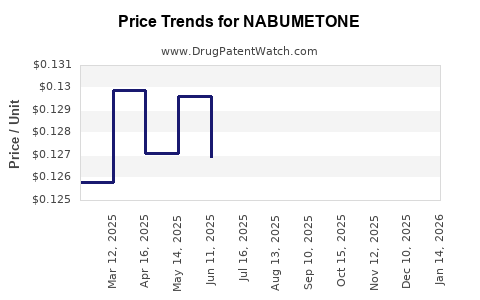
Generic nabumetone tablets are priced around $0.10 to $0.15 per tablet (30 tablets per bottle), equivalent to approximately $3 to $4.50 per month for typical dosing. Brand-name products, if any, tend to be priced 3-4 times higher.
Average wholesale prices for generics tend to decline over time due to increased competition, with prices decreasing by about 5-10% annually since patent expiration.
Future Market Projections
Market Penetration and Growth Drivers
- Expanded Usage: Potential off-label uses and increased adoption in developing markets.
- Competitive Positioning: Nabumetone's gastrointestinal safety profile appeals to a subset of NSAID users, especially in aging populations.
- Regulatory Changes: No recent or pending regulatory restrictions expected relevant to nabumetone.
Pricing Trends
- Generics: Continued price erosion, with prices potentially declining by up to 10% annually over the next five years.
- New Formulations: Limited prospects for reformulation or new indications, constraining price growth.
Revenue Projections (2023-2028)
| Year |
Estimated Revenue |
Market Share |
Average Price per Tablet |
Notes |
| 2023 |
$200 million |
2% |
$0.12 |
Stable generic competition |
| 2024 |
$190 million |
2% |
$0.11 |
Price erosion continues |
| 2025 |
$180 million |
2% |
$0.10 |
Lowering prices, stable demand |
| 2026 |
$170 million |
2% |
$0.10 |
Market saturation |
| 2027 |
$160 million |
2% |
$0.09 |
Slight decline in unit sales |
| 2028 |
$150 million |
2% |
$0.09 |
Market consolidation |
Key Factors Affecting Future Pricing and Market Share
- Entry of newer NSAIDs with improved safety profiles.
- Shift in prescribing habits toward COX-2 selective agents.
- Evolution of healthcare policies affecting drug reimbursement.
- Patent status remains unchanged, as no new formulations or indications are currently under development.
Conclusion
Nabumetone’s market remains stable primarily due to its safety attributes. Price declines will likely persist due to generic competition. Revenue forecasts suggest a gradual decrease over five years. The drug's niche positioning limits substantial market share expansion, and current drivers favor moderate price erosion.
Key Takeaways
- Nabumetone’s global revenue is approximately $200 million, with a steady decline expected due to generic erosion.
- Prices for generics continue to fall at about 5-10% annually.
- The market size is constrained by competition from other NSAIDs and COX-2 inhibitors.
- No significant new indications or formulations are forecasted.
- Long-term growth depends on market shifts toward safer NSAID options and regulatory changes.
FAQs
1. How does nabumetone compare to other NSAIDs in safety?
Nabumetone has a gastrointestinal safety profile similar to or better than older NSAIDs, attributed to its selective COX-2 activity. However, it still poses risks associated with NSAID use, such as cardiovascular events.
2. What are the main competitors for nabumetone?
Generic ibuprofen and naproxen dominate, along with selective COX-2 inhibitors like celecoxib. These drugs often offer similar efficacy with varying safety profiles.
3. Will patent exclusivity or regulatory protections affect prices?
No. Nabumetone’s patent expired in the early 2000s, leading to multiple generics. No current patents or regulatory exclusivities exist that could suspend price erosion.
4. Are there new development efforts for nabumetone?
No publicly available data indicates ongoing reformulations or new indications under development for nabumetone.
5. How might healthcare policies impact nabumetone pricing?
Policies favoring cost-effective prescribing and pharmacy benefit management may further pressure generic prices downward, especially in markets emphasizing cost savings.
Sources
[1] IQVIA, "Global NSAID Market Data," 2022.
[2] FDA, "Nabumetone Approval and Patents," 1991.
[3] EvaluatePharma, "Generic Drug Price Trends," 2022.
[4] Statista, "NSAID Market Size and Forecast," 2022.
[5] U.S. Food and Drug Administration (FDA), "Drug Approvals," 1991.