Last updated: September 8, 2026
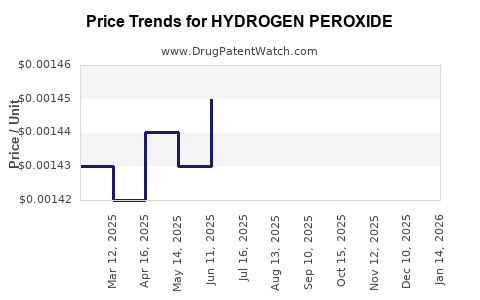
Hydrogen peroxide is a low-cost, mature pharmaceutical active rather than a single branded drug. Its commercial value is concentrated in OTC topical antiseptics, oral debriding products, wound-care preparations, contact-lens disinfection systems, and pharmaceutical-grade supply. The market has limited patent protection, intense price competition, low switching costs, and substantial exposure to chemical feedstock, packaging, logistics, and regulatory-compliance costs.
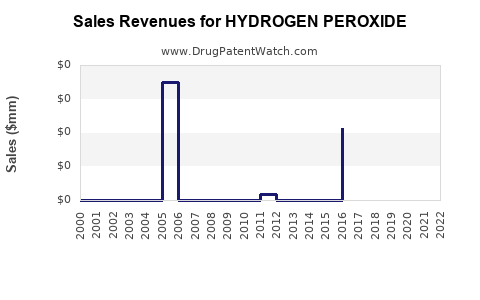
No standalone global pharmaceutical revenue figure is consistently reported because manufacturers generally combine hydrogen peroxide sales with broader disinfectants, specialty chemicals, wound-care products, or consumer-health portfolios. The financial trajectory is therefore best assessed through product categories, manufacturer economics, raw-material pricing, and channel dynamics.
What pharmaceutical products contain hydrogen peroxide?
Hydrogen peroxide is used in several healthcare product categories:
| Product category |
Typical concentration or role |
Regulatory position |
Main commercial channel |
| Topical antiseptic |
Commonly 3% consumer solution |
OTC drug labeling and state or federal requirements vary by product |
Pharmacies, mass retail, e-commerce |
| Oral debriding rinse |
Often approximately 1.5% to 3% in labeled products |
OTC oral-health product requirements |
Drugstores, dental retail, hospitals |
| Contact-lens disinfection |
Hydrogen peroxide-based disinfecting system |
Often regulated as a medical device system rather than a conventional drug |
Optical, pharmacy, and e-commerce channels |
| Pharmaceutical excipient or processing material |
High-purity hydrogen peroxide |
Controlled by pharmacopeial and supplier specifications |
Pharmaceutical manufacturers |
| Institutional disinfectant |
Various concentrations and delivery systems |
Environmental and healthcare-disinfectant rules may apply |
Hospitals, laboratories, facilities |
Retail 3% hydrogen peroxide solution is generally sold as a generic or private-label product. Brand differentiation is limited because the active ingredient is inexpensive, familiar, and chemically simple.
Hydrogen peroxide decomposes into water and oxygen. That property supports its use as an oxidizing and cleansing agent but creates stability, packaging, transportation, and storage requirements. Light, heat, contamination, and incompatible materials can accelerate decomposition.
What is the FDA regulatory status of hydrogen peroxide?
Hydrogen peroxide does not have one uniform FDA classification across all uses. The regulatory pathway depends on the intended use, concentration, claims, formulation, and delivery system.
For OTC products, the relevant questions are whether the formulation fits an applicable OTC monograph or administrative order, whether the labeling is compliant, and whether the product makes claims that move it into another regulatory category. A solution labeled for cleansing or debriding is treated differently from one claiming treatment of infection, sterilization, or disease.
DailyMed lists numerous hydrogen peroxide products under National Drug Code entries, including 3% topical solutions and oral-health products. Those listings establish the existence of marketed drug products but do not mean that all formulations have the same FDA status or clinical evidence base (National Library of Medicine, n.d.).
Contact-lens systems require separate analysis. A hydrogen peroxide lens-care system can be regulated as a medical device because the product is used to disinfect and store lenses through a controlled system. Its regulatory and competitive profile differs from that of an OTC topical solution.
When does hydrogen peroxide lose exclusivity?
Hydrogen peroxide has no meaningful molecule-level exclusivity remaining. The compound has been known and commercially used for more than a century. Any historic composition or basic-use patents have expired.
Exclusivity risk today arises from narrower rights:
- Stabilized formulations
- Specialty packaging
- Metered-dose delivery systems
- Contact-lens disinfection systems
- Manufacturing and purification processes
- Combination products
- Hospital-use systems
- Proprietary containers that limit decomposition
- Trademark and retail-brand positioning
These rights generally protect a formulation, device, process, or brand rather than hydrogen peroxide itself. They do not prevent competitors from selling a conventional 3% solution using a different formulation and package.
What patents protect pharmaceutical hydrogen peroxide products?
The core active ingredient is not patent-protected. Patent value is concentrated in application-specific technology.
| Patent area |
Protection potential |
Commercial strength |
| Hydrogen peroxide molecule |
None |
Expired |
| Conventional 3% aqueous solution |
Very limited |
Weak |
| Stabilizer system |
Moderate if technically differentiated |
Medium |
| Light-resistant or child-resistant packaging |
Narrow |
Low to medium |
| Contact-lens disinfection system |
Moderate to strong at the system level |
Medium |
| Metered delivery or foam formulation |
Narrow and design-around risk |
Low to medium |
| Manufacturing and purification |
Potentially valuable for suppliers |
Medium |
| Combination oral-care formulation |
Dependent on formulation claims |
Low to medium |
Formulation patents face a high design-around risk because competitors can change stabilizers, container materials, surfactants, concentrations, or delivery mechanisms. Manufacturing patents can protect cost, purity, or stability advantages, but they are often difficult to enforce against competitors whose production occurs in different jurisdictions.
Are there Orange Book listings for hydrogen peroxide?
Conventional OTC hydrogen peroxide products generally do not create the same Orange Book framework as an innovator prescription drug with an approved NDA. Products sold under OTC pathways may have NDC listings without having an Orange Book-listed patent estate.
The practical result is limited Paragraph IV exposure. A generic company usually does not need to challenge a major branded NDA patent to enter the 3% hydrogen peroxide market. It can market a compliant product if it satisfies the applicable FDA requirements, labeling rules, manufacturing standards, and facility obligations.
For contact-lens systems and other device-led products, the central regulatory issue may be 510(k) clearance, device compliance, or product-specific authorization rather than Orange Book patent certification.
How many patents cover hydrogen peroxide pharmaceuticals?
There is no commercially meaningful count of patents covering hydrogen peroxide as a drug substance. Patent families exist around formulations, devices, manufacturing, packaging, and specific medical uses, but they do not form a consolidated blocking estate.
A freedom-to-operate review would normally separate:
- The active ingredient.
- The concentration range.
- The stabilizer and excipient system.
- The container and closure.
- The manufacturing process.
- The label claims.
- The delivery device.
- The territory of sale.
For a conventional aqueous 3% topical solution, the active-ingredient and basic-formulation risk is low. Risk increases where a company uses a patented stabilizer system, a proprietary lens-care platform, or a specialized dispensing package.
What generic entry risks exist for hydrogen peroxide?
Generic entry risk is high. Conventional hydrogen peroxide products have several characteristics that favor rapid competition:
- The active ingredient is inexpensive.
- The chemical structure is simple.
- The product is easy to source from multiple suppliers.
- Clinical differentiation is limited for basic cleansing uses.
- Switching costs for pharmacies and consumers are low.
- Private-label retailers can match branded products.
- Product technology is usually visible from the label and package.
The main barriers are manufacturing quality and product stability rather than patent exclusivity. A supplier must control concentration, contamination, decomposition, container compatibility, labeling, and transportation. These requirements create operational risk but rarely support premium pricing for ordinary 3% solutions.
Which companies compete in the hydrogen peroxide pharmaceutical market?
Competition is fragmented across chemical producers, OTC consumer-health companies, medical-device manufacturers, and private-label retailers.
Chemical suppliers
Large hydrogen peroxide producers include Evonik Industries, Solvay, Arkema, Mitsubishi Gas Chemical, and other regional manufacturers. These companies generally sell hydrogen peroxide as part of broader industrial and specialty-chemical portfolios rather than report pharmaceutical hydrogen peroxide as a separate revenue segment.
Their economics depend on plant utilization, electricity and hydrogen costs, energy prices, transportation, local supply-demand conditions, and customer contracts. Pharmaceutical-grade supply can receive a quality premium, but the underlying molecule remains a commodity chemical.
Consumer-health manufacturers
OTC products are sold by branded consumer-health companies, generic manufacturers, pharmacy chains, and private-label suppliers. Many retail products are manufactured under contract. The brand owner may control the label and distribution while a third-party facility supplies the solution.
This structure limits brand power. A retailer can often replace one contract supplier with another, subject to quality qualification and regulatory controls.
Medical-device companies
Hydrogen peroxide contact-lens systems have a more defensible commercial position than basic topical solutions because the consumer purchases a complete disinfection system, including containers, neutralization steps, instructions, and compatibility claims. System design and brand trust can support better margins than a basic bottle of 3% solution.
What is the financial trajectory for hydrogen peroxide pharmaceuticals?
The financial trajectory is mature and volume-driven rather than innovation-driven.
| Financial driver |
Expected effect |
| Rising healthcare and hygiene demand |
Supports stable unit growth |
| Private-label penetration |
Compresses retail prices |
| Commodity input volatility |
Creates margin swings |
| Packaging and freight costs |
Affect low-value products disproportionately |
| Hospital infection-control demand |
Supports institutional volumes |
| Specialty formulation growth |
Improves margins in selected niches |
| Limited patent protection |
Restricts sustained price premiums |
| E-commerce expansion |
Increases price transparency |
Basic OTC hydrogen peroxide has low revenue per unit and limited ability to support promotional spending. Profitability depends on procurement, packaging efficiency, plant scale, retailer terms, and supply-chain control.
Chemical manufacturers can achieve higher margins from pharmaceutical-grade and specialty applications, but the pharmaceutical portion is usually too small to determine total company earnings. Public company disclosures from major producers typically report hydrogen peroxide within broader regional or chemical segments rather than as a separate pharmaceutical product line (Evonik Industries AG, 2023; Solvay SA, 2023).
The stronger financial opportunities are in adjacent products:
- Stabilized high-purity solutions
- Sterile or controlled-environment manufacturing
- Hospital disinfection systems
- Contact-lens care
- Dental and oral-care formulations
- Specialized packaging
- Contract manufacturing
- Pharmaceutical process applications
What patent litigation affects hydrogen peroxide products?
Hydrogen peroxide is not associated with a major recurring branded-drug patent litigation pattern. There is no dominant prescription product whose revenue depends on a single core patent.
Disputes are more likely to involve:
- False or unsupported antimicrobial claims
- Labeling and advertising
- Trade dress
- Packaging design
- Contract manufacturing
- Product contamination
- Quality deviations
- Device-system patents
- Supplier agreements
- Regulatory classification
Paragraph IV litigation is generally not the central market-entry mechanism for ordinary hydrogen peroxide solutions. A company seeking entry is more likely to compete through an OTC pathway, a private-label agreement, or a device clearance strategy.
Are biosimilar risks relevant to hydrogen peroxide?
No. Hydrogen peroxide is a small chemical molecule, not a biologic. Biosimilar regulations do not apply. Competition occurs through generic, OTC, private-label, chemical-supply, or medical-device channels.
How does hydrogen peroxide compare with competing antiseptics?
| Product |
Main advantage |
Main limitation |
Patent and pricing profile |
| Hydrogen peroxide |
Low cost, familiar, oxidizing action |
Limited use claims and tissue-irritation concerns |
Weak patent protection, low price |
| Povidone-iodine |
Broad antiseptic use |
Iodine sensitivity and staining concerns |
Mature branded and generic competition |
| Chlorhexidine |
Strong healthcare adoption |
Safety and formulation restrictions |
More specialized, higher-value segments |
| Isopropyl alcohol |
Fast drying and inexpensive |
Poor suitability for some wounds |
Commodity product |
| Benzalkonium chloride |
Convenient formulations |
Resistance and efficacy considerations |
Formulation-led competition |
Hydrogen peroxide competes most effectively where consumers value low price, availability, and visible cleansing action. It is less advantaged in settings requiring a broad, clinically differentiated antimicrobial claim or a tissue-specific safety profile.
What generic launch scenarios exist?
A conventional launch can occur through three routes:
- A compliant OTC product using an accepted regulatory pathway.
- A private-label product manufactured by a qualified contract producer.
- A specialized formulation or device requiring product-specific FDA review.
The first route has the lowest commercial barrier and the highest price pressure. The third route has more regulatory cost but can support stronger customer retention and higher margins.
Geographic coverage is also important. A manufacturer may have a low-cost product but still face country-specific labeling, concentration, transport, hazardous-material, facility, and disinfectant-registration requirements. Patent expiry does not create automatic global market access.
How strong is the hydrogen peroxide pharmaceutical patent estate?
The estate is weak for basic OTC products and stronger only in narrow technical applications. A useful commercial rating is:
| Segment |
Patent strength |
Entry risk |
| Conventional 3% topical solution |
Low |
Low |
| Basic oral rinse |
Low |
Low |
| Stabilized specialty formulation |
Medium |
Moderate |
| Contact-lens system |
Medium |
Moderate |
| Proprietary delivery device |
Medium |
Moderate |
| Manufacturing and purification |
Medium |
Process-dependent |
| Branded prescription product |
Not generally applicable |
Not applicable |
The principal barriers are quality systems, scale, distribution, regulatory compliance, and customer contracts. Patent rights are secondary for the largest volume segment.
Key Takeaways
- Hydrogen peroxide is a mature OTC and specialty chemical active, not a single branded pharmaceutical.
- The conventional 3% solution has minimal molecule-level or formulation-level exclusivity.
- Orange Book and Paragraph IV strategies are usually not central to ordinary hydrogen peroxide market entry.
- Generic and private-label competition keeps prices low.
- Pharmaceutical-grade supply, contact-lens systems, packaging, and stabilized formulations offer better margin potential.
- Revenue is rarely disclosed separately by public chemical or consumer-health companies.
- Financial performance depends more on volume, plant utilization, raw-material costs, packaging, and retailer economics than on patents.
- Biosimilar risk does not apply.
- The strongest commercial protections are technical quality, regulatory compliance, manufacturing scale, and distribution relationships.
FAQs About Hydrogen Peroxide Pharmaceuticals
Is 3% hydrogen peroxide an FDA-approved drug?
3% hydrogen peroxide products are marketed as OTC drug products, but the regulatory basis depends on the product’s claims, formulation, labeling, and applicable FDA requirements. An NDC listing alone does not establish a uniform approval pathway for every product.
Can a generic company launch hydrogen peroxide without a Paragraph IV filing?
For conventional OTC products, a Paragraph IV filing is generally not the primary entry mechanism because the product may not be tied to an Orange Book-listed NDA patent. Entry depends on the applicable OTC and manufacturing requirements.
Does hydrogen peroxide have pharmaceutical-grade pricing power?
Limited pricing power exists for ordinary 3% solutions. Higher pricing is more feasible for controlled-purity material, sterile supply, stabilized formulations, specialized packaging, and validated medical-device systems.
Are hydrogen peroxide contact-lens products drugs or devices?
The classification depends on the specific product and claims. Many hydrogen peroxide lens-care systems are regulated as medical-device systems because they disinfect and store lenses through a defined process.
Is hydrogen peroxide manufacturing protected by patents?
Some manufacturing and purification processes may be patented, but the commercial value is usually tied to cost, purity, reliability, and scale. Competitors can often use alternative processes or source material from other producers.
References
-
Evonik Industries AG. (2023). Annual report 2023. Evonik Industries AG.
-
National Library of Medicine. (n.d.). DailyMed: Hydrogen peroxide drug labels. U.S. National Library of Medicine.
-
Solvay SA. (2023). Integrated report 2023. Solvay SA.
-
U.S. Food and Drug Administration. (n.d.). Over-the-counter drug products and nonprescription medicines. U.S. Department of Health and Human Services.
-
U.S. Food and Drug Administration. (n.d.). Drug approvals and databases. U.S. Department of Health and Human Services.