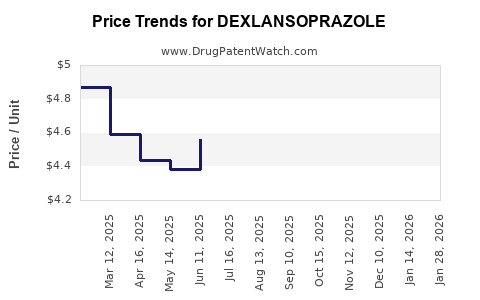
Last updated: July 8, 2026
Dexlansoprazole (Dexilant, dual delayed-release proton pump inhibitor) has transitioned from exclusivity to a generic/low-cost competitive regime. The market trajectory now depends on (1) residual protection of specific dexlansoprazole formulations and strengths, (2) payer-driven substitution to lower-priced generics, and (3) utilization trends in GERD and erosive esophagitis. In the U.S., the product’s financial trajectory is best characterized as declining after generic launch, with remaining revenue concentrated among channels that slow formulary churn and where branded contracting still exists.
What is dexlansoprazole’s market size and revenue trajectory since generic entry?
Short answer: Revenue has shifted from brand-led growth to price-competition dynamics dominated by generics and contracting.
Dexlansoprazole is a proton pump inhibitor (PPI) used for gastroesophageal reflux disease (GERD) and erosive esophagitis. The dual delayed-release (DDR) formulation differentiated Dexilant from single delayed-release PPIs, but that differentiation has narrowed in the face of widespread generic availability for the same active ingredient.
How does dexlansoprazole revenue typically evolve after loss of brand exclusivity?
Post-exclusivity, the standard financial path in PPIs is:
- Immediate price compression from first-filed generics and subsequent entrants.
- Payer step therapy and formulary placement that shifts volume away from branded PPIs.
- Brand revenue declines that stabilize when remaining contracted volume offsets further erosion.
Key market drivers that still support utilization
Even under generic competition, PPIs retain baseline utilization due to chronic indications and guideline use. For dexlansoprazole specifically, usage is linked to:
- Treatment of symptomatic GERD
- Healing and maintenance therapy patterns in erosive esophagitis
- Substitution decisions within the PPI class based on formulary preferences and patient tolerability
What financial indicators matter most right now?
For a drug like dexlansoprazole, investors and commercial teams monitor:
- U.S. prescription trends by strength (30 mg vs 60 mg)
- Net price trajectory versus list price (contracting and rebates)
- Market share vs other PPIs and within DDR-specific switching behavior
- Segment performance by channel (mail, retail, specialty, 340B)
When does dexlansoprazole lose exclusivity and what are the practical timing implications for generics?
Short answer: The practical exclusivity period ended with generic availability, so the current risk is not “whether,” but “how fast” contracting and payer policies push volume away from branded Dexilant.
Brand-to-generic timing model
Even after patent expiry, the market moves in phases:
- Paragraph IV and first generic launch: faster volume shift if launch is early and payers remove branded option.
- Second and third generic waves: deeper price compression and higher substitution rates.
- Long-tail stabilization: branded contracting may persist with narrow volume carve-outs, but share erodes.
Key implication for financial trajectory
With most of the commercial lift already harvested, revenue outlook is now driven more by:
- Payer-specific formulary dynamics
- Competitive intensity from other PPIs
- Ongoing pharmacy channel conversion to lowest net-cost options
What patents protect dexlansoprazole and how do they influence market dynamics?
Short answer: Patent scope around dexlansoprazole’s protected DDR formulations and specific claims historically shaped the timing of generic entry. After entry, remaining value is mostly promotional and contracting, not IP-led price premium.
Patent estate categories that can affect exclusivity timing
For PPIs like dexlansoprazole, protection often splits into:
- Drug substance and early composition claims
- Drug product and formulation claims (including modified-release structures)
- Method-of-use claims for indications or dosing regimens
- Process and manufacturing method claims
How formulation and method-of-use patents affect competition after launch
Even after generics launch, formulation and method-of-use claims can:
- Delay “label-matching” launches at certain strengths or regimens
- Influence authorized generic availability
- Create switching friction for payers and integrated health systems if competing products face coverage or interchange restrictions
What is the Orange Book status of dexlansoprazole (Dexilant) and what does it imply for generic risk?
Short answer: Orange Book listings determine litigation and exclusivity posture for FDA approval and launch timing. For mature products, the main financial impact comes from whether Orange Book-listed patents are still litigated or newly expired.
Orange Book-driven scenarios
Two scenarios matter commercially:
- Patents already expired or cleared: generics can sell without launch delays, driving sustained net price compression.
- Remaining listed patents still litigated: limited remaining branded premium and delayed substitution for certain product presentations.
Commercial implication
As Orange Book barriers fall, expect:
- Faster payer movement to generics
- Higher share concentration among lowest-cost sellers
- Continued decline in branded revenue, unless a brand retains differentiated access via contracting
Which companies are positioned to capture dexlansoprazole volume from generics?
Short answer: Generic manufacturers and authorized generic programs typically capture the bulk of volume once exclusivity ends, with market share split among first movers and lower-net-cost bidders.
Generic capture dynamics in PPIs
Generic PPIs generally distribute share based on:
- First-to-market speed and coverage in large PBMs
- Contracting advantage and bid aggressiveness
- Pharmacy channel formulary status and wholesaler inventory economics
How branded incumbents try to defend share
Dexilant historically can defend through:
- Access and rebate structures tied to formulary placement
- Therapy management programs that slow switching at the margin
- Retaining specific patient cohorts with perceived tolerability or prior response
How does dexlansoprazole compare with other PPIs on competitive landscape and payer behavior?
Short answer: Within-class competition is the dominant commercial force post-generic entry. Payers choose based on net cost, step therapy, and day-to-day coverage rules, not molecular novelty.
Competitive set logic for PPIs
Payer substitution typically prioritizes:
- Lowest net-cost PPI options in formulary tiers
- Generic versions of widely used PPIs
- Step therapy restrictions that limit switching to “preferred” PPIs
Where dexlansoprazole DDR can still win
Even when active ingredient is generic, DDR can retain niche advantages if:
- A payer maintains coverage for the DDR option
- Patients have stable response and clinicians avoid switching
- Health plans treat DDR differently due to formulary rules or historical utilization
What formulation and dosage-strength issues matter for dexlansoprazole market access?
Short answer: Market access and substitution are strength- and presentation-specific, which affects how quickly volume shifts.
Strength-specific dynamics
Dexlansoprazole is marketed in different strengths (notably 30 mg and 60 mg). In competitive landscapes, pricing and payer contracting can differ by:
- Strength demand profile
- Prescriber preference and patient history
- Submission and launch sequencing by generic manufacturers
Delivery system differentiation post-generic
Even with generic active ingredient approval, product differences can still influence:
- Pharmacy interchange policy (particularly if product is not considered therapeutically equivalent under plan rules)
- Real-world switching friction
What generic entry risks remain for dexlansoprazole?
Short answer: After initial generic availability, remaining risks shift from “whether generics can enter” to “how much more they can displace branded share,” driven by contracting and PBM policy.
Risk channels
- Additional entrants: deeper discounting and further share erosion.
- Authorized generics: renewed pressure on net price if deployed at scale.
- Formulary tightening: removal of branded options from preferred tiers.
What dexlansoprazole patent litigation affected market entry and price?
Short answer: Patent litigation is a key determinant of the launch timing for generic dexlansoprazole products. Once the litigation resolves, commercial effects follow through contracting.
Typical litigation-commercial pathway
- Paragraph IV filing triggers litigation and stays.
- Resolution enables market entry.
- After entry, PBMs and payers accelerate switching to lowest net-cost alternatives.
How do FDA regulatory status and labeling affect dexlansoprazole competitiveness?
Short answer: Labeling determines clinical interchangeability within plan policies. For PPIs, equivalence to labeled indications governs coverage and step therapy feasibility.
Label-driven substitution
Plans and pharmacy benefit managers may encourage substitution when:
- Indications overlap
- Dosing convenience matches plan utilization patterns
- Therapeutic equivalence supports interchange
How do PBM formulary and contracting mechanics drive dexlansoprazole financial performance?
Short answer: Net revenue trajectory follows PBM contracting more than clinical differentiation once generics exist.
PBM mechanics that matter
- Preferred vs non-preferred tier placement
- Quantity limits and step edits
- Prior authorization requirements for branded coverage
- Exclusions or carve-outs for specific delivery systems (DDR vs non-DDR), if any
Brand defense strategy
Branded incumbents often seek:
- Coverage retention via rebate-backed performance guarantees
- Tight contracting that keeps branded options within formulary tiers
What is the geographic and channel exposure profile for dexlansoprazole?
Short answer: U.S. is the primary profit and volume engine for Dexilant-like launches due to PBM influence and payer coverage centralization. Commercial trajectory in other markets is generally less sensitive unless local patent expiries and tender systems slow generic substitution.
Channel exposure
- Large retail chains and mail order typically respond faster to formulary changes.
- Hospital and integrated health system procurement can lag depending on formulary review cycles and patient cohort management.
Key takeaways
- Dexlansoprazole’s financial trajectory is governed by generic competition and payer contracting after exclusivity periods end.
- Market dynamics now follow net price compression, formulary placement, and PBM step therapy behavior more than IP differentiation.
- DDR is most useful commercially as a niche differentiator when payers treat it differently within PPI formularies, otherwise active ingredient genericization drives revenue erosion.
- Remaining “risk” for the brand is mostly incremental: additional entrants, authorized generic pressure, and faster formulary tightening.
FAQs
1) How fast do PPIs like dexlansoprazole lose branded share after generic launch?
Typically within the first contract cycle after launch, driven by PBM formulary tiering, with additional erosion as successive generic entrants increase bid pressure.
2) Does dexlansoprazole’s dual delayed-release delivery system materially delay generic substitution?
It can slow substitution only when payers maintain DDR-specific coverage rules; otherwise, plan net-cost selection accelerates switching.
3) What outcomes matter most in dexlansoprazole generic market penetration?
Net pricing and formulary tier placement, plus how quickly mail order and large retail chains convert prescriptions.
4) Are method-of-use or formulation patents the main remaining barriers for dexlansoprazole?
Historically, formulation or product-specific claims can shape launch sequencing for particular presentations and strengths; once cleared, competition becomes primarily contracting-driven.
5) What competitive event most impacts dexlansoprazole revenue now?
PBM and health system formulary changes that move dexlansoprazole to non-preferred status or tighten step therapy triggers.
References
- U.S. Food and Drug Administration. (n.d.). Orange Book: Approved Drug Products with Therapeutic Equivalence Evaluations. FDA. https://www.accessdata.fda.gov/scripts/cder/daf/
- U.S. Food and Drug Administration. (n.d.). Drug Trials Snapshots: Dexilant. FDA. https://www.fda.gov/