Last updated: September 7, 2026
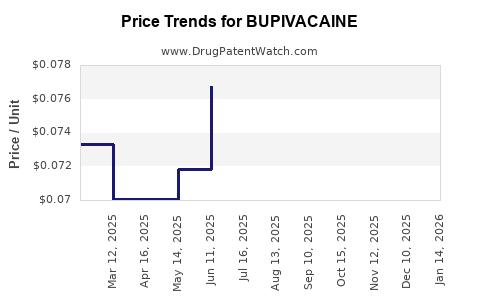
Bupivacaine is a mature local anesthetic with a bifurcated market. Conventional bupivacaine hydrochloride is a low-margin generic injectable sold by multiple manufacturers. Liposomal bupivacaine, marketed primarily as EXPAREL by Pacira BioSciences, captures most of the branded economic value through extended-release delivery, differentiated clinical positioning, and procedure-specific adoption.
The conventional market has limited patent protection and persistent price pressure. EXPAREL remains the principal commercial growth asset, but its trajectory depends on hospital formulary access, procedure adoption, reimbursement, clinical evidence, and the timing of generic or competing long-acting local anesthetics.
What is the current market structure for bupivacaine?
Bupivacaine is sold in several formulations, with materially different economics.
| Product category |
Main active ingredient |
Typical dosage form |
Market position |
Economic profile |
| Conventional injectable |
Bupivacaine hydrochloride |
Vials, ampules, premixed bags |
Generic standard of care |
Low price, fragmented supply |
| Liposomal injectable |
Bupivacaine hydrochloride encapsulated in DepoFoam particles |
Single-dose injectable suspension |
Branded extended-release product |
Premium pricing and higher gross profit potential |
| Combination products |
Bupivacaine with other local anesthetics or adjuncts |
Injectable formulations |
Niche and institutional use |
Dependent on clinical protocol |
| Delivery-system products |
Bupivacaine administered through pumps or localized systems |
Catheters, infusion systems |
Procedure-specific |
Economics shared between drug and device suppliers |
Conventional bupivacaine is used for local infiltration, peripheral nerve blocks, epidural anesthesia, and other regional anesthesia procedures. The product is widely available through generic suppliers, including subsidiaries or product lines associated with Pfizer, Fresenius Kabi, Hikma, Sandoz, Eugia, and other injectable manufacturers.
EXPAREL is designed to release bupivacaine over an extended period after administration. Its commercial value comes from the delivery technology rather than from a new active pharmaceutical ingredient. The product is used primarily in postsurgical pain management and regional anesthesia settings. FDA labeling has expanded over time to include additional administration approaches, including certain nerve blocks in adults. (U.S. Food and Drug Administration, 2024a)
How large is the bupivacaine market?
There is no single authoritative public figure for total global bupivacaine revenue because conventional generic sales are distributed across manufacturers, countries, hospital contracts, and government procurement channels. Commercial market-research estimates vary widely depending on whether they include only bupivacaine hydrochloride, liposomal bupivacaine, combination products, or related delivery devices.
The more reliable public financial indicator is Pacira’s EXPAREL revenue. Pacira reported 2023 net product sales of approximately $678 million, with EXPAREL representing the company’s core commercial product. (Pacira BioSciences, 2024) That figure does not represent the total bupivacaine market. It represents the branded liposomal segment and excludes generic bupivacaine hydrochloride revenue.
A practical market segmentation is:
| Segment |
Revenue visibility |
Margin profile |
Growth profile |
| U.S. generic bupivacaine |
Low at aggregate market level |
Low to moderate |
Stable or declining in price |
| Non-U.S. generic bupivacaine |
Low |
Low |
Driven by procedure volumes and tenders |
| U.S. EXPAREL |
High through Pacira reporting |
Higher than conventional generic products |
Dependent on adoption and label expansion |
| Long-acting local-anesthetic competitors |
Emerging |
Potentially high |
Dependent on clinical differentiation |
| Drug-device delivery systems |
Company-specific |
Variable |
Linked to ambulatory surgery and enhanced recovery |
The market is therefore economically concentrated even though unit supply is fragmented. Generic manufacturers compete for volume, while Pacira competes for clinical protocol placement and reimbursement value.
What is the financial trajectory for bupivacaine products?
The financial trajectory differs sharply between conventional bupivacaine and EXPAREL.
Conventional bupivacaine financial outlook
Conventional bupivacaine has the profile of a mature injectable generic:
- Multiple approved suppliers
- Limited differentiation at the molecule level
- Hospital and group-purchasing-organization contracting
- Price competition during tenders and shortages
- Revenue linked more closely to surgical volumes than to innovation
- Limited ability to sustain premium pricing
The product can generate dependable cash flow for manufacturers with efficient sterile-injectable operations. It is less attractive as a standalone growth asset because regulatory approval does not create durable market exclusivity once multiple suppliers are established.
Manufacturing economics remain important. Sterile injectable production requires validated aseptic processing, container-closure controls, quality testing, and reliable capacity. Manufacturing failures or plant interruptions can cause temporary shortages and price increases. Those events can improve near-term realization for available suppliers but do not generally create durable structural pricing power.
EXPAREL financial outlook
EXPAREL has a higher-value economic model. Pacira has used clinical evidence, surgeon adoption, hospital protocols, and procedure-specific marketing to position the product as a tool for reducing opioid use and supporting postsurgical recovery.
Its revenue trajectory depends on five factors:
- Expansion into additional nerve-block and surgical applications.
- Conversion of hospitals from conventional bupivacaine or opioid-heavy protocols.
- Reimbursement and hospital budget acceptance.
- Evidence showing reduced opioid consumption, shorter recovery, or lower total episode cost.
- Protection against generic versions of the liposomal product.
Pacira’s reported EXPAREL revenue demonstrates that a differentiated delivery system can sustain substantial revenue even when the underlying active ingredient is generic. The commercial risk is that hospitals may compare EXPAREL’s acquisition cost directly with low-cost bupivacaine hydrochloride rather than evaluating total recovery costs.
What patents protect bupivacaine and EXPAREL?
Conventional bupivacaine hydrochloride is effectively off-patent in the United States. The active ingredient has been marketed for decades, and generic versions are approved under abbreviated new drug applications. The basic molecule does not provide a meaningful current exclusivity barrier.
EXPAREL is different. Its protection has centered on:
- Liposomal or multivesicular delivery technology
- Composition and particle architecture
- Manufacturing processes
- Release characteristics
- Dosage forms and administration methods
- Specific nerve-block or postsurgical uses
The FDA Orange Book is the principal source for identifying listed patents and regulatory exclusivity associated with approved drug products. The Orange Book distinguishes product patents from method-of-use patents and identifies expiration dates relevant to generic applicants. (U.S. Food and Drug Administration, 2024b)
Publicly associated EXPAREL patent families have included patents such as U.S. Patent No. 8,545,866 and later patents directed to liposomal bupivacaine formulations and related technology. Patent scope and enforceability depend on claim construction, prosecution history, terminal disclaimers, patent-term adjustment, and any later regulatory or judicial developments.
| Protection layer |
Conventional bupivacaine |
Liposomal bupivacaine |
| Active-ingredient patent |
Expired |
Expired active ingredient |
| Formulation patent |
Minimal current protection |
Material protection possible |
| Manufacturing patent |
Limited commercial barrier |
Potentially important |
| Method-of-use patent |
Narrow or product-specific |
Relevant for labeled procedures |
| Regulatory exclusivity |
Expired |
Depends on approval history |
| Generic substitution risk |
High |
Lower than conventional product, but increasing over time |
The main commercial question is not whether bupivacaine itself is patent protected. It is whether a competitor can reproduce the liposomal product’s formulation, manufacturing process, release profile, and clinical performance without infringing enforceable claims.
When does bupivacaine lose exclusivity?
Conventional bupivacaine lost meaningful U.S. market exclusivity decades ago. Generic entry is established, and the product is subject to ordinary injectable-generic competition.
EXPAREL’s exclusivity is more complex. A product can lose one patent barrier while retaining others. Method-of-use patents may be carved out of a generic label, while formulation or composition patents can present a broader barrier. The practical loss-of-exclusivity date therefore depends on:
- The expiration of listed patents
- Pediatric exclusivity, if applicable
- Patent-term adjustment
- The scope of generic labeling
- FDA approval of competing products
- Litigation outcomes
- Whether a competitor develops a non-infringing formulation
A nominal patent expiration date does not automatically equal immediate commercial erosion. Generic manufacturers must still complete development, submit an ANDA, resolve patent certifications, obtain FDA approval, secure manufacturing capacity, and launch under a viable price structure.
What is the Orange Book status of bupivacaine?
The Orange Book contains listings for approved branded and generic drug products, including injectable bupivacaine products and, where applicable, listed patents for branded formulations.
For conventional bupivacaine hydrochloride:
- Multiple generic products are approved.
- The active ingredient is not protected by current composition-of-matter exclusivity.
- Generic substitution and institutional contracting are established.
- Patent-based barriers are generally not the central competitive issue.
For EXPAREL:
- Orange Book-listed patents have been central to generic-entry analysis.
- The relevant patents concern the product’s liposomal delivery system and related claims rather than bupivacaine as a molecule.
- Method-of-use listings can permit a generic applicant to omit certain indications through a section viii statement, depending on the patent and label language.
The Orange Book should be read together with FDA approval letters, product labeling, patent-family records, and court dockets. An Orange Book listing identifies a regulatory patent assertion; it does not by itself establish that every claim will survive litigation.
Which companies compete with bupivacaine products?
Competition occurs at three levels.
Generic injectable competition
Generic suppliers compete primarily on price, supply reliability, product presentation, and hospital-contract performance. Relevant suppliers include Pfizer’s Hospira business, Fresenius Kabi, Hikma, Sandoz, Eugia, and other regional manufacturers.
Branded long-acting local anesthetics
EXPAREL is the best-known branded long-acting bupivacaine product in the United States. Competitive products may use different local anesthetics, delivery technologies, or combination approaches rather than copying bupivacaine directly.
Drug-device alternatives
Continuous peripheral nerve-block catheters and infusion pumps can compete with single-dose long-acting injections. These systems may offer adjustable delivery but require equipment, placement expertise, monitoring, and operational resources.
The relevant competitive comparison is not limited to acquisition price. Hospitals assess operating-room time, recovery-unit utilization, opioid consumption, readmission risk, catheter management, nursing workload, and patient throughput.
Which companies are challenging bupivacaine exclusivity?
Conventional bupivacaine has already been challenged through extensive generic entry. The more important competitive issue is whether generic or alternative manufacturers can enter the liposomal bupivacaine market.
Potential entry routes include:
- ANDA applications for a bioequivalent or pharmaceutically equivalent product
- Paragraph IV certifications against Orange Book-listed patents
- Section viii statements carving out patented methods of use
- 505(b)(2) applications for modified formulations or delivery systems
- Non-infringing extended-release technologies
- Hospital-use alternatives based on continuous infusion or other anesthetics
A Paragraph IV certification would create potential patent litigation risk for the branded sponsor. The filing itself does not establish infringement or invalidity. It starts a statutory process that can delay FDA approval under the Hatch-Waxman framework if litigation is filed within the applicable period. (U.S. Food and Drug Administration, 2024c)
No comparable Paragraph IV exposure exists for the basic conventional bupivacaine market because approved generic products are already established.
What patent litigation affects bupivacaine?
Patent litigation is most relevant to liposomal bupivacaine, not conventional bupivacaine hydrochloride.
The primary litigation questions are likely to involve:
- Whether a competing product uses the claimed liposomal architecture
- Whether the manufacturing process falls within asserted claims
- Whether claims are anticipated or obvious
- Whether written-description and enablement requirements are met
- Whether a generic label induces infringement of method-of-use claims
- Whether a patent’s term has expired or is limited by a terminal disclaimer
The commercial impact of litigation depends on the timing of the challenge. A late-filed challenge may have limited value if the branded product has already lost meaningful market share or if development costs make launch unattractive.
Settlement agreements are commercially important when they establish an agreed generic-entry date. They can also include supply terms, licensing arrangements, authorized-generic provisions, or restrictions on launch strategy. Publicly disclosed information does not establish a single, broadly applicable settlement date for all potential EXPAREL challengers. The relevant agreement must be analyzed by challenger, product, patent, and jurisdiction.
What generic launch scenarios exist for liposomal bupivacaine?
A generic launch would likely follow one of four scenarios.
| Scenario |
Timing |
Market effect |
| First-filer launch with patent settlement |
Defined by agreement |
Rapid price reduction and share capture |
| Litigation victory for generic |
Potentially earlier than patent expiry |
High erosion risk for branded product |
| Patent expiry without early challenge |
At or after final enforceable expiry |
Delayed but predictable erosion |
| Non-infringing 505(b)(2) competitor |
Dependent on development and approval |
May pressure price without full generic substitution |
The first approved competitor would have an advantage in formulary negotiations and contracting. Price erosion could be less severe than in an ordinary tablet market because sterile liposomal manufacturing is complex and hospital conversion takes time. It could still be substantial if several suppliers enter within a short period.
How strong is the bupivacaine patent estate?
The conventional bupivacaine patent estate is weak because the molecule is mature and generic.
The EXPAREL patent estate is stronger but narrower. Its strength depends on the degree to which patents cover the commercial product rather than peripheral process features. Formulation and composition claims generally provide broader protection than narrow manufacturing or method-of-use claims. Method-of-use patents can still support commercial protection when the indication is central to product demand, but they are more vulnerable to label carve-outs and non-infringing use arguments.
A practical assessment is:
| Patent estate |
Strength |
Commercial implication |
| Conventional bupivacaine molecule |
Low |
No meaningful exclusivity |
| Conventional injectable formulation |
Low |
Commodity competition |
| Liposomal composition |
Moderate to high, depending on claim validity |
Main barrier to direct generic entry |
| Manufacturing process |
Moderate |
Can increase development complexity |
| Method of use |
Narrow to moderate |
Supports selected indications |
| Delivery-system know-how |
Potentially high operational value |
May deter manufacturing even without broad patent claims |
Trade secrets and manufacturing know-how may matter as much as patents. Multivesicular liposome production requires process control, particle-size consistency, encapsulation performance, sterility, and release-profile reproducibility. A theoretically non-infringing competitor may still face high technical and regulatory execution risk.
What FDA regulatory status applies to bupivacaine?
FDA-approved conventional bupivacaine products are regulated as prescription injectable drugs. Generic products generally enter through the ANDA pathway and must demonstrate pharmaceutical equivalence and bioequivalence or satisfy applicable FDA requirements for injectable products.
EXPAREL was approved as a liposomal injectable suspension and has received label expansions for additional uses. Its approval and labeling have been central to its commercial differentiation. FDA has also issued warnings and safety communications concerning local anesthetic administration, dosing, systemic toxicity, and medication errors, which can affect institutional protocols. (U.S. Food and Drug Administration, 2024a)
Biosimilar risk is not applicable to bupivacaine. Bupivacaine is a small-molecule drug, not a biologic. Competitive entry occurs through ANDA, 505(b)(2), or other small-molecule regulatory pathways rather than the biosimilar pathway.
What revenue exposure does bupivacaine create?
Revenue exposure is concentrated in EXPAREL for Pacira and in broader injectable portfolios for generic manufacturers.
For Pacira, EXPAREL represents substantial product concentration risk. A successful generic or clinically differentiated long-acting competitor could affect:
- Net product sales
- Gross margin
- Sales and marketing leverage
- Cash flow available for pipeline investment
- Valuation multiples
- Licensing and partnership economics
For generic manufacturers, bupivacaine is usually a portfolio product rather than a standalone financial driver. Its value comes from recurring hospital demand, manufacturing utilization, and participation in injectable contracts. Supply interruptions can temporarily increase revenue, but sustained returns depend on production efficiency and contract retention.
What licensing deals affect the bupivacaine market?
The most significant commercial licensing structure is associated with technology and commercialization rights surrounding liposomal delivery. Pacira developed and commercialized EXPAREL using its DepoFoam delivery platform and related intellectual property.
Licensing opportunities in the sector generally involve:
- Regional rights for liposomal bupivacaine
- Co-development of long-acting local anesthetics
- Drug-device combinations
- Hospital or ambulatory-surgery distribution
- Formulation technology applicable to other injectable drugs
Conventional bupivacaine is unlikely to support attractive licensing economics because multiple generic suppliers can manufacture the active ingredient and basic injectable presentations. Licensing value is higher for proprietary delivery systems, differentiated clinical uses, or manufacturing platforms.
How does bupivacaine compare with other local anesthetics?
| Attribute |
Bupivacaine |
Ropivacaine |
Lidocaine |
Liposomal bupivacaine |
| Duration |
Long |
Long |
Shorter |
Extended-release profile |
| Generic availability |
Extensive |
Extensive |
Extensive |
Limited relative to standard generics |
| Price pressure |
High |
High |
High |
Lower before direct generic entry |
| Main use |
Regional anesthesia and postoperative pain |
Regional anesthesia |
Local anesthesia and shorter procedures |
Postsurgical pain and selected nerve blocks |
| Patent value |
Minimal for molecule |
Minimal for molecule |
Minimal for molecule |
Formulation and delivery claims |
| Key commercial factor |
Supply and price |
Clinical preference and price |
Volume and price |
Clinical outcomes and hospital economics |
Bupivacaine’s conventional market position is defensible through clinical familiarity and supply availability, not patent protection. EXPAREL’s differentiation depends on whether the extended-release profile produces enough operational or clinical value to justify its premium.
Key Takeaways
- Conventional bupivacaine hydrochloride is a mature, off-patent generic injectable.
- Generic competition limits pricing power and fragments revenue across manufacturers.
- EXPAREL is the principal branded economic asset in the bupivacaine category.
- Pacira reported approximately $678 million in EXPAREL net product sales in 2023.
- EXPAREL protection is based on liposomal formulation, delivery technology, manufacturing, and method-of-use patents.
- Paragraph IV risk is relevant to liposomal bupivacaine, not to the established conventional generic market.
- Biosimilar risk does not apply because bupivacaine is a small-molecule drug.
- Generic entry into liposomal bupivacaine would likely reduce price and market share, but sterile manufacturing complexity could slow erosion.
- Hospital adoption depends on total episode economics, opioid reduction, recovery pathways, and reimbursement rather than drug acquisition cost alone.
- The strongest long-term barriers are proprietary formulation know-how, validated manufacturing, clinical evidence, and institutional protocol integration.
FAQs
Is bupivacaine still profitable for pharmaceutical companies?
Yes, but profitability differs by product. Conventional bupivacaine is generally a low-margin portfolio product. Liposomal bupivacaine can generate higher margins because it has differentiated delivery technology and branded pricing.
Is EXPAREL a generic form of bupivacaine?
No. EXPAREL contains bupivacaine but uses a proprietary liposomal delivery system. It is not economically equivalent to conventional bupivacaine hydrochloride simply because both products contain the same active ingredient.
Can a generic manufacturer copy EXPAREL?
A competitor must satisfy FDA requirements and avoid or invalidate enforceable patents. It must also reproduce complex liposomal manufacturing characteristics, including release behavior and product quality attributes.
Does bupivacaine have biosimilar competition?
No. Biosimilars apply to biological products. Bupivacaine is regulated as a small-molecule drug, so competition occurs through generic or modified-drug pathways.
What would most increase the value of a bupivacaine product?
The strongest value drivers are a protected extended-release formulation, evidence of lower total surgical costs, expanded labeled uses, reliable sterile manufacturing, and a reimbursement pathway that supports premium pricing.
References
Pacira BioSciences, Inc. (2024). 2023 annual report and Form 10-K. U.S. Securities and Exchange Commission.
U.S. Food and Drug Administration. (2024a). EXPAREL (bupivacaine liposome injectable suspension) prescribing information. FDA.
U.S. Food and Drug Administration. (2024b). Approved drug products with therapeutic equivalence evaluations: Orange Book. FDA.
U.S. Food and Drug Administration. (2024c). Hatch-Waxman amendments and abbreviated new drug applications. FDA.
U.S. Patent No. 8,545,866. (2013). Bupivacaine multivesicular liposomes. U.S. Patent and Trademark Office.