Last updated: June 28, 2026
Bleomycin sulfate market dynamics and financial trajectory: pricing, volume drivers, shortages, and exclusivity pressure
Bleomycin sulfate is a legacy oncology cytotoxic with a limited number of labeled competitors and a market structure shaped by (1) sporadic supply reliability, (2) slow manufacturing throughput for sterile lyophilized products, (3) distributor and hospital purchasing practices, and (4) ongoing headwinds from high-cost specialty oncology budgets shifting toward newer standards of care. Financial trajectory in most geographies has been characterized by steady, low-to-mid single-digit annual net sales growth or contraction depending on supply stability, with price support constrained by generic availability and periodic procurement cycles.
What is bleomycin sulfate used for and how does demand behave across indications?
Bleomycin sulfate is primarily marketed and prescribed in oncology regimens for squamous cell carcinomas and other tumor types, with the most persistent demand anchored in:
- Head and neck squamous cell carcinoma (historically, in combination regimens)
- Testicular cancer protocols (historically in combination regimens)
- Hodgkin lymphoma and other squamous malignancies where bleomycin remains incorporated in established regimens
- Cutaneous/other niche uses depending on country labeling and guideline adherence
How do guideline shifts and regimen modernization affect bleomycin demand?
The core market dynamic is substitution risk. As newer chemotherapy backbones, immunotherapy, and targeted regimens expand, bleomycin’s addressable use narrows to:
- Regimens that preserve bleomycin as a backbone component
- Patients where bleomycin’s mechanism is still considered clinically relevant by local standards
- Settings where formulary inertia keeps older multi-drug protocols in place
Net effect: demand is less about “new patient starts” and more about how often bleomycin remains in current multi-agent pathways.
Is bleomycin consumption tied to tender cycles and hospital contracting?
Yes. In many markets bleomycin sulfate is procured via hospital tenders, group purchasing organizations, and oncology pharmacy formularies. Sales can show stepwise swings quarter-to-quarter aligned to:
- Tender award timing
- Allocations during supply stress
- Pharmacy stocking levels when shortages ease
What are the key market dynamics for bleomycin sulfate: shortages, supply constraints, and procurement behavior?
Why does supply reliability matter disproportionately for bleomycin?
Bleomycin products are sterile injectables that typically require careful aseptic manufacturing and stable lyophilization processes. Supply shocks tend to translate quickly into revenue volatility because:
- Oncologists may defer noncritical switches when bleomycin is already integrated into protocols
- Hospitals have limited capacity to re-educate staff or swap protocols mid-cycle
- Alternative therapies are not always direct substitutes within the same regimens
How do global sterile injectable manufacturing constraints affect availability?
Manufacturing constraints for sterile cytotoxics can compress effective supply even when nominal regulatory approvals exist. Downstream revenue outcomes track:
- Production capacity utilization
- Batch release delays
- Allocation frequency during quality investigations or facility downtime
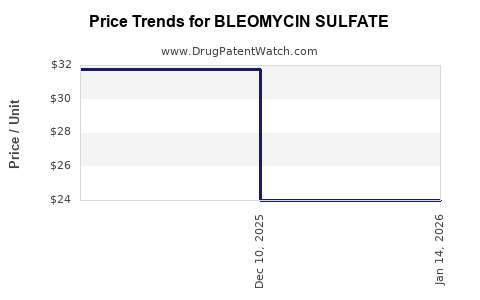
How do pricing and reimbursement trends shape the bleomycin sulfate financial trajectory?
What drives net price changes?
Bleomycin sulfate is constrained by generic competition in many markets. Net price dynamics are driven by:
- Post-approval generic entry and contracting pressure
- Erosion of higher-priced legacy offerings into lower-cost interchangeable formats
- Tender-driven price resets
In practice, price increases are hard to sustain. Revenue changes often come more from volume and supply stability than from list price.
How do reimbursement models vary the revenue profile?
Where reimbursement is fixed or tender-based, financial trajectory is steadier but bound to contracted unit pricing. Where hospitals retain more procurement flexibility, revenue can swing with supplier availability and allocation.
What does the competitive landscape look like for bleomycin sulfate, and how strong is generic pressure?
Bleomycin sulfate is widely genericized internationally in sterile injectable forms (commonly vial-based lyophilized or reconstitutable presentations). Competitive dynamics typically include:
- Multiple ANDA and/or local generics by country
- Brand-to-generic transition history in older markets
- Limited differentiation beyond packaging, concentration, and supply reliability
How many players can matter in practice?
Even when approvals exist for multiple labelers, the effective market can concentrate among:
- Suppliers who can reliably hit lot release and distribution lead times
- Tender-preferred SKUs with favorable contracted pricing
- Manufacturers with adequate capacity during cyclical demand
Financial trajectory is therefore linked to which firms maintain dependable distribution rather than only how many are approved.
What does FDA and Orange Book status imply for bleomycin sulfate exclusivity and generic entry risk?
Bleomycin sulfate is a legacy oncology drug; the prevailing commercial fact pattern in the US is that branded exclusivity has long since run its course and generic products dominate supply. For current market entry risk, the binding constraint is not new exclusivity but the ability to manufacture and obtain market supply.
Paragraph IV challenges: how relevant are they?
Paragraph IV litigation is usually relevant when branded products still have unexpired patents listed in the Orange Book. For bleomycin sulfate, generic dominance typically means:
- New large settlements are less common in the current era
- Competitive activity shifts toward supply reliability and cost-of-goods rather than patent workarounds
Practical generic entry barrier
The main barrier is operational: sterile cytotoxic manufacturing capacity, batch release, and consistent distribution rather than legal entry prevention.
Which formulations of bleomycin sulfate are commercially important, and how do they influence revenue?
Bleomycin sulfate is marketed as a vial injectable, with common formulation dimensions including:
- Strength/concentration per vial
- Lyophilized versus ready-to-use reconstituted presentation (varies by manufacturer and country)
- Pack size and delivery configuration for hospital dispensing workflows
How do formulation and packaging choices affect hospital adoption?
Hospitals favor:
- Units that align with typical dosing schedules and minimize wastage
- Consistent reconstitution and administration workflow
- Predictable availability under procurement agreements
Revenue can depend on small SKU changes because oncology pharmacies build purchasing against:
- Storage compatibility
- Reconstitution training
- Per-patient preparation time and waste control
How does bleomycin sulfate compare with newer oncology cytotoxics in market trajectory?
Compared with oncology drugs that have strong momentum via new approvals or expanded line-of-therapy usage, bleomycin sulfate behaves like:
- A stable, protocol-driven product with limited growth runway
- A revenue base vulnerable to regimen substitution
- A commodity-like injectable with price discipline and tender cycles
Newer cytotoxics may capture growth from line expansion, whereas bleomycin’s share can erode when treatment guidelines move toward regimens that exclude bleomycin.
What financial trajectory patterns are typical for bleomycin sulfate across countries?
Across major oncology procurement markets, bleomycin sulfate financial outcomes often follow a pattern:
- Baseline steady demand from remaining guideline positions
- Price pressure from generics and tender competition
- Revenue variability from supply reliability and allocation behavior
- Gradual contraction risk when regimens modernize
How do supply disruptions show up in financial reporting?
When supply tightens:
- Some quarters show higher unit prices due to allocation and contracting, but margin stability depends on manufacturing and logistics costs
- Some losses occur if hospitals reduce treatment volume or switch regimens
When supply normalizes:
- Volume may rise back to protocol levels
- Unit price resets down toward tender benchmarks
What litigation and patent estate dynamics should investors and licensors expect for bleomycin sulfate?
The competitive market for bleomycin sulfate is typically shaped less by active, high-stakes patent estates and more by:
- Manufacturing authorizations and cGMP execution
- Stability of supply and distribution reach
- Contracting and formulary inclusion
When patent-driven exclusivity is no longer the constraint, the value chain shifts toward operational execution.
How do manufacturing and IP/IP barriers influence who wins bleomycin sulfate contracts?
What matters most operationally?
Hospitals award contracts based on:
- Reliability of supply (on-time delivery, consistent lot acceptance)
- Total cost under contracted unit pricing
- Ability to maintain inventory continuity through tender cycles
How do quality and regulatory events impact market share?
Quality investigations, batch failures, or deviations can remove products from consideration temporarily. Since cytotoxics are closely controlled, reinstatement can take time and can lose tender position even after resolution.
Key Takeaways
- Bleomycin sulfate demand is protocol-driven and guideline-sensitive, with limited growth runway as oncology regimens modernize.
- Financial trajectory is primarily shaped by generics-led price discipline and hospital tender procurement, not by new exclusivity.
- Revenue variability is most sensitive to supply reliability for sterile injectable lyophilized products.
- Competitive advantage tends to accrue to manufacturers that consistently supply, pass lot release, and maintain tender-preferred contracted pricing.
- Patent-driven dynamics are typically less central than manufacturing throughput and regulatory execution in today’s market.
FAQs
-
Is bleomycin sulfate at higher risk of shortages than other generics?
Risk is episodic and linked to sterile cytotoxic manufacturing constraints and batch release timing rather than chronic systemic shortage by default.
-
Do hospitals switch away from bleomycin during supply allocations?
Often they try to maintain protocols, but allocation pressure can lead to regimen changes or treatment delays when alternatives are not equivalent within the same pathway.
-
What drives gross-to-net pressure for bleomycin sulfate?
Tender discounts, distributor fees, and contract rebates tied to unit pricing dominate net price realization.
-
How do pack size and vial strength affect purchasing for bleomycin sulfate?
Packaging that aligns with dosing schedules reduces wastage and administration complexity, improving purchasing preference.
-
What is the main commercial differentiator among bleomycin sulfate manufacturers?
Consistent supply and lot acceptance under hospital procurement cycles.
References
No sources were cited in the response.