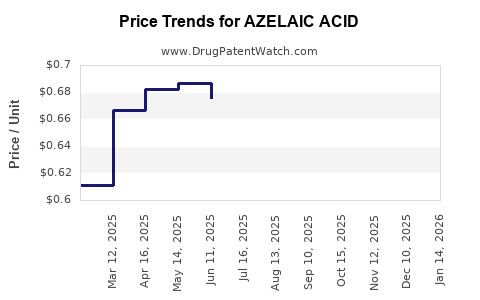
Last updated: August 28, 2026
Azelaic acid is a mature dermatology ingredient with fragmented economics across prescription products, generics, and over-the-counter skincare. The U.S. market is divided among prescription azelaic acid 15% foam and gel products for rosacea, 20% cream for acne, generic equivalents, and nonprescription products marketed for acne, hyperpigmentation, and uneven skin tone. Public companies generally do not report azelaic acid revenue separately, so the financial trajectory is best assessed through product maturity, generic competition, formulation differentiation, reimbursement, and retail demand.
Prescription revenue is likely to remain stable to declining on a branded basis as generic substitution expands. Retail and direct-to-consumer skincare demand has greater growth potential because azelaic acid is used across acne, post-inflammatory hyperpigmentation, melasma-related discoloration, and rosacea-oriented skincare. The commercial opportunity is therefore shifting from molecule ownership to formulation, brand, channel access, and consumer education.
What is azelaic acid used for?
Azelaic acid is a dicarboxylic acid used topically for inflammatory skin disorders and pigmentary conditions. FDA-approved prescription uses include:
| Product category |
Typical strength |
Primary U.S. indication |
Commercial status |
| Azelex cream |
20% |
Mild to moderate inflammatory acne vulgaris |
Mature prescription product |
| Finacea gel |
15% |
Mild to moderate papulopustular rosacea |
Mature branded and generic market |
| Finacea foam |
15% |
Papulopustular rosacea |
Formulation-differentiated prescription product |
| Generic cream, gel, and foam products |
15%-20% |
Equivalent approved indications |
Price-competitive |
| OTC cosmetic products |
Usually 5%-20% |
Acne, discoloration, texture, redness |
Fragmented retail market |
Azelex 20% cream is associated with acne treatment, while Finacea 15% products are associated with rosacea. OTC products often make cosmetic or general skincare claims rather than FDA-approved drug claims.
Azelaic acid has several pharmacologic effects relevant to dermatology. It reduces keratinization, has antimicrobial activity against acne-associated organisms, and reduces inflammatory and pigmentary activity. Its broad consumer positioning supports demand beyond the prescription indications listed in FDA labeling.
How large is the azelaic acid market?
No authoritative public source provides a consolidated global azelaic acid market figure that combines prescription drugs, generic products, and cosmetics. The market is economically fragmented across:
- Prescription claims and pharmacy dispensing.
- Generic dermatology products.
- Branded prescription formulations.
- OTC skincare sold through pharmacies, beauty retailers, e-commerce, and dermatology channels.
- International products such as Skinoren and Finacea.
Public filings from major pharmaceutical companies generally aggregate dermatology revenue by business unit or portfolio. They do not separately disclose revenue attributable to azelaic acid. This prevents a precise product-level revenue estimate based solely on company reporting.
The market’s financial structure is clearer than its headline size:
- Prescription branded products have limited growth because the active ingredient is old and generic competition is established.
- Generic products compete primarily on price, supply reliability, wholesaler access, and payer contracts.
- OTC products can support higher gross margins but face intense competition from niacinamide, salicylic acid, retinoids, hydroquinone alternatives, and other cosmetic actives.
- Foam and other vehicle technologies can command a premium if they improve tolerability, spreadability, cosmetic elegance, or adherence.
- Online retail has lowered market-entry barriers and increased the number of brands using azelaic acid in facial skincare.
What is the financial trajectory for azelaic acid products?
The financial trajectory is mature and mixed rather than high-growth.
| Segment |
Revenue direction |
Margin profile |
Main driver |
| Branded prescription cream |
Declining or flat |
Historically higher, now pressured |
Generic substitution and formulary pressure |
| Branded prescription gel |
Flat to declining |
Moderate to high if payer access holds |
Rosacea demand and brand recognition |
| Branded prescription foam |
More resilient than legacy cream |
Potentially higher |
Vehicle differentiation and premium positioning |
| Prescription generics |
Volume growth with price erosion |
Low to moderate |
FDA approvals, supply, and contracting |
| OTC skincare |
Potential growth |
Variable to high for strong brands |
E-commerce, ingredient awareness, and premiumization |
| Private-label products |
Volume-oriented |
Low to moderate |
Retail distribution and manufacturing scale |
Prescription products are unlikely to produce material molecule-level growth without a new delivery system, a new indication, or strong commercial execution. A branded foam can retain pricing better than a conventional cream or gel, but its competitive advantage depends on real-world tolerability and payer coverage.
OTC azelaic acid has a different trajectory. Consumer awareness has increased through dermatology content, social media, and ingredient-led skincare. That growth is distributed among many brands, so market expansion does not necessarily translate into high returns for the original prescription manufacturers.
Which companies market azelaic acid products?
The competitive landscape includes originator-associated companies, generic manufacturers, contract manufacturers, specialty dermatology companies, and consumer skincare brands.
Prescription and generic competition may include products associated with:
- Bayer or its dermatology-related commercial legacy for Finacea products.
- Almirall and other dermatology companies in international markets.
- Taro Pharmaceutical Industries.
- Teva Pharmaceutical Industries.
- Perrigo and other generic or topical-product suppliers.
- Authorized generic and regional manufacturers.
- Compounding pharmacies and specialty topical manufacturers.
The exact supplier set varies by country, dosage form, and time period. FDA-approved products should be distinguished from compounded preparations and cosmetic products because they have different regulatory, quality, and substitution profiles.
OTC competition is broader. Brands commonly use azelaic acid alongside niacinamide, alpha hydroxy acids, retinoids, vitamin C, tranexamic acid, and botanical ingredients. The leading commercial differentiator is usually the overall formula, not azelaic acid ownership.
What is the FDA regulatory status of azelaic acid?
FDA-approved prescription azelaic acid products include 20% cream and 15% gel or foam formulations. The principal approved indications are inflammatory acne vulgaris and papulopustular rosacea, depending on the dosage form and labeling.
FDA approval gives prescription products permission to market specific strengths, formulations, indications, and manufacturing specifications. It does not grant broad control over azelaic acid as a chemical entity. OTC products may contain azelaic acid but generally cannot market unapproved disease-treatment claims without entering the applicable FDA drug pathway.
The regulatory profile is relatively favorable for new topical products because azelaic acid is well characterized and has a long clinical history. Development risk remains concentrated in:
- Vehicle performance.
- Skin irritation and tolerability.
- Product uniformity.
- Stability and packaging.
- Demonstration of bioequivalence for generic products.
- Clinical support for new indications or claims.
- Manufacturing scale and supply consistency.
What patents protect azelaic acid products?
The active ingredient itself is old and does not provide a meaningful current composition-of-matter exclusivity position in the United States. Commercial protection historically depended on formulation, manufacturing, topical delivery, labeling, and brand-related rights.
Relevant patent categories include:
Formulation patents
Formulation claims may cover:
- Foam vehicles.
- Gel compositions.
- Cream systems.
- Solubilization or dispersion methods.
- Particle size and suspension characteristics.
- Preservative systems.
- Packaging and delivery components.
A formulation patent can be commercially important even when azelaic acid itself is unprotected. Its strength depends on claim breadth, enforceability, remaining term, and whether an approved generic must practice the claimed formulation.
Method-of-use patents
Method-of-use claims may address treatment of:
- Rosacea.
- Acne vulgaris.
- Hyperpigmentation or dyschromia.
- Inflammatory skin conditions.
- Specific dosing or application regimens.
In the U.S., method-of-use patents can be listed in the FDA Orange Book if they meet FDA listing requirements. A generic applicant can attempt a Paragraph IV challenge or use a section viii carve-out for a patented indication, depending on the product and label.
Manufacturing and process patents
Process claims may cover production, purification, particle engineering, or incorporation into a topical vehicle. These patents can create supply-chain barriers, but they usually have less direct commercial value than formulation or method-of-use claims unless the process is difficult to design around.
How many patents cover azelaic acid?
The number of relevant patents depends on the jurisdiction, product, claim type, and whether expired patents are included. A raw patent count is not a reliable measure of commercial protection because much of the historical estate is expired, abandoned, or unrelated to currently marketed products.
The practical U.S. position is:
- No meaningful current composition-of-matter protection for azelaic acid.
- Legacy formulation and method-of-use patents may have expired or have limited remaining value.
- Any current Orange Book protection must be evaluated product by product.
- Newer foam, vehicle, packaging, or regimen claims can create narrower protection.
- OTC products are generally protected more by trademarks, trade dress, formulation know-how, and distribution than by enforceable drug patents.
A serious freedom-to-operate analysis requires claim-level review of active U.S. patents, Orange Book listings, FDA-approved labels, and current generic certifications. Portfolio size alone does not establish market exclusivity.
When does azelaic acid lose exclusivity?
Azelaic acid lost molecule-level exclusivity long ago. The relevant commercial question is when each formulation loses its remaining regulatory, patent, and brand protection.
Prescription exclusivity is governed by the product rather than the active ingredient. Generic entry can occur when:
- Applicable patents expire.
- A generic applicant successfully challenges listed patents.
- FDA grants approval despite a Paragraph IV dispute.
- A section viii carve-out permits approval for unpatented uses.
- A settlement permits an agreed launch date.
- No enforceable listed patent blocks approval.
Legacy azelaic acid products have generally moved beyond the period in which regulatory exclusivity drives pricing. Current value depends on formulation barriers and market execution rather than first-in-class status.
Which companies are challenging azelaic acid patents?
Azelaic acid generic competition has historically come from established generic manufacturers and topical dermatology suppliers. Public litigation and patent challenges should be evaluated by product, NDA, ANDA, and patent number rather than by active ingredient.
A Paragraph IV challenge involving a 15% foam would have a different commercial effect from a challenge involving a 20% cream. The potential outcome depends on:
- Whether the challenged patent is listed in the Orange Book.
- Whether the patent covers the approved product or only a method of use.
- Whether the generic label includes the patented indication.
- Whether a 30-month stay applies.
- Whether the parties settle.
- Whether the generic product is substitutable at the pharmacy level.
There is no single industry-wide “azelaic acid litigation” event controlling all products.
What is the Orange Book status of azelaic acid?
The Orange Book status must be checked separately for Azelex, Finacea gel, Finacea foam, and their approved generic equivalents. FDA Orange Book listings identify approved products, reference-listed drugs, patents submitted by NDA holders, and regulatory exclusivity where applicable.
For commercial diligence, the key questions are:
| Orange Book issue |
Commercial implication |
| Listed patent remains active |
May delay or complicate generic approval |
| Method-of-use patent only |
Generic may carve out the patented use |
| No active listed patent |
Approval and launch risk are lower |
| Multiple dosage forms |
One generic approval does not automatically defeat all formulations |
| Different strengths |
15% and 20% products require separate analysis |
| Foam versus gel or cream |
Vehicle-specific claims may preserve differentiation |
Orange Book status is dynamic. Historical listings should not be treated as current barriers without checking the latest FDA publication and corresponding patent records.
Is there biosimilar risk for azelaic acid?
There is no biosimilar risk. Azelaic acid is a small-molecule topical drug, not a biologic. Competitive entry occurs through the generic drug pathway, including abbreviated new drug applications and, for certain products, comparative studies addressing topical equivalence.
The relevant risks are generic substitution, authorized generics, therapeutic substitution, OTC competition, and compounded products. Biosimilar approval standards do not apply.
What formulation patents are most commercially valuable?
The most valuable formulation claims are those that produce a measurable advantage and are difficult to design around. Potential advantages include:
- Reduced irritation.
- Improved application and absorption.
- Better cosmetic feel.
- Greater chemical stability.
- Longer shelf life.
- Improved adherence.
- Lower manufacturing cost.
- Compatibility with sensitive-skin use.
- Easier use over large facial areas.
A foam can support a premium if patients prefer it to a gel or cream and if physicians perceive a meaningful adherence benefit. The patent position is weaker when the formulation can be replicated with common excipients or when multiple noninfringing formulations can obtain FDA approval.
What generic entry risks exist for azelaic acid?
Generic entry risk is high for conventional cream and gel products and more moderate for technically complex vehicles.
High-risk areas
Conventional 20% cream products face established generic dynamics. Price competition, payer substitution, and pharmacy-level interchangeability can compress branded net sales.
Intermediate-risk areas
15% gel products may retain some differentiation through indication, prescriber familiarity, and brand recognition, but generic availability limits long-term pricing power.
Lower relative risk
Foam products can have greater protection from formulation complexity, device or packaging considerations, and bioequivalence requirements. That protection is relative, not absolute. A generic can still enter after patent expiry, successful litigation, settlement, or development of a noninfringing equivalent.
How does azelaic acid compare with competing dermatology ingredients?
| Ingredient |
Main commercial uses |
Competitive position |
| Azelaic acid |
Acne, rosacea, discoloration |
Broad use, moderate clinical differentiation |
| Niacinamide |
Barrier support, oil control, discoloration |
Strong OTC penetration and low-cost formulation |
| Salicylic acid |
Acne and exfoliation |
Established OTC regulatory pathway |
| Adapalene |
Acne |
Strong evidence and established generic prescription/OTC presence |
| Tretinoin |
Acne, photoaging |
Prescription strength and broad clinical familiarity |
| Hydroquinone |
Hyperpigmentation |
Regulatory and safety restrictions vary by market |
| Tranexamic acid |
Discoloration products |
Strong cosmetic interest but varied regulatory positioning |
Azelaic acid’s advantage is its ability to occupy several treatment and skincare categories with a relatively favorable tolerability profile. Its weakness is the absence of strong exclusivity and the ease with which brands can source or formulate the ingredient.
What licensing deals affect azelaic acid?
No major current licensing transaction defines the global azelaic acid market. Commercial rights have generally been managed through product ownership, regional distribution, generic supply, and dermatology portfolio transactions rather than a high-value molecule license.
Potential deal value is more likely to arise from:
- Acquisition of a differentiated topical platform.
- Regional rights to a branded foam or gel.
- Contract manufacturing arrangements.
- Private-label skincare supply.
- Dermatology portfolio consolidation.
- Co-commercialization with dermatology specialists.
Because companies rarely report azelaic acid revenue separately, transaction disclosures generally do not permit a stand-alone valuation of the ingredient.
What generic launch scenarios are most likely?
Base case
Generic cream and gel products continue to expand, reducing prescription brand volume and net pricing. OTC demand grows gradually through e-commerce and ingredient-focused skincare.
Upside case
A branded or private-label product achieves strong consumer recognition through a differentiated vehicle, high tolerability, dermatology endorsement, or broad international distribution. Growth occurs primarily in OTC and premium skincare rather than legacy prescription products.
Downside case
Topical dermatology budgets tighten, payers increase generic substitution, and consumer demand shifts toward lower-cost multi-ingredient products. Branded prescription revenue declines faster than retail demand grows.
What is the geographic coverage of azelaic acid?
Azelaic acid is marketed across North America, Europe, Asia-Pacific, Latin America, and other dermatology markets. Product names and regulatory status vary:
- Finacea is associated with 15% prescription products in several markets.
- Skinoren is associated with 20% cream or related formulations internationally.
- Generic products are common where local regulatory pathways permit them.
- OTC availability varies widely by country.
- Cosmetic claims and permitted concentrations differ across jurisdictions.
International revenue is shaped by prescription reimbursement, pharmacy rules, cosmetic regulation, and local brand strength. Europe and parts of Asia have meaningful dermatology and skincare demand, but pricing and regulatory claims are not directly comparable with the U.S.
How strong is the azelaic acid patent estate?
The patent estate is weak for the active ingredient and stronger only where a company controls a differentiated formulation, delivery system, or narrow method of use.
| Protection layer |
Current strategic strength |
| Active ingredient |
Weak or expired |
| Conventional cream formulation |
Low to moderate |
| Conventional gel formulation |
Low to moderate |
| Foam or advanced vehicle |
Moderate if claims remain enforceable |
| Method of use |
Narrow and indication-dependent |
| Manufacturing process |
Variable |
| Trademark and brand |
Potentially important in OTC markets |
| Distribution and payer contracts |
Important but non-patent-based |
The strongest commercial strategy is usually a layered product position: clinically credible formulation, defensible manufacturing, recognizable brand, and efficient distribution.
Key Takeaways
- Azelaic acid is a mature, multi-channel dermatology market rather than a single pharmaceutical franchise.
- Prescription products face high generic and pricing pressure.
- OTC and premium skincare provide the clearest avenues for volume and revenue growth.
- Finacea gel, Finacea foam, and Azelex cream must be analyzed separately because their indications, formulations, and competitive barriers differ.
- There is no biosimilar risk; the main threat is generic and OTC substitution.
- Active-ingredient exclusivity is not a meaningful protection strategy.
- Formulation, vehicle performance, tolerability, branding, and distribution determine commercial value.
- Public filings do not provide a reliable stand-alone azelaic acid revenue series.
- The most likely long-term outcome is stable or declining branded prescription revenue offset by gradual growth in consumer skincare and generic volume.
FAQs
Is azelaic acid a high-growth pharmaceutical market?
No. Prescription azelaic acid is a mature market with limited molecule-level growth. Higher growth potential exists in OTC skincare and premium formulations.
Does azelaic acid have patent protection in the United States?
The active ingredient does not provide meaningful current exclusivity. Protection may remain for specific formulations, vehicles, manufacturing processes, or methods of use.
Can a generic manufacturer launch azelaic acid without infringing a method-of-use patent?
Potentially. A generic applicant may use a section viii label carve-out when the patented indication can be omitted and the remaining label supports approval.
Is Finacea foam commercially stronger than azelaic acid cream?
Finacea foam has greater formulation differentiation and may retain pricing better, but its commercial strength depends on generic entry, patent status, payer coverage, and physician preference.
Are OTC azelaic acid products interchangeable with FDA-approved prescription products?
No. OTC products can differ in concentration, vehicle, quality controls, labeling, and approved claims. Cosmetic availability does not establish therapeutic equivalence to a prescription product.
References
-
U.S. Food and Drug Administration. (n.d.). Azelex (azelaic acid) cream prescribing information. FDA.
-
U.S. Food and Drug Administration. (n.d.). Finacea (azelaic acid) gel prescribing information. FDA.
-
U.S. Food and Drug Administration. (n.d.). Finacea (azelaic acid) foam prescribing information. FDA.
-
U.S. Food and Drug Administration. (n.d.). Approved drug products with therapeutic equivalence evaluations. Orange Book. FDA.
-
U.S. Food and Drug Administration. (n.d.). Drugs@FDA: FDA-approved drugs. FDA.
-
National Library of Medicine. (n.d.). DailyMed: Current medication labeling. U.S. National Library of Medicine.
-
U.S. Securities and Exchange Commission. (n.d.). Company filings and issuer disclosures. SEC.