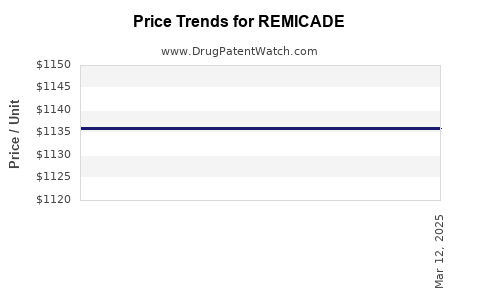
Last updated: September 7, 2026
REMICADE (infliximab) is a mature anti-TNF biologic facing sustained biosimilar erosion in the United States and Europe. Janssen retains the U.S. brand, while Merck has commercial rights in many markets outside the United States. Global originator revenue has fallen from a peak above $9 billion annually to the low-single-digit billions as Inflectra, Renflexis, Avsola, and other infliximab products expanded access and reduced net pricing. The product remains commercially relevant because of its large installed base, multiple autoimmune indications, hospital-administered dosing, and physician familiarity, but its growth profile is structurally negative.
What is REMICADE and which companies commercialize it?
REMICADE is an intravenous formulation of infliximab, a chimeric monoclonal antibody that binds tumor necrosis factor alpha, or TNF-alpha. The drug is administered primarily in infusion centers and hospital outpatient settings.
| Attribute |
REMICADE |
| Active ingredient |
Infliximab |
| Biologic class |
Chimeric monoclonal antibody |
| Original innovator |
Centocor, later Janssen |
| U.S. commercial company |
Janssen Biotech, a Johnson & Johnson company |
| Major non-U.S. commercial partner |
Merck |
| FDA approval |
1998 |
| Administration |
Intravenous infusion |
| Principal therapeutic areas |
Rheumatoid arthritis, Crohn's disease, ulcerative colitis, ankylosing spondylitis, psoriatic arthritis, plaque psoriasis |
| Main competitors |
Humira, Enbrel, Stelara, Entyvio, Simponi, Cimzia, biosimilar infliximab products |
| Regulatory category |
Biologic license application product |
REMICADE is approved for several chronic inflammatory diseases. Its broad label has supported durable use in gastroenterology, rheumatology, dermatology, and immunology. The intravenous route differentiates it from self-injected TNF inhibitors but also makes purchasing, site of care, infusion capacity, and payer contracting central to its market performance.
How has REMICADE revenue changed over time?
REMICADE revenue has followed the standard lifecycle of a first-generation biologic: rapid expansion after approval, a long period of high sales, and accelerated erosion after biosimilar entry.
Janssen and Merck report sales by company and geography, so their figures should not be added without accounting for reporting boundaries. The combined originator franchise reached more than $9 billion in annual sales at its peak. By the early 2020s, annual revenue had fallen to approximately $3 billion or less, depending on the reporting period and inclusion of regional sales.
| Period |
Financial trajectory |
Primary driver |
| 1998-2005 |
Rapid adoption |
First-in-class or early biologic positioning across multiple autoimmune diseases |
| 2006-2014 |
Peak commercial period |
Broad indication expansion and limited direct biologic substitution |
| 2015-2018 |
Early decline |
U.S. and European biosimilar approvals; payer pressure |
| 2019-2021 |
Accelerated erosion |
Wider biosimilar availability and contracting |
| 2022-2024 |
Mature decline |
Lower net pricing, substitution, and migration to newer therapies |
Janssen’s annual reports show a multiyear decline in U.S. REMICADE sales after biosimilar entry. Merck has also reported declining REMICADE revenue in international markets as biosimilars gained share and reference-product pricing weakened. The decline has been gradual rather than an immediate loss of the franchise because infusion providers, physicians, and payers have adopted biosimilars at different rates.
The financial exposure is now concentrated in residual brand share, contracting economics, and markets where substitution is slower. REMICADE no longer has the growth characteristics of newer Janssen assets such as STELARA or DARZALEX.
When did REMICADE lose market exclusivity?
REMICADE’s regulatory exclusivity ended before or around the period when biosimilar competition became commercially significant. The first U.S. biosimilar approvals occurred in 2016, although product launches were affected by patent litigation and settlement agreements.
The key U.S. biosimilar timeline is:
| Product |
Sponsor |
FDA approval |
Commercial status |
| Inflectra |
Celltrion; U.S. commercialized by Pfizer |
April 2016 |
Launched in the U.S. in 2016 |
| Renflexis |
Samsung Bioepis; commercialized by Organon/Merck in the U.S. |
April 2017 |
Launched in 2017 |
| Ixifi |
Pfizer |
May 2017 |
Approval obtained; commercial impact limited |
| Avsola |
Amgen |
December 2019 |
U.S. launch in 2020 |
The Biologics Price Competition and Innovation Act gives reference biologics 12 years of data exclusivity in the United States. REMICADE was approved in 1998, so the statutory exclusivity period expired well before the current biosimilar market matured. Patent settlements and commercial contracting delayed or shaped the timing of some launches, but they did not preserve a long-term monopoly.
What biosimilars compete with REMICADE?
Inflectra
Inflectra is the principal early U.S. biosimilar competitor. Pfizer commercialized the product in the United States after Celltrion developed it. Inflectra gained a first-mover advantage and became an important source of price competition in hospital and physician-administered channels.
Renflexis
Renflexis is Samsung Bioepis’ infliximab biosimilar. Organon has commercialized the product in the United States after the separation of Organon from Merck. Its market position is supported by hospital contracting and portfolio relationships.
Avsola
Avsola is Amgen’s infliximab biosimilar. It entered the U.S. market after the first two competitors and has been used to increase contracting pressure on REMICADE and other infliximab products.
Ixifi
Ixifi received FDA approval but has had less visible commercial impact than Inflectra, Renflexis, and Avsola. Approval does not necessarily translate into material market share in a physician-administered biologic market, where contracting, distribution, inventory, and infusion-provider economics are decisive.
As of the relevant U.S. market period, these products were biosimilar infliximab products but not generally designated as interchangeable by the FDA. Pharmacy-level automatic substitution rules therefore do not apply in the same way as they do for interchangeable products dispensed through retail pharmacies. Prescribers, health systems, payers, and infusion providers remain central to product selection.
How do biosimilars affect REMICADE pricing and market share?
Biosimilar competition has reduced REMICADE’s net price and volume, but the impact has been less abrupt than in many small-molecule generic markets.
The main commercial factors are:
- Physician-administered purchasing. Hospitals and infusion centers negotiate prices directly or through group purchasing organizations.
- Buy-and-bill reimbursement. Providers purchase the product, administer it, and receive reimbursement, creating incentives to select products with favorable acquisition margins.
- Payer policy. Health plans use preferred-product policies, site-of-care rules, prior authorization, and differential reimbursement.
- Switching evidence. Infliximab has multiple indications and long-term users, so switching decisions can depend on physician confidence and patient stability.
- Contracting. Originator discounts can narrow the gap between REMICADE and biosimilars.
- Distribution economics. Wholesaler and specialty-distribution arrangements influence inventory and availability.
The result is a market with declining average selling prices, continuing originator use, and variable biosimilar penetration by indication and geography. Europe generally adopted infliximab biosimilars earlier than the United States, supported by centralized procurement, hospital tenders, and national reimbursement controls.
What patents protect REMICADE?
REMICADE’s core patent protection has largely expired or reached the end of its commercially meaningful life. The historic U.S. patent estate included patents covering anti-TNF antibodies, antibody sequences, and related biologic subject matter.
Key patent issues included:
| Patent issue |
Commercial relevance |
| Antibody and anti-TNF claims |
Supported the original biologic monopoly |
| Manufacturing and cell-culture claims |
Could create additional barriers, but generally have narrower practical value than composition claims |
| Formulation claims |
Relevant to stability and administration, but less decisive for an intravenously administered legacy biologic |
| Method-of-use claims |
Covered treatment of inflammatory diseases and could support litigation in specific indications |
| Patent settlements |
Controlled the timing and conditions of certain biosimilar launches |
The principal REMICADE patent estate did not create a durable post-biosimilar barrier comparable to a newer biologic with multiple late-filed formulation, device, dosing, and manufacturing patents. Infliximab is administered intravenously, so injector-device patents are not a major protection layer. The remaining commercial defense has therefore depended more on contracting, physician loyalty, service support, and reimbursement than on enforceable exclusionary rights.
What is the Orange Book status of REMICADE?
REMICADE is a biologic, so its patent listings are handled through the FDA’s biologics framework rather than the conventional small-molecule Orange Book listing system.
The FDA’s Purple Book is the principal reference for biologic reference products, biosimilars, and interchangeability designations. REMICADE’s competitive analysis should therefore use:
- FDA Purple Book records
- Biologic License Application information
- FDA biosimilar approval letters
- Patent litigation dockets
- Annual reports and securities filings
- Medicare and commercial payer policies
The absence of a traditional Orange Book listing does not mean the product lacked patent protection. It means the legal and regulatory framework differs from an abbreviated new drug application product.
Which companies challenged REMICADE exclusivity?
The main competitive challengers were Celltrion, Pfizer, Samsung Bioepis, Organon, and Amgen.
| Company |
Role in infliximab competition |
| Celltrion |
Developed Inflectra and pursued the U.S. biosimilar pathway |
| Pfizer |
Commercialized Inflectra and obtained approval for Ixifi |
| Samsung Bioepis |
Developed Renflexis |
| Organon |
Commercialized Renflexis in the United States after its separation from Merck |
| Amgen |
Developed and commercialized Avsola |
| Janssen |
Defended REMICADE patents and managed originator contracting |
| Merck |
Commercialized REMICADE in many markets outside the United States |
Patent disputes involving REMICADE biosimilars were resolved through litigation and settlement arrangements that permitted market entry while preserving some period of originator protection. The settlements limited the risk of an immediate injunction against biosimilar entry but did not stop long-term competition.
What is the current FDA regulatory status of REMICADE?
REMICADE remains an FDA-approved reference biologic for multiple autoimmune indications. Its principal regulatory risk is not withdrawal or safety-driven loss of approval. The key issue is erosion of commercial preference as FDA-approved biosimilars become accepted by payers and clinicians.
The regulatory market has several characteristics:
- Multiple FDA-approved infliximab biosimilars are available.
- Biosimilarity does not automatically establish interchangeability.
- Switching authority varies by state, payer, institution, and product designation.
- REMICADE retains reference-product status.
- New indications for a biosimilar may be supported through extrapolation where FDA standards are met.
- Pharmacovigilance and immunogenicity monitoring remain relevant for all infliximab products.
The product’s long safety history supports continued use, but it also reduces the strategic advantage of the originator because competing products can rely on an established clinical and regulatory record.
How strong is the REMICADE patent estate?
REMICADE has a weak-to-moderate current patent position and a strong historical patent position.
| Dimension |
Assessment |
| Core composition protection |
Largely expired or commercially exhausted |
| Formulation protection |
Limited incremental value |
| Method-of-use protection |
Potentially relevant but difficult to use against broad biosimilar substitution |
| Manufacturing protection |
May create process barriers, but does not normally block biosimilar approval by itself |
| Device protection |
Limited relevance because administration is intravenous |
| Litigation leverage |
Reduced after multiple biosimilar launches |
| Commercial durability |
Based more on contracts and clinical familiarity than patents |
The remaining IP can still affect litigation strategy or specific manufacturing pathways. It is unlikely to restore broad exclusivity or reverse the long-term revenue decline.
How does REMICADE compare with competing biologics?
| Product |
Mechanism |
Route |
Competitive position |
| REMICADE |
TNF-alpha inhibitor |
Intravenous |
Mature originator with multiple biosimilars |
| HUMIRA |
TNF inhibitor |
Subcutaneous |
Large biosimilar wave after 2023 U.S. entry |
| ENBREL |
TNF inhibitor |
Subcutaneous |
Durable U.S. position with limited U.S. biosimilar competition |
| STELARA |
IL-12/23 inhibitor |
Subcutaneous or intravenous induction |
Higher-value successor asset with biosimilar risk emerging later |
| ENTYVIO |
Integrin inhibitor |
Intravenous or subcutaneous |
Gastroenterology competitor with differentiated mechanism |
| SIMPONI |
TNF inhibitor |
Subcutaneous or intravenous formulation depending on product |
Smaller TNF competitor |
| CIMZIA |
TNF inhibitor |
Subcutaneous |
Differentiated pregnancy and immunogenicity positioning in some uses |
REMICADE’s primary strategic weakness is class maturity. Inflammatory bowel disease and rheumatology treatment increasingly use newer mechanisms, including IL-12/23, IL-23, JAK, integrin, and IL-17 pathways. Biosimilars intensify the price disadvantage, while newer therapies compete on efficacy, convenience, persistence, and patient preference.
What generic or biosimilar launch risks remain?
The direct risk is continued biosimilar share gain rather than a single future launch event. Key scenarios are:
Base case
REMICADE revenue continues to decline at a mid-single-digit to low-double-digit rate as biosimilar contracting expands and originator discounts increase.
Downside case
A large payer or integrated health-system contract makes a biosimilar the preferred infliximab product across major indications. REMICADE loses volume and must reduce price to retain accounts.
Stabilization case
REMICADE preserves a meaningful share among established patients and infusion providers through service, supply reliability, rebates, and physician preference. Revenue declines but does not collapse.
Automatic substitution is less likely to produce a sudden retail-style conversion because most infliximab is administered under medical benefits. The commercial transition is therefore managed account by account.
What licensing deals affect REMICADE?
REMICADE’s commercial history depends on regional licensing and co-commercialization arrangements.
Centocor developed the product, while Schering-Plough held rights in many markets outside the United States. Merck acquired Schering-Plough in 2009 and inherited the international REMICADE business. Janssen retained the U.S. business within Johnson & Johnson.
After Merck separated its established-products business into Organon in 2021, Organon became a major commercial participant in infliximab through Renflexis and retained relevant international commercial relationships. These arrangements create different revenue trajectories and competitive strategies by geography.
The commercial split matters because U.S. Janssen revenue and international Merck or Organon revenue are reported separately. A global market estimate must avoid treating one company’s reported sales as total REMICADE revenue.
What is REMICADE’s revenue exposure for Johnson & Johnson and Merck?
REMICADE is no longer a major growth engine for Johnson & Johnson. Its financial importance has declined as newer products, especially STELARA and oncology medicines, became more important to the company’s pharmaceutical portfolio.
For Merck and Organon, REMICADE has also shifted from a growth asset to a mature established product. International price controls and biosimilar tendering create additional pressure outside the United States.
The financial exposure has three components:
- Direct product revenue
- Rebates and price concessions needed to defend share
- Cannibalization risk from affiliated or partner biosimilar products
The third factor is strategically important. A company connected to both the originator and a biosimilar may accept lower REMICADE revenue if the combined portfolio captures more infliximab volume and protects channel relationships.
What is the commercial outlook for REMICADE?
REMICADE should be modeled as a declining, cash-generative legacy biologic rather than a growth product. The product retains value in patients who are stable on therapy, in markets with slower biosimilar uptake, and in infusion settings where operational familiarity matters.
The strongest downside pressures are:
- Continued biosimilar price competition
- Payer mandates and preferred-product policies
- Physician acceptance of switching
- Lower reimbursement spreads for originator products
- Migration to newer mechanisms
- European tendering and reference pricing
- Portfolio prioritization by manufacturers
The principal supports are:
- Long clinical experience
- Broad indication coverage
- Established infusion infrastructure
- Patient persistence
- Supply reliability
- Contracting flexibility
- Physician familiarity
A reasonable strategic valuation should assign limited value to REMICADE patent protection and place greater weight on remaining brand share, net price, biosimilar penetration, and the economics of infusion-provider contracts.
Key takeaways
- REMICADE is a mature infliximab biologic with a long-established autoimmune franchise.
- Its combined global originator revenue has fallen from more than $9 billion at peak levels to the low-single-digit billions.
- U.S. biosimilar competition began with Inflectra in 2016 and expanded through Renflexis, Ixifi, and Avsola.
- The product’s historic patent estate has largely expired or lost practical exclusionary force.
- REMICADE is evaluated through the FDA’s Purple Book framework rather than conventional Orange Book listings.
- Biosimilar erosion is gradual because infliximab is administered in clinics and hospitals under medical-benefit reimbursement.
- Janssen’s financial exposure is declining, while Merck and Organon face separate geographic and portfolio effects.
- The remaining commercial defense is contracting, clinical familiarity, supply reliability, and infusion-provider economics.
- Long-term revenue should continue to decline unless originator retention materially exceeds current biosimilar adoption trends.
FAQs about REMICADE market dynamics and financial performance
Is REMICADE still commercially important?
Yes. REMICADE remains widely used, but it is no longer a high-growth biologic. Its value is concentrated in established patients, infusion networks, and markets with slower biosimilar conversion.
Which REMICADE biosimilar has the strongest U.S. position?
Inflectra had the earliest U.S. entry and broad recognition. Renflexis and Avsola increased contracting pressure. Actual share varies by payer, provider, indication, and net price.
Can a pharmacy automatically substitute a REMICADE biosimilar?
Generally not in the same manner as an interchangeable retail generic. REMICADE is administered by infusion, and product selection usually involves the prescriber, payer, hospital, or infusion provider.
Does REMICADE have patent protection beyond its core patent?
Some method-of-use, manufacturing, or related claims may remain relevant in particular jurisdictions or disputes. Those claims are unlikely to recreate broad market exclusivity after multiple biosimilar launches.
Is REMICADE exposed to biosimilar competition outside the United States?
Yes. European and other international markets have experienced substantial infliximab biosimilar competition, often through hospital tenders, centralized procurement, and reimbursement controls.
References
- Amgen Inc. (2024). 2023 annual report. https://www.amgen.com
- Food and Drug Administration. (2016). FDA approves Inflectra, a biosimilar to Remicade. https://www.fda.gov
- Food and Drug Administration. (2017). FDA approves Renflexis, a biosimilar to Remicade. https://www.fda.gov
- Food and Drug Administration. (2017). FDA approves Ixifi, a biosimilar to Remicade. https://www.fda.gov
- Food and Drug Administration. (2019). FDA approves Avsola, a biosimilar to Remicade. https://www.fda.gov
- Food and Drug Administration. (2024). Purple Book: Database of licensed biological products. https://purplebooksearch.fda.gov
- Johnson & Johnson. (2024). 2023 annual report. https://www.jnj.com
- Merck & Co., Inc. (2021). 2020 annual report. https://www.merck.com
- Organon & Co. (2024). 2023 annual report. https://www.organon.com
- U.S. Congress. (2010). Biologics Price Competition and Innovation Act of 2009, Pub. L. No. 111-148, §7002. https://www.congress.gov