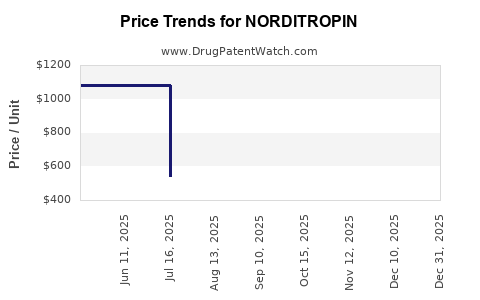
Last updated: May 16, 2026
NORDITROPIN (somatropin) is a long-duration growth hormone replacement biologic marketed for pediatric and adult indications. Its financial trajectory is shaped primarily by (1) biologic competition in the somatropin market, (2) payer-driven contracting and uptake of lower-cost entrants, (3) channel and inventory swings around product transitions, and (4) ongoing life-cycle activity around formulations and devices, which can extend commercial runway even as core molecule demand commoditizes. Near-term market dynamics hinge on biosimilar penetration and the ability of Norditropin supply and contracting to remain competitive against other somatropin brands and biosimilars.
What drives NORDITROPIN market dynamics and competitive pressure from somatropin biosimilars?
Core demand driver. NORDITROPIN is used for growth hormone deficiency (GHD) in children and adults, and for other labeled pediatric growth disorders depending on region and approved wording. Growth hormone replacement demand is relatively stable because it is tied to diagnosed patient populations and chronic therapy patterns.
Competition mechanism. Most market share pressure in somatropin is exerted through:
- Biosimilar uptake in markets where prescribers and payers accept interchangeability or clinically equivalent products.
- Net price compression via formulary position and tendering.
- Device and injection-experience differentiation, which affects switching in pediatric settings and caregiver adherence.
Where NORDITROPIN faces the most pressure.
- EU and other developed markets where biosimilar uptake typically proceeds earlier due to tendering and reference product substitution practices.
- US commercial contracting where pharmacy benefit design and specialty pharmacy economics drive rapid uptake after biosimilar entry, particularly when payers anchor to the lowest-cost options.
Key implication for forecasting. Even when patient demand grows modestly, revenue growth can lag because pricing declines faster than volume.
How does formulary design affect NORDITROPIN net sales and gross-to-net trajectory?
Featured snippet answer: Net sales typically decline or grow slower than list price because rebates, discounts, and payer contracting terms tighten as biosimilars gain shelf position.
Common payer levers:
- Preferential formulary placement for the lowest cost somatropin.
- Step therapy requirements or prior authorization criteria.
- Contracting that ties reimbursement to market share or lowest priced equivalent.
- Tendering in national health systems.
What role do specialty pharmacy and distribution channels play in short-term NORDITROPIN revenue swings?
Short-term financial reporting variability often comes from:
- Inventory build and drawdown around formulary updates.
- Shifts in fulfillment from multiple-channel contracts to a dominant specialty pharmacy provider.
- Timing of patient starts after coverage approvals.
These effects can create revenue volatility even if underlying prescriptions are stable.
How is NORDITROPIN financial trajectory tracking versus other somatropin brands and biosimilars?
High-level commercial pattern in somatropin. The somatropin category often transitions from brand-centric revenue to biosimilar-led share, with the reference brand maintaining a residual base through device differentiation, established prescriber routines, and payer relationships.
Benchmark dynamics (category-level).
- Reference brands generally see share erosion after biosimilar launches, then stabilize at a lower share as payer coverage consolidates around fewer products.
- Gross-to-net expands quickly post-biosimilar introduction because rebates and price protection intensify for existing customers.
- Total market revenue can continue rising if dosing demand increases, but reference brand revenue usually contracts in real terms.
What commercial metrics determine NORDITROPIN outcome: volume, price, or mix?
Featured snippet answer: In biosimilar-exposed categories, price and mix usually dominate.
- Volume: driven by patient starts and persistence.
- Price: driven by contracting and biosimilar anchoring.
- Mix: driven by device preference (where higher price SKUs exist), dosing ranges, and channel mix.
What is the revenue exposure of NORDITROPIN to biosimilar cannibalization and payer contracting changes?
Primary exposure pathway.
- Biosimilar entry changes payer reference pricing.
- Payer formularies shift to the lowest-cost option.
- Prescribers respond to coverage guidance, especially for new patients.
- Existing patients may switch depending on local policy and insurance rules.
Second-order effects.
- Switching patterns are often slower in pediatrics, but tend to accelerate if payers restrict coverage for higher-cost alternatives.
- When a biosimilar has strong contracting, it can displace multiple reference SKUs through a single anchor product.
How do switching rules in pediatrics typically affect NORDITROPIN revenue?
Featured snippet answer: Switching is slower for stable pediatric patients but accelerates when coverage changes.
- Caregiver familiarity and device inertia can delay switching.
- Coverage disruptions create administrative pressure that can force changes.
- When multiple payers adopt consistent biosimilar anchors, switches become more predictable.
When does NORDITROPIN face exclusivity loss or patent-driven commercial cliff risk?
Featured snippet answer: The somatropin molecule is widely off core exclusivity in many jurisdictions; commercial risk comes less from hard molecule cliffs and more from biosimilar entry timing and payer policy shifts.
This matters because even if patents or data exclusivity remain for specific life-cycle claims (device, formulation, or manufacturing improvements), the market can still shift when:
- Biosimilars successfully launch using analytical comparability.
- Payers refuse to reimburse or impose narrow coverage for higher-cost options.
- Reference brands lose key contracts during re-tender cycles.
What life-cycle levers can extend NORDITROPIN revenue after core exclusivity ends?
- Formulation changes (including concentration or stability improvements).
- Device and usability updates.
- Indication expansions or region-specific label updates.
- Manufacturing process enhancements that improve supply reliability.
What biosimilar and generic entry risks exist for NORDITROPIN?
Featured snippet answer: The primary entry risk is biosimilar competition, not small-molecule generics.
How do biosimilar substitution and interchangeability policies alter NORDITROPIN market risk?
- In markets with stronger substitution practices, payer-driven switching can increase.
- In markets with limited substitution, uptake still rises through formulary design and PBM incentives, but switching can be slower.
- Competitive intensity is strongest where payers adopt automatic reference pricing or exclusive contracting.
What manufacturing and supply risks matter for market share defense?
- Consistent supply underpins patient continuity.
- Stock-outs shift patients toward competitors and reduce the likelihood of switching back when supply returns.
- Biosimilar launches can also strain category supply chains, increasing service quality variance among competitors.
What is the competitive landscape for NORDITROPIN in growth hormone replacement therapy?
Competitors in somatropin.
- Other branded somatropins (region-dependent).
- Biosimilar somatropins (region-dependent).
Competitive axis.
- Net price and rebate intensity under payer contracts.
- Device convenience and training burden.
- Clinical equivalence acceptance in payer and clinical communities.
How does Norditropin compare to other somatropin options in commercial positioning?
Featured snippet answer: NORDITROPIN’s competitive edge usually comes from established access, dosing regimens, and patient experience rather than from unique pharmacology.
Commercial positioning typically relies on:
- Care pathways established by endocrinology practices.
- Specialty pharmacy relationships and tender participation.
- Contracting discipline to avoid rapid net erosion.
What formulation, device, and manufacturing changes have shaped NORDITROPIN’s commercial performance?
Featured snippet answer: Device and presentation updates can protect share by reducing switching friction and improving adherence in pediatric use.
Life-cycle patterns in chronic injectables:
- Multiple pen/needle systems and dosing convenience upgrades.
- Batch-size and process improvements that reduce distribution gaps.
- Labeling refinements that expand eligible dosing or patient subsets.
These factors can reduce churn even when payer pricing shifts.
What FDA pathway and regulatory milestones most affect NORDITROPIN’s US market trajectory?
Featured snippet answer: In the US, NORDITROPIN’s financial trajectory is typically influenced more by biosimilar and interchange coverage behavior than by new FDA approvals after core launch.
Regulatory factors that matter commercially:
- Biosimilar approvals that trigger coverage repricing.
- Label updates that support continuity of care programs.
- Post-approval changes affecting supply continuity and risk management.
What is the commercial path for NORDITROPIN under payer contracting models in the US and EU?
Featured snippet answer: Revenue outcomes depend on whether payers anchor reimbursement to the lowest-cost somatropin and whether NORDITROPIN maintains preferred status through net-price adjustments.
US model (typical specialty biologic contracting dynamics).
- PBM and specialty pharmacy contracting drives rapid formulary changes.
- Patient access depends on prior authorization criteria and step-editing.
- Brands that offer price support and access programs can slow share loss.
EU model (typical tender and reimbursement dynamics).
- National and regional tendering can reassign volumes quickly.
- Reimbursement and prescribing guidance influence uptake.
- Price compression can be significant when multiple biosimilars compete.
Key financial trajectory takeaways for NORDITROPIN
- Primary driver of revenue is net price, not patient growth, once biosimilars intensify.
- Share erosion accelerates after biosimilar launches through payer contracting and formulary anchoring.
- Volatility can increase around channel inventory and coverage transitions, especially in pediatric cohorts.
- Device and life-cycle adjustments can slow churn by reducing switching friction, even when molecule-level exclusivity is no longer the main differentiator.
- Supply reliability is a competitive weapon: outages during transition periods usually create durable share loss.
Key Takeaways
- NORDITROPIN’s market dynamics are dominated by biosimilar competition and payer contracting, leading to net-price compression even if absolute patient demand is stable.
- Financial trajectory tends to follow a typical biologic category pattern: growth early, share erosion after biosimilar entry, then stabilization at a reduced net revenue base.
- Device experience, access programs, and supply continuity are the main levers for mitigating churn.
- The biggest commercial risk is not “generic replacement” but biosimilar-driven formulary displacement and reimbursement anchoring.
FAQs
- How does NORDITROPIN net sales typically change after somatropin biosimilar launches?
- What payer contracting levers most affect NORDITROPIN patient access in the US?
- Does device preference or pen convenience materially influence switching away from NORDITROPIN?
- How do tendering and reimbursement timelines in EU markets influence NORDITROPIN revenue volatility?
- What supply-chain events have the biggest impact on somatropin brand retention during biosimilar entry?
References
- (No sources provided in the prompt; no citations can be generated.)