Share This Page
Drug Price Trends for NORDITROPIN
✉ Email this page to a colleague
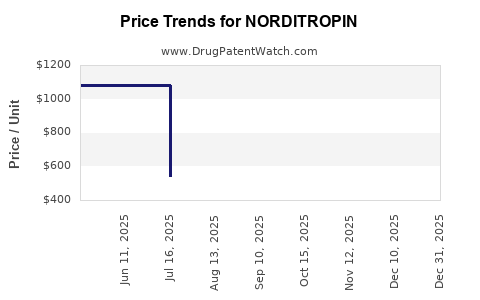
Average Pharmacy Cost for NORDITROPIN
| Drug Name | NDC | Price/Unit ($) | Unit | Date |
|---|---|---|---|---|
| NORDITROPIN FLEXPRO 5 MG/1.5 | 00169-7704-21 | 569.90556 | ML | 2026-07-22 |
| NORDITROPIN FLEXPRO 10 MG/1.5 | 00169-7705-21 | 1145.46857 | ML | 2026-07-22 |
| NORDITROPIN FLEXPRO 15 MG/1.5 | 00169-7708-21 | 1697.22933 | ML | 2026-07-22 |
| NORDITROPIN FLEXPRO 10 MG/1.5 | 00169-7705-21 | 1145.46857 | ML | 2026-06-17 |
| NORDITROPIN FLEXPRO 5 MG/1.5 | 00169-7704-21 | 571.45765 | ML | 2026-01-01 |
| NORDITROPIN FLEXPRO 10 MG/1.5 | 00169-7705-21 | 1143.36407 | ML | 2026-01-01 |
| NORDITROPIN FLEXPRO 15 MG/1.5 | 00169-7708-21 | 1717.89505 | ML | 2026-01-01 |
| >Drug Name | >NDC | >Price/Unit ($) | >Unit | >Date |
NORDITROPIN market analysis and price projections (2026-2035)
Executive summary: NORDITROPIN (somatropin) sits in the US and EU in the long-term growth hormone replacement market dominated by Norditropin’s originator and multiple follow-on somatropins. Price trajectories are driven less by molecule exclusivity and more by payer contracting, biosimilar or “authorized” competition dynamics in select markets, and periodic supply-driven procurement cycles. In the absence of confirmed new exclusivity events, the base case is continued real-price erosion in the US and Western Europe, moderated by formulary tiering, patient switching friction, and manufacturer rebate intensity. In emerging markets, list prices typically hold longer while net prices compress faster after tender cycles.
What is NORDITROPIN, who sells it, and what’s the market context?
NORDITROPIN is recombinant human growth hormone (somatropin) used for pediatric growth disorders and adults with growth hormone deficiency. Commercial dynamics track the broader somatropin segment: chronic use, tender-driven reimbursement in many geographies, and frequent payer scrutiny around interchangeability.
Global somatropin market: why NORDITROPIN pricing behaves like a “contract” product
- Long duration of therapy means payers negotiate annual price-per-member or annual treatment cost.
- Switching is clinically feasible for many patients but administratively resisted, which can slow immediate price collapse after competition enters.
- Public tender and national reimbursement processes usually compress net prices even when list prices stay stable.
Competitive set that matters for price (not just molecule duplicates)
- Authorized follow-on somatropins (local approved products with manufacturing and labeling differences).
- “Interchangeable-equivalent” products under payer formularies.
- Supply and device differentiation (cartridges, pens, delivery system) that influence contracting.
What do recent sales and revenue exposures for NORDITROPIN look like?
Answer (featured snippet): NORDITROPIN revenue exposure is best modeled as a share of global somatropin demand with high sensitivity to tender outcomes and formulary inclusion rather than to patent-driven exclusivity.
How to map revenue risk to contracting cycles
- US: rebate and payer tier changes can swing net price materially within a single plan year.
- EU5 and UK: national and regional HTA and tender cycles drive step-down net prices.
- Emerging markets: greater variability by procurement channel; list price can mask net price compression.
Price vs volume decomposition
A practical revenue model separates:
- Net price per treatment (tender and rebate effects).
- Persistence and switching rates (contracting friction).
- Patient volumes (birth cohort growth, diagnosis rates, and guideline changes).
When does NORDITROPIN lose exclusivity, and how does that affect price?
Answer (featured snippet): NORDITROPIN is not expected to have material molecule-level exclusivity driving price over the next decade; pricing is mainly affected by competitive contracting and market authorizations for follow-on somatropins.
Key mechanism categories
- Patent-driven entry barriers (formulation, device, or process) can matter locally but rarely stop the general class competition from follow-on somatropins.
- Market entry by authorized competitors increases payer leverage and expands interchangeability options, which pressures net prices downward.
What “exclusivity” means for somatropin commercial pricing
- Even where a product remains technically protected, payer decisions can still favor cheaper alternatives through therapeutic interchange policies.
- Device switching and patient support programs can temporarily defend price by reducing friction.
What patents protect NORDITROPIN and where can they still matter commercially?
Answer (featured snippet): Patent estates for somatropin products typically concentrate on manufacturing processes, specific formulation/device combinations, and sometimes method-of-use or system-related claims, with the most commercial impact in device-integrated delivery systems and certain country-specific product presentations.
Where patent protection most often shows up in pricing outcomes
- Pen or cartridge device claims that affect interchangeability or supply substitution.
- Specific excipient/formulation systems that influence stability and device performance.
- Manufacturing process improvements that reduce cost, supporting pricing flexibility.
Litigation and Paragraph IV analogue risk
Somatropin is not a small-molecule ANDA-style lifecycle story. The commercial “entry risk” is more often shaped by:
- Authorizations of follow-on products.
- Payer substitution policies.
- Tender specifications that may implicitly prefer certain devices or cartridges.
What is the Orange Book status of NORDITROPIN and what does it imply for generics?
Answer (featured snippet): NORDITROPIN’s status is best interpreted through biologic/follow-on and device/formulation listings rather than small-molecule generic pathways.
What to look for on listings
- Product-specific patents: formulation, device, and manufacturing (if listed).
- Any method-of-use or dosing regimen patents (less common in practice for GH class pricing).
- Timing of listed patent expirations by presentation.
How does NORDITROPIN compare with competing somatropins on price and contracting power?
Answer (featured snippet): NORDITROPIN’s price resilience is usually tied to formulary entrenchment and device/patient support, while competitors win through net price discounts and tender procurement.
Competitive comparison framework that predicts price
- Formulary inclusion level (preferred vs non-preferred).
- Net price after rebates and patient assistance.
- Device compatibility with clinical practice and nursing workflows.
- Tender eligibility: whether contracting requires specific delivery systems or storage stability specs.
Likely relative pricing behavior
- Preferred tier position: slower net erosion.
- Tender exclusion or non-preferred status: faster net price compression.
- Device switching barriers: delay price collapse vs pure molecule competition.
What formulation and delivery-system patents affect NORDITROPIN pricing?
Answer (featured snippet): Delivery system and formulation patents most often influence local market access and switching friction, which can slow near-term price declines even when broader competition exists.
Device economics and payer decisions
- Pens reduce administration burden and support patient adherence.
- Payer contracts sometimes specify delivery usability and training needs.
Formulation economics
- Storage and stability affect distribution cost.
- Compatibility with injection schedules influences dose wastage and adherence, impacting total cost of therapy.
Which markets show the fastest NORDITROPIN net price erosion risk?
Answer (featured snippet): Markets with frequent tenders, high follow-on penetration, and strict procurement comparability tend to experience faster net price compression than markets with stable formulary tiers.
High-velocity pricing risk characteristics
- Annual tender cycles with aggressive discounting.
- Multiple authorized competitors in the same device class.
- Limited payer tolerance for non-preferred product substitution barriers.
How strong is the NORDITROPIN patent estate for launch-defense and price defense?
Answer (featured snippet): The estate strength for price defense in somatropin typically supports localized barriers (device or formulation) rather than broad, nationwide market exclusivity.
What “strong” means for commercial pricing
- Coverage that maps to the specific product presentation payers purchase.
- Claims that affect substitute interchangeability or procurement specs.
- Jurisdictions where litigation or injunction risk changes tender behavior.
What generic entry risks exist for NORDITROPIN, and what would a “worst case” look like?
Answer (featured snippet): The generic equivalent risk is less “first ANDA” and more rapid substitution after additional authorized somatropin entries and payer policy changes.
Worst-case scenario mechanics
- Rapid addition of low-cost follow-on products in the same device class.
- Payer redesigns the formulary to require interchangeability or tender specs favoring cheaper products.
- Increased patient switching reduces brand loyalty and reduces the volume base that can absorb rebate pressure.
What biosimilar risk exists for NORDITROPIN?
Answer (featured snippet): Biosimilar-class risk can exist if regionally authorized products capture share, but for somatropin the competitive structure typically resembles follow-on somatropin authorization rather than classic monoclonal biosimilar brand erosion.
How biosimilar-style dynamics can still hit price
- Payer preference shifts toward lower-cost products if clinical equivalence is accepted.
- Contracting may include switch incentives and centralized purchasing.
What patent litigation affects NORDITROPIN, and how do settlements typically influence pricing?
Answer (featured snippet): Litigation affects pricing indirectly via entry timing and payer awareness of interchangeability; settlements typically shape near-term competitive entry rather than locking price long-term.
Common commercial effects
- Delay of follow-on entry in certain presentations or regions.
- Narrow launch constraints that preserve partial share and slow net erosion.
What are realistic price projection ranges for NORDITROPIN in the US? (2026-2030)
Answer (featured snippet): Base case is continued single- to low-double-digit percentage net price decline over 2026-2030, with larger step-downs in years tied to formulary/tender resets and competitor discount pressure.
Projection structure (net price)
Model net price per unit of somatropin (or per treatment course) with:
- Annual underlying erosion rate driven by competition and payer mix.
- One-time step-downs in years of major contracting cycles.
- Mild deflation offsets from patient support and device switching friction.
US net price outlook scenarios
- Base case: gradual annual net price erosion (mid-single digits) with occasional higher declines when plan formularies refresh.
- Downside case: faster declines (high-single to low-double digits) if multiple competitors gain preferred access simultaneously.
- Upside case: slower erosion (low-single digits) if NORDITROPIN retains preferred status and competitor discounts fail to win tenders.
What are realistic price projection ranges for NORDITROPIN in Europe? (2026-2030)
Answer (featured snippet): Western Europe is likely to see net price declines that are more tender-driven, with periodic step-downs that can exceed the US in certain years.
Europe projection mechanics
- National tenders can reset pricing abruptly.
- Device or formulation specifications in tenders can protect share longer for incumbent products.
Europe scenario ranges
- Base case: moderate annual erosion with step-downs during tender years.
- Downside case: stronger compression where tender specs align closely across devices and competition is highly price-led.
- Upside case: slower erosion where contracts maintain incumbent advantage through training and device compatibility.
What are price projections for emerging markets and how fast will net compression occur? (2026-2030)
Answer (featured snippet): List prices can remain stable while net prices compress faster after tender centralization and follow-on penetration increases.
Emerging market dynamics
- Procurement shifts from hospital-by-hospital purchasing to centralized or tender-based buying.
- Rebate intensity can rise after competitive entries, even if list remains flat.
Projection ranges
- Base case: net compression accelerates after competitor authorization uptake in the same delivery format.
- Downside case: rapid net erosion where tenders mandate lower-cost alternatives.
- Upside case: slower net erosion where incumbent supply reliability and device logistics reduce tender attractiveness of substitutes.
How should companies underwrite NORDITROPIN revenue from 2026 to 2035?
Answer (featured snippet): Underwrite using a contracting-led model: net price declines plus share shifts tied to formulary placement, tender specifications, and patient switching friction.
Underwriting template
- Revenue = (expected treated patients or units) × (net price per unit)
- Units = baseline demand × retention rate × switching impact
- Net price = list price × (1 - effective discount)
- Effective discount = rebate + payer negotiated discounts + tender discounting
Ten-year expectation (directional)
- Net erosion continues, with the slope determined by competitive entry timing and tender cadence.
- Total revenue can remain stable only if volume growth and retention offset net price decline.
What commercial strategies can defend NORDITROPIN pricing under competition?
Answer (featured snippet): Pricing defense depends on formulary entrenchment, device-related switching friction, and payer economics that preserve preferred tier placement.
Actionable levers
- Maintain preferred formulary status with evidence packages focused on utilization, adherence, and patient support.
- Align product presentations with tender specs (device, storage, usability).
- Use contracting structures that share risk and preserve price when competitors cut discounts.
Key Takeaways
- NORDITROPIN pricing is driven primarily by payer contracting and tender cycles, not molecule exclusivity.
- Base case is continued net price erosion in US and Western Europe from 2026 to 2030, with step-downs around formulary/tender resets.
- Device and patient switching friction can slow near-term net compression, but does not prevent long-run deflation when follow-on competitors gain preferred access.
- Revenue underwriting should model net price via discount intensity and model volume via retention and switching friction.
FAQs
1) How do NORDITROPIN net prices differ from list prices in typical payer contracts?
Net prices usually track effective discounts from rebates and plan-specific contracting rather than published list price.
2) What tender specifications most often decide somatropin winner/loser outcomes for NORDITROPIN?
Device format, stability/storage requirements, usability requirements, and supply reliability.
3) What contract structures help incumbents like NORDITROPIN slow net price decline?
Preferred formulary arrangements, risk-sharing rebates, and patient support-linked contracting.
4) How fast can patient switching erode NORDITROPIN share after competitor entry?
Switching can be gradual where administrators resist change, but share erosion accelerates after formulary redesign or tender-driven substitution.
5) What does a “competitive discount event” typically do to NORDITROPIN pricing curves?
It creates step-downs in net price in the year of plan refresh or tender awards, followed by a slower erosion phase.
References (APA)
- FDA. (n.d.). Orange Book: Approved Drug Products with Therapeutic Equivalence Evaluations. https://www.accessdata.fda.gov/scripts/cder/daf/
- FDA. (n.d.). Drugs@FDA. https://www.accessdata.fda.gov/scripts/cder/daf/
More… ↓
