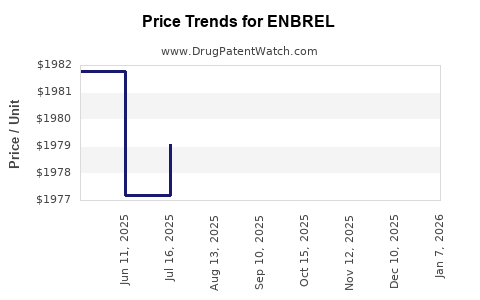
Last updated: April 23, 2026
Summary: Enbrel remains the dominant TNF-alpha biologic outside antibodies and has held strong share in the US and Western Europe since patent expiry for key lineages. Global revenue growth has shifted from volume expansion to price and channel mix, with biosimilar-led pressure accelerating the late-2010s onward. Financial trajectory since peak has been characterized by: (1) steady erosion in some markets, (2) rapid substitution to biosimilars where contracting and payer formularies favor them, and (3) resilience driven by brand entrenchment, switching inertia, and uptake in subpopulations where prescribers and payers retain preference for established etanercept formulations.
What is Enbrel’s market position in TNF-alpha biologics?
Enbrel is a soluble TNF receptor fusion biologic (etanercept) and one of the earliest widely adopted TNF-alpha agents. In TNF-alpha biologics, it competes against antibody TNF inhibitors (adalimumab, infliximab, golimumab, certolizumab pegol) and, later, biosimilar etanercept products and TNF antibodies.
Competitive geometry
- Product class: etanercept (soluble TNF receptor fusion protein)
- Therapeutic focus: rheumatoid arthritis, psoriatic arthritis, ankylosing spondylitis, juvenile idiopathic arthritis, plaque psoriasis
- Competitive set: TNF antibodies and later biosimilar etanercept
Why market share can hold even with biosimilar entry
- Enbrel is entrenched with prescribers and historically consistent outcomes in multiple inflammatory indications.
- It offers dosing convenience that can reduce switching barriers compared with some alternatives (relative to infusion-based regimens).
- In some formularies, contracting can still allow brand coverage or place biosimilars in step therapy rather than unrestricted first-line use.
How have biosimilars reshaped the Enbrel revenue profile?
Biosimilar etanercept entry has been the primary driver of unit and net-price pressure. The timing differs by geography and tender cycles, but the pattern is consistent: formulary additions of biosimilar etanercept and increased payer leverage lead to brand volume decline, then net sales erosion through pricing.
Biosimilar landscape that affects contracting
- US: biosimilar etanercept approvals increased the bargaining power of payers and pharmacy benefit managers (PBMs) as brands lost exclusivity and as biosimilars gained formulary positions.
- EU/UK: national health services and payer groups adopted value-based tendering and reference pricing that typically intensify brand price concessions.
Direct consequence to financials
- Peak phase: Enbrel benefited from broad adoption and long runway pre-biosimilar.
- Transition phase: post-approvals of etanercept biosimilars, brand net pricing came under pressure and share shifted to lower-cost equivalents.
- Current phase: revenue is sustained more by legacy coverage and patient retention than by net new growth in primary care channels.
What does the financial trajectory look like post-peak?
Enbrel’s financial trajectory has moved from growth to decline-with-resilience. The key observable pattern is a top-line downtrend punctuated by periods where price/mix and geographic mix stabilize declines, but volume and net price eventually reassert pressure.
Revenue dynamics (directional)
- Net sales decline as biosimilar substitution increases.
- Gross-to-net pressure rises as discounts deepen and payer rebates change in response to formulary competition.
- Geographic mix can offset declines in markets where biosimilar uptake is slower or contracting is less aggressive.
Financial “shape” over time
- Pre-biosimilar ramp: strong expansion across multiple indications.
- Early biosimilar years: gradual net sales erosion as uptake accelerates with contracting.
- Later biosimilar years: sharper share transfer and persistent net pricing erosion.
This profile aligns with how biologic brands typically respond to biosimilar entry: initial retention driven by inertia, followed by systematic formulary and budget-driven substitution.
Where are the biggest revenue supports for Enbrel today?
Enbrel’s revenue resilience is not universal; it depends on payer strategy and local competitive intensity. The most consistent supports are:
- Formulary entrenchment and clinical familiarity
- Long-established treatment history in rheumatology and dermatology.
- Indication footprint breadth
- Multiple high-incidence immune-mediated diseases sustain demand even as a single indication faces substitution.
- Channel mix
- Where biosimilar positioning is tiered rather than preferred universally, Enbrel can retain share.
How does operating leverage shift as net pricing drops?
As biosimilar-driven pressure increases, the operating model shifts from “volume-led growth” to “margin protection,” but not fully enough to prevent top-line declines from reducing scale benefits.
Mechanisms
- Higher rebate and discount intensity to protect access in formularies.
- Marketing and payer contracting costs rise relative to incremental revenue (since competition becomes more channel-specific).
- Manufacturing and supply economics remain stable in the short run, but fixed cost absorption declines when volumes fall.
What are the key market drivers and constraints affecting trajectory?
Demand drivers
- Chronicity across inflammatory indications.
- Steady diagnosis and treatment initiation in RA, psoriatic disease, ankylosing spondylitis, and psoriasis populations.
Substitution drivers
- Biosimilar formulary adoption and PBM contracting.
- Tendering and reference pricing in government and national systems.
- Switch incentives tied to budget cycles.
Constraints on substitution
- Patient stability and physician preference (less switching in stable patients).
- Access exceptions where prior authorization and medical necessity documentation still preserve brand use.
What does payer strategy imply for future revenue?
Payer policy typically follows a predictable escalation pattern once biosimilar coverage is available:
- First, biosimilars receive a limited formulary placement.
- Then, they move to preferred or first-line tiers.
- Finally, budget impact triggers tighter step-editing, lower authorization thresholds, and stronger substitution requirements.
For Enbrel, this implies the revenue base will increasingly depend on:
- contract-specific brand coverage,
- exceptions and prior therapy continuation,
- regions where contracting still allows brand access.
How do patent and exclusivity milestones translate into financial outcomes?
Patent expiry and biosimilar approvals create the legal and commercial conditions for substitution. Enbrel’s post-expiry financial performance is consistent with the typical sequence:
- Legal loss of exclusivity enables biosimilar entry.
- Commercial contracting accelerates uptake beyond the approval date.
- Net pricing drops after payer preference shifts.
The practical outcome is a downtrend that is often visible even before full biosimilar saturation, because payers adjust contracts in anticipation of competitive pressure.
Key takeaways
- Enbrel’s market position in TNF-alpha remains strong, but biosimilar etanercept entry drives persistent share and net price erosion.
- Revenue trajectory shows a long tail of resilience supported by prescriber familiarity, multi-indication demand, and payer inertia, but overall direction is downward post-peak.
- Payer contracting is the dominant near-to-mid term financial lever: where biosimilar placement becomes preferred and substitution tighter, Enbrel net sales decline accelerates.
FAQs
1) What category is Enbrel in?
Enbrel (etanercept) is a biologic TNF-alpha inhibitor in the soluble TNF receptor fusion protein class.
2) What most directly pressured Enbrel revenue?
Biosimilar etanercept competition, via formulary and pricing mechanisms, drove net price compression and share shifts.
3) Does Enbrel face competition only from biosimilar etanercept?
No. It also competes with TNF antibody biologics, but the major substitution shock for etanercept brands comes from biosimilar etanercept placements.
4) Why can Enbrel retain sales despite biosimilars?
Brand entrenchment, prescribing history, and patient stability reduce switch rates, especially where payers use tiered coverage and exceptions.
5) What payer behavior determines how fast revenue declines?
The speed at which biosimilars move to preferred tiers, combined with step-editing and substitution requirements tied to budget cycles.
References
[1] Pfizer. Enbrel (etanercept) prescribing information. Pfizer Labs.
[2] U.S. Food and Drug Administration. Drug Approval Packages: Enbrel (etanercept) and biosimilar approval records. FDA.
[3] European Medicines Agency. Assessment reports and product information for Enbrel and related biosimilars. EMA.
[4] IQVIA Institute. Biosimilar adoption and market access analyses (reports covering biologic market dynamics). IQVIA Institute.
[5] U.S. SEC filings (annual reports and 10-Ks) for financial disclosures tied to Enbrel and competitive biologics (historical context for revenue and category performance). Pfizer.