Share This Page
Drug Price Trends for ENBREL
✉ Email this page to a colleague
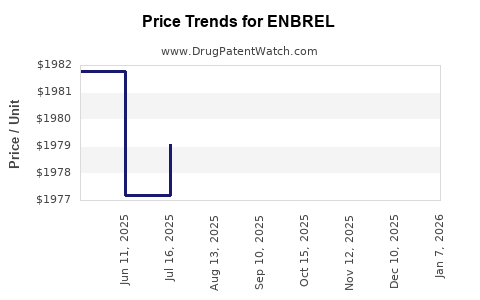
Average Pharmacy Cost for ENBREL
| Drug Name | NDC | Price/Unit ($) | Unit | Date |
|---|---|---|---|---|
| ENBREL 25 MG/0.5 ML SYRINGE | 58406-0010-04 | 2086.20417 | ML | 2026-07-22 |
| ENBREL 50 MG/ML SYRINGE | 58406-0021-04 | 2080.51112 | ML | 2026-07-22 |
| ENBREL 50 MG/ML SURECLICK | 58406-0032-04 | 2083.19341 | ML | 2026-07-22 |
| >Drug Name | >NDC | >Price/Unit ($) | >Unit | >Date |
What is Enbrel and what is its market positioning?
Enbrel (etanercept) is a tumor necrosis factor (TNF) inhibitor approved for treating rheumatoid arthritis (RA), psoriatic arthritis (PsA), ankylosing spondylitis, polyarticular juvenile idiopathic arthritis, and plaque psoriasis. Developed by Amgen and sold globally, Enbrel was one of the first biologics targeting TNF-alpha to reach the market.
As of 2022, Enbrel maintained a leadership position in the TNF inhibitor segment with annual sales exceeding $8 billion, primarily driven by the U.S., Europe, and Japan. It faces competition from newer agents such as Humira (adalimumab), Stelara (ustekinumab), and Cosentyx (secukinumab).
What are recent trends impacting Enbrel's market?
Patent expiration and biosimilar entry
Enbrel's key patents expired in several markets, including the U.S. in 2029 and in the European Union in 2028. Biosimilar versions are expected to penetrate the market post-patent expiry, with several biosimilar candidates already approved or in late-stage development. Biosimilar competition typically results in price erosion of 20-40% initially, with further declines over time.
Competitive landscape evolution
Emerging biologics and oral therapies are challenging Enbrel's market share. Janus kinase (JAK) inhibitors like Xeljanz (tofacitinib) and Olumiant (baricitinib) offer oral administration and convenience, impacting demand for injectable biologics like Enbrel.
Market growth factors
The global autoimmune disease market is projected to grow at a compound annual growth rate (CAGR) of approximately 8-10% through 2027, driven by increased diagnosis, improved patient access, and expanded indications.
What are the key drivers and challenges for Enbrel's pricing?
Drivers
- Established efficacy and safety profile in chronic autoimmune disease management.
- Broad label coverage across multiple indications.
- Insurance and payer reimbursement support in major markets.
Challenges
- Patent expiry leading to biosimilar entry and price competition.
- Market saturation in developed countries.
- Preference for oral or newer biologic agents with more convenient dosing.
- Cost containment measures reducing reimbursed prices.
What are current and projected price levels?
Current pricing (2023)
- List price per 50 mg/50 mL prefilled syringe (U.S.): approximately $2,800 to $3,200.
- Average wholesale prices (AWP): varies by region, often discounted by payers.
Price trends post-patent expiry
Price erosion of 25-40% is anticipated within 3-5 years following biosimilar launches. For sponsored biosimilars, initial discounts range from 20-25% versus reference biologic.
Projections for 2027 and beyond
- For Enbrel, retail prices are expected to decline by 30-50% in major markets due to biosimilar competition.
- The No. 1 biosimilar competitor launched in Europe in 2022, with U.S. entries expected in 2024-2025.
- Payer negotiations may further reduce effective prices.
How do biosimilar entrants influence the market?
Biosimilars will account for an estimated 35-45% of TNF inhibitor market share in Europe and North America within four years of launch. This shift will lower Enbrel's average selling price significantly.
Market share impact
- Enbrel's share in RA treatment is projected to decline from over 70% (pre-patent expiry) to less than 40% by 2027.
- Overall biologic market share in autoimmune disorders will shift toward biosimilars and newer agents.
Price competition
- Industry reports forecast biosimilar prices settling 20-40% below reference biologics initially.
- Payer-driven demand for lower-cost options will exert pressure on Enbrel's pricing and reimbursement.
What are the strategic outlooks for Enbrel?
While Enbrel retains a strong long-term position owing to brand recognition and clinical profile, its future revenue will depend on biosimilar penetration rates and uptake of alternative therapies.
Possible pathways
- Emphasis on differentiated delivery methods or combination therapies.
- Focus on markets with delayed biosimilar entry or limited biosimilar uptake.
- Price adjustments and volume growth strategies to mitigate revenue declines.
Key financial projections
| Year | Estimated revenue for Enbrel | Assumed biosimilar price erosion | Market share decline |
|---|---|---|---|
| 2023 | $8.2 billion | 0% | 100% (original product) |
| 2025 | $6.2 billion | 25% | ~70% |
| 2027 | $4.8 billion | 40% | <50% |
These projections are contingent on biosimilar launch timelines, market uptake, and competitive pressure.
Summary
Enbrel remains a significant product with over $8 billion annual sales. Patent expiry and biosimilar competition are poised to reduce revenue by up to 50% over the next five years. Price declines of 20-40% following biosimilar introductions are expected, with a substantial market share shift toward biosimilar products and newer oral agents.
Key Takeaways
- Enbrel’s market dominance faces erosion due to patent expiration and biosimilar entry.
- Price reductions of 20-40% are projected within 3-5 years post-biosimilar launch.
- Market share is expected to decline significantly, especially in developed markets.
- Payer and policy pressures will continue to influence pricing.
- Strategic adjustments are necessary to maintain competitiveness amid evolving therapeutic landscape.
FAQs
Q1: When will biosimilars for Enbrel be available in the U.S.?
A1: Biosimilars are expected to launch in the U.S. around 2024-2025 following patent challenges and regulatory approvals.
Q2: What impact will biosimilar competition have on Enbrel’s pricing?
A2: Biosimilar entry typically leads to a 20-40% decrease in price within the first few years of introduction.
Q3: How are physicians’ preferences changing regarding Enbrel?
A3: Physicians are increasingly adopting oral JAK inhibitors for convenience, impacting biologic prescribing patterns.
Q4: Are there any clinical advantages for biosimilars over Enbrel?
A4: Biosimilars are designed to have the same efficacy and safety profile as Enbrel, with no clinical superiority but likely lower cost.
Q5: What strategies can Amgen pursue to sustain Enbrel’s revenue?
A5: Strategies include optimizing existing indications, exploring new combinations, expanding into underserved markets, and managing pricing strategies to retain market share.
Sources
[1] EvaluatePharma, "Biologic Market Forecast," 2022.
[2] FDA, "Biosimilar Product Information," 2023.
[3] Pharma Intelligence, "TNF Inhibitors Market Share Analysis," 2022.
More… ↓
