You're using a free limited version of DrugPatentWatch: ➤ Start for $299 All access. No Commitment.

Last Updated: December 18, 2025

ADMELOG Drug Profile


✉ Email this page to a colleague

« Back to Dashboard


Summary for Tradename: ADMELOG
High Confidence Patents:14
Applicants:1
BLAs:1
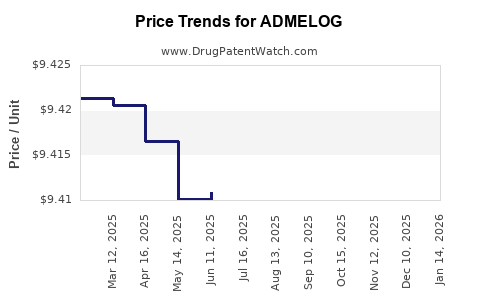
Drug Prices: Drug price information for ADMELOG
Pharmacology for ADMELOG
Ingredient-typeInsulin
Established Pharmacologic ClassInsulin Analog
Note on Biologic Patents

Matching patents to biologic drugs is far more complicated than for small-molecule drugs.

DrugPatentWatch employs three methods to identify biologic patents:

  1. Brand-side disclosures in response to biosimilar applications
  2. These patents were identified from disclosures by the brand-side company, in response to a potential biosimilar seeking to launch. They have a high certainty of blocking biosimilar entry. The expiration dates listed are not estimates — they're expiration dates as indicated by the brand-side company.

  3. DrugPatentWatch analysis and company disclosures
  4. These patents were identified from searching various sources, including drug labels and other general disclosures from the brand-side company. This list may exclude some of the patents which block biosimilar launch, and some of these patents listed may not actually block biosimilar launch. The expiration dates listed for these patents are estimates, based on the grant date of the patent.

  5. Patents from broad patent text search
  6. For completeness, these patents were identified by searching the patent literature for mentions of the branded or ingredient name of the drug. Some of these patents protect the original drug, whereas others may protect follow-on inventions or even inventions casually mentioning the drug. The expiration dates listed for these patents are estimates, based on the grant date of the patent.

1) High Certainty: US Patents for ADMELOG Derived from Brand-Side Litigation

No patents found based on brand-side litigation

2) High Certainty: US Patents for ADMELOG Derived from DrugPatentWatch Analysis and Company Disclosures

These patents were obtained from company disclosures
Applicant Tradename Biologic Ingredient Dosage Form BLA Patent No. Estimated Patent Expiration Source
Sanofi-aventis U.s. Llc ADMELOG insulin lispro Injection 209196 5,474,978 2014-06-16 DrugPatentWatch analysis and company disclosures
Sanofi-aventis U.s. Llc ADMELOG insulin lispro Injection 209196 5,958,881 2017-10-24 DrugPatentWatch analysis and company disclosures
Sanofi-aventis U.s. Llc ADMELOG insulin lispro Injection 209196 7,476,652 2025-03-25 DrugPatentWatch analysis and company disclosures
Sanofi-aventis U.s. Llc ADMELOG insulin lispro Injection 209196 7,713,930 2028-12-04 DrugPatentWatch analysis and company disclosures
Sanofi-aventis U.s. Llc ADMELOG insulin lispro Injection 209196 8,012,932 2025-07-22 DrugPatentWatch analysis and company disclosures
Sanofi-aventis U.s. Llc ADMELOG insulin lispro Injection 209196 8,461,120 2030-07-30 DrugPatentWatch analysis and company disclosures
>Applicant >Tradename >Biologic Ingredient >Dosage Form >BLA >Patent No. >Estimated Patent Expiration >Source

3) Low Certainty: US Patents for ADMELOG Derived from Patent Text Search

These patents were obtained by searching patent claims

Market Dynamics and Financial Trajectory for the Biologic Drug: ADMELOG

Last updated: September 23, 2025

Introduction

ADMELOG (insulin lispro), a rapid-acting insulin analog, has carved a significant niche within the diabetes management landscape since its FDA approval in 2010. As a biosimilar to Eli Lilly’s Humalog (insulin lispro), ADMELOG offers a cost-effective alternative aimed at improving patient access and adherence. Understanding its market dynamics and financial trajectory involves dissecting factors such as patent lifecycles, competitive landscape, healthcare policies, and evolving market demands.

Market Overview

Global Diabetes Burden and Therapeutic Demand

The global prevalence of diabetes mellitus exceeds 537 million adults, projected to rise to 643 million by 2030 [1]. Insulin therapies like ADMELOG serve as critical management options, especially for type 1 and advanced type 2 diabetes. The increasing diabetic population underpins sustained demand, but market growth is moderated by factors such as biosimilar penetration, formulary positioning, and pricing strategies.

Biologics and Biosimilars Climate

Biologics account for a substantial portion of big pharma revenues, with insulin comprising a significant segment. The entry of biosimilars like ADMELOG has intensified competition, leading to downward pressure on prices. Regulatory pathways, primarily governed by the FDA and EMA, facilitate biosimilar approvals, catalyzing market entry and driving price competition.

Market Dynamics

Patents and Exclusivity

ADMELOG's initial exclusivity periods, aligned with Lilly's patent protections, delayed biosimilar entry. Patent cliffs typically occur around 2025-2027, opening market share for biosimilar formulations. Patent litigation and strategies for extending exclusivity through secondary patents influence market access timelines significantly [2].

Competitive Landscape

Initially, ADMELOG faced minimal competition as a biosimilar. However, recent approvals of multiple insulin biosimilars (e.g., SAR441902 by Samsung Bioepis, LY011 by Biocon) intensify competition. Price undercutting and formulary preferences favor biosimilars, pressuring original biologics' revenues.

Pricing and Reimbursement

Reimbursement policies shaped by national health agencies and pharmacy benefit managers (PBMs) substantially influence adoption. Countries like the U.S. exhibit favorable coverage for biosimilars, but supply chain dynamics, physician prescribing habits, and patient acceptance play pivotal roles. Price cuts—often up to 30-50% compared to branded insulins—make biosimilars like ADMELOG more attractive to payers.

Market Penetration and Adoption

Physician familiarity, clinical inertia, and patient preference influence biosimilar uptake. Education initiatives and incentive programs drive adoption, with some markets demonstrating rapid transition to biosimilars. However, brand loyalty and perceptions of efficacy impact speed and scope of penetration.

Financial Trajectory

Revenue Projections

Pre-patent expiry, ADMELOG's revenues ranged between \$400 million to \$600 million annually, maintaining a steady growth attributable to increasing diabetes prevalence. Post-patent expiry, projections indicate gradual revenue decline coupled with biosimilar market share gains.

Based on industry estimates, biosimilars like ADMELOG could capture between 30-50% of the insulin lispro market within five years of entry [3]. This translates into a revenue decrease of approximately 30-50% for original biologics, assuming pricing remains competitive.

Cost Dynamics

Cost reductions are driven by manufacturing efficiencies, supply chain optimization, and declining R&D expenditure per new biosimilar approvals. However, marketing and legal costs for patent challenges and market defense can offset savings.

Market Share Evolution

Initial biosimilar launches typically achieve low single-digit market shares but can surge to over 50% within a decade, contingent on pricing strategies, formulary inclusion, and physician acceptance [4].

Factors Influencing Future Financial Trajectory

  • Patent Expirations: Key patent cliffs forecasted around 2025-2027 will open market access.
  • Regulatory Environment: Accelerated pathways or patent challenge reforms could influence timing and volume of biosimilar introductions.
  • Market Acceptance: Clinical confidence and physician education will determine biosimilar uptake rates.
  • Pricing Strategies: Affordability initiatives and competitive pricing will shape revenue trajectories.
  • Market Consolidation: Strategic mergers and acquisitions may impact distribution channels and market dynamics.

Emerging Trends and Opportunities

  • Personalized Insulin Delivery: Integration with digital health platforms may transform usage patterns.
  • Enhanced Biosimilar Portfolio: Competitors developing next-generation insulin analogs could reshape therapeutic options.
  • Global Market Expansion: Emerging markets with large diabetic populations present growth opportunities, especially with affordable biosimilars.

Regulatory and Policy Impacts

Policy shifts favoring biosimilar substitution, such as in the European Union and select U.S. states, bolster market penetration. Conversely, stringent regulatory hurdles or patent litigations can delay biosimilar commercialization, affecting financial prospects.

Key Takeaways

  • The expiration of key patents around 2025-2027 will significantly accelerate biosimilar competition, including ADMELOG.
  • Competitive pricing and strategic formulary placements are critical for sustaining revenue streams.
  • Increasing global diabetic populations will support consistent demand, but biosimilar market share gains will challenge initial revenues.
  • Physician and patient acceptance remain pivotal—educational initiatives can catalyze adoption.
  • Regulatory policies and patent strategies will continue to influence market timing, access, and profitability.

Conclusion

ADMELOG's market and financial outlook hinges on the intersection of patent protections, biosimilar competition, healthcare policies, and market acceptance. While immediate revenues face pressure from evolving biosimilar entrants, long-term growth opportunities stem from expanding diabetic populations and strategic market positioning. Proactive adaptation in pricing, stakeholder engagement, and technological advancements will determine the drug’s financial trajectory in this dynamic landscape.


FAQs

1. When do patents for ADMELOG expire, enabling biosimilar competition?
Patent protections for ADMELOG are expected to expire around 2025-2027, after which biosimilars can rapidly penetrate the market, impacting revenue streams.

2. How does biosimilar entry affect the pricing of ADMELOG?
Biosimilar entry typically results in significant price reductions—often 30-50%—through increased competition, pressuring original biologics to decrease prices to maintain market share.

3. What factors influence biosimilar adoption in the diabetes market?
Physician familiarity, formulary coverage, patient acceptance, education, and pricing strategies are primary drivers of biosimilar adoption.

4. How might healthcare policies impact ADMELOG’s future market share?
Policies favoring biosimilar substitution and reimbursement reforms encourage uptake, whereas restrictive regulations may delay market penetration.

5. What are key growth opportunities for ADMELOG beyond patent expiry?
Expanding into emerging markets, integrating with digital health tools, and establishing strong physician and patient trust are critical growth avenues post-patent expiration.


Sources

[1] International Diabetes Federation. IDF Diabetes Atlas, 9th Edition. 2019.
[2] U.S. Food and Drug Administration. Biosimilar and Interchangeable Products. 2022.
[3] IQVIA. The Global Use of Medicines in 2020. 2021.
[4] Evaluate Pharma. Biosimilars and Insulin Market Reports. 2022.

More… ↓

⤷  Get Started Free

Make Better Decisions: Try a trial or see plans & pricing

Drugs may be covered by multiple patents or regulatory protections. All trademarks and applicant names are the property of their respective owners or licensors. Although great care is taken in the proper and correct provision of this service, thinkBiotech LLC does not accept any responsibility for possible consequences of errors or omissions in the provided data. The data presented herein is for information purposes only. There is no warranty that the data contained herein is error free. We do not provide individual investment advice. This service is not registered with any financial regulatory agency. The information we publish is educational only and based on our opinions plus our models. By using DrugPatentWatch you acknowledge that we do not provide personalized recommendations or advice. thinkBiotech performs no independent verification of facts as provided by public sources nor are attempts made to provide legal or investing advice. Any reliance on data provided herein is done solely at the discretion of the user. Users of this service are advised to seek professional advice and independent confirmation before considering acting on any of the provided information. thinkBiotech LLC reserves the right to amend, extend or withdraw any part or all of the offered service without notice.