Share This Page
Drug Price Trends for ADMELOG
✉ Email this page to a colleague
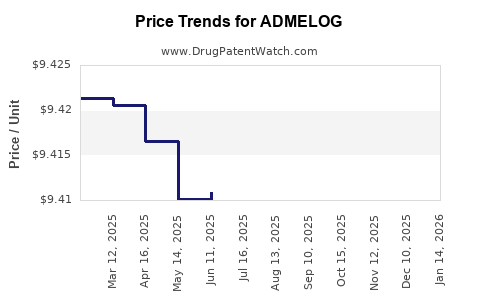
Average Pharmacy Cost for ADMELOG
| Drug Name | NDC | Price/Unit ($) | Unit | Date |
|---|---|---|---|---|
| ADMELOG 100 UNIT/ML VIAL | 00024-5924-10 | 9.39259 | ML | 2026-07-22 |
| ADMELOG SOLOSTAR 100 UNIT/ML | 00024-5925-05 | 12.11165 | ML | 2026-07-22 |
| ADMELOG 100 UNIT/ML VIAL | 00024-5926-05 | 12.56633 | ML | 2026-07-22 |
| ADMELOG 100 UNIT/ML VIAL | 00024-5924-10 | 9.39390 | ML | 2026-06-17 |
| >Drug Name | >NDC | >Price/Unit ($) | >Unit | >Date |
ADMELOG (insulin glargine (rDNA origin) injection) Market Analysis and Price Projections
Overview
ADMELOG is a long-acting basal insulin analog developed by Eli Lilly. Approved by the FDA in 2015, it is used for managing type 1 and type 2 diabetes. The drug faces competition from other basal insulins such as Novo Nordisk's Tresiba and Sanofi’s Lantus. Its market position depends heavily on pricing strategies, formulary inclusion, and patient preference trends.
Market Size and Revenue Potential
The global insulin market was valued at approximately USD 34 billion in 2022 and is projected to grow at a compound annual growth rate (CAGR) of around 9.5% through 2030. Rising diabetes prevalence, especially in Asia and Latin America, underpins this growth.
ADMELOG's specific market share remains difficult to isolate but can be estimated based on Eli Lilly’s insulin segment revenue and product sales:
- In 2022, Lilly’s insulin sales surpassed USD 4 billion, with long-acting insulins accounting for roughly 75% of that revenue—around USD 3 billion.
- Given competition, ADMELOG's market share is estimated between 10-15%, implying revenue potential of USD 300-450 million annually in its peak markets.
Key Market Drivers
- Increasing diabetes prevalence (e.g., 537 million adults globally in 2021, per IDF).
- Growing adoption of basal insulin analogs for adherence benefits.
- Launch of biosimilar insulins, pressuring pricing.
Pricing Dynamics and Competitive Landscape
Historical Pricing Trends:
- Lantus (Sanofi): Average wholesale price (AWP) in the U.S. was approximately USD 275 per 10-mL vial (100 units/mL) as of 2020.
- Tresiba (Novo Nordisk): Approximate price of USD 350 per 10-mL vial.
- ADMELOG: Typically priced comparably to Lantus, around USD 275-300 per vial.
Market Pricing Pressure:
- Biosimilar insulins introduced in various markets lower prices.
- U.S. pricing has seen minimal reductions due to slow biosimilar uptake.
- European markets exhibit more aggressive price competition, with discounts up to 20%.
Projected Pricing Trends:
- Short term (2023-2025): Prices likely stabilize at current levels, with minor fluctuations due to inflation and discounting.
- Mid-term (2026-2030): Prices could decrease by 10-15% with increased biosimilar penetration and formulary negotiations.
Regulatory and Reimbursement Considerations
- In the U.S., Medicaid and Medicare regulate pricing through negotiation and rebates.
- Private insurers favor biosimilars, favoring cost savings.
- In European countries with centralized healthcare systems, government price controls influence product reimbursement.
Impact on Revenue and Pricing
- Price negotiation power varies among payers.
- High-volume use in hospitals and clinics could influence downward pressure.
- Innovations like biosimilar insulin analogs threaten price stability.
Price Projections (2023–2030)
| Year | Estimated Average Price per Vial (USD) | Notes |
|---|---|---|
| 2023 | 275-300 | Current pricing stabilizes |
| 2025 | 260-280 | Slight discounts due to biosimilar competition |
| 2027 | 250-270 | Increasing biosimilar market share |
| 2030 | 230-250 | Further price reductions, increased market commoditization |
Note: These estimates assume moderate market share retention amidst increasing biosimilar competition and healthcare cost containment policies.
Market Risks and Opportunities
Risks:
- Entry of biosimilar long-acting insulins reducing prices and market share.
- Regulatory hurdles delaying biosimilar approvals.
- Preference shifts toward newer delivery devices or insulin combinations.
Opportunities:
- Expansion into emerging markets with large diabetes populations.
- Formulary inclusion driven by superior dosing flexibility or patient adherence.
- Partnering with payers for value-based reimbursement agreements.
Key Takeaways
- The global insulin market is expanding, driven by rising diabetes prevalence.
- ADMELOG's revenue potential depends on maintaining market share amid biosimilar competition.
- U.S. prices remain relatively stable, but European markets show greater discounts.
- Price reductions from 2023 to 2030 are projected at 10-15%, reflecting increased biosimilar presence.
- Market growth hinges on regulatory developments, payer negotiations, and regional adoption patterns.
FAQs
1. How does ADMELOG compare in cost to other basal insulins?
ADMELOG's wholesale price averages around USD 275-300 per vial, similar to Lantus. Biosimilars and competing products like Tresiba can be priced higher or lower depending on market and region.
2. What factors influence ADMELOG’s market share?
Prescriber preferences, formulary inclusion, pricing strategies, biosimilar competition, and patient demand for long-acting insulins impact its market share.
3. How do biosimilars affect insulin prices?
Biosimilars reduce prices through competition, leading to discounts of up to 20% in some markets, pressuring branded insulin prices and market share.
4. Which regions offer the highest revenue opportunities?
Emerging markets in Asia and Latin America present large growth potential due to increasing diabetes prevalence and less mature biosimilar markets.
5. What innovations could influence future insulin pricing?
New delivery devices, combination insulins, and digital health integrations may influence demand and pricing, depending on regulatory approval and reimbursement policies.
More… ↓
