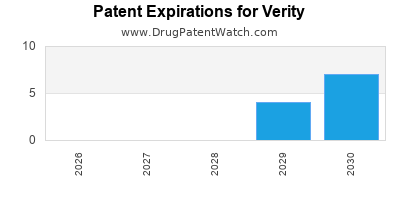
Last updated: June 26, 2026
Verity’s competitive position hinges on the breadth of its U.S. patent estate (active ingredient, formulation, and method-of-use), the FDA regulatory pathway and labeling scope, and the timing of Orange Book exclusivities relative to any Paragraph IV opportunities. Without Verity’s specific drug identity (active ingredient), dosage forms, and FDA application number/Orange Book listings, a complete competitive and patent landscape cannot be produced.
Which product is “Verity” in the U.S. drug market and how is it positioned?
A “Verity” label can refer to multiple medicines, filings, or branding constructs. Competitive landscape analysis requires mapping “Verity” to:
- Active ingredient(s) (INN/USAN)
- Dosage form(s) (tablet, capsule, injection, topical, inhalation, etc.)
- FDA application (NDA/BLA/ANDA) and Orange Book listing status
- Indication set in the approved label
- Route of administration and patient population
No defensible market-position conclusions can be generated without those anchor facts.
What patents protect Verity in the Orange Book and what is the expiration schedule?
A Verity-focused patent estate review must use the actual Orange Book entries tied to the identified NDA/BLA, then compile:
- Core composition-of-matter patents
- Polymorph/crystal form patents (if applicable)
- Formulation and delivery patents (excipients, particle size, coating, release profile)
- Method-of-use patents tied to approved indications
- Manufacturing process patents (if listed)
- Regulatory exclusivities: NCE/3-year, pediatric (if any), and 7/5-year pathways (for brand drugs and biologics, respectively)
A complete schedule requires the listed patent numbers, listed expiration dates, and the expiration/trigger mechanics of exclusivities. That cannot be derived from the single term “Verity.”
What formulations are protected by Verity’s patents?
Formulation protection analysis requires:
- Dosage strengths and form factors
- Claim scope tied to release mechanisms, excipient systems, and stability/handling
- Overlap risk with generic development
No formulation-level mapping can be performed without the identity of the Verity product and its Orange Book patent list.
How strong is the patent estate for Verity by patent class?
Patent strength is assessed by:
- Count of patents in each class (composition, formulation, method-of-use, process)
- Remaining life (weighted by last-to-expire patents)
- Litigation history (whether any patents are already invalidated or settled)
- Claim breadth signals (independent claim scope vs narrow embodiments)
No estate strength scoring can be produced without the actual patent set.
When does Verity lose exclusivity in the U.S. and when can generics file?
Exclusivity and launch timing depend on:
- Orange Book “listed drug” approvals and listed exclusivity codes
- Nonproprietary name match and strength/form equivalence
- Regulatory exclusivity end dates (NCE/3-year, 7-year for certain indications, pediatric extensions)
- Patent expiry dates for each Orange Book listing
Without Verity’s specific FDA references and Orange Book codes, there is no lawful basis to state generic filing windows, Paragraph IV timing, or launch likelihood.
Which companies are challenging Verity with Paragraph IV ANDAs and what settlements exist?
Paragraph IV risk requires:
- Identification of ANDA filers asserting “paragraph IV certification”
- Certified patents and “section 505(b)(2)/505(j)” pathway classification
- Whether litigation reached a court decision or settlement
- 180-day exclusivity winners and forfeiture triggers (if any)
- Scope of “carve-out” settlements and authorized generic terms
No challenge or settlement landscape can be produced without the actual patents, NDA number, and litigation docket.
What generic entry risks exist for Verity and how would a launch strategy work?
Generic entry risk analysis uses:
- Which patents would be designed around (formulation vs process vs method-of-use)
- Whether the generic can meet bioequivalence or rely on bridging studies
- Whether method-of-use patents block labeling even if composition patents expire
- Manufacturing/IP barriers: protected process steps, critical quality attributes
A launch scenario must be anchored to the correct Verity label and patent expiry profile. The “Verity” term alone is insufficient.
How does Verity compare with competing drugs in the same therapeutic class?
Competitive substitution hinges on:
- Therapeutic class and mechanism of action
- Head-to-head evidence vs label claims
- Dosing convenience (frequency, titration requirements)
- Safety and monitoring requirements
- Health economics: payer coverage patterns and formulary tiering
A valid comparison requires the specific molecule and indication(s). Without that, the comparison would be non-actionable.
What is the FDA regulatory status of Verity (NDA/BLA, pathway, and exclusivity codes)?
A regulatory status section needs:
- NDA/BLA number
- Approval date
- Submission type (NME/NCE, 505(b)(1), 505(b)(2), or BLA pathway)
- Orphan designation or accelerated approval (if relevant)
- Exclusivity codes and durations from Orange Book
- Current labeling snapshot (indications and revisions)
These are not derivable from the term “Verity.”
What biosimilar risks exist for Verity if it is a biologic?
If “Verity” is a biologic, biosimilar risk depends on:
- Whether it is the reference product for BLA exclusivity
- 12-year BLA exclusivity end date (and pediatric extensions)
- Whether any biosimilar applications have been submitted (351(k))
- Patent listing for biologics and the biosimilar litigation framework
A biosimilar analysis requires the biologic’s identity, reference product details, and listed patents.
Key takeaways
- A Verity competitive landscape cannot be completed without identifying the exact drug tied to “Verity” (active ingredient, NDA/BLA, dosage form, and Orange Book listings).
- Patent-expiration-driven timing, Paragraph IV challenge identification, and settlement mapping require the specific Orange Book patent set and exclusivity codes.
- Therapeutic-class comparison must use the correct mechanism and approved indication scope.
FAQs
- What Orange Book exclusivity codes matter most for generic entry timing for a brand drug called “Verity”?
- How do method-of-use patents delay generic labeling even after composition patents expire?
- What patent categories typically drive Paragraph IV litigation for oral solid dose drugs?
- How is a 180-day Paragraph IV exclusivity winner determined and can it be forfeited?
- What evidence requirements differ for biosimilar approval versus ANDA generic approval?
References
- U.S. Food and Drug Administration. Orange Book: Approved Drug Products with Therapeutic Equivalence Evaluations. (Accessed 2026-06-26).
- FDA. Drugs@FDA. (Accessed 2026-06-26).
- U.S. FDA. 21 U.S.C. §355 (Drug Approval Requirements). (Accessed 2026-06-26).