You're using a free limited version of DrugPatentWatch: Upgrade for Complete Access

Last Updated: March 26, 2026

TRELSTAR Drug Patent Profile


✉ Email this page to a colleague

« Back to Dashboard


Which patents cover Trelstar, and when can generic versions of Trelstar launch?

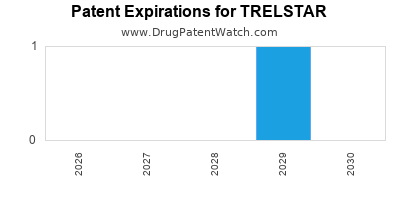
Trelstar is a drug marketed by Verity and is included in three NDAs. There is one patent protecting this drug.

This drug has forty-seven patent family members in thirty-two countries.

The generic ingredient in TRELSTAR is triptorelin pamoate. There are three drug master file entries for this compound. Two suppliers are listed for this compound. Additional details are available on the triptorelin pamoate profile page.

DrugPatentWatch® Generic Entry Outlook for Trelstar

Trelstar was eligible for patent challenges on June 15, 2004.

By analyzing the patents and regulatory protections it appears that the earliest date for generic entry will be June 30, 2029. This may change due to patent challenges or generic licensing.

Indicators of Generic Entry

< Available with Subscription >

  Start Trial

AI Deep Research
Questions you can ask:
  • What is the 5 year forecast for TRELSTAR?
  • What are the global sales for TRELSTAR?
  • What is Average Wholesale Price for TRELSTAR?
Summary for TRELSTAR
International Patents:47
US Patents:1
Applicants:1
NDAs:3
Finished Product Suppliers / Packagers: 1
Raw Ingredient (Bulk) Api Vendors: 1
Clinical Trials: 12
Patent Applications: 1,149
Drug Prices: Drug price information for TRELSTAR
What excipients (inactive ingredients) are in TRELSTAR?TRELSTAR excipients list
DailyMed Link:TRELSTAR at DailyMed
Drug patent expirations by year for TRELSTAR
Drug Prices for TRELSTAR

See drug prices for TRELSTAR

DrugPatentWatch® Estimated Loss of Exclusivity (LOE) Date for TRELSTAR
Generic Entry Date for TRELSTAR*:
Constraining patent/regulatory exclusivity:
NDA:
Dosage:
INJECTABLE;INTRAMUSCULAR

*The generic entry opportunity date is the latter of the last compound-claiming patent and the last regulatory exclusivity protection. Many factors can influence early or later generic entry. This date is provided as a rough estimate of generic entry potential and should not be used as an independent source.

Recent Clinical Trials for TRELSTAR

Identify potential brand extensions & 505(b)(2) entrants

SponsorPhase
Sidney Kimmel Comprehensive Cancer Center at Johns HopkinsPHASE2
Zenith EpigeneticsPHASE2
National Cancer Institute (NCI)PHASE2

See all TRELSTAR clinical trials

US Patents and Regulatory Information for TRELSTAR

TRELSTAR is protected by one US patents.

Based on analysis by DrugPatentWatch, the earliest date for a generic version of TRELSTAR is ⤷  Start Trial.

This potential generic entry date is based on patent ⤷  Start Trial.

Generics may enter earlier, or later, based on new patent filings, patent extensions, patent invalidation, early generic licensing, generic entry preferences, and other factors.

Applicant Tradename Generic Name Dosage NDA Approval Date TE Type RLD RS Patent No. Patent Expiration Product Substance Delist Req. Exclusivity Expiration
Verity TRELSTAR triptorelin pamoate INJECTABLE;INTRAMUSCULAR 020715-001 Jun 15, 2000 RX Yes Yes ⤷  Start Trial ⤷  Start Trial ⤷  Start Trial
Verity TRELSTAR triptorelin pamoate INJECTABLE;INTRAMUSCULAR 021288-001 Jun 29, 2001 RX Yes Yes ⤷  Start Trial ⤷  Start Trial ⤷  Start Trial
Verity TRELSTAR triptorelin pamoate INJECTABLE;INTRAMUSCULAR 022437-001 Mar 10, 2010 RX Yes Yes ⤷  Start Trial ⤷  Start Trial Y ⤷  Start Trial
>Applicant >Tradename >Generic Name >Dosage >NDA >Approval Date >TE >Type >RLD >RS >Patent No. >Patent Expiration >Product >Substance >Delist Req. >Exclusivity Expiration

Expired US Patents for TRELSTAR

Applicant Tradename Generic Name Dosage NDA Approval Date Patent No. Patent Expiration
Verity TRELSTAR triptorelin pamoate INJECTABLE;INTRAMUSCULAR 020715-001 Jun 15, 2000 ⤷  Start Trial ⤷  Start Trial
Verity TRELSTAR triptorelin pamoate INJECTABLE;INTRAMUSCULAR 021288-001 Jun 29, 2001 ⤷  Start Trial ⤷  Start Trial
Verity TRELSTAR triptorelin pamoate INJECTABLE;INTRAMUSCULAR 022437-001 Mar 10, 2010 ⤷  Start Trial ⤷  Start Trial
Verity TRELSTAR triptorelin pamoate INJECTABLE;INTRAMUSCULAR 020715-001 Jun 15, 2000 ⤷  Start Trial ⤷  Start Trial
>Applicant >Tradename >Generic Name >Dosage >NDA >Approval Date >Patent No. >Patent Expiration

International Patents for TRELSTAR

When does loss-of-exclusivity occur for TRELSTAR?

Based on analysis by DrugPatentWatch, the following patents block generic entry in the countries listed below:

African Regional IP Organization (ARIPO)

Patent: 00
Patent: Slow release pharmaceutical composition made of microparticles
Estimated Expiration: ⤷  Start Trial

Australia

Patent: 08259411
Patent: Slow release pharmaceutical composition made of microparticles
Estimated Expiration: ⤷  Start Trial

Brazil

Patent: 0812250
Patent: COMPOSIÇÃO FARMACÊUTICA DE LIBERAÇÃO LENTA FEITA DE MICROPARTÍCULAS
Estimated Expiration: ⤷  Start Trial

Canada

Patent: 88478
Patent: COMPOSITION PHARMACEUTIQUE A LIBERATION LENTE, FAITE DE MICROPARTICULES (SLOW RELEASE PHARMACEUTICAL COMPOSITION MADE OF MICROPARTICLES)
Estimated Expiration: ⤷  Start Trial

China

Patent: 1677959
Patent: Slow release pharmaceutical composition made of microparticles
Estimated Expiration: ⤷  Start Trial

Colombia

Patent: 51234
Patent: COMPOSICIONES QUE COMPRENDEN MICROPARTICULAS DE UN COPOLIMERO DE ACIDO LACTICO Y GLICOLICO (PLGA) CON UNA SUSTANCIA ACTIVA EN LA FORMA DE UNA SAL PEPTIDICA INSOLUBLE
Estimated Expiration: ⤷  Start Trial

Croatia

Patent: 0161785
Estimated Expiration: ⤷  Start Trial

Patent: 0181854
Estimated Expiration: ⤷  Start Trial

Cyprus

Patent: 18434
Estimated Expiration: ⤷  Start Trial

Patent: 20891
Estimated Expiration: ⤷  Start Trial

Denmark

Patent: 64467
Estimated Expiration: ⤷  Start Trial

Patent: 00014
Estimated Expiration: ⤷  Start Trial

Eurasian Patent Organization

Patent: 9284
Patent: ФАРМАЦЕВТИЧЕСКАЯ КОМПОЗИЦИЯ С ПРОЛОНГИРОВАННЫМ ВЫСВОБОЖДЕНИЕМ, ПРИГОТОВЛЕННАЯ ИЗ МИКРОЧАСТИЦ (SLOW RELEASE PHARMACEUTICAL COMPOSITION MADE OF MICROPARTICLES)
Estimated Expiration: ⤷  Start Trial

Patent: 0971132
Patent: ФАРМАЦЕВТИЧЕСКАЯ КОМПОЗИЦИЯ С ПРОЛОНГИРОВАННЫМ ВЫСВОБОЖДЕНИЕМ, ПРИГОТОВЛЕННАЯ ИЗ МИКРОЧАСТИЦ
Estimated Expiration: ⤷  Start Trial

European Patent Office

Patent: 64467
Patent: COMPOSITION PHARMACEUTIQUE À LIBÉRATION LENTE, FAITE DE MICROPARTICULES (SLOW RELEASE PHARMACEUTICAL COMPOSITION MADE OF MICROPARTICLES)
Estimated Expiration: ⤷  Start Trial

Patent: 00014
Patent: Composition pharmaceutique à libération lente, faite de microparticules (Slow release pharmaceutical composition made of microparticles)
Estimated Expiration: ⤷  Start Trial

Patent: 31077
Patent: COMPOSITION PHARMACEUTIQUE À LIBÉRATION LENTE FABRIQUÉE À PARTIR DE MICROPARTICULES (SLOW RELEASE PHARMACEUTICAL COMPOSITION MADE OF MICROPARTICLES)
Estimated Expiration: ⤷  Start Trial

Finland

Patent: 00014
Estimated Expiration: ⤷  Start Trial

Hong Kong

Patent: 41737
Patent: SLOW RELEASE PHARMACEUTICAL COMPOSITION MADE OF MICROPARTICLES
Estimated Expiration: ⤷  Start Trial

Hungary

Patent: 31550
Estimated Expiration: ⤷  Start Trial

Patent: 40391
Estimated Expiration: ⤷  Start Trial

Israel

Patent: 2501
Patent: תכשירים המכילים מיקרו חלקיקים לשחרור מבוקר של טריפטולרין ושימוש בהם להכנת תרופה לטיפול בסרטן הערמונית (Pharmaceutical composition made of microparticles for controlled release of triptorelin and use thereof for the manufacture of a drug for the treatment of prostate cancer)
Estimated Expiration: ⤷  Start Trial

Japan

Patent: 19169
Estimated Expiration: ⤷  Start Trial

Patent: 10529106
Estimated Expiration: ⤷  Start Trial

Lithuania

Patent: 64467
Estimated Expiration: ⤷  Start Trial

Patent: 00014
Estimated Expiration: ⤷  Start Trial

Malaysia

Patent: 0450
Patent: SLOW RELEASE PHARMACEUTICAL COMPOSITION MADE OF MICROPARTICLES
Estimated Expiration: ⤷  Start Trial

Mexico

Patent: 09012856
Patent: COMPOSICION FARMACEUTICA DE LIBERACION LENTA HECHA DE MICROPARTICULAS. (SLOW RELEASE PHARMACEUTICAL COMPOSITION MADE OF MICROPARTICLES.)
Estimated Expiration: ⤷  Start Trial

Montenegro

Patent: 959
Patent: FARMACEUTSKA KOMPOZICIJA SA SPORIM OSLOBAĐANJEM KOJA JE FORMIRANA OD MIKROČESTICA (SLOW RELEASE PHARMACEUTICAL COMPOSITION MADE OF MICROPARTICLES)
Estimated Expiration: ⤷  Start Trial

Morocco

Patent: 422
Patent: COMPOSITION PHARMACEUTIQUE A LIBERATION PROLONGEE CONSTITUEE DE MICROPARTICULES
Estimated Expiration: ⤷  Start Trial

New Zealand

Patent: 2423
Patent: SLOW RELEASE PHARMACEUTICAL COMPOSITION MADE OF MICROPARTICLES COMPRISING PLGA, LHRH AND LACTIC ACID
Estimated Expiration: ⤷  Start Trial

Poland

Patent: 64467
Estimated Expiration: ⤷  Start Trial

Patent: 00014
Estimated Expiration: ⤷  Start Trial

Portugal

Patent: 64467
Estimated Expiration: ⤷  Start Trial

Patent: 00014
Estimated Expiration: ⤷  Start Trial

Serbia

Patent: 591
Patent: FARMACEUTSKA KOMPOZICIJA SA SPORIM OSLOBAĐANJEM PRIPREMLJENA OD MIKROČESTICA (SLOW RELEASE PHARMACEUTICAL COMPOSITION MADE OF MICROPARTICLES)
Estimated Expiration: ⤷  Start Trial

Patent: 248
Patent: FARMACEUTSKA KOMPOZICIJA SA SPORIM OSLOBAĐANJEM PRIPREMLJENA OD MIKROČESTICA (SLOW RELEASE PHARMACEUTICAL COMPOSITION MADE OF MICROPARTICLES)
Estimated Expiration: ⤷  Start Trial

Slovenia

Patent: 64467
Estimated Expiration: ⤷  Start Trial

Patent: 00014
Estimated Expiration: ⤷  Start Trial

South Africa

Patent: 0907940
Patent: Slow release pharmaceutical composition made of microparticles
Estimated Expiration: ⤷  Start Trial

South Korea

Patent: 1631475
Estimated Expiration: ⤷  Start Trial

Patent: 100023950
Patent: SLOW RELEASE PHARMACEUTICAL COMPOSITION MADE OF MICROPARTICLES
Estimated Expiration: ⤷  Start Trial

Spain

Patent: 11020
Estimated Expiration: ⤷  Start Trial

Patent: 94401
Estimated Expiration: ⤷  Start Trial

Tunisia

Patent: 09000476
Patent: SLOW RELEASE PHARMACEUTICAL COMPOSITION MADE OF MICROPARTICLES
Estimated Expiration: ⤷  Start Trial

Ukraine

Patent: 830
Patent: ФАРМАЦЕВТИЧЕСКАЯ КОМПОЗИЦИЯ С ПРОЛОНГИРОВАННЫМ ВЫСВОБОЖДЕНИЕМ, ИЗГОТОВЛЕННАЯ ИЗ МИКРОЧАСТИЦ;ФАРМАЦЕВТИЧНА КОМПОЗИЦІЯ З ПРОЛОНГОВАНИМ ВИВІЛЬНЕННЯМ, ВИГОТОВЛЕНА З МІКРОЧАСТИНОК (SLOW RELEASE PHARMACEUTICAL COMPOSITION MADE OF MICROPARTICLES)
Estimated Expiration: ⤷  Start Trial

Generics may enter earlier, or later, based on new patent filings, patent extensions, patent invalidation, early generic licensing, generic entry preferences, and other factors.

See the table below for additional patents covering TRELSTAR around the world.

Country Patent Number Title Estimated Expiration
Italy BS910119 ⤷  Start Trial
Spain 2049617 PROCEDIMIENTO DE PREPARACION DE UNA COMPOSICION FARMACEUTICA. ⤷  Start Trial
Portugal 94842 PROCESSO PARA A PREPARACAO DE UMA COMPOSICAO FARMACEUTICA SOB A FORMA DE MICROPARTICULAS DE UM COPOLIMERO DE ACIDO LACTICO E GLICOLICO E INCORPORANDO COMO SUBSTANCIA ACTIVA UM PAMOATO, TANATO, ESTEARATO OU PALMITATO DE UM PEPTIDO NATURAL OU SINTETICO ⤷  Start Trial
Japan H01121222 DRUG COMPOSITION FOR KEEPING AND REGULATING RELEASE OF DRUG OVER LONG TIME ⤷  Start Trial
>Country >Patent Number >Title >Estimated Expiration

Trelstar: Market Dynamics and Financial Trajectory

Last updated: February 19, 2026

Trelstar (degarelix) is a gonadotropin-releasing hormone (GnRH) antagonist used for the palliative treatment of advanced hormone-dependent prostate cancer. Its market trajectory is shaped by its efficacy, competition, patent landscape, and reimbursement policies.

What is Trelstar's Clinical Profile and Mechanism of Action?

Trelstar is an injectable synthetic decapeptide that binds competitively to GnRH receptors in the anterior pituitary gland. This binding prevents the normal pulsatile release of GnRH, leading to a rapid and sustained suppression of luteinizing hormone (LH) and follicle-stimulating hormone (FSH) secretion. The reduction in LH and FSH, in turn, causes a significant decrease in testicular testosterone production. This mechanism effectively achieves medical castration, a standard treatment for advanced hormone-dependent prostate cancer by reducing androgen levels that fuel cancer cell growth.

Clinical studies have demonstrated Trelstar's ability to achieve and maintain testosterone suppression comparable to or exceeding that of GnRH agonists. A key differentiator is its rapid onset of action; testosterone levels decline within days of administration, whereas GnRH agonists initially cause a surge in testosterone (a "flare") before suppressing levels. This flare phenomenon can exacerbate symptoms in patients with metastatic disease. Trelstar avoids this initial flare, offering a potential clinical advantage in managing symptomatic patients.

Key clinical data points include:

  • Median time to reach testosterone levels < 0.5 ng/mL: 3 days with Trelstar [1].
  • Sustained testosterone suppression: Achieved in over 90% of patients throughout treatment cycles with Trelstar [2].
  • PSA decline: Significant prostate-specific antigen (PSA) declines are observed in response to testosterone suppression [3].

What is the Competitive Landscape for Trelstar?

The market for advanced hormone-dependent prostate cancer treatment is crowded, with GnRH antagonists and agonists representing the primary therapeutic classes. Trelstar competes with established GnRH agonists and other GnRH antagonists.

GnRH Agonists:

  • Leuprolide (e.g., Lupron, Eligard): A long-acting injectable that initially stimulates GnRH receptors, causing a testosterone flare before achieving suppression. It is available in various formulations (monthly, quarterly, semi-annually).
  • Goserelin (e.g., Zoladex): Similar to leuprolide, it causes a testosterone flare and is available in monthly and quarterly depots.
  • Triptorelin (e.g., Trelstar, Decapeptyl): Also a GnRH agonist with different depot formulations.

Other GnRH Antagonists:

  • Degarelix (Firmagon®): Developed by Ipsen, this is the same active pharmaceutical ingredient as Trelstar. It offers a direct competitive alternative to Trelstar with a similar mechanism and rapid onset of action.
  • Relugolix (Orgovyx®): An orally administered GnRH antagonist approved in late 2020. Its oral route offers convenience and avoids injection site reactions, posing a significant competitive threat.

The competitive positioning of Trelstar is influenced by its non-inferiority in testosterone suppression compared to agonists, the absence of a flare effect, and its established safety profile. However, the emergence of oral GnRH antagonists like relugolix presents a substantial challenge by offering a more convenient administration route.

What is Trelstar's Patent and Exclusivity Status?

The patent landscape for Trelstar is critical for its long-term revenue generation. As of late 2023, the primary patents protecting Trelstar (degarelix) have expired or are nearing expiration in major markets.

  • United States: The compound patent for degarelix has expired. However, there may be formulation patents or method-of-use patents that still provide some residual market exclusivity, though their strength and duration are subject to ongoing legal challenges and landscape analysis. The compound patent expired around 2019-2020.
  • Europe: Similar to the US, key compound patents have expired. Supplementary Protection Certificates (SPCs) may have extended protection in certain European countries, but these are also expiring.

Impact of Patent Expiration:

The expiration of key patents opens the door for generic manufacturers to introduce biosimilar or generic versions of degarelix. This is expected to lead to:

  • Price Erosion: Generic competition typically drives down drug prices significantly, impacting Trelstar's revenue.
  • Increased Market Access: Lower prices can lead to broader adoption, but the overall revenue for the branded product will likely decline.
  • Market Share Shift: Physicians and payers may switch to lower-cost generic alternatives.

The precise timing and impact of generic entry depend on regulatory approvals and market dynamics in each region.

What are Trelstar's Sales and Financial Performance?

Trelstar, marketed by Ipsen, has demonstrated a significant revenue stream, though its growth trajectory is subject to competition and patent expirations.

Historical Sales Data (USD Millions):

Year Trelstar (Degarelix) Net Sales
2019 312.0
2020 325.7
2021 325.8
2022 330.8
2023 (YTD - Q3) 253.0

Source: Ipsen Group Annual Reports and Quarterly Earnings Releases (e.g., [4], [5])

Analysis of Financial Trajectory:

  • Sustained Revenue: Trelstar has maintained a relatively stable revenue base for several years, indicating consistent demand and effective market penetration.
  • Moderate Growth: In the pre-genericization period, Trelstar showed modest year-over-year growth, driven by increased patient adoption and potential market share gains against older therapies.
  • Impact of Competition: The introduction of oral GnRH antagonists, particularly relugolix, is expected to temper future growth and potentially lead to a revenue decline as generics enter.
  • Future Outlook: With key patents expired, the entry of generic degarelix is imminent. This will likely lead to a significant price erosion and a reduction in branded Trelstar sales. The long-term financial performance will depend on Ipsen's ability to compete in a generics market, potential new indications, or lifecycle management strategies.

What are the Reimbursement and Market Access Considerations?

Reimbursement policies and market access strategies are crucial for Trelstar's commercial success. Payers, including government programs and private insurers, evaluate the drug's clinical value, cost-effectiveness, and comparison to alternatives.

  • Medicare Part D (US): Trelstar is typically covered under Medicare Part D, subject to formulary placement and patient cost-sharing. Prior authorization may be required.
  • Commercial Payers (US): Coverage varies by plan. Preferred placement on formularies, often achieved through rebates and value-based agreements, is key. The drug's cost-effectiveness in comparison to agonists and newer oral options is a major consideration.
  • European Healthcare Systems: Reimbursement is determined by national health technology assessment (HTA) bodies. These bodies assess clinical efficacy, safety, and pharmacoeconomic data. Pricing and reimbursement negotiations are country-specific.
  • Cost-Effectiveness: The cost of Trelstar, particularly the initial loading dose, is a significant factor for payers. Its advantage of avoiding a testosterone flare can be a strong value proposition for symptomatic patients, justifying a potential price premium over some agonists. However, the availability of generic agonists and now generic degarelix, along with oral alternatives, intensifies the cost-effectiveness debate.
  • Post-Patent Expiration: The advent of generic degarelix will significantly alter the reimbursement landscape. Payers will favor lower-cost generic options, leading to reduced reimbursement rates for branded Trelstar.

What is the Future Outlook and Strategic Implications?

The future of Trelstar is predominantly shaped by the impending genericization and the evolving competitive landscape in advanced prostate cancer.

  • Generic Competition: The primary strategic challenge is the imminent market entry of generic degarelix. This will necessitate a recalibration of Ipsen's commercial strategy, focusing on retaining market share through product differentiation, patient support programs, or potentially exploring new indications if feasible and patent-protected.
  • Competition from Oral Therapies: The success of oral GnRH antagonists like relugolix sets a new standard for convenience. While Trelstar is an injectable, its established efficacy and safety profile may continue to appeal to certain patient and physician segments.
  • Market Share Dynamics: Expect a significant shift in market share towards generics and potentially continued competition from oral options. Ipsen may focus on leveraging its existing infrastructure and relationships to maintain a presence in the degarelix market, potentially at lower price points or through specific channel strategies.
  • Pipeline and Diversification: For Ipsen, the strategic imperative will be to rely on its pipeline of other therapeutic areas and products to offset the anticipated decline in Trelstar revenues. Investments in oncology and rare diseases outside of prostate cancer will be critical.
  • Geographic Variations: The impact of generic entry and competitive pressures will vary by region, influenced by local regulatory timelines, pricing policies, and payer preferences.

The focus will shift from maximizing branded revenue to managing a mature product in a highly competitive, price-sensitive market.

Key Takeaways

  • Trelstar (degarelix) is a GnRH antagonist for advanced hormone-dependent prostate cancer, distinguished by its rapid testosterone suppression and lack of initial flare.
  • The competitive landscape includes established GnRH agonists and newer oral GnRH antagonists, with oral formulations posing a significant convenience advantage.
  • Key patents for Trelstar have expired or are nearing expiration, paving the way for generic degarelix entry and expected price erosion.
  • Trelstar has demonstrated stable, moderate revenue growth historically, with sales around $330 million annually prior to widespread generic threat.
  • Reimbursement is subject to payer evaluations of cost-effectiveness and clinical value, which will be significantly impacted by the introduction of lower-cost generic alternatives.
  • The future outlook for Trelstar involves intensified competition from generics and oral therapies, requiring strategic adjustments from its marketer.

Frequently Asked Questions

  1. When is generic degarelix expected to become widely available in the US and Europe? Generic degarelix availability is dependent on FDA and EMA approval timelines for specific generic manufacturers. Based on typical patent expiration cycles, significant generic penetration in the US and Europe is anticipated to begin in late 2024 through 2025.

  2. Does Trelstar have any approved indications beyond advanced prostate cancer? As of late 2023, Trelstar is primarily approved for the palliative treatment of advanced hormone-dependent prostate cancer. Exploration of other indications would require extensive clinical trials and regulatory submissions.

  3. What is the typical dosing regimen for Trelstar? Trelstar is administered via subcutaneous injection. The initial dose typically involves a loading dose (e.g., 240 mg given as two 120 mg injections) followed by a maintenance dose of 80 mg every four weeks. Dosage adjustments may be required based on clinical response and testosterone levels.

  4. How does Trelstar's safety profile compare to GnRH agonists? Trelstar shares a similar overall safety profile to GnRH agonists, with common side effects including injection site reactions (pain, redness, swelling), hot flashes, fatigue, and weight gain. A key safety differentiator is the absence of the initial testosterone flare associated with GnRH agonists, which can mitigate risks like bone pain exacerbation or urinary obstruction in patients with metastatic disease.

  5. What is the estimated market size for GnRH antagonists and agonists in advanced prostate cancer globally? The global market for GnRH antagonists and agonists in advanced prostate cancer is substantial, estimated to be in the billions of US dollars annually. This market size is influenced by the prevalence of prostate cancer, aging populations, diagnostic advancements, and the introduction of new therapeutic options, including oral agents and emerging treatments. Precise figures fluctuate based on market reports and are subject to change with competitive dynamics.

Citations

[1] Trelstar Prescribing Information. (n.d.). Retrieved from [Manufacturer's Website or FDA Label Database]. [2] Global Medical Affairs, Ipsen. (2020). Degarelix: A review of its efficacy and safety in the management of advanced prostate cancer. Therapeutic Advances in Urology, 12, 1756287220909117. [3] Pergolotti, F. A., Jr., et al. (2010). Degarelix: A GnRH antagonist for androgen deprivation therapy. Expert Opinion on Pharmacotherapy, 11(10), 1685-1694. [4] Ipsen Group. (2020). Annual Report 2019. [5] Ipsen Group. (2023). Q3 2023 Results.

More… ↓

⤷  Start Trial

Make Better Decisions: Try a trial or see plans & pricing

Drugs may be covered by multiple patents or regulatory protections. All trademarks and applicant names are the property of their respective owners or licensors. Although great care is taken in the proper and correct provision of this service, thinkBiotech LLC does not accept any responsibility for possible consequences of errors or omissions in the provided data. The data presented herein is for information purposes only. There is no warranty that the data contained herein is error free. We do not provide individual investment advice. This service is not registered with any financial regulatory agency. The information we publish is educational only and based on our opinions plus our models. By using DrugPatentWatch you acknowledge that we do not provide personalized recommendations or advice. thinkBiotech performs no independent verification of facts as provided by public sources nor are attempts made to provide legal or investing advice. Any reliance on data provided herein is done solely at the discretion of the user. Users of this service are advised to seek professional advice and independent confirmation before considering acting on any of the provided information. thinkBiotech LLC reserves the right to amend, extend or withdraw any part or all of the offered service without notice.