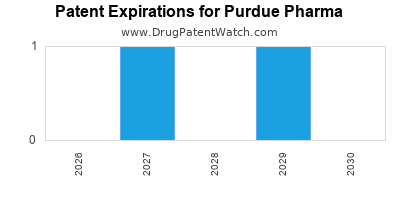
Last updated: July 30, 2026
Purdue Pharma’s competitive position is defined less by active new-drug approvals and more by (1) legacy analgesic and opioid brand portfolios, (2) the scope and survivability of its patent estates around extended-release opioid formulations, and (3) litigation, bankruptcy-structured resolutions, and ongoing regulatory scrutiny that affect commercial continuity, distribution, and reformulation timelines. The firm’s competitive advantage historically hinged on controlled-release technology and lifecycle management, while its constraint set is dominated by IP expiration schedules, consent decrees, and the practical risk that future launches face both legal and FDA-enforcement headwinds.
What is Purdue Pharma’s market position in opioids and chronic pain?
Executive answer: Purdue’s market exposure is concentrated in opioid analgesics, historically led by OxyContin and other extended-release products. Competitive dynamics reflect FDA and state pressure on opioid prescribing, distribution controls, and the shift toward tamper-resistant and abuse-deterrent formulations. Business outcomes now depend on whether Purdue-specific products can maintain supply, label positioning, and distribution access under litigation and settlement-driven controls.
How does Purdue’s product mix shape competitive positioning?
Core historical anchors (extended-release opioids):
- OxyContin (oxycodone HCl extended-release): flagship brand and primary driver of legacy revenue exposure and patent lifecycle strategy.
- Other opioid analgesic brands have been present over time, but the competitive center of gravity in public sources is OxyContin extended-release.
Competitive implications:
- Competitors with abuse-deterrent and generic extended-release versions compress pricing and market share after exclusivity and patent expiry.
- Entering “new” opioid products is rare due to regulatory risk, controlled-substance constraints, and strong enforcement posture.
What are Purdue’s major competitive threats?
- Authorized generics and Paragraph IV generics after patent and exclusivity expiry.
- Abuse-deterrent platform competitors that can capture prescriber preference in institutional formularies.
- Enforcement-led channel risk: state-by-state distribution restrictions can shift demand among brands.
Which patents protect Purdue Pharma’s opioid brands, especially OxyContin?
Executive answer: Purdue’s enforceable advantage historically centers on patents covering extended-release oxycodone formulations, manufacturing processes, and abuse-deterrent or tamper-resistant properties for OxyContin-related product lines. Patent coverage typically spans formulation composition, dosage-unit design, and controlled-release mechanisms.
What types of patents typically underpin extended-release opioid exclusivity?
Patent estates for controlled-release opioids typically include:
- Formulation patents (polymer matrices, excipients, drug release profiles)
- Compositions and dosage forms (tablet/capsule structure, coating layers)
- Manufacturing process patents (granulation, compression, coating, curing)
- Abuse-deterrence or tamper-resistance patents (physical/chemical barriers)
- Method-of-use patents (less common for opioids than formulation)
- Polymorph/particle engineering (where applicable)
How broad is the OxyContin patent estate in practice?
A practical way to view breadth is by timing: Purdue’s litigation and lifecycle strategy historically targeted late-expiring formulation and dosage patents and defended against generic and reformulation entry. The most material risk for a brand like OxyContin is a generic applicant gaining a regulatory pathway to market through ANDA and challenging one or more listed Orange Book patents.
When does OxyContin lose exclusivity and patent protection?
Executive answer: OxyContin’s exclusivity and patent protection have already largely transitioned into a period where generics and authorized generics have had meaningful entry opportunities, with the remaining value concentrated in last-mile lifecycle patents and abuse-deterrent or reformulated SKUs. Precise expiration dates must be confirmed against the active Orange Book listings for each exact NDC strength and dosage form.
How do exclusivity categories impact launch timing?
- Orange Book listed patents set the legal bar for ANDA/505(b)(2) challenges.
- FDA exclusivity (market exclusivity and regulatory exclusivity) can extend beyond patent expiry depending on drug approval history and changes to product or label.
- Settlement and injunction outcomes can create delayed generic entry even after statutory expiry.
Which companies are challenging Purdue Pharma’s patents via Paragraph IV ANDAs?
Executive answer: The competitive field for OxyContin-style extended-release opioids typically includes large generic manufacturers that file ANDAs with Paragraph IV certifications against Orange Book patents. The market effect is a staged wave of launches tied to patent and settlement outcomes per strength and formulation.
What Paragraph IV disputes historically do to market pricing?
- Paragraph IV filings increase the probability of:
- a negotiated settlement with a design-around,
- launch-at-risk outcomes,
- or longer brand protection if a court enjoins launch.
- Even where courts rule for the patent holder, the mere uncertainty can increase manufacturing and contracting costs.
Who wins: brand or generic?
In opioid markets, winners often depend on:
- whether the generic can match release profile and meet bioavailability requirements,
- whether the brand’s reformulated abuse-deterrent features are patent-protected,
- and whether distribution access remains stable under settlement-driven controls.
What is the Orange Book status of Purdue Pharma products like OxyContin?
Executive answer: Purdue products are listed in the FDA Orange Book with multiple patents per dosage form and strength, reflecting long-lived formulation and lifecycle management. Competitive leverage depends on which patents are still listed and not expired for the exact NDC the investor or competitor cares about.
How to interpret Orange Book listings for strategy
- Patents are listed per NDC and can differ by:
- strength,
- release design,
- and abuse-deterrence or reformulation status.
- A competitor’s ANDA scope can target:
- specific strengths,
- specific release types,
- or specific alternative designs to avoid infringement.
How strong is Purdue Pharma’s patent estate versus generic and abuse-deterrent competitors?
Executive answer: Purdue’s patent estate strength historically comes from formulation and dosage patents tied to controlled release. Strength is measured by (1) how many active Orange Book patents remain for each OxyContin SKU, (2) whether prior litigation created durable barriers (injunctions or settlements), and (3) whether competing products are meaningfully design-differentiated.
Patent strength indicators that matter commercially
- Number of unexpired Orange Book patents per NDC
- Remaining claims scope after any construction or invalidity rulings
- Design-around feasibility (whether competitors can change matrix/coating/dosage unit)
- Time remaining until expiry and whether settlements have extended launch dates
What usually erodes brand patent strength in this class?
- “Evergreening” success declines when:
- earlier composition claims expire,
- reformulation protections fail to cover the exact competing product,
- or courts narrow the patent claims materially.
What formulations are protected by Purdue Pharma patents?
Executive answer: The protected subject matter for Purdue’s flagship products is concentrated in extended-release oxycodone dosage forms and, for certain product evolutions, abuse-deterrent features embedded into the dosage-unit design and/or tablet matrix.
Formulation strategy: what competitors try to copy
Competitors generally attempt to:
- match pharmacokinetic parameters (Cmax and AUC),
- achieve similar release profiles across GI conditions,
- and avoid infringement of specific matrix composition or coating structure claims.
What protected features are usually hardest to design around?
- Specific controlled-release mechanisms that depend on:
- drug dispersion method,
- matrix excipient composition ratios,
- coating layer architecture,
- and physical integrity under tampering scenarios.
What method-of-use patents protect Purdue products, and do they matter?
Executive answer: For opioids like OxyContin, competitive impact is typically driven more by formulation and dosage patents than by method-of-use claims, since generics can often pursue technical bioequivalence and rely on formulation rather than prescribing changes. Method-of-use patents can still matter if they cover narrow claims tied to labeling or specific therapeutic regimens.
Why method-of-use enforcement is often narrower
- Generic carve-outs and label language changes can reduce infringement risk.
- Courts may construe method claims narrowly or require strict correspondence to label-supported use.
What patent litigation affects Purdue Pharma’s ability to defend market share?
Executive answer: Purdue’s litigation profile is dominated by opioid-related claims and product-liability and settlement-driven restructuring, but for competitive patent analysis the key question is whether litigation outcomes created enforceable patent barriers that delay generic entry or constrain specific reformulation SKUs.
How litigation outcomes translate into commercial risk
- Injunctions: can delay generic launch if a specific patent is found valid and infringed.
- Settlements: can replace open-ended litigation with defined “launch windows.”
- Bankruptcy and restructuring: can change enforcement priorities and the practical ability to fund patent defense at scale.
What settlement agreements and bankruptcy outcomes change Purdue’s competitive posture?
Executive answer: Purdue’s bankruptcy and opioid settlement framework changed the competitive landscape by reshaping the firm’s legal posture, limiting some direct enforcement pathways, and constraining future cash flows that would otherwise support aggressive IP defense and life-cycle investment.
Commercial impact mechanisms
- Settlement-driven distribution controls and monitoring can change demand allocation across brands and generics.
- Patent enforcement strategies can be affected by restructuring priorities and asset transfer terms.
How does FDA regulation and drug safety scrutiny affect Purdue’s future competition?
Executive answer: FDA and state-level opioid scrutiny affects Purdue through labeling, REMS-like expectations (where applicable), prescribing guidance pressure, and enforcement posture around controlled substances and risk management. This environment favors products that can demonstrate abuse-deterrence and consistent controlled-release performance, and it punishes firms perceived as increasing risk.
Regulatory factors that influence market access
- Compliance risk in manufacturing and distribution
- Label content and safety communications
- Postmarketing obligations tied to opioid risk management
Which generic entry risks exist for Purdue Pharma opioids?
Executive answer: Generic entry risks concentrate on:
- unexpired Orange Book patents by NDC/strength,
- whether competitors can obtain favorable claim construction or invalidity outcomes,
- and whether settlements define launch dates or permit design-around entry.
Launch-at-risk versus settlement-protected entry
- If competitors file ANDAs with Paragraph IV certifications and are not enjoined, they may enter at risk, betting on eventual patent invalidation.
- Settlement outcomes can create predictable market timing but can also allow faster entry if the settlement design covers competitors’ modified versions.
How does Purdue’s product competition compare with other extended-release oxycodone players?
Executive answer: Purdue competes against a mix of brand survivors, generic extended-release oxycodone products, and abuse-deterrent alternatives. Market share tends to follow pricing, formulary placement, and prescriber comfort with abuse-deterrent performance and consistent pharmacokinetics.
Competitive comparison axes
- Patent protection remaining per SKU
- Abuse-deterrent evidence and patent coverage
- Generic availability and substitution rates
- Distribution channel access under enforcement and settlement frameworks
Revenue exposure: what parts of Purdue’s business are most at risk from IP expiry?
Executive answer: The highest revenue exposure is tied to OxyContin-related SKUs still protected by active Orange Book patents and/or exclusivity extensions. Once those barriers lapse, the class faces price compression from generics and authorized generics.
What investors should model in scenarios
- SKU-by-SKU expiry of listed patents
- whether abuse-deterrent reformulations maintain separation from generic substitution
- expected generic launch timing under settlement/ANDA litigation dynamics
- distribution and reimbursement friction due to opioid oversight
Key Takeaways
- Purdue Pharma’s competitive position historically relied on extended-release oxycodone formulation IP and lifecycle management for OxyContin-related products.
- Current competitive dynamics are dominated by generic/authorized generic substitution risk after Orange Book patent expiry, with timing and launch scope driven by Paragraph IV ANDA strategy and per-NDC patent listings.
- Patent estate strength is measured by the number and enforceability of still-listed formulation/dosage patents for each SKU, not by method-of-use claims alone.
- Purdue’s broader competitive posture is constrained by opioid settlement/bankruptcy outcomes, which affect enforcement priorities and commercialization risk.
- FDA and state scrutiny increases the value of abuse-deterrent and consistent controlled-release performance, and it raises compliance exposure for manufacturers and distributors.
FAQs
-
Which Purdue Pharma OxyContin strengths are most exposed to generic substitution risk?
Focus on the per-NDC Orange Book patent lists and the latest active listed patents tied to each strength.
-
How do settlement terms typically affect the timing of ANDA launches against OxyContin patents?
Settlements commonly define a launch window, sometimes tied to design-around criteria or specific patent lists.
-
What do competitors change to avoid infringement of extended-release oxycodone formulation patents?
They typically adjust matrix composition ratios, coating architecture, manufacturing parameters, and dosage-unit structure to create non-infringing designs.
-
Do abuse-deterrent features create durable patent protection for Purdue, or do they fall away quickly?
Durability depends on whether abuse-deterrence claims are still unexpired for the specific reformulated SKU and whether courts construe claims broadly enough to cover design-around attempts.
-
How should an investor assess Purdue’s IP value in the context of bankruptcy and enforcement constraints?
Model enforceable unexpired Orange Book coverage per NDC and weigh practical defense capacity against expected generic launch timelines.
References
- FDA. Drugs@FDA: FDA Approved Drug Products. U.S. Food and Drug Administration. https://www.accessdata.fda.gov/scripts/cder/daf/
- FDA. Orange Book: Approved Drug Products with Therapeutic Equivalence Evaluations. U.S. Food and Drug Administration. https://www.accessdata.fda.gov/scripts/cder/daf/
- U.S. FDA and HHS. Controlled Substances Act and FDA Drug Safety Information. U.S. Department of Health and Human Services / FDA. https://www.fda.gov/