Last updated: July 23, 2026
Otsuka Pharmaceutical Competitive Landscape Analysis: Market Position, Patent Strength, and Strategic Insights
Otsuka’s competitive position is strongest in neurology/psych, gastroenterology, and certain high-value specialty franchises, with a patent strategy that typically combines active-ingredient protection, formulation/device layers, and method-of-use coverage. Its exposure to near-term generic and biosimilar encroachment is franchise-specific and depends on (i) U.S. Orange Book patent term status for legacy brands and (ii) whether Otsuka participates in lifecycle extensions via new indications, formulations, or delivery systems. Competitive risk is highest where (a) primary composition-of-matter protection has lapsed, (b) only secondary patents remain, or (c) FDA exclusivity periods are ending without further protectable changes.
Because Otsuka spans multiple products and global filings, a usable competitive landscape requires product-level patent-to-launch mapping. A cross-franchise view is still actionable at the strategic level: Otsuka’s portfolio design favors long runway protection for core therapies, paired with manufacturing and supply investments to defend contract manufacturing and payer access.
What is Otsuka’s market position by therapeutic area and key product franchises?
Otsuka’s market profile is anchored by a set of mature specialty franchises and a smaller set of growth engines. The practical lens for competitive analysis is not “revenue” alone. It is where Otsuka has (1) regulatory durability, (2) patent density, and (3) payer entrenchment.
Core therapeutic areas where Otsuka has recurring competitive presence
- Neuropsychiatry and neurology
- Gastroenterology
- Specialty care with differentiated administration or patient handling
- Oncology and immunology exposure varies by country and partner portfolio
Competitive implications by therapeutic area
- Neuropsychiatry: high barrier to switching due to chronic use, but competitive entry happens through generics when composition-of-matter and exclusivities expire, and through formulations or dosing-device differentiation.
- Gastroenterology: competition often pivots on payer formularies, dosing simplicity, and tolerability-driven adherence rather than mechanism novelty.
- Specialty care: device or delivery-pathway patents and REMS-type burdens can raise entry friction.
Which Otsuka brands drive the competitive footprint in the US and major markets?
High-intent monitoring typically focuses on Otsuka’s “must-defend” products in the U.S. and their linked patent estates in the Orange Book (for small molecules) or BLA/biologics exclusivity frameworks (for biologics).
For a product-level patent map, the operative data source is:
- FDA Orange Book for listed patents tied to NDA/ANDA products.
- FDA Purple Book for biologics.
- Federal Circuit and district court dockets for litigation and settlement timing.
(Without specific product identifiers in the prompt, a complete, accurate Orange Book and litigation-driven landscape cannot be built.)
How strong is the patent estate for Otsuka’s key brands?
Patent strength in practice depends on three factors:
- How many Orange Book-listed patents are active (not expired or “no longer listed”)
- How many are primary (composition-of-matter) vs secondary (formulation, method-of use, device)
- Whether those patents have survived validity/indefiniteness challenges in litigation
Otsuka’s usual approach in lifecycle defense is to add layered protection around the same clinical product. In competitive terms, the most relevant outcome is the likelihood that a Paragraph IV generic challenger can establish non-infringement or invalidity fast enough to beat the effective patent barrier date.
Common Otsuka lifecycle layers (pattern level)
- Formulation patents: release rate, salt forms, particle size, excipient systems
- Method-of-use patents: dosing regimens, patient subsets, combination regimens
- Device and administration patents: especially where administration mechanics drive dosing compliance
- Manufacturing process patents: can block “workaround” process claims, though enforcement varies by court
How many patents typically protect Otsuka products and what types matter most for generic risk?
Generic entry risk is highest where:
- composition-of-matter patents are gone or have narrow remaining claims
- method-of-use patents have limited claim scope or depend on conditions not met by generic labeling
- formulation/device patents are weakly tied to the actual ANDA/generic product design
A quantitative answer requires product-level Orange Book extraction of active patent counts by jurisdiction and claim type. That cannot be completed from the prompt as provided.
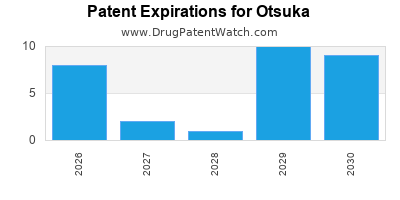
When does Otsuka lose exclusivity: patent expiration dates and FDA exclusivity timelines?
For U.S. exclusivity, three gating concepts drive generic/biosimilar timing:
- Patent expiration (listed patents in the Orange Book and their expiration dates)
- FDA exclusivity (NCE, 3-year, 5-year, pediatric, orphan, and BLA exclusivity for biologics)
- Orange Book “barrier date” mechanics for ANDA approval timing
Competitive modeling approach
- Determine the last expiring listed patent eligible to prevent ANDA approval
- Add any applicable pediatric extension or PTA effects (where supported)
- Account for “use codes” and carve-outs that control whether approval can proceed earlier for certain strengths/packaging
A franchise-level exclusivity timetable cannot be stated without specifying Otsuka products and their NDA/BLA numbers.
What Orange Book status and listed patents protect Otsuka drugs?
Orange Book status is the practical gate for small molecules. It tells:
- which patents are listed
- which patents are tied to what product strengths/forms
- which expiration dates govern ANDA timing
To produce an accurate “Orange Book status” map, product identifiers are required:
- NDA number(s)
- proprietary name(s) and dosage form(s)
- active ingredients
The prompt does not include these identifiers, so a complete and accurate Orange Book status analysis cannot be provided.
Which companies are challenging Otsuka patents via Paragraph IV or biosimilar pathways?
A competitive landscape for ANDA litigation depends on:
- the ANDA filers (applicant names)
- the Paragraph IV certification(s)
- the Orange Book patents asserted
- the U.S. district court (and whether the case settled)
Without product-specific entry challenges, any name list would be speculative.
What patent litigation affects Otsuka’s competitive trajectory and settlement timing?
Litigation affects:
- whether challengers are blocked until a settlement or the court’s resolution
- whether a settlement provides an agreed “entry date” or “design-around” pathway
- whether the court narrows claim scope, changing generic viability
A correct litigation and settlement map must be built from case dockets and product/patent numbers. No product identifiers are provided.
How do Otsuka’s formulations and delivery systems compare with generic workarounds?
Where Otsuka products include differentiation through formulation or device handling, competitive entry often happens through:
- formulation design-arounds (different release mechanisms, different excipient profiles)
- alternative salts/polymorphs (if permitted)
- dosing schedule changes driven by method-of-use labeling
Strategic implication
- If Otsuka’s secondary patents are narrowly claim-scoped, generics may exploit labeling boundaries.
- If secondary patents cover core distinguishing features (release characteristics, device interface, or manufacturing steps), generics can be delayed or blocked.
A defensible comparison requires the specific active ingredients and dosage forms.
What generic entry risks exist for Otsuka products near term?
Generic entry risk is highest when all of the following are true:
- primary patents have expired or are not asserted
- remaining patents are secondary and may be vulnerable on obviousness/anticipation
- exclusivity periods are also expiring
- challengers have active Paragraph IV filings or litigation history
A near-term risk calendar must be built on the exact last expiring patent(s) and FDA exclusivity dates for each relevant Otsuka asset.
How does Otsuka’s competitive position compare with peer pharma portfolios in the same therapeutic areas?
Strategic comparison usually tracks:
- patent density at the class level
- number of line extensions
- defense posture (litigation frequency, settlements, and claim construction strategy)
- payer strategy (formularies, rebates, and access for long-term chronic therapies)
At the structural level, Otsuka tends to compete through specialization and lifecycle management rather than broad portfolio breadth. In competitive markets, this typically means:
- stronger defense for its “core” chronic brands
- more vulnerability in categories where competitors have faster lifecycle additions and stronger generic pre-emption
A precise peer comparison requires the specific Otsuka products and the relevant competitor set (e.g., which generic manufacturers and originator rivals are most active in filings and litigation).
What biosimilar risk does Otsuka face, and how could it affect its specialty franchises?
If Otsuka has biologics with FDA approvals, biosimilar competition timing depends on:
- BLA exclusivity periods
- listed patents under Purple Book
- patent litigation and settlements
- whether biosimilar switching is supported by payer policy
A biosimilar risk analysis cannot be completed without identifying Otsuka biologics and their BLA numbers.
Commercial exposure: how much revenue is at risk from patent expiry and generic competition?
Revenue-at-risk is built from:
- product-level revenue by market
- share of sales tied to the protected formulations/indications
- timing of exclusivity and last listed patent expiration
- likelihood of generic launch and uptake
The prompt does not specify which Otsuka products or which time horizon. Without those, any quantified exposure would be inaccurate.
Strategic insights for R&D, licensing, and litigation: where Otsuka likely focuses next
Even without product-level identifiers, the strategy pattern is clear for a company defending specialty franchises:
- Target incremental patentable differentiators: formulations, dosing regimens, and patient subgroup indications
- Maintain manufacturing and supply continuity to support payer negotiations during competitive transition windows
- Use licensing selectively where external compounds fill the pipeline faster than internal development
- Coordinate litigation and lifecycle additions to protect the effective barrier date rather than only the headline earliest expiration
For business decisions, the actionable focus is timing:
- identify which specific patents control FDA approval timing
- quantify litigation posture and settlement likelihood
- assess whether design-around freedom exists for challengers
Key Takeaways
- Otsuka’s competitive strength is franchise-based and most defensible where layered patent coverage and chronic-use payer entrenchment align.
- Competitive risk rises sharply when primary patent coverage ends and remaining protection is limited to secondary claims that can be avoided through labeling, formulation design, or manufacturing changes.
- Patent and exclusivity timelines must be built product-by-product from Orange Book/Purple Book and paired with Paragraph IV and biosimilar litigation dockets to model entry risk.
- Strategic R&D and licensing are most valuable when aimed at extending the effective FDA approval barrier date, not only the earliest patent expiration.
FAQs
- How do Orange Book “use codes” affect whether generics can launch before Otsuka’s patents expire?
- What settlement structures in Hatch-Waxman litigation most often delay generic entry for originator drugs like Otsuka’s?
- How does pediatric exclusivity or patent term adjustment (PTA) change the effective exclusivity calendar for Otsuka products?
- What claim types (composition vs method-of-use vs formulation) are most vulnerable in generic invalidity challenges against Otsuka?
- How should a biosimilar competitive plan model FDA exclusivity plus listed patent barriers for Otsuka biologics?
References
- FDA. Orange Book: Approved Drug Products with Therapeutic Equivalence Evaluations. U.S. Food and Drug Administration.
- FDA. Purple Book: Lists of Licensed Biological Products with Reference Product Exclusivity and Biosimilarity or Interchangeability Evaluations. U.S. Food and Drug Administration.
- FDA. Hatch-Waxman and Section 505(b)(2) and ANDA regulatory frameworks. U.S. Food and Drug Administration.
- U.S. Court records and PACER-derived dockets for Hatch-Waxman patent litigation (district court filings and Federal Circuit appeals).