Last updated: August 1, 2026
Amgen acquired Onyx Pharmaceuticals in October 2013 for approximately $10.4 billion, converting Onyx’s oncology portfolio into an Amgen growth platform. Onyx no longer operates as an independent pharmaceutical company. Its most important retained asset, Kyprolis (carfilzomib), gives Amgen a commercial position in multiple myeloma, while Bayer remains the principal commercial partner for Nexavar (sorafenib) and Stivarga (regorafenib) in major markets.[1]
Amgen’s Onyx-derived portfolio has strategic value but faces a mature competitive environment. Kyprolis competes with Johnson & Johnson and Genmab’s Darzalex, Bristol Myers Squibb’s Pomalyst and Empliciti, and generic versions of older myeloma therapies. Patent protection, combination-regimen adoption, manufacturing complexity, and clinical differentiation determine the duration of Kyprolis revenue.
What is the relationship between Onyx Pharmaceuticals and Amgen?
Amgen acquired Onyx Pharmaceuticals through a tender offer and subsequent merger that closed on October 1, 2013. The transaction valued Onyx at approximately $10.4 billion, or $125 per share.[1]
Onyx contributed:
- Kyprolis, a proteasome inhibitor for multiple myeloma
- Nexavar rights and economics, under the Bayer collaboration
- Stivarga rights and economics, under the Bayer collaboration
- Oncology development capabilities and intellectual property
- Commercial relationships in hematology and solid tumors
Amgen integrated Onyx rather than maintaining it as an independent operating company. Onyx Pharmaceuticals is therefore best analyzed as an acquired asset platform within Amgen’s oncology business.
Which Onyx products are now associated with Amgen?
| Product |
Active ingredient |
Principal disease area |
Commercial structure |
Current strategic relevance |
| Kyprolis |
Carfilzomib |
Multiple myeloma |
Amgen |
Core Onyx-derived Amgen asset |
| Nexavar |
Sorafenib |
Renal cell, hepatocellular, thyroid cancers |
Bayer and Onyx collaboration |
Mature oncology product |
| Stivarga |
Regorafenib |
Colorectal cancer, gastrointestinal stromal tumor, hepatocellular carcinoma |
Bayer and Onyx collaboration |
Mature multi-indication product |
| Xgeva and Prolia |
Denosumab |
Bone complications and osteoporosis |
Amgen |
Not Onyx assets, but relevant competitive context in oncology |
Kyprolis is the product most directly associated with Amgen’s acquisition thesis. Bayer controls major commercial responsibilities for Nexavar and Stivarga, while the economic and legal arrangements derive from the prior Onyx collaborations.[2]
What is Kyprolis and how does it compete in multiple myeloma?
Kyprolis is an intravenous proteasome inhibitor containing carfilzomib. The FDA first approved it in 2012 for patients with multiple myeloma who had received at least two prior therapies, including bortezomib and an immunomodulatory agent.[3]
The label has since expanded to earlier lines and combination regimens. Current Kyprolis use includes combinations with:
- Lenalidomide and dexamethasone
- Dexamethasone alone
- Daratumumab and dexamethasone
- Isatuximab and dexamethasone
Kyprolis competes in a treatment market increasingly shaped by anti-CD38 antibodies, cellular therapies, bispecific antibodies, and immunomodulatory drugs.
How does Kyprolis compare with competing multiple myeloma drugs?
| Drug |
Company or companies |
Mechanism |
Administration |
Competitive position |
| Kyprolis |
Amgen |
Proteasome inhibitor |
Intravenous |
Established efficacy in relapsed disease; cardiovascular and administration burden |
| Velcade |
Takeda |
Proteasome inhibitor |
Subcutaneous or intravenous |
Older, lower-cost, widely used; generic competition |
| Darzalex |
Johnson & Johnson and Genmab |
Anti-CD38 antibody |
Subcutaneous or intravenous |
Strong brand and combination backbone |
| Pomalyst |
Bristol Myers Squibb |
Immunomodulatory agent |
Oral |
Established relapsed-myeloma therapy; generic risk later in decade |
| Empliciti |
Bristol Myers Squibb and AbbVie |
SLAMF7 antibody |
Intravenous |
Smaller competitive position |
| Sarclisa |
Sanofi |
Anti-CD38 antibody |
Intravenous |
Direct antibody competitor |
| Carvykti |
Johnson & Johnson and Legend Biotech |
BCMA-directed CAR-T |
Intravenous cellular therapy |
High-efficacy option for later-line patients |
| Abecma |
Bristol Myers Squibb and 2seventy bio |
BCMA-directed CAR-T |
Intravenous cellular therapy |
Later-line cellular therapy competitor |
| Bispecific antibodies |
Several companies |
BCMA or other immune targets |
Mostly injectable |
Expanding alternatives in relapsed disease |
Kyprolis remains relevant because it is used in combination regimens and has demonstrated clinical activity in heavily pretreated patients. Its main commercial constraints are intravenous administration, monitoring requirements, cardiovascular and renal safety considerations, and competition from antibody-based and cellular therapies.[3][4]
What patents protect Kyprolis and carfilzomib?
Kyprolis protection is based on a combination of composition-of-matter, formulation, dosing, and method-of-use rights. The most important patent families originated with Onyx and are now controlled or licensed by Amgen.
Publicly identified U.S. patent rights associated with carfilzomib include:
| Patent or patent family |
Subject matter |
Strategic function |
| U.S. Patent No. 7,598,374 |
Carfilzomib-related compound and proteasome-inhibitor chemistry |
Core chemical protection |
| U.S. Patent No. 8,367,838 |
Carfilzomib formulations and pharmaceutical use |
Product and formulation protection |
| Later continuation and method-of-use families |
Dosing schedules and combination treatment |
Lifecycle management |
Patent term and enforceability depend on terminal disclaimers, patent-term adjustment, patent-term extension, claim scope, and the specific product code listed in FDA records. A single nominal expiration date should not be treated as the complete generic-entry analysis.
What formulations are protected by Kyprolis patents?
Kyprolis is supplied as a lyophilized powder for intravenous reconstitution. Formulation protection can address:
- Stabilized carfilzomib compositions
- Lyophilized preparations
- Reconstitution conditions
- Concentration ranges
- Excipient systems
- Storage and administration parameters
Formulation patents are commercially important because they can remain relevant after broad chemical claims approach expiration. Their value depends on whether a generic applicant can design around the claims or challenge them through a Paragraph IV certification.
How strong is the Kyprolis patent estate?
The Kyprolis estate is moderately strong in commercial terms because it combines a branded intravenous product, clinical-regimen patents, manufacturing know-how, and regulatory complexity. Its strength is weaker than that of a newly launched biologic with long remaining composition-of-matter protection.
Key strengths include:
- Established clinical use in combination regimens.
- Complex sterile manufacturing and reconstitution requirements.
- Multiple potential barriers beyond the original compound patent.
- Physician familiarity in relapsed and refractory myeloma.
Key weaknesses include:
- Small-molecule status, which permits an ANDA pathway.
- Mature clinical positioning.
- Competition from newer immune therapies.
- Potentially limited value of narrow method-of-use claims.
- A growing commercial shift toward subcutaneous, oral, bispecific, and cellular therapies.
When does Kyprolis lose exclusivity?
Kyprolis loses exclusivity through a sequence rather than a single event:
| Exclusivity component |
Timing or status |
Impact |
| Original FDA approval |
July 20, 2012 |
Established the initial regulatory exclusivity period |
| Orphan-drug exclusivity |
Initial approval period |
Protected the approved orphan indication |
| Supplemental approvals |
2015 onward |
Expanded label and commercial utility |
| Core patent estate |
Mid-to-late 2020s, depending on patent and adjustment |
Primary generic-entry barrier |
| Formulation and method patents |
Potentially later than core composition claims |
May delay product-specific entry |
| Small-molecule ANDA pathway |
Available to generic applicants |
Creates Paragraph IV litigation exposure |
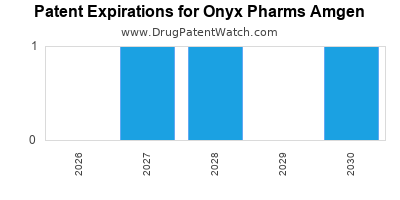
The commercial risk window is likely to intensify in the second half of the 2020s as core patents mature. Actual generic launch timing will depend on FDA Orange Book listings, ANDA filing dates, Paragraph IV litigation, settlement terms, pediatric exclusivity, patent-term adjustments, and any court-ordered injunction.
What is the FDA and Orange Book status of Kyprolis?
Kyprolis is FDA-approved and listed as a prescription oncology product. The FDA-approved active ingredient is carfilzomib. The product is regulated as a small-molecule drug, not a biologic, so generic applicants can use the ANDA pathway rather than the biosimilar pathway.[3][5]
The Orange Book is the controlling source for currently listed patents and FDA-recognized exclusivity. Relevant categories include:
- Drug substance patents
- Drug product or formulation patents
- Method-of-use patents
- Patent expiration dates
- Pediatric exclusivity, if applicable
- Approved dosage forms and strengths
An Orange Book listing does not guarantee that every listed claim will survive litigation. Generic applicants can file Paragraph IV certifications alleging that listed patents are invalid, unenforceable, or not infringed.
Which companies are challenging Kyprolis with generics?
Kyprolis is vulnerable to generic competition because carfilzomib is a small molecule. A generic company could file an ANDA for the approved intravenous dosage form and challenge listed patents through Paragraph IV.
The principal potential challengers are large injectable-generic manufacturers, including:
- Teva Pharmaceutical Industries
- Fresenius Kabi
- Sandoz
- Viatris
- Hikma Pharmaceuticals
- Dr. Reddy’s Laboratories
- Cipla
- Sun Pharmaceutical Industries
The existence of a potential challenger does not establish that an ANDA has been filed. Public litigation, FDA Orange Book activity, and court dockets are required to confirm a specific challenge.
What generic launch scenarios exist for Kyprolis?
| Scenario |
Likely commercial effect |
| No Paragraph IV filing before core patent expiry |
Delayed but orderly generic entry after patent expiry |
| Paragraph IV filing with litigation |
Possible 30-month FDA stay and settlement-driven entry date |
| Narrow patent invalidated |
Earlier entry, depending on surviving patents |
| Formulation patent upheld |
Delayed or limited generic entry |
| At-risk launch |
Rapid price erosion but substantial damages exposure |
| First generic approval without immediate launch |
Limited near-term erosion; later competitive pressure |
Generic penetration could be slower than for an oral tablet because Kyprolis requires sterile injectable manufacturing, hospital or infusion-center administration, and specialized distribution.
What patent litigation affects Onyx and Amgen oncology products?
The major historical litigation risk around Onyx products has involved product patents, licensing disputes, and generic challenges. Kyprolis litigation would likely focus on:
- Validity of carfilzomib compound claims
- Infringement of formulation claims
- Written-description and enablement issues
- Obviousness
- Double-patenting
- Scope of method-of-use claims
- ANDA labeling and induced-infringement theories
Nexavar and Stivarga have had more extensive patent and regulatory litigation histories because of their commercial scale, multiple indications, and Bayer-Onyx collaboration structure. Those disputes have involved patent expiry, generic entry timing, and FDA exclusivity issues.
What settlement agreements could affect generic entry?
A settlement between Amgen and a generic applicant could establish:
- A negotiated launch date
- A license to manufacture or sell
- Restrictions on indications or labeling
- Supply arrangements
- Waiver of damages claims
- Acceleration provisions if patents are invalidated
The most important commercial fact in any settlement is the authorized-entry date. A settlement can preserve branded revenue while eliminating litigation uncertainty, but it can also create an earlier generic-entry date than the patent owner would obtain through successful litigation.
What licensing deals shaped the Onyx portfolio?
Onyx built its portfolio through licensing and collaboration rather than through wholly owned commercialization of every asset.
Nexavar and Stivarga collaboration with Bayer
Bayer and Onyx entered into a long-term collaboration covering sorafenib and regorafenib. Bayer led major global development and commercialization activities, while Onyx held economic rights in the oncology products.[2]
The collaboration gave Onyx:
- Access to Bayer’s global commercial infrastructure
- Shared development economics
- Exposure to multiple solid-tumor indications
- Reduced commercialization costs
For Amgen, the acquisition preserved participation in those products but did not convert Bayer’s assets into wholly Amgen-controlled brands.
Kyprolis commercialization
Kyprolis is the clearest Amgen-controlled Onyx asset. Amgen has managed its regulatory expansion, clinical development, commercialization, and lifecycle strategy since the acquisition.
The strategic logic is direct: Kyprolis supplied a branded hematology product with additional-line expansion potential, while Nexavar and Stivarga provided collaboration-derived oncology economics.
How does Amgen’s Onyx portfolio compare with competing oncology patent estates?
| Company |
Representative asset |
Patent-estate profile |
Main risk |
| Amgen |
Kyprolis |
Mature small-molecule estate with formulation and method claims |
Generic entry and myeloma innovation |
| Johnson & Johnson and Genmab |
Darzalex |
Antibody estate supported by formulation, dosing, and combination claims |
Biosimilar and next-generation therapy competition |
| Bristol Myers Squibb |
Pomalyst, Empliciti, Abecma partnership |
Mixed small-molecule, antibody, and cellular-product protection |
Generic, biosimilar, and clinical substitution |
| Sanofi |
Sarclisa |
Biologic estate with manufacturing and method claims |
Anti-CD38 class competition |
| Takeda |
Velcade |
Mature small-molecule estate |
Generic substitution |
| Legend Biotech and Johnson & Johnson |
Carvykti |
Biologic and cellular manufacturing protection |
Capacity, durability, and competing BCMA therapies |
Kyprolis has a narrower strategic moat than a leading antibody or CAR-T franchise. Its defensibility depends on clinical positioning, treatment-line utility, manufacturing execution, and the time required for injectable-generic competitors to qualify and scale.
What revenue exposure does Amgen have to Onyx-derived products?
Kyprolis is the principal direct revenue exposure. Nexavar and Stivarga add collaboration-derived economics but are mature products facing generic and therapeutic competition.
Amgen’s broader oncology revenue base is diversified across products such as Xgeva, Prolia, Repatha, and newer acquired or internally developed medicines. That diversification reduces the risk that Kyprolis erosion alone would materially destabilize the company.
The more relevant investment question is whether Kyprolis can maintain revenue through:
- Earlier-line treatment adoption
- Combination use with Darzalex or other antibodies
- Increased use in relapsed disease
- Geographic expansion
- New dosing schedules
- Clinical differentiation against bispecific antibodies and CAR-T therapies
What geographic coverage protects the Onyx-Amgen portfolio?
Patent rights are territorial. The U.S. estate is the most important for Amgen’s branded revenue and ANDA litigation. European and other national rights may have different:
- Filing dates
- Patent-term adjustments
- Supplementary protection certificates
- Claim scope
- Opposition outcomes
- Generic-entry rules
Bayer’s commercial role is particularly relevant outside the United States for Nexavar and Stivarga. Kyprolis is commercialized through Amgen’s global infrastructure, subject to country-specific approvals and reimbursement decisions.
Manufacturing know-how, sterile-filling capacity, quality systems, and regulatory chemistry documentation create practical barriers that are separate from patent rights. Those barriers can slow market entry but do not replace an enforceable patent.
What is the strategic outlook for Amgen’s Onyx assets?
Amgen’s Onyx portfolio has three strategic characteristics:
- Kyprolis remains a valuable but mature hematology asset.
- Nexavar and Stivarga provide collaboration economics rather than full commercial control.
- The portfolio’s long-term growth depends more on clinical positioning than on new broad patent protection.
Amgen’s main strategic challenge is managing Kyprolis through a transition from proteasome-inhibitor differentiation to combination-based relevance. The company must defend use in regimens where physicians balance efficacy, toxicity, administration burden, and access against bispecific antibodies and cellular therapies.
Key Takeaways
- Amgen acquired Onyx Pharmaceuticals for approximately $10.4 billion in 2013.
- Onyx is no longer an independent company.
- Kyprolis is the principal Onyx-derived Amgen asset.
- Nexavar and Stivarga remain tied to the Bayer-Onyx collaboration structure.
- Kyprolis is an FDA-approved small-molecule intravenous therapy, so generic ANDA and Paragraph IV challenges are possible.
- The Kyprolis patent estate includes compound, formulation, and method-of-use protection, with commercial risk concentrated in the second half of the 2020s.
- Biosimilar risk does not apply directly to Kyprolis because carfilzomib is a small molecule.
- Generic entry may be slower than for oral products because of sterile injectable manufacturing and infusion-center administration.
- Darzalex, CAR-T products, bispecific antibodies, and generic Velcade create the principal competitive pressure.
- Amgen’s Onyx-derived revenue is strategically meaningful but diversified within Amgen’s broader portfolio.
FAQs
Is Onyx Pharmaceuticals still a separate company?
No. Amgen acquired Onyx Pharmaceuticals in 2013 and integrated its assets into Amgen’s oncology business.
Is Kyprolis a biologic or a small-molecule drug?
Kyprolis is a small-molecule drug containing carfilzomib. Generic applicants can pursue an ANDA rather than a biosimilar application.
Can a generic company launch carfilzomib before all Kyprolis patents expire?
A generic company could launch before patent expiry only through a license, successful patent challenge, court ruling, or an at-risk launch. Each route has different litigation and damages consequences.
Does Amgen own Nexavar and Stivarga outright?
No. Nexavar and Stivarga arose from the Bayer-Onyx collaboration. Bayer has major commercial and development responsibilities, while Amgen retains the rights and economics assigned to the post-acquisition Onyx position.
What is the biggest long-term threat to Kyprolis?
The largest threat is clinical substitution by anti-CD38 antibodies, bispecific antibodies, CAR-T therapies, and other treatments that can reduce proteasome-inhibitor use in later-line multiple myeloma.
References
- Amgen Inc. (2013). Amgen completes acquisition of Onyx Pharmaceuticals. Amgen investor relations.
- Bayer AG. (2024). Annual report 2023. Bayer AG.
- U.S. Food and Drug Administration. (2024). Kyprolis (carfilzomib) prescribing information. FDA.
- International Myeloma Foundation. (2024). Multiple myeloma treatment overview. International Myeloma Foundation.
- U.S. Food and Drug Administration. (2024). Approved drug products with therapeutic equivalence evaluations: Orange Book. FDA.