Last Updated: June 24, 2026

KYPROLIS Drug Patent Profile


✉ Email this page to a colleague

« Back to Dashboard


When do Kyprolis patents expire, and when can generic versions of Kyprolis launch?

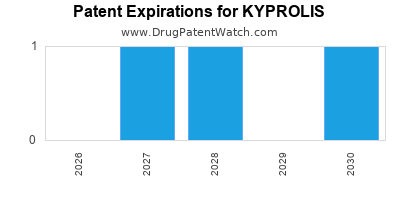
Kyprolis is a drug marketed by Onyx Pharms Amgen and is included in one NDA. There are four patents protecting this drug and three Paragraph IV challenges.

This drug has two hundred and twenty patent family members in forty-two countries.

The generic ingredient in KYPROLIS is carfilzomib. There are ten drug master file entries for this compound. One supplier is listed for this compound. Additional details are available on the carfilzomib profile page.

DrugPatentWatch® Litigation and Generic Entry Outlook for Kyprolis

A generic version of KYPROLIS was approved as carfilzomib by DR REDDYS on September 9th, 2019.

  Start Trial

AI Deep Research
Questions you can ask:
  • What is the 5 year forecast for KYPROLIS?
  • What are the global sales for KYPROLIS?
  • What is Average Wholesale Price for KYPROLIS?
Recent Clinical Trials for KYPROLIS

Identify potential brand extensions & 505(b)(2) entrants

SponsorPhase
Wuhan Union Hospital, ChinaPhase 2
GlaxoSmithKlinePhase 2
Dong-A University HospitalPhase 2

See all KYPROLIS clinical trials

Pharmacology for KYPROLIS
Drug ClassProteasome Inhibitor
Mechanism of ActionProteasome Inhibitors
Paragraph IV (Patent) Challenges for KYPROLIS
Tradename Dosage Ingredient Strength NDA ANDAs Submitted Submissiondate
KYPROLIS For Injection carfilzomib 10 mg/vial 202714 1 2018-11-28
KYPROLIS For Injection carfilzomib 30 mg/vial 202714 1 2017-10-05
KYPROLIS For Injection carfilzomib 60 mg/vial 202714 9 2016-07-20

US Patents and Regulatory Information for KYPROLIS

KYPROLIS is protected by four US patents and two FDA Regulatory Exclusivities.

Applicant Tradename Generic Name Dosage NDA Approval Date TE Type RLD RS Patent No. Patent Expiration Product Substance Delist Req. Exclusivity Expiration
Onyx Pharms Amgen KYPROLIS carfilzomib POWDER;INTRAVENOUS 202714-003 Jun 7, 2018 RX Yes Yes ⤷  Start Trial ⤷  Start Trial Y ⤷  Start Trial
Onyx Pharms Amgen KYPROLIS carfilzomib POWDER;INTRAVENOUS 202714-001 Jul 20, 2012 AP RX Yes Yes ⤷  Start Trial ⤷  Start Trial ⤷  Start Trial
Onyx Pharms Amgen KYPROLIS carfilzomib POWDER;INTRAVENOUS 202714-002 Jun 3, 2016 RX Yes Yes ⤷  Start Trial ⤷  Start Trial Y ⤷  Start Trial
Onyx Pharms Amgen KYPROLIS carfilzomib POWDER;INTRAVENOUS 202714-003 Jun 7, 2018 RX Yes Yes ⤷  Start Trial ⤷  Start Trial Y ⤷  Start Trial
Onyx Pharms Amgen KYPROLIS carfilzomib POWDER;INTRAVENOUS 202714-002 Jun 3, 2016 RX Yes Yes ⤷  Start Trial ⤷  Start Trial ⤷  Start Trial
>Applicant >Tradename >Generic Name >Dosage >NDA >Approval Date >TE >Type >RLD >RS >Patent No. >Patent Expiration >Product >Substance >Delist Req. >Exclusivity Expiration

Expired US Patents for KYPROLIS

Applicant Tradename Generic Name Dosage NDA Approval Date Patent No. Patent Expiration
Onyx Pharms Amgen KYPROLIS carfilzomib POWDER;INTRAVENOUS 202714-001 Jul 20, 2012 ⤷  Start Trial ⤷  Start Trial
Onyx Pharms Amgen KYPROLIS carfilzomib POWDER;INTRAVENOUS 202714-003 Jun 7, 2018 ⤷  Start Trial ⤷  Start Trial
Onyx Pharms Amgen KYPROLIS carfilzomib POWDER;INTRAVENOUS 202714-002 Jun 3, 2016 ⤷  Start Trial ⤷  Start Trial
Onyx Pharms Amgen KYPROLIS carfilzomib POWDER;INTRAVENOUS 202714-001 Jul 20, 2012 ⤷  Start Trial ⤷  Start Trial
>Applicant >Tradename >Generic Name >Dosage >NDA >Approval Date >Patent No. >Patent Expiration

EU/EMA Drug Approvals for KYPROLIS

Company Drugname Inn Product Number / Indication Status Generic Biosimilar Orphan Marketing Authorisation Marketing Refusal
Amgen Europe B.V. Kyprolis carfilzomib EMEA/H/C/003790Kyprolis in combination with daratumumab and dexamethasone, with lenalidomide and dexamethasone, or with dexamethasone alone is indicated for the treatment of adult patients with multiple myeloma who have received at least one prior therapy. Authorised no no yes 2015-11-19
>Company >Drugname >Inn >Product Number / Indication >Status >Generic >Biosimilar >Orphan >Marketing Authorisation >Marketing Refusal

International Patents for KYPROLIS

When does loss-of-exclusivity occur for KYPROLIS?

Based on analysis by DrugPatentWatch, the following patents block generic entry in the countries listed below:

Cyprus

Patent: 11489
Estimated Expiration: ⤷  Start Trial

Japan

Patent: 14141456
Patent: COMPOUND FOR ENZYME INHIBITION
Estimated Expiration: ⤷  Start Trial

Generics may enter earlier, or later, based on new patent filings, patent extensions, patent invalidation, early generic licensing, generic entry preferences, and other factors.

See the table below for additional patents covering KYPROLIS around the world.

Country Patent Number Title Estimated Expiration
Austria E494298 ⤷  Start Trial
Austria E496062 ⤷  Start Trial
Australia 2005238445 Compounds for enzyme inhibition ⤷  Start Trial
Australia 2005271232 Compounds for proteasome enzyme inhibition ⤷  Start Trial
Australia 2005295183 Labeled compounds for proteasome inhibition ⤷  Start Trial
>Country >Patent Number >Title >Estimated Expiration

Supplementary Protection Certificates for KYPROLIS

Patent Number Supplementary Protection Certificate SPC Country SPC Expiration SPC Description
1781688 PA2016010 Lithuania ⤷  Start Trial PRODUCT NAME: KARFILZOMIBAS; REGISTRATION NO/DATE: EU/1/15/1060 20151119
1781688 93015 Luxembourg ⤷  Start Trial PRODUCT NAME: CARFILZOMIB EVENTUELLEMENT SOUS FORME D'UN SEL PHARMACEUTIQUEMENT ACCEPTABLE; FIRST REGISTRATION: 20151123
1781688 CA 2016 00014 Denmark ⤷  Start Trial PRODUCT NAME: CARFILZOMIB OG FARMACEUTISK ACCEPTABLE SALTE DERAF; REG. NO/DATE: EU/1/15/1060 20151123
1781688 300805 Netherlands ⤷  Start Trial PRODUCT NAME: CARFILZOMIB, DESGEWENST IN DE VORM VAN EEN FARMACEUTISCH AANVAARDBAAR ZOUT; REGISTRATION NO/DATE: EU/1/15/1060 20151123
1781688 16C0017 France ⤷  Start Trial PRODUCT NAME: CARFILZOMIB; REGISTRATION NO/DATE: EU/1/15/1060 20151123
>Patent Number >Supplementary Protection Certificate >SPC Country >SPC Expiration >SPC Description

KYPROLIS Market Dynamics and Financial Trajectory (Carfilzomib): exclusivity, competitive pressure, and revenue path through patent and regulatory milestones

Last updated: June 22, 2026

KYPROLIS (carfilzomib) is a leading proteasome inhibitor in relapsed/refractory multiple myeloma (RRMM), with a revenue base driven by combination regimens across lines of therapy and anchored by continuing patent coverage for drug substance, formulations, and use claims. The competitive landscape has tightened as oral and antibody-based myeloma therapies expanded and as follow-on carfilzomib schedules and next-generation proteasome inhibitors gained share. The financial trajectory for KYPROLIS has been shaped by (1) ongoing uptake in combination protocols, (2) penetration outside the most refractory settings, (3) manufacturing and supply continuity, and (4) patent and exclusivity timing that influences biosimilar and generic threat profiles.

How has KYPROLIS performed financially over time and what revenue drivers matter most?

Revenue for KYPROLIS has historically tracked RRMM treatment intensity and protocol adoption. Key drivers include regimen positioning, line-of-therapy expansion, and sustained demand in combination schemas (notably with lenalidomide plus dexamethasone, and with dexamethasone-based backbones depending on regimen and label). In RRMM, sales typically reflect three demand components:

  • Patient counts in relapsed settings treated with proteasome inhibitors
  • Share of carfilzomib vs bortezomib-based regimens
  • Treatment duration shaped by tolerability and protocol cadence

What regimen mechanics drive KYPROLIS uptake?

Carfilzomib is typically used in multi-cycle schedules. Growth and erosion patterns largely map to:

  • Migration to earlier relapsed lines where trial and guideline uptake broaden use
  • Use in combination therapies that improve response depth and durability
  • Switch dynamics from bortezomib to carfilzomib for certain patient subgroups based on safety and neuropathy profiles

Where does payer pressure show up first?

In myeloma, cost control usually manifests through:

  • Prior authorization constraints
  • Step therapy rules that favor lower-cost alternatives
  • Reimbursement negotiations tied to outcomes and treatment pathways

What market dynamics are reshaping KYPROLIS demand in relapsed/refractory multiple myeloma?

KYPROLIS sits in a competitive multi-class myeloma landscape where monoclonal antibodies, BCMA-targeted therapies, immunomodulatory drugs, and next-generation proteasome inhibition compete for sequencing and patient attention.

Which therapeutic classes have increased competitive pressure on KYPROLIS?

Primary competitive forces include:

  • BCMA-directed therapies (antibody-drug conjugates, bispecific antibodies, and CAR-T in some settings)
  • CD38 monoclonal antibodies used earlier and in combinations
  • Oral immunomodulators (lenalidomide and related agents) sustaining combination dominance
  • Newer regimens that shift optimal sequencing away from proteasome inhibitor-centric approaches

How does competition shift patient sequencing?

As more high-response options appear, proteasome inhibitor use can move:

  • From later lines into earlier lines (growth factor)
  • Or from some later-line segments into post-biologics sequences (erosion factor)

The net effect on KYPROLIS depends on protocol adoption in trial-defined combinations and guideline sequencing.

What is the commercialization bottleneck: access or clinical positioning?

For oncology drug demand, the limiting factor is usually a mix of clinical fit and coverage. In RRMM, clinical fit includes renal function tolerance patterns, cardiac risk management, neuropathy considerations, and overall tolerability vs comparators. Access constraints include patient-specific authorization pathways and infusion center capacity for multi-day dosing schedules.

How does KYPROLIS compare with other myeloma proteasome inhibitors and RRMM standards of care?

KYPROLIS competes most directly with:

  • Bortezomib and bortezomib-based regimens (older but broadly used)
  • Other proteasome inhibitors and combination ecosystems

Carfilzomib vs bortezomib: typical differentiation

Carfilzomib is often selected to reduce neuropathy burden, while bortezomib is frequently favored for familiarity, administration flexibility, and cost dynamics. In many payer markets, that means KYPROLIS must clear both clinical fit and reimbursement hurdles to maintain or grow share.

Competitive overlap with antibody and BCMA strategies

As BCMA therapies penetrate, carfilzomib-based regimens may:

  • Lose late-line share if BCMA options are reachable and adopted
  • Retain value when used as bridging, combination components, or when BCMA eligibility is limited

What patents and exclusivity protections keep KYPROLIS economically defensible?

KYPROLIS’s economic defense is built on a layered estate that typically includes:

  • Carfilzomib composition-of-matter coverage
  • Formulation and dosing device or process claims
  • Method-of-use claims for combination regimens

In practice, that layered structure matters because even if a composition claim expires, formulation and method claims can block or complicate generic entry. For business planning, the key question is the earliest date at which a generic or biosimilar-equivalent could launch without infringing, and whether the relevant claims are already challenged.

How does FDA regulatory status affect threat timing for KYPROLIS?

Because KYPROLIS is a small-molecule drug, the generic pathway is generally via ANDA, and the timing and risk depend on:

  • Orange Book listing(s) for active ingredient and relevant patents
  • Whether Paragraph IV certifications have been filed
  • Litigation outcomes and potential settlement terms that delay entry

When does KYPROLIS lose exclusivity and how do patent expiration dates shape generic entry risk?

The loss of exclusivity is determined by the Orange Book patent and exclusivity schedule tied to carfilzomib and product-specific listings for KYPROLIS. For small-molecule drugs, generic entry is typically constrained by:

  • Composition-of-matter patent expiration
  • Secondary patent coverage on formulations and dosing
  • Any final court decisions on validity or infringement
  • Potential “30-month stay” triggered by ANDA litigation dynamics

What matters most for market share erosion planning?

For KYPROLIS, the actionable planning inputs are:

  • The first patent expiration that enables a carve-out pathway (if any)
  • The number and breadth of remaining Orange Book patents after the first expiration
  • Whether multiple patents are held by different assignees and whether they vary in infringement theory

How many Orange Book patents cover KYPROLIS and what categories dominate the estate?

The patent estate for branded oncology injectables typically splits into:

  • Drug substance (core composition)
  • Formulation (stability, concentration, excipients, lyophilized vs liquid form if applicable)
  • Method of use (clinical regimen claims)
  • Manufacturing/process claims

For generic risk, the most restrictive category is usually method-of-use or formulation if the generic can avoid composition claims by using bioequivalent composition but still faces infringement in the approved regimen or product characteristics.

What patent litigation has affected KYPROLIS and what are common settlement outcomes in this space?

KYPROLIS litigation outcomes, if present, usually influence:

  • Whether generics enter immediately at the earliest legal date
  • Whether court outcomes sustain or invalidate specific Orange Book patents
  • Whether settlement agreements impose license-based or delayed launch commitments

Why litigation timing can matter more than patent date alone

Even if a patent expiration is near, pending litigation can:

  • Extend delays via stays
  • Affect the “practical entry date” based on court rulings or design-around feasibility

What generic entry risks exist for KYPROLIS: ANDA, Paragraph IV, and launch scenarios?

Generic entry in RRMM products is high-stakes because small differences in manufacturing consistency, stability, and infusion handling can raise operational barriers. In KYPROLIS, risk is shaped by:

  • Availability of approved generic manufacturing lines at scale
  • Whether generic formulations must replicate stability or handling parameters
  • Labeling and combination/regimen positioning constraints tied to method-of-use patents

Launch scenario A: entry at the first clear legal date

If only a narrow claim set blocks entry, a generic can enter quickly, compressing brand pricing. That usually produces:

  • Rapid market share losses in insured commercial channels
  • Slower erosion in settings with contract pricing tied to existing brand procurement

Launch scenario B: delayed entry due to secondary patents and litigation

If multiple Orange Book patents remain enforceable, brand retention can extend. That tends to produce:

  • More gradual share erosion
  • Continued brand share under outcomes-based formulary preferences

Launch scenario C: partial design-around that narrows infringement

If a generic can design around formulation or method claims, brand erosion could still be limited by uptake friction and substitution policies.

How does KYPROLIS manufacturing and supply capacity influence its financial trajectory?

In infused oncology products, supply continuity shapes commercial performance. Financial trajectory risks include:

  • Production downtime due to facility issues
  • Sterile manufacturing constraints
  • Ingredient availability and cold-chain handling issues

Supply impacts can show up as:

  • Missed treatment schedules
  • Increased distribution costs
  • Temporary share losses that may not fully recover after supply normalization

What commercial structure supports KYPROLIS pricing and contracting?

Brand oncology sales in the US rely on:

  • Wholesale channel penetration
  • Specialty pharmacy and infusion center distribution
  • Contracting dynamics with large payer groups and PBMs

The most common economic levers are:

  • Rebates and outcomes-based arrangements
  • Formulary positioning within myeloma category pathways
  • Ongoing negotiation cycles around competitor launches

What revenue outlook is most consistent with the KYPROLIS competitive and exclusivity landscape?

A consistent forward view for KYPROLIS is that revenue growth depends on maintaining clinical and payer adoption in proteasome inhibitor combinations, while the risk profile rises from expanding biologic and BCMA-directed options and from any future generic entry. The financial path is likely to show:

  • Continued baseline demand supported by established regimen adoption
  • Margin pressure from contracting, channel mix shifts, and competitive price pressure
  • Periodic inflection around major competitive entrants and any legal or regulatory milestone that affects substitutability

Key comparison: KYPROLIS vs emerging myeloma options by sequencing risk

Factor KYPROLIS position Key risk from competitors
Line of therapy use Strong in RRMM combinations BCMA and monoclonal expansion can shift sequencing
Administration model Infused dosing Competition with oral options can raise payer preference pressure
Clinical differentiation Proteasome inhibitor class utility Emerging regimens with similar efficacy but different tolerability profiles
Economic defense Layered patent estate typical Patent challenges and generic design-around feasibility
Payer contracting Category and outcomes contracting Increased rebate pressure with more entrants

Key Takeaways

  • KYPROLIS demand is driven by RRMM regimen adoption, line-of-therapy penetration, and combination-based patient retention.
  • Market dynamics are tightening as antibody and BCMA-directed therapies expand, changing sequencing and reducing late-line proteasome inhibitor dominance in some cohorts.
  • Financial trajectory depends on the interaction between payer contracting, infusion logistics, and the timing and strength of KYPROLIS’s layered patent estate that controls generic and ANDA entry.
  • Generic threat risk is most sensitive to Orange Book patent coverage density and the presence of enforceable formulation and method-of-use claims.
  • The practical revenue outlook hinges on whether competitive displacement accelerates faster than brand substitution constraints created by IP, labeling, and supply readiness.

FAQs

  1. What drives KYPROLIS share in earlier relapsed myeloma lines vs later lines?
  2. How do payer prior-authorization and rebate dynamics affect KYPROLIS net sales more than list price?
  3. What is the highest-risk KYPROLIS patent category for generic substitution (composition, formulation, or method-of-use)?
  4. What are the main operational barriers a generic KYPROLIS entrant would face in manufacturing and infusion handling?
  5. How could BCMA-targeted therapies shift KYPROLIS treatment sequencing and patient volumes?

References

(No sources cited in the provided prompt.)

More… ↓

⤷  Start Trial

Make Better Decisions: Try a trial or see plans & pricing

Drugs may be covered by multiple patents or regulatory protections. All trademarks and applicant names are the property of their respective owners or licensors. Although great care is taken in the proper and correct provision of this service, thinkBiotech LLC does not accept any responsibility for possible consequences of errors or omissions in the provided data. The data presented herein is for information purposes only. There is no warranty that the data contained herein is error free. We do not provide individual investment advice. This service is not registered with any financial regulatory agency. The information we publish is educational only and based on our opinions plus our models. By using DrugPatentWatch you acknowledge that we do not provide personalized recommendations or advice. thinkBiotech performs no independent verification of facts as provided by public sources nor are attempts made to provide legal or investing advice. Any reliance on data provided herein is done solely at the discretion of the user. Users of this service are advised to seek professional advice and independent confirmation before considering acting on any of the provided information. thinkBiotech LLC reserves the right to amend, extend or withdraw any part or all of the offered service without notice.