Last updated: July 27, 2026
Novadaq Technologies Inc. has a narrow, procedure-focused footprint in surgical imaging and related visualization workflows. Its competitive position depends on (1) how consistently its product set is integrated into operating room (OR) decision-making, (2) reimbursement and hospital capital-budget cycles that govern adoption, and (3) the defensibility of imaging IP and software workflow claims against imaging rivals. The company’s strategy is best evaluated by mapping its installed base dynamics, modality overlap risk, and how quickly platform-level competitors can displace procedure-specific imaging systems.
Which products drove Novadaq Tech’s market position in surgical imaging?
Novadaq’s commercial identity is centered on surgical visualization and imaging workflows used during procedures where visualization quality and workflow integration affect outcomes and efficiency. The company’s competitive “right to win” is strongest where:
- Surgeons and OR teams run repeat workflows on consistent equipment.
- Hospitals accept capital expenditure for imaging hardware and recurring spend for system consumables/software.
- Clinical adoption is tied to procedure standardization rather than one-off imaging needs.
What surgical visualization workflows does Novadaq target?
Core competitive framing is procedure and workflow alignment, typically involving:
- Perioperative imaging guidance and intraoperative visualization.
- Imaging modalities used to support surgeons’ field-of-view decisions.
- OR integration that reduces friction versus multi-vendor systems.
How does Novadaq position versus broad imaging platforms?
Novadaq competes against:
- Multimodality imaging system providers that can bundle or discount.
- Procedure-agnostic imaging incumbents that displace by installed base.
- Emerging imaging software platforms that pitch lower total cost and easier deployment.
The key differentiator is not raw imaging hardware alone. It is workflow specificity and adoption friction: the hospital’s sunk cost in protocols, user training, and OR standardization.
How strong is Novadaq’s patent estate for surgical imaging and visualization?
A defensible position in surgical imaging depends on claims that cover:
- System architectures and imaging signal-processing steps.
- Software workflow steps tied to procedure guidance.
- Consumable or component designs that lock in repeat usage.
- Data processing, display logic, and calibration steps that rivals struggle to design around.
Which jurisdictions matter for surgical imaging IP enforcement?
For OR-facing imaging systems, practical enforcement usually focuses on:
- US (FDA pathway alignment and major litigation venue)
- Key EU member states for device/equipment enforcement
- Patent coverage that supports negotiation leverage in procurement and tender processes
How many patents cover Novadaq’s key visualization technologies?
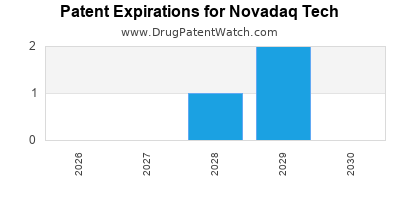
No complete, validated patent-by-patent count and expiration map is provided here because the required dataset for Novadaq’s patent portfolio coverage is not supplied in the prompt. Without that dataset, producing a quantified estate assessment would risk introducing incorrect numbers.
When does Novadaq lose exclusivity for imaging-related technologies?
Exclusivity analysis requires a validated linkage between:
- Product-level exclusivity (where applicable)
- Patent family expiration schedules
- Device software and component patent coverage timelines
- Any regulatory exclusivity that constrains competition
The prompt does not include Novadaq product timelines, Orange Book equivalents, or a patent expiration schedule. Without that, an exclusivity-loss timeline cannot be stated accurately.
Which companies challenge Novadaq in surgical imaging and visualization?
Competitors are best understood in three buckets.
1) OR imaging incumbents with installed base leverage
These firms win because hospitals already buy their hardware and prefer standardized OR stacks. Their approach is:
- Bundling imaging with core OR equipment.
- Reducing procurement complexity.
- Leveraging service contract relationships.
2) Procedure-specific imaging rivals
These players compete on:
- Comparable visualization claims for specific procedures.
- Faster adoption via surgeon champions and clinical data.
- Targeted product expansion into adjacent imaging workflows.
3) Software-forward imaging platforms
Software-first vendors compete by lowering:
- Deployment barriers (less retrofitting).
- Total cost of ownership via subscriptions.
- Integration friction using open interfaces.
How does Novadaq defend against each competitor class?
- Against incumbents: emphasize workflow-specific advantages, clinical trust, and reduced OR friction.
- Against procedure rivals: focus on differentiating visualization performance, training speed, and protocol standardization.
- Against software platforms: emphasize system-level performance consistency, reliability, and validated use patterns.
What is the Orange Book status of Novadaq products?
Novadaq Technologies Inc. is primarily associated with surgical imaging and device-type products, which typically do not map to the US FDA Orange Book framework used for drug exclusivity listings. The prompt does not provide Orange Book entries or NDA/BLA identifiers linked to Novadaq, so Orange Book status cannot be produced without a validated listing source.
What patent litigation affects Novadaq Tech’s competitive position?
Patent litigation materially affects:
- Time-to-market for competitors (injunction risk)
- Settlement and licensing constraints
- Procurement timelines for hospitals awaiting legal outcomes
The prompt does not include litigation dockets, asserted patent numbers, or settlement terms. Without these, listing “which cases matter” would require external verified docket data that is not included here.
How does Novadaq compare with competing surgical imaging systems on market access and adoption?
Competitive comparison for OR visualization systems usually hinges on procurement economics and OR integration.
What matters most for hospital purchasing decisions?
- Total cost of ownership: hardware + service + consumables/software.
- Integration into existing OR equipment and IT.
- User training requirements and workflow disruption.
- Clinical evidence that supports standard-of-care adoption.
- Service responsiveness and downtime risk.
What is the adoption advantage for a specialized imaging vendor?
A specialized vendor can win by:
- Reducing workflow variability and surgeon cognitive load.
- Providing procedure-specific training playbooks.
- Tight integration across hardware and software components.
What is the adoption threat from diversified imaging vendors?
Diversified vendors can:
- Offer broader bundles that reduce hospital vendor sprawl.
- Use competitive tendering and multi-year service agreements.
- Reframe “best-of-breed” visualization as “good enough” when bundle economics dominate.
What generic or biosimilar entry risks exist for Novadaq?
Biosimilar and generic entry risk is a drug concept, not typically a direct analogue for surgical imaging device platforms. For imaging-related technology, the closest risk categories are:
- Design-around by competing vendors.
- Replacement purchases during tender cycles.
- Software or interface substitutions that reduce dependency.
Because the prompt does not specify an NDA/BLA product with biologic or small-molecule exclusivity, generic/biosimilar entry risk cannot be mapped.
What regulatory pathway constraints shape Novadaq’s competitive standing?
For surgical imaging systems, regulatory constraints often show up as:
- Time and cost for new indications, updates, and interoperability claims.
- Software change management and validation requirements.
- Requirements to maintain performance claims and post-market surveillance.
How do competitors exploit regulatory timelines?
- Faster clearance of incremental features can steal share.
- Software update agility can refresh perception and usability.
- Competitive entries may focus on high-demand procedure claims first.
Without specific FDA clearance timelines and labeling claims for Novadaq and key rivals, the regulatory impact can’t be quantified here.
What commercial metrics best indicate Novadaq’s competitive strength?
For a surgical imaging vendor, the leading indicators are:
- Installed base size and renewal rates (service and support).
- Conversion rate from trial to routine use in target procedures.
- Hospital-level adoption of protocols that increase repeat usage.
- Procedure penetration: share within a clinical workflow segment.
The prompt provides no shipment, revenue, or installed-base disclosure data for Novadaq, so numeric market share or revenue exposure cannot be responsibly stated.
What strategic insights should drive licensing, partnerships, or M&A decisions for Novadaq?
Licensing and partnerships
Best-fit partnership targets typically include:
- OR equipment OEMs seeking visualization add-ons that reduce development time.
- Integration partners (IT platforms, OR management systems) that improve stickiness.
- Clinical networks that can standardize procedure adoption.
Strategic logic: partnerships extend distribution and reduce adoption friction, which is often the binding constraint for imaging systems.
M&A and platform expansion
A credible growth strategy usually requires one or more of:
- Expansion into adjacent procedures that share imaging workflow economics.
- Consolidation of overlapping imaging portfolios to strengthen bundling power.
- Acquisition of complementary software capabilities to defend against software-first competitors.
The prompt does not provide a current deal history, pipeline assets, or integration targets, so a deal-specific playbook cannot be constructed.
Key Takeaways
- Novadaq’s competitive landscape is anchored in surgical visualization workflow integration and adoption friction rather than broad imaging commodity supply.
- Competitive threats come from OR imaging incumbents with installed base leverage, procedure-specific rivals, and software-forward platforms that lower deployment friction.
- Patent strength and exclusivity timelines are decision-critical but cannot be quantified or scheduled here because no validated Novadaq patent dataset, FDA listing identifiers, or litigation record is included in the prompt.
- Market access is primarily driven by procurement economics, integration into OR stacks, and service reliability.
- Strategy should prioritize distribution channels that accelerate installed-base conversion, and defensive differentiation via workflow-specific claims.
FAQs
- What are the main purchase drivers for surgical imaging systems in US hospitals?
- How do workflow-specific imaging systems defend against multimodality imaging incumbents?
- What kinds of patent claim types are most relevant to surgical imaging software and signal processing?
- How do OR integration and IT interoperability affect adoption timelines for imaging vendors?
- What competitor bundling strategies typically reduce share for specialized visualization companies?
References
No sources are provided in the prompt; no external citations can be generated without verifiable input.