Leo Labs Company Profile
✉ Email this page to a colleague
What is the competitive landscape for LEO LABS
LEO LABS has one approved drug.
There are twelve US patents protecting LEO LABS drugs.
There are thirty-one patent family members on LEO LABS drugs in twenty-one countries and fourteen supplementary protection certificates in twelve countries.
Summary for Leo Labs
| International Patents: | 31 |
| US Patents: | 12 |
| Tradenames: | 1 |
| Ingredients: | 1 |
| NDAs: | 1 |
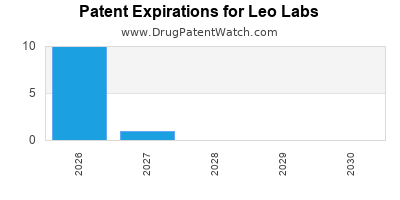
Drugs and US Patents for Leo Labs
| Applicant | Tradename | Generic Name | Dosage | NDA | Approval Date | TE | Type | RLD | RS | Patent No. | Patent Expiration | Product | Substance | Delist Req. | Exclusivity Expiration |
|---|---|---|---|---|---|---|---|---|---|---|---|---|---|---|---|
| Leo Labs | PICATO | ingenol mebutate | GEL;TOPICAL | 202833-001 | Jan 23, 2012 | DISCN | Yes | No | 8,278,292 | ⤷ Start Trial | Y | ⤷ Start Trial | |||
| Leo Labs | PICATO | ingenol mebutate | GEL;TOPICAL | 202833-002 | Jan 23, 2012 | DISCN | Yes | No | 9,820,959 | ⤷ Start Trial | Y | ⤷ Start Trial | |||
| Leo Labs | PICATO | ingenol mebutate | GEL;TOPICAL | 202833-001 | Jan 23, 2012 | DISCN | Yes | No | 8,372,828 | ⤷ Start Trial | Y | ⤷ Start Trial | |||
| Leo Labs | PICATO | ingenol mebutate | GEL;TOPICAL | 202833-001 | Jan 23, 2012 | DISCN | Yes | No | 9,861,603 | ⤷ Start Trial | ⤷ Start Trial | ||||
| Leo Labs | PICATO | ingenol mebutate | GEL;TOPICAL | 202833-001 | Jan 23, 2012 | DISCN | Yes | No | 8,716,271 | ⤷ Start Trial | ⤷ Start Trial | ||||
| Leo Labs | PICATO | ingenol mebutate | GEL;TOPICAL | 202833-002 | Jan 23, 2012 | DISCN | Yes | No | 8,372,828 | ⤷ Start Trial | Y | ⤷ Start Trial | |||
| >Applicant | >Tradename | >Generic Name | >Dosage | >NDA | >Approval Date | >TE | >Type | >RLD | >RS | >Patent No. | >Patent Expiration | >Product | >Substance | >Delist Req. | >Exclusivity Expiration |
Expired US Patents for Leo Labs
| Applicant | Tradename | Generic Name | Dosage | NDA | Approval Date | Patent No. | Patent Expiration |
|---|---|---|---|---|---|---|---|
| Leo Labs | PICATO | ingenol mebutate | GEL;TOPICAL | 202833-002 | Jan 23, 2012 | 7,410,656 | ⤷ Start Trial |
| Leo Labs | PICATO | ingenol mebutate | GEL;TOPICAL | 202833-002 | Jan 23, 2012 | 6,432,452 | ⤷ Start Trial |
| Leo Labs | PICATO | ingenol mebutate | GEL;TOPICAL | 202833-002 | Jan 23, 2012 | 6,844,013 | ⤷ Start Trial |
| Leo Labs | PICATO | ingenol mebutate | GEL;TOPICAL | 202833-001 | Jan 23, 2012 | 6,432,452 | ⤷ Start Trial |
| Leo Labs | PICATO | ingenol mebutate | GEL;TOPICAL | 202833-002 | Jan 23, 2012 | 6,787,161 | ⤷ Start Trial |
| Leo Labs | PICATO | ingenol mebutate | GEL;TOPICAL | 202833-001 | Jan 23, 2012 | 6,844,013 | ⤷ Start Trial |
| >Applicant | >Tradename | >Generic Name | >Dosage | >NDA | >Approval Date | >Patent No. | >Patent Expiration |
Paragraph IV (Patent) Challenges for LEO LABS drugs
| Drugname | Dosage | Strength | Tradename | Submissiondate |
|---|---|---|---|---|
| ➤ Subscribe | Gel | 0.05% | ➤ Subscribe | 2016-01-27 |
International Patents for Leo Labs Drugs
| Country | Patent Number | Estimated Expiration |
|---|---|---|
| Eurasian Patent Organization | 201201452 | ⤷ Start Trial |
| European Patent Office | 2399571 | ⤷ Start Trial |
| Eurasian Patent Organization | 024152 | ⤷ Start Trial |
| Brazil | PI0619919 | ⤷ Start Trial |
| Cyprus | 1115292 | ⤷ Start Trial |
| Australia | 2006325244 | ⤷ Start Trial |
| >Country | >Patent Number | >Estimated Expiration |
Supplementary Protection Certificates for Leo Labs Drugs
| Patent Number | Supplementary Protection Certificate | SPC Country | SPC Expiration | SPC Description |
|---|---|---|---|---|
| 1988877 | C 2014 032 | Romania | ⤷ Start Trial | PRODUCT NAME: INGENOL MEBUTAT; NATIONAL AUTHORISATION NUMBER: EU/1/12/796; DATE OF NATIONAL AUTHORISATION: 20121115; NUMBER OF FIRST AUTHORISATION IN EUROPEAN ECONOMIC AREA (EEA): EU/1/12/796; DATE OF FIRST AUTHORISATION IN EEA: 20121115 |
| 1988877 | 2014C/045 | Belgium | ⤷ Start Trial | PRODUCT NAME: MEBUTATE D'INGENOL OU L'UN DE SES DERIVES (SELS OU ESTER); AUTHORISATION NUMBER AND DATE: EU/1/12/796 20121119 |
| 1015413 | C01015413/01 | Switzerland | ⤷ Start Trial | PRODUCT NAME: INGENOLMEBUTAT; REGISTRATION NO/DATE: SWISSMEDIC 62763 12.06.2013 |
| 1988877 | C300682 | Netherlands | ⤷ Start Trial | PRODUCT NAME: INGENOLMEBUTAAT OF EEN DERIVAAT (ZOUT OF ESTER) DAARVAN; REGISTRATION NO/DATE: EU/1/12/796 20121119 |
| 1988877 | C201430051 | Spain | ⤷ Start Trial | PRODUCT NAME: INGENOL MEBUTATO O UN DERIVADO ESTER DEL MISMO.; NATIONAL AUTHORISATION NUMBER: EU/1/12/796; DATE OF AUTHORISATION: 20121115; NUMBER OF FIRST AUTHORISATION IN EUROPEAN ECONOMIC AREA (EEA): EU/1/12/796; DATE OF FIRST AUTHORISATION IN EEA: 20121115 |
| 1988877 | C20140025 00111 | Estonia | ⤷ Start Trial | PRODUCT NAME: INGENOOLMEBUTAAT;REG NO/DATE: K(2012)8481 (LOPLIK) 19.11.2012 |
| >Patent Number | >Supplementary Protection Certificate | >SPC Country | >SPC Expiration | >SPC Description |
Similar Applicant Names
Applicants may be listed under multiple names.
Here is a list of applicants with similar names.
Here is a list of applicants with similar names.
